Yosemite Falls: What to Know Before You Visit

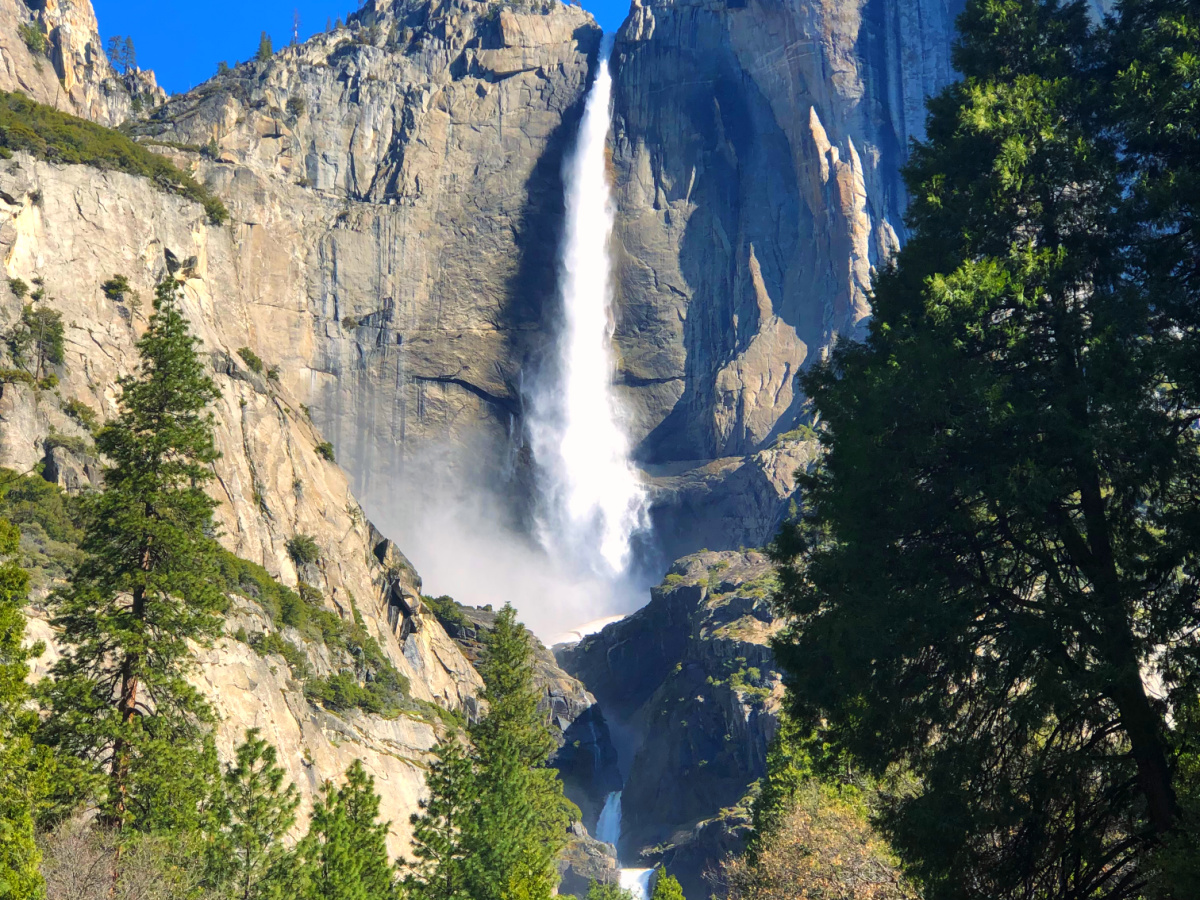
Planning a visit to Yosemite Falls? Here’s what to know about the Lower Yosemite Fall Trail, parking, shuttle stops, accessibility, spring flow, and hiking Upper Yosemite Fall.
Estimated reading time: 25 minutes
Yosemite has no shortage of places that make you stop in your tracks. But Yosemite Falls is one of those places where the payoff is almost ridiculous compared to the amount of effort it takes to get there.
You do not have to tackle a difficult hike. You do not have to climb thousands of feet. You don’t even have to venture very far from the heart of Yosemite Valley.
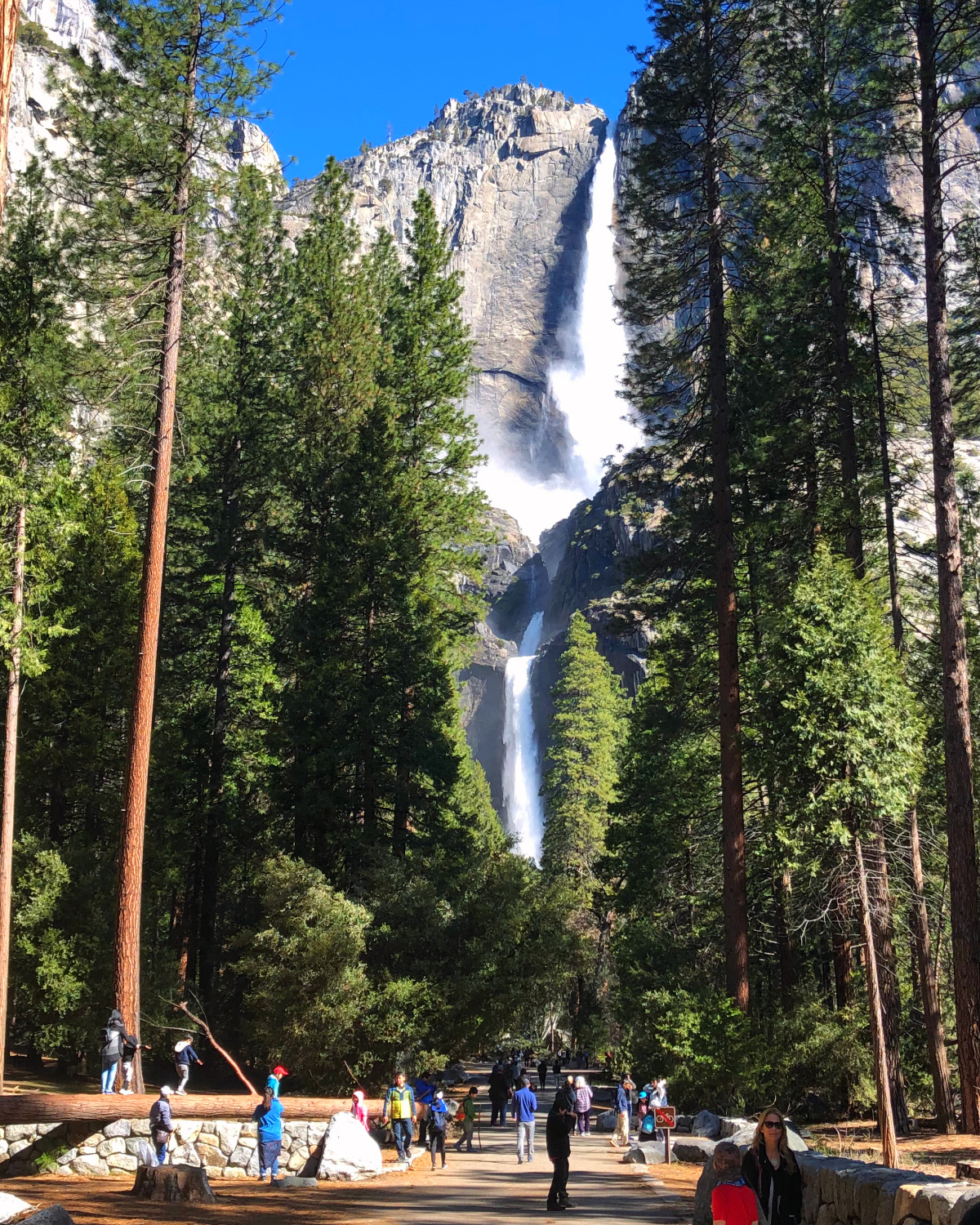
The walk to Lower Yosemite Fall is short, mostly flat, and paved. And almost immediately, you are surrounded by enormous trees with glimpses of Yosemite Falls appearing above you as you make your way toward the base.
Then you get to the footbridge.
This is where Lower Yosemite Fall stops looking like the comparatively small section of the waterfall you saw from across Yosemite Valley. When we visited in April, the water was absolutely thundering over the cliff. Yosemite Creek was roaring over the boulders below us, spray filled the air, and rainbows appeared in the mist.
It was glorious.
If you are visiting Yosemite with kids, grandparents, limited time, or simply don’t want every incredible view to require a strenuous hike, Yosemite Falls belongs near the top of your list.
Yosemite Falls Is More Than One Waterfall
One of the things that’s hard to appreciate until you see Yosemite Falls from across the valley is just how enormous the entire waterfall system is.
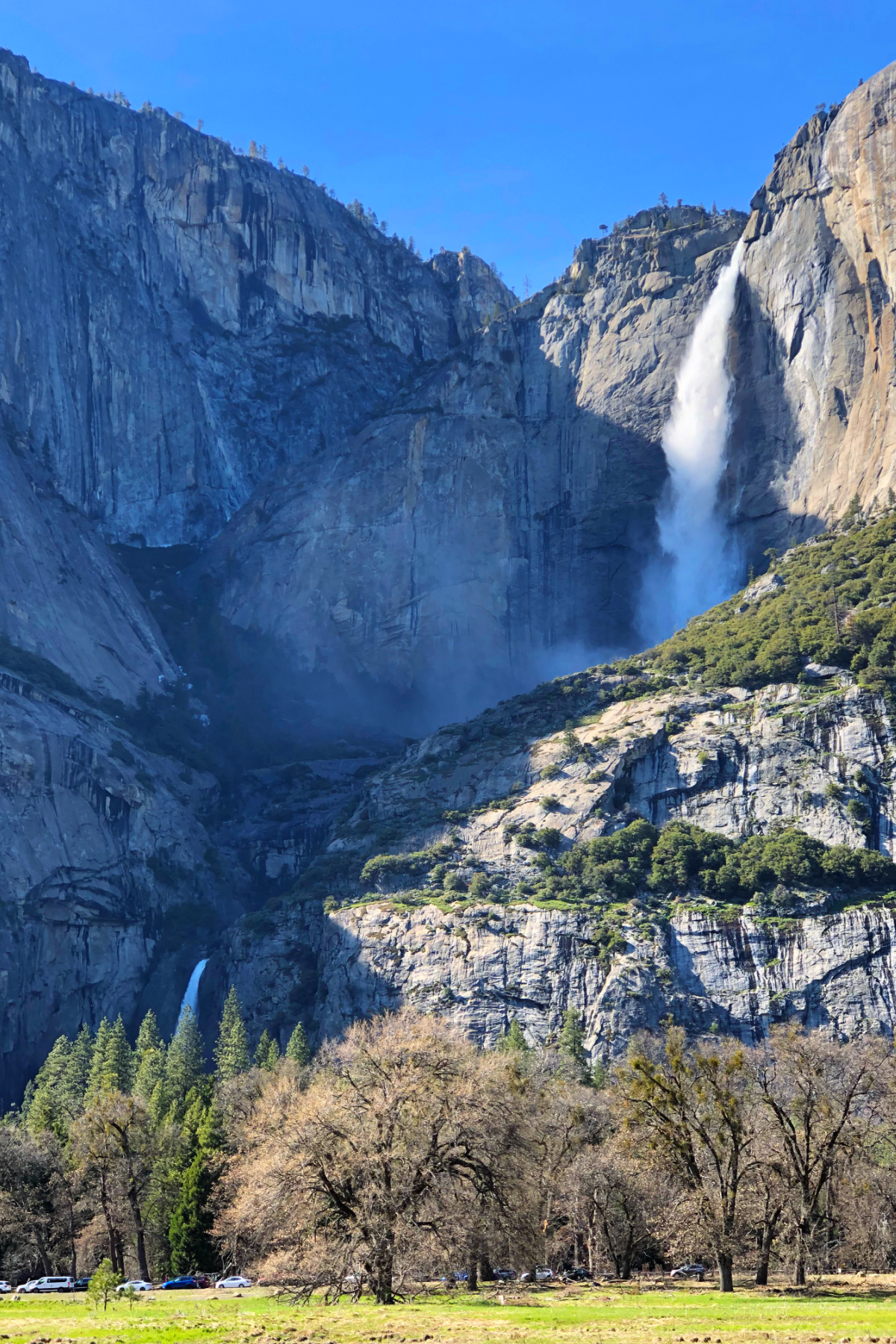
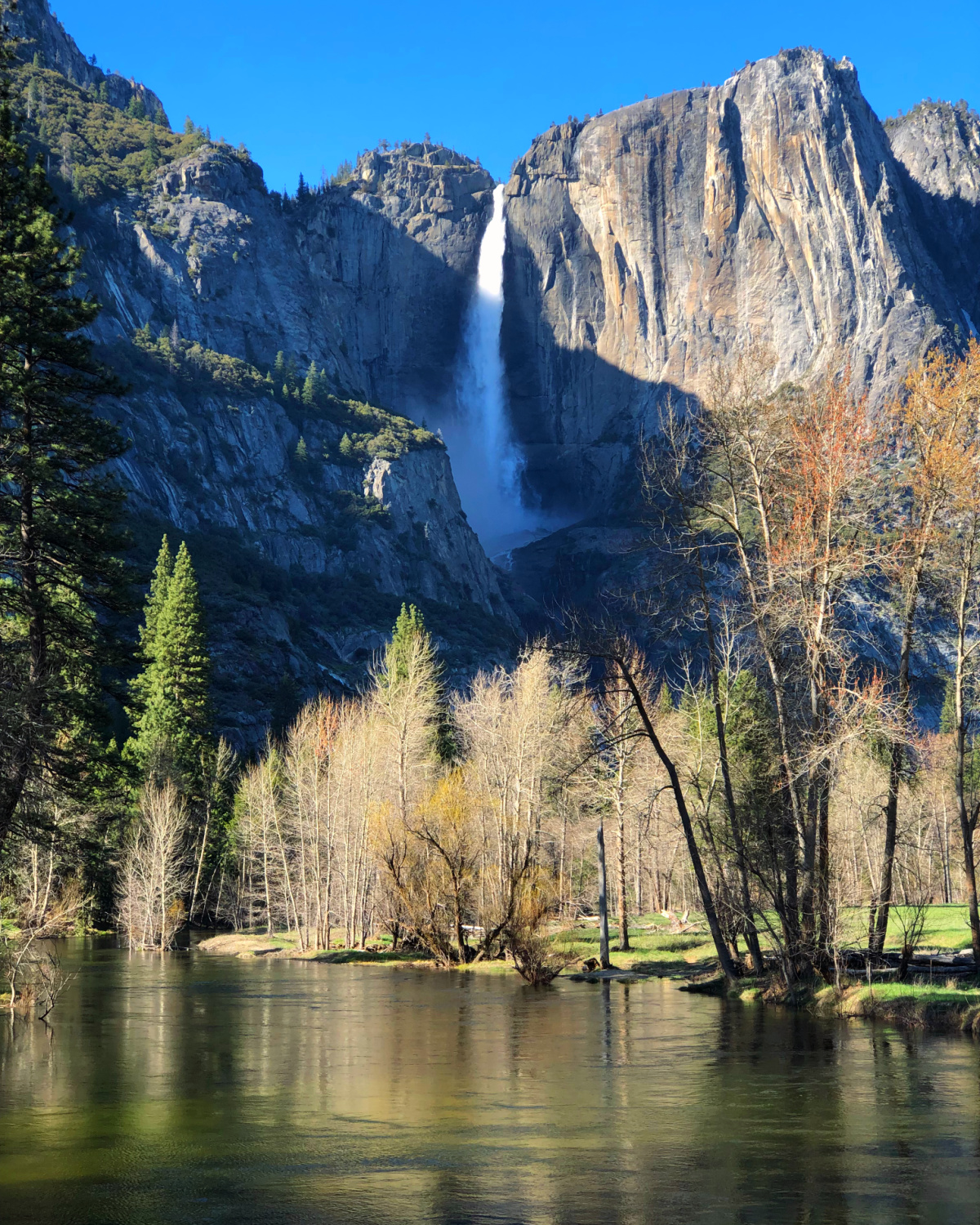
There is Upper Yosemite Fall, the huge dramatic plunge that gets most of your attention from a distance. Below that are the Middle Cascades, which tumble through the rocky gorge. And finally there is Lower Yosemite Fall, which drops 320 feet before Yosemite Creek continues through the forest and into Yosemite Valley.
From some places in Yosemite Valley, you can see almost the entire system at once.
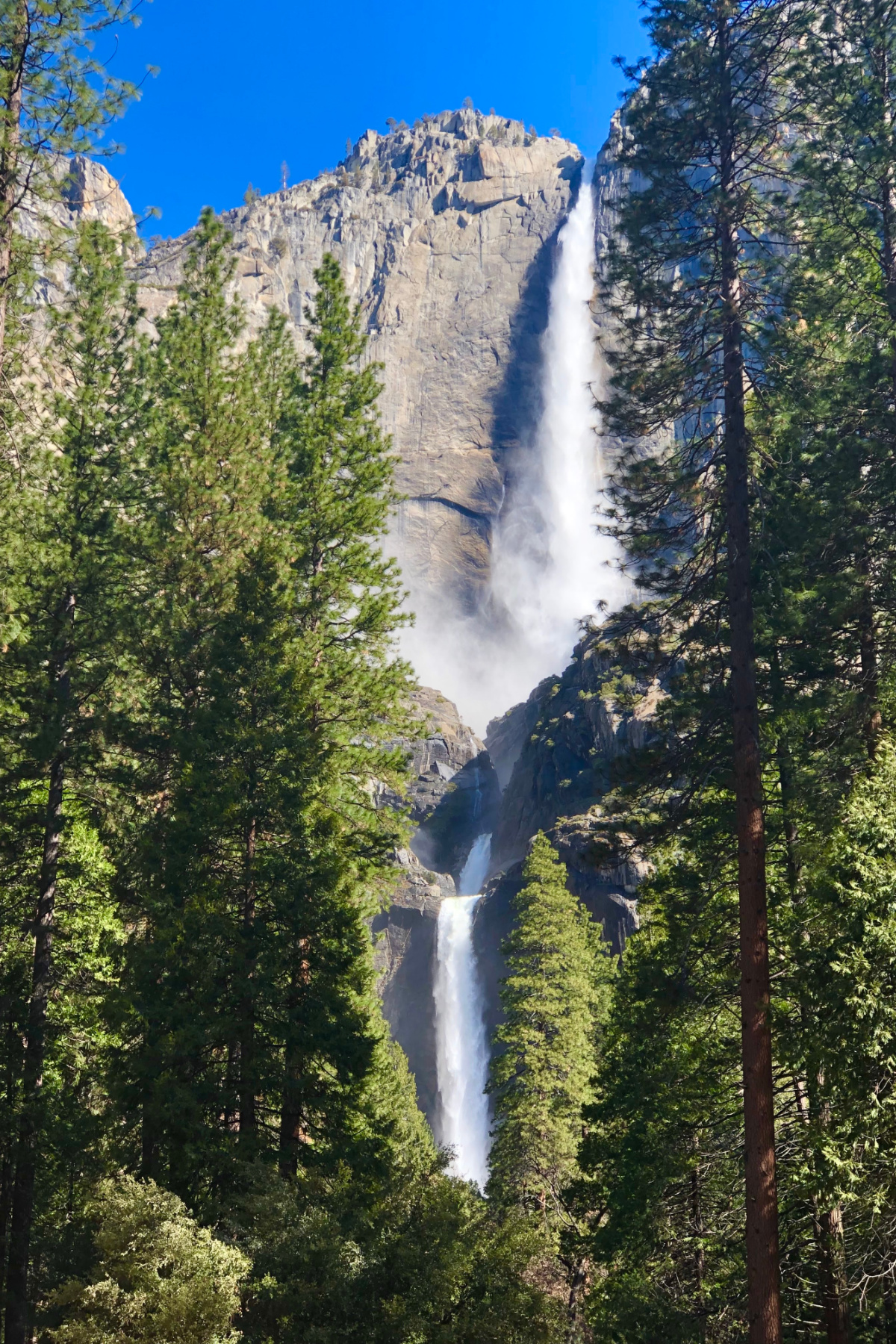
That was one of my favorite things about walking toward Lower Yosemite Fall. The waterfall doesn’t suddenly appear when you reach the end of the trail. You keep catching views of it through the trees as you walk.
And because Upper Yosemite Fall is so enormous, Lower Yosemite Fall can almost look tiny underneath it.
It isn’t.
You realize that very quickly when you get closer.
Walking the Lower Yosemite Fall Trail
The Lower Yosemite Fall Trail is one of the easiest ways to experience one of Yosemite’s iconic landmarks up close.
The entire loop is about one mile with roughly 50 feet of elevation gain, and the National Park Service rates it as an easy hike. Most visitors can complete the loop in around 30 minutes, although I would absolutely allow longer because there is plenty to stop and look at along the way.
Honestly, calling this a “trail” almost makes it sound more difficult than it is.
Much of the route feels more like a beautiful walk through the forest.
The trail winds beneath towering ponderosa pines and other conifers, with Yosemite’s granite cliffs rising above the trees. There are benches and interpretive exhibits along the route, and every so often the forest opens enough to give you another spectacular view of the falls.
This is not one of those hikes where you spend an hour walking through the woods waiting for something interesting to happen at the end.
The walk itself is part of the experience.
And if you’re visiting with kids, that can be a very good thing.
Sometimes the Best Travel Memories Have Nothing to Do With the Main Attraction
One of my favorite memories from our entire Yosemite trip happened along this trail, and it had almost nothing to do with Yosemite Falls.
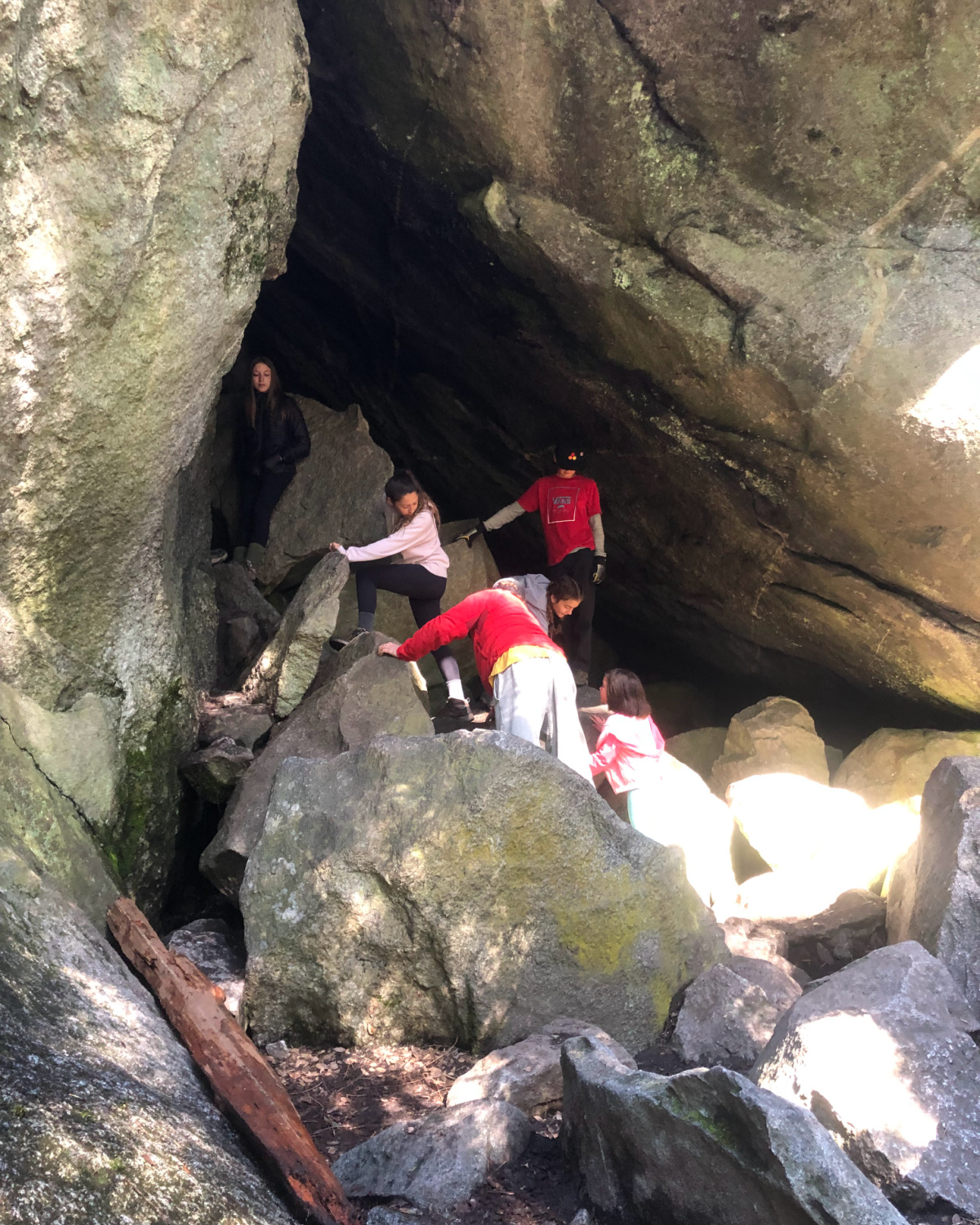
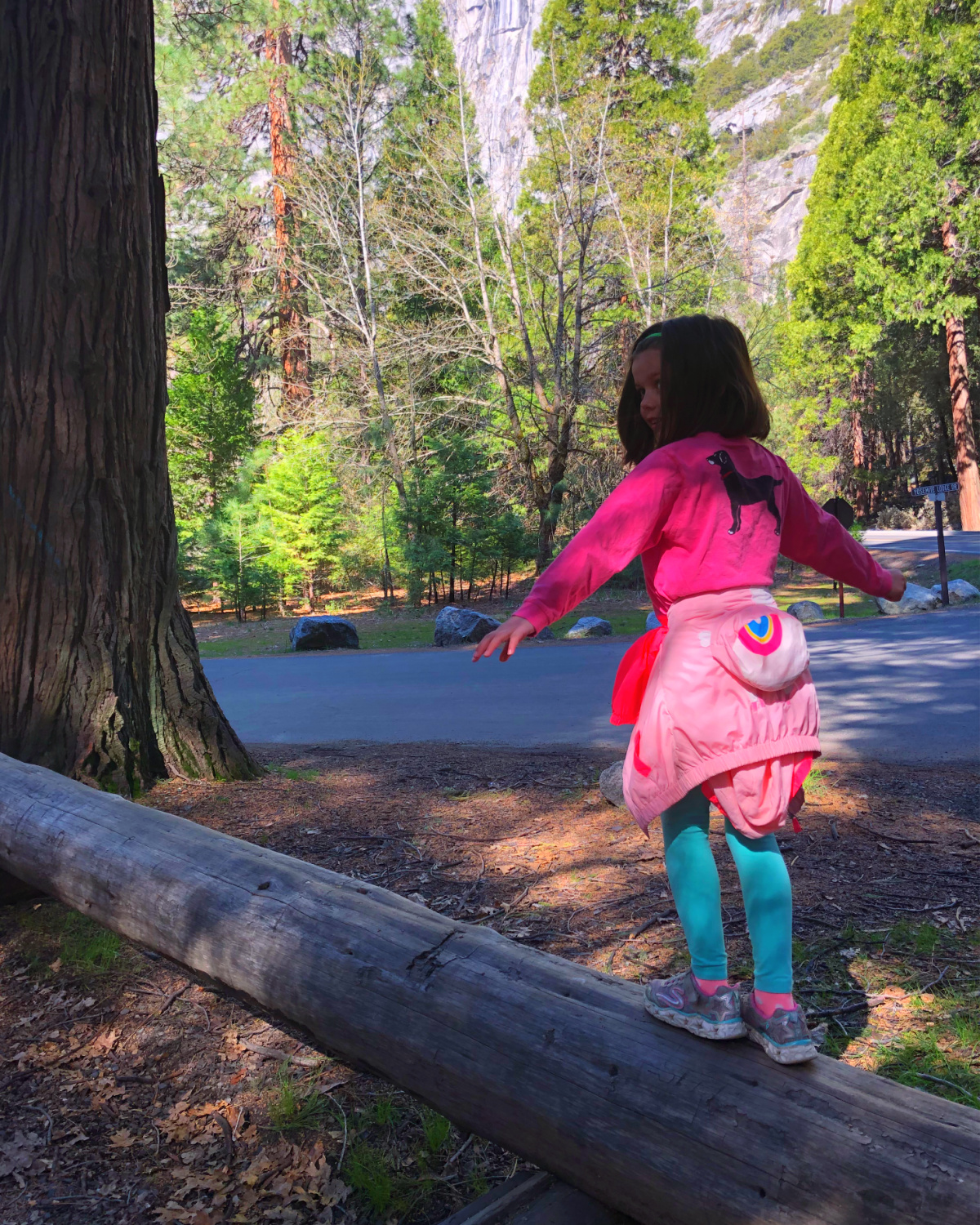
My daughter was little at the time, and somewhere along the walk she discovered fallen logs and rocks that were apparently far more interesting than simply walking down a paved path like a normal person.
So she created an obstacle course.
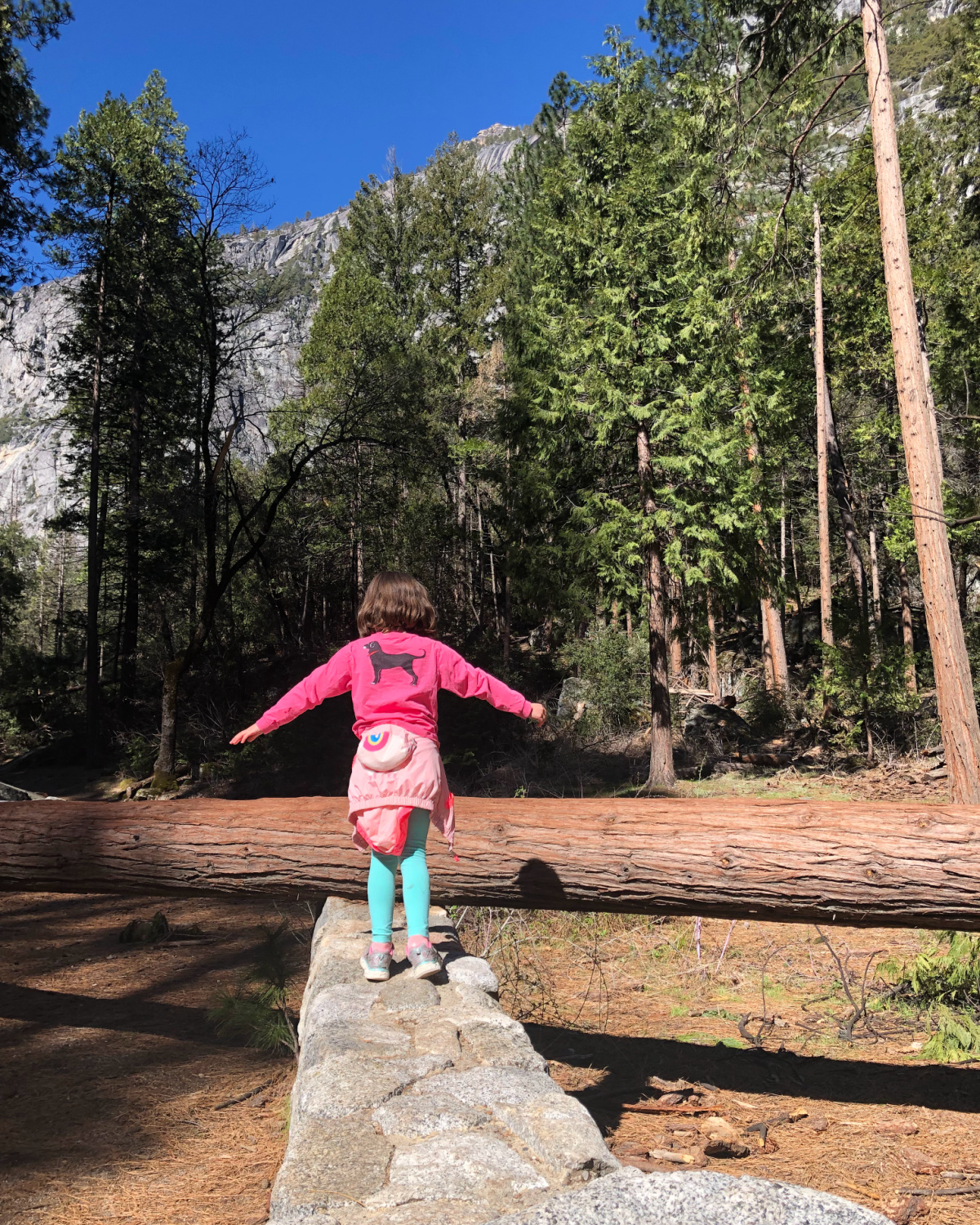
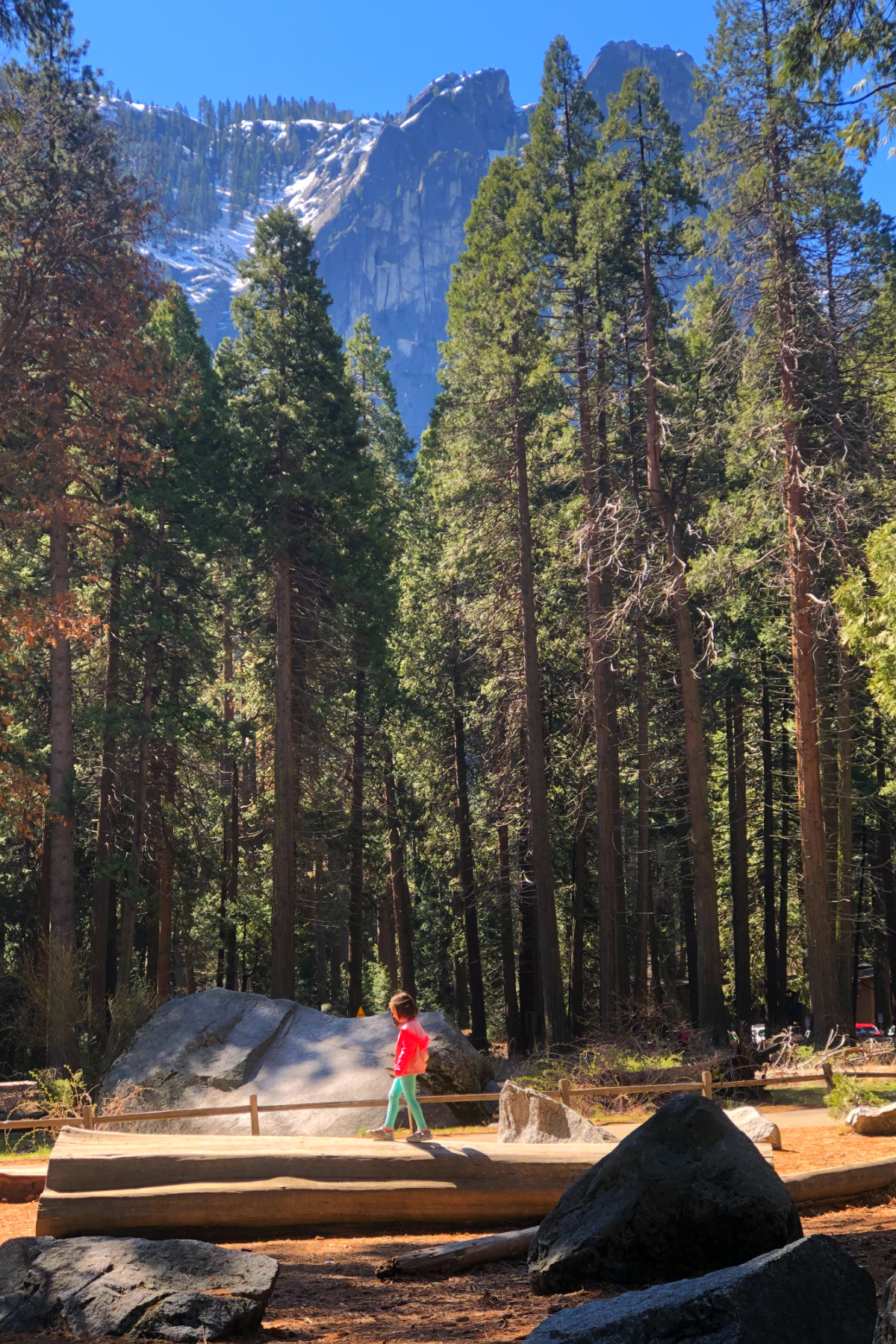
She balanced along logs. She climbed over rocks. She jumped down and started over again. For a while, Yosemite Falls basically became the backdrop to her personal wilderness playground.
And I loved it.
That’s one of the reasons I think this area works so well for families. Adults can appreciate the absolutely ridiculous scenery, while kids notice all the smaller things along the way—the giant trees, interesting rocks, fallen logs, squirrels, water, and whatever else captures their attention.
A word of caution, though: there is a big difference between letting kids explore safe areas along the forest floor and scrambling on the boulders near Yosemite Creek. The National Park Service specifically warns visitors to stay on the paved trail around the waterfall. The rocks above the footbridge can be extremely slippery, even when they look dry, and people have been seriously injured there.
There is plenty of adventure here without getting anywhere near the dangerous water.
The View of Yosemite Falls Keeps Getting Better
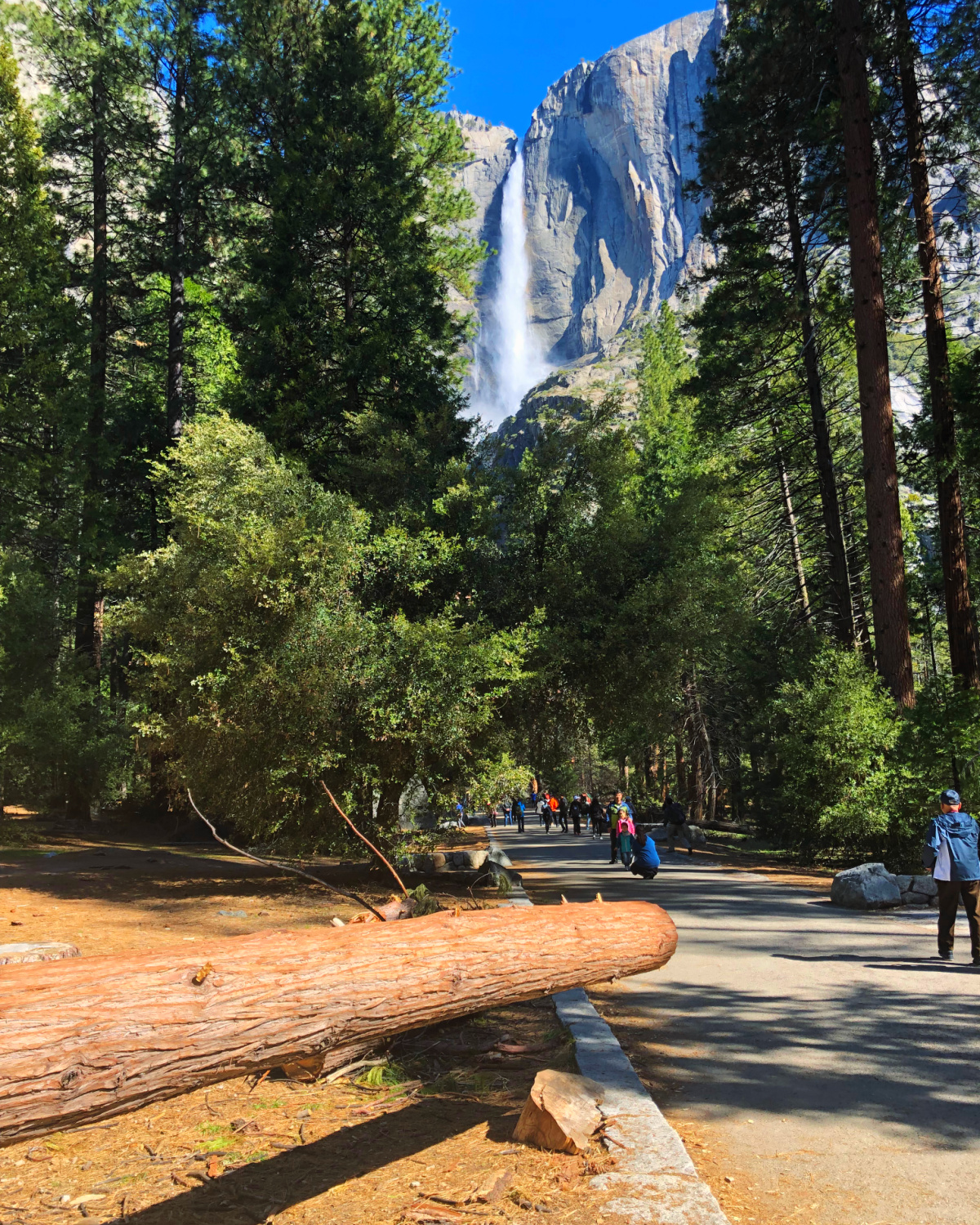
As you continue toward Lower Yosemite Fall, the views through the forest become increasingly impressive.
This is also one of the best places to appreciate the relationship between Upper and Lower Yosemite Falls.
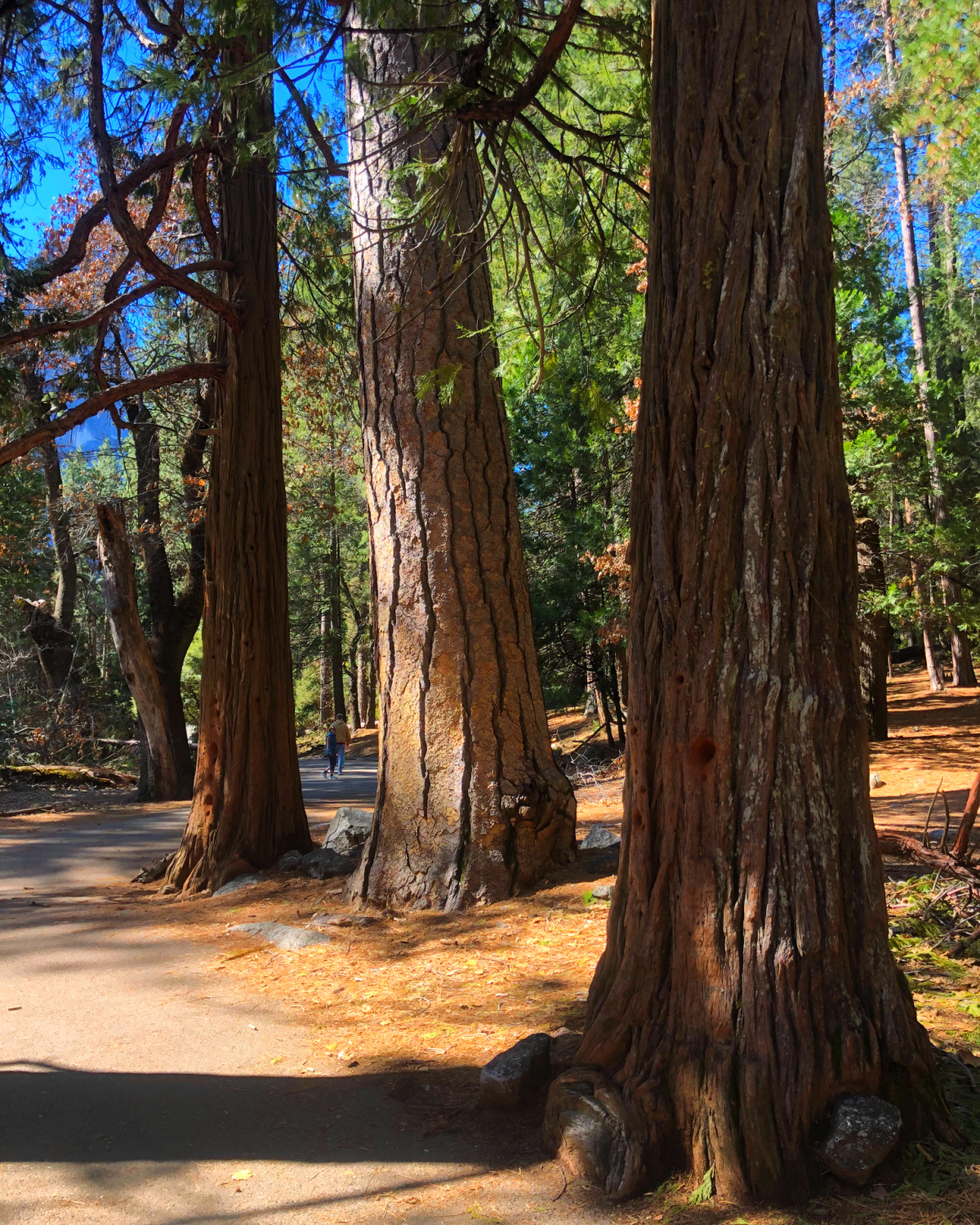
Upper Yosemite Fall towers above everything. Depending on where you’re standing, you may also catch glimpses of the Middle Cascades before Lower Yosemite Fall appears farther down the cliff.
I loved seeing the falls framed between the pine trees.
There are places in Yosemite where the scenery feels almost too enormous to photograph properly. Yosemite Falls is one of them. A wide-open view from Yosemite Valley helps you understand the scale, but walking through the trees gives the waterfall an entirely different feel.
And then you reach the base.
The Footbridge at Lower Yosemite Fall
If you do nothing else here, walk to the footbridge at the base of Lower Yosemite Fall.
This was easily the highlight for us.
Lower Yosemite Fall plunges 320 feet, which sounds relatively small only because it sits underneath one of the largest waterfalls on the continent. Standing near the base completely changes your perspective.
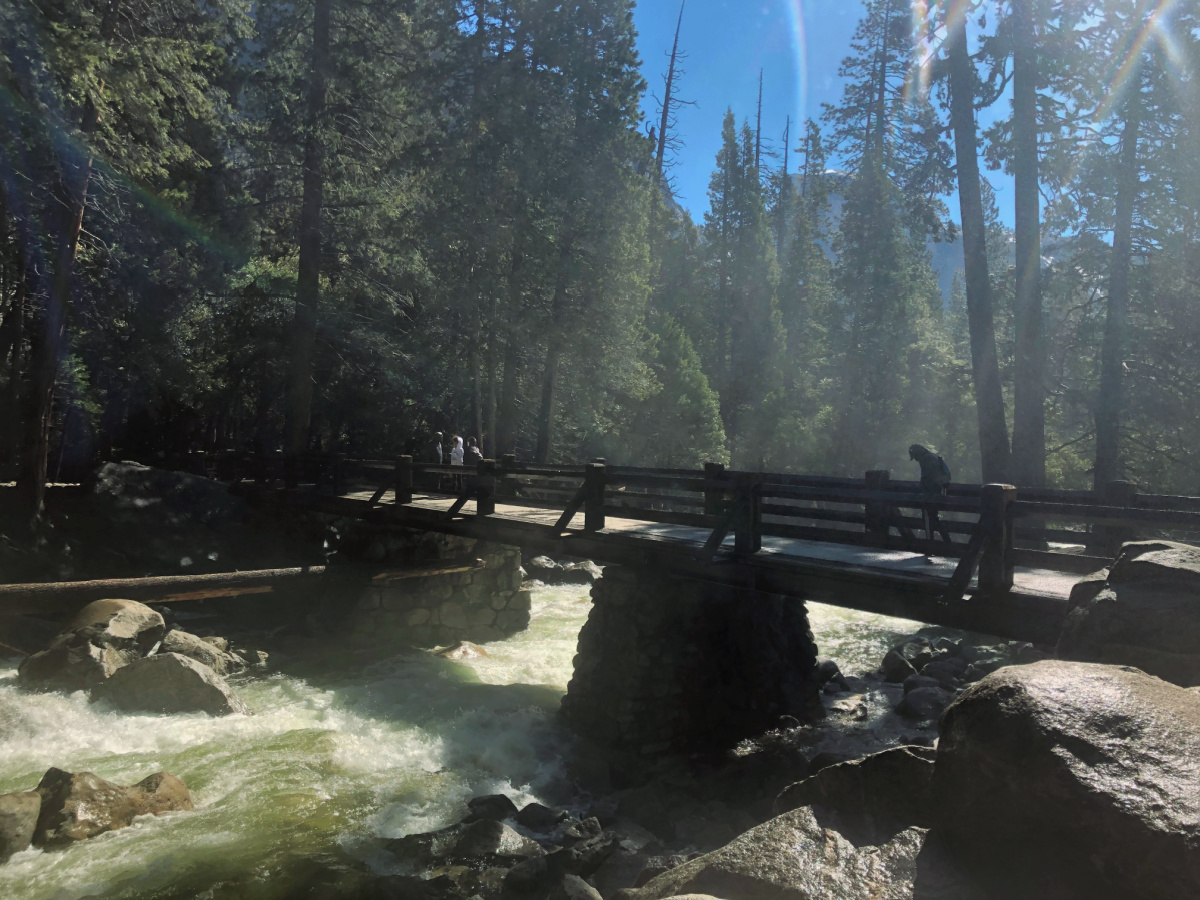
When we visited in April, Lower Yosemite Fall was powerful.
Really powerful.
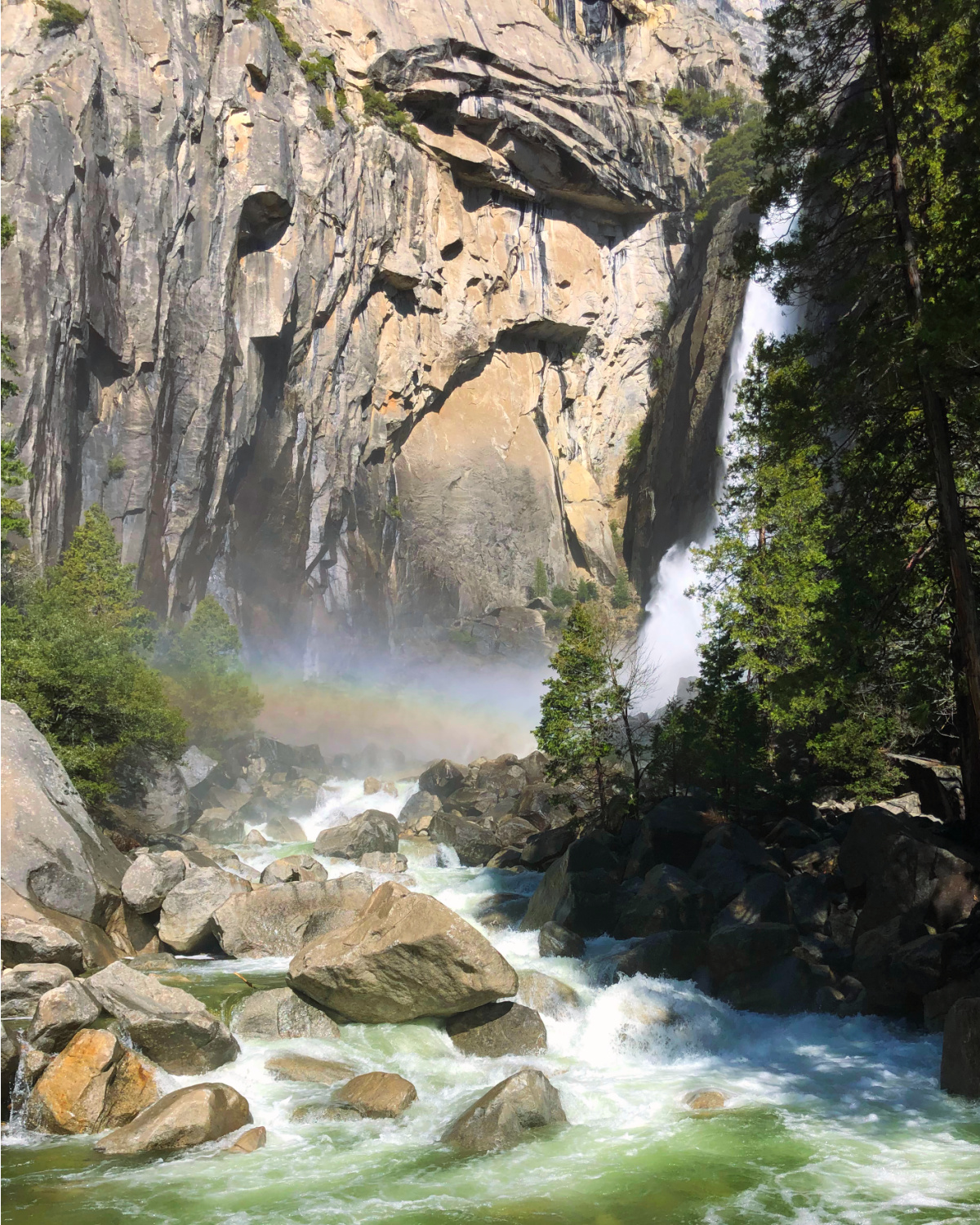
You could hear the water long before you were standing directly in front of it. Once we reached the bridge, there was spray everywhere. Yosemite Creek was rushing through enormous boulders beneath us, and the combination of the waterfall, the granite walls, the trees, and the absolutely roaring water was spectacular.
This was not a delicate waterfall experience.
It was loud.
It was wet.
And it was fantastic.
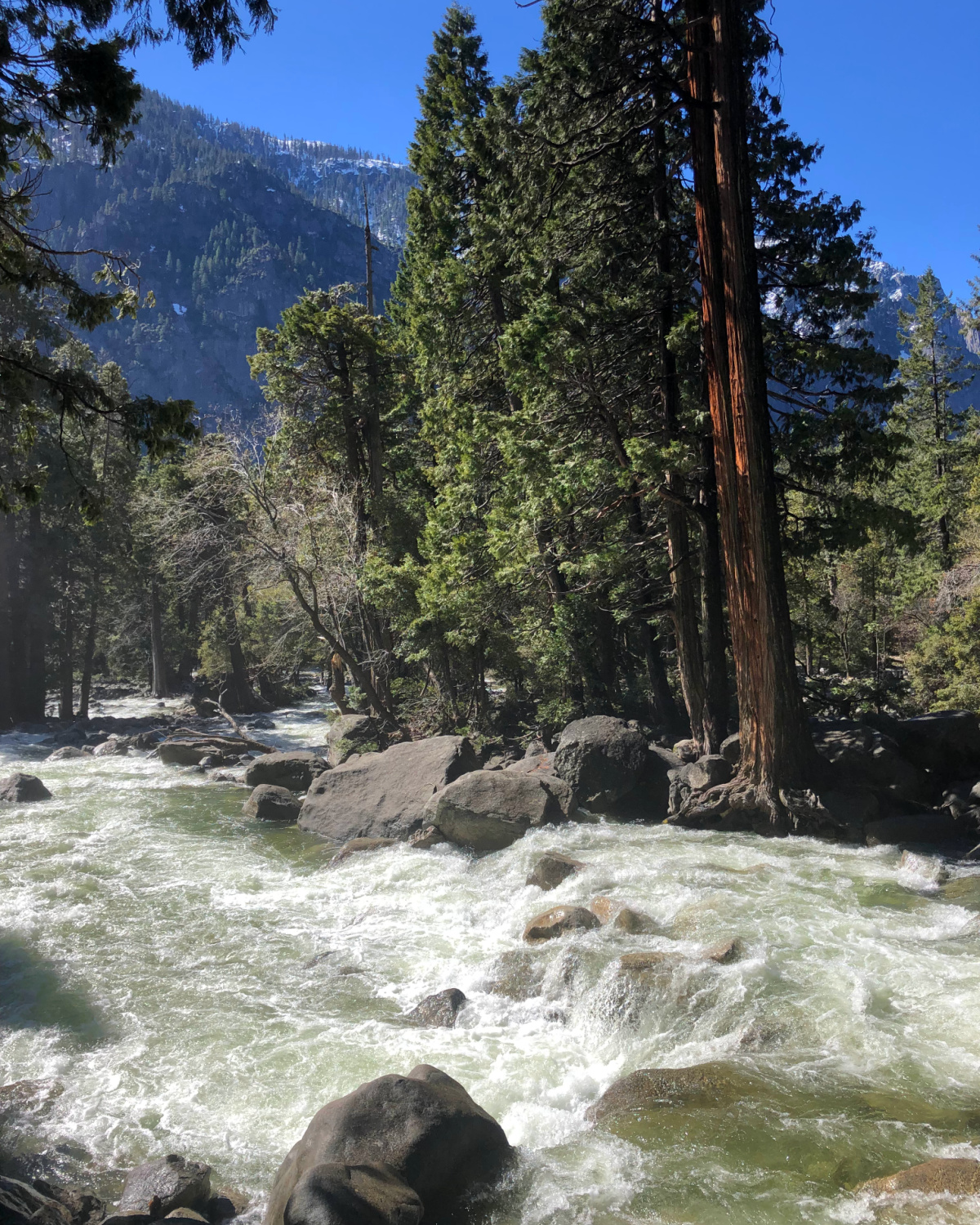
Spring snowmelt typically brings Yosemite Falls to life, and the National Park Service notes that the waterfall is especially powerful in spring and early summer. The footbridge is close enough to the base that visitors should expect spray when the falls are running strongly.
We definitely got the full experience.
And somehow, it got even better.
We Saw a Double Rainbow at Lower Yosemite Fall
All that spray combined with the bright California sunshine created rainbows over Yosemite Creek.
At one point, we could see a double rainbow stretching across the rushing water and boulders below the falls.
It was absolutely gorgeous.
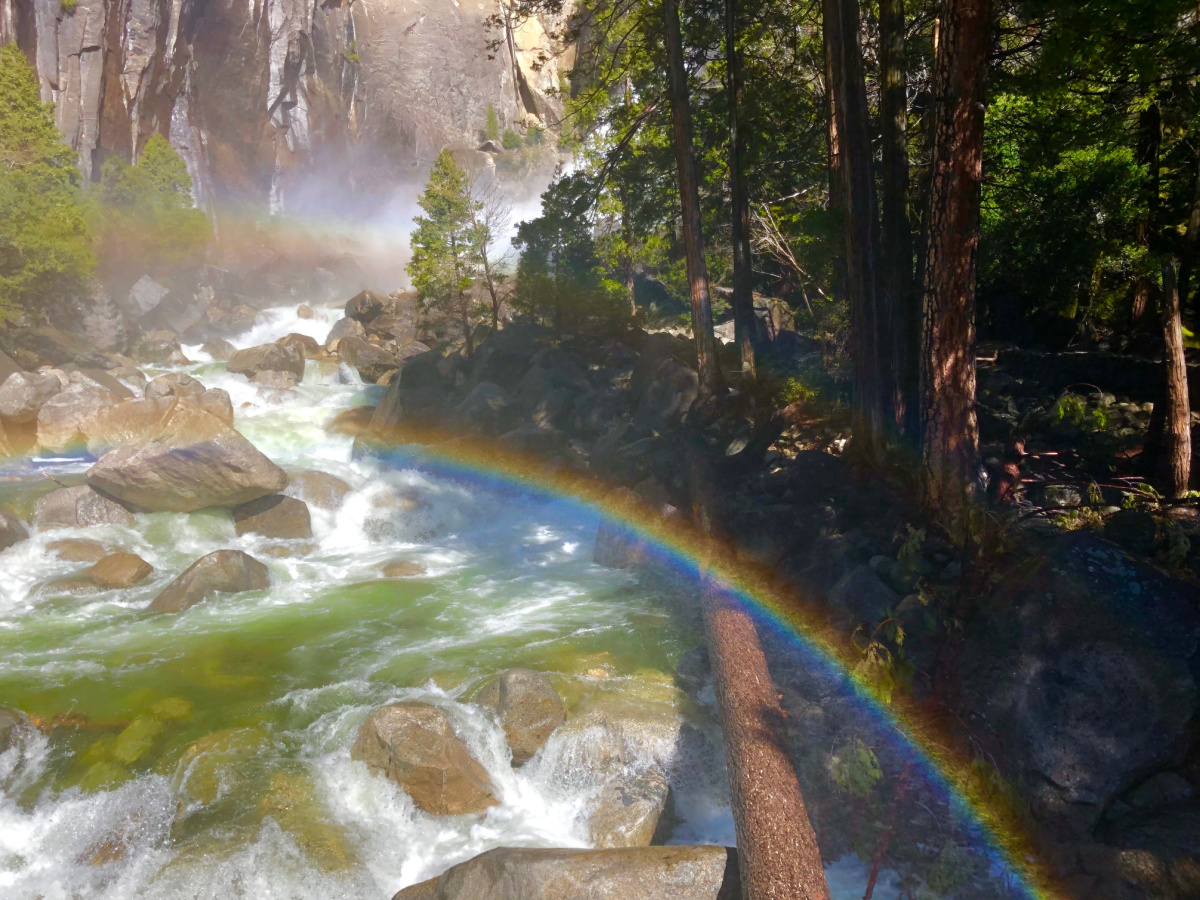
The water itself was already mesmerizing—green in places, white and frothy where it crashed around the rocks—but the rainbow made the entire scene feel almost unreal.
This is another reason I wouldn’t rush through the Lower Yosemite Fall Trail.
Technically, you can walk the loop pretty quickly.
But why would you?
Stand on the bridge for a while. Watch the mist move through the trees. Look upstream toward the waterfall and downstream at Yosemite Creek. Listen to the water.
Especially if you visit during peak spring runoff, Lower Yosemite Fall isn’t just something you look at.
You feel it.
When Is the Best Time to See Yosemite Falls?
If seeing Yosemite Falls at its most dramatic is important to you, spring is the sweet spot.
Yosemite Falls is primarily fed by snowmelt, so the amount of water changes dramatically throughout the year. Flow typically builds through spring and is often strongest in April and May. By late summer, the waterfall can slow to a trickle or even disappear completely.
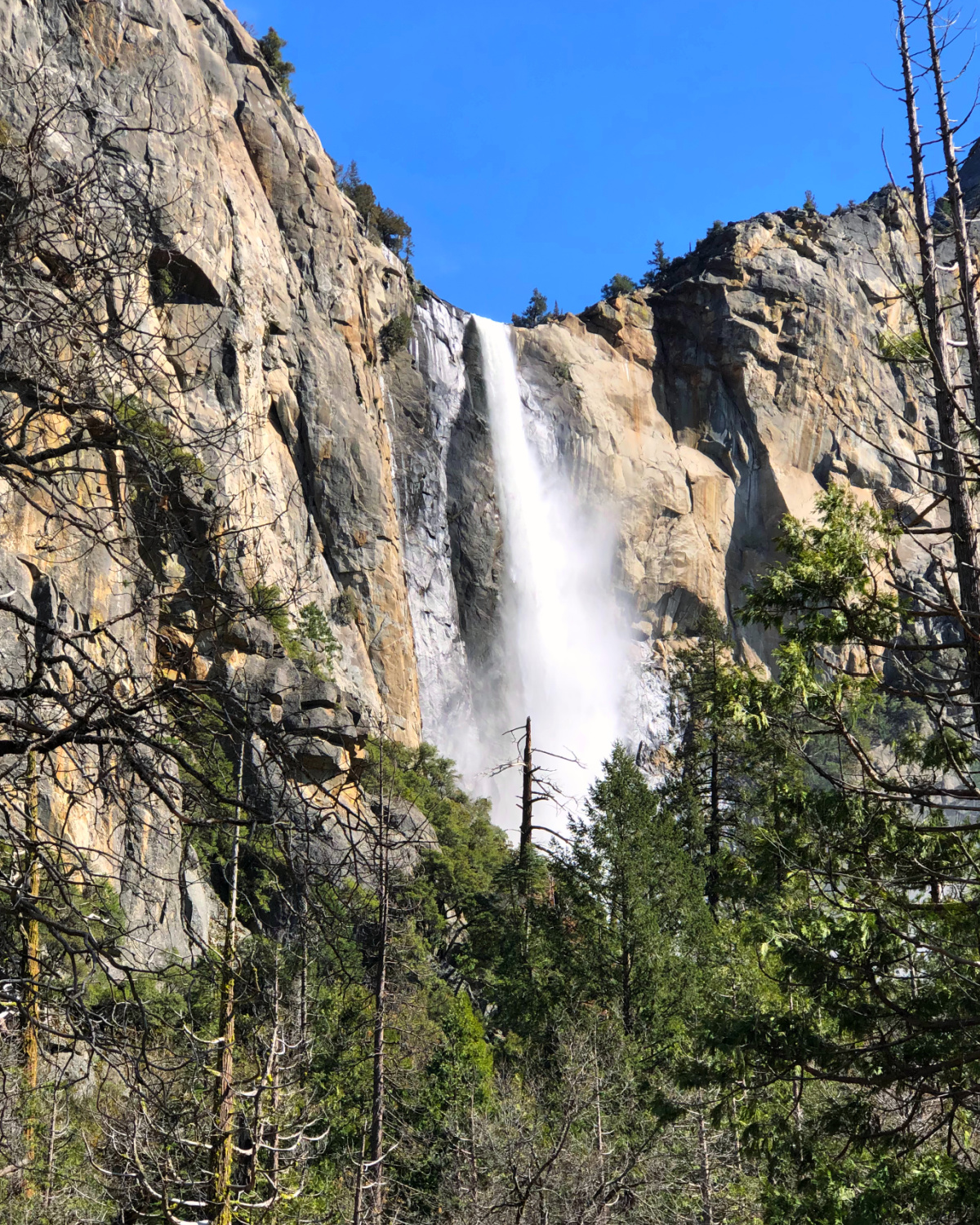
We visited in April, and I honestly cannot imagine a better introduction to Yosemite Falls.
The upper fall was pouring over the cliff. Lower Yosemite Fall was thundering. Yosemite Creek was racing through the boulders. There was enough mist near the base to create rainbows.
If waterfalls are one of the main reasons you’re visiting Yosemite, this is one of the strongest arguments for coming in spring.
There is a tradeoff, of course. Spring weather in Yosemite can be unpredictable, and higher-elevation roads and trails may still be closed because of snow. But for Yosemite Valley waterfalls? Spring is spectacular.
Summer visitors should adjust their expectations. Yosemite Falls can still have decent flow in early summer, particularly after a snowy winter, but the waterfall usually diminishes as the season progresses.
And by late summer, you may be staring at the cliff where Yosemite Falls is supposed to be.
The trail is still beautiful. The forest is still beautiful. Yosemite Valley is still Yosemite Valley.
But this particular experience is very different without the water.
Is the Lower Yosemite Fall Trail Really Accessible?
This is one of the things I appreciate most about Yosemite Falls.
You can get extremely close to an iconic Yosemite landmark without tackling a strenuous hike.
The entire Lower Yosemite Fall loop is paved. The eastern side of the loop is the most accessible route to the viewing area, while the western side has a short, noticeably steeper section near the falls that can require assistance for some wheelchair users. The National Park Service also provides accessible seating at the viewing area.
For families using strollers, the Lower Yosemite Fall Trail is also one of the easier sightseeing options in Yosemite Valley.
That doesn’t mean every inch of the surrounding area is accessible. There are plenty of boulders, fallen logs, and unpaved places off the main route. But you don’t have to navigate any of that to see the waterfall.
That matters.
National parks have a reputation—sometimes deserved—for making their most spectacular places available primarily to people who can hike long distances or handle substantial elevation gain.
Lower Yosemite Fall is the opposite.
You can bring small children. You can bring grandparents. You can visit when you’re tired after several days of hiking. You can make this one of your first stops in Yosemite Valley and get an enormous payoff almost immediately.
And because the trail itself is so beautiful, it doesn’t feel like you’re taking some watered-down version of the Yosemite experience.
Not even remotely.
Where to Park for Yosemite Falls
This is where I would strongly encourage visitors to think in terms of Yosemite Valley transportation rather than trying to park directly beside every attraction.
There is no parking lot at the Lower Yosemite Fall trailhead itself.
The two best general options are the Yosemite Falls parking area near Yosemite Valley Lodge or the larger Yosemite Village parking area. From Yosemite Village, you can either take the shuttle or walk roughly half a mile along the paved bike path to the Lower Yosemite Fall area.
If you can find a space in the Yosemite Falls parking area near Yosemite Valley Lodge, that’s particularly convenient because you’re already very close to the trail and all of the services at the lodge.
But Yosemite Valley parking fills.
And once you have a decent parking space, especially during busy periods, I wouldn’t spend your day driving around the valley trying to relocate your car every time you want to see something else.
Park once.
Then walk or use the shuttle.
That approach is usually much less frustrating.
Taking the Yosemite Shuttle to Yosemite Falls
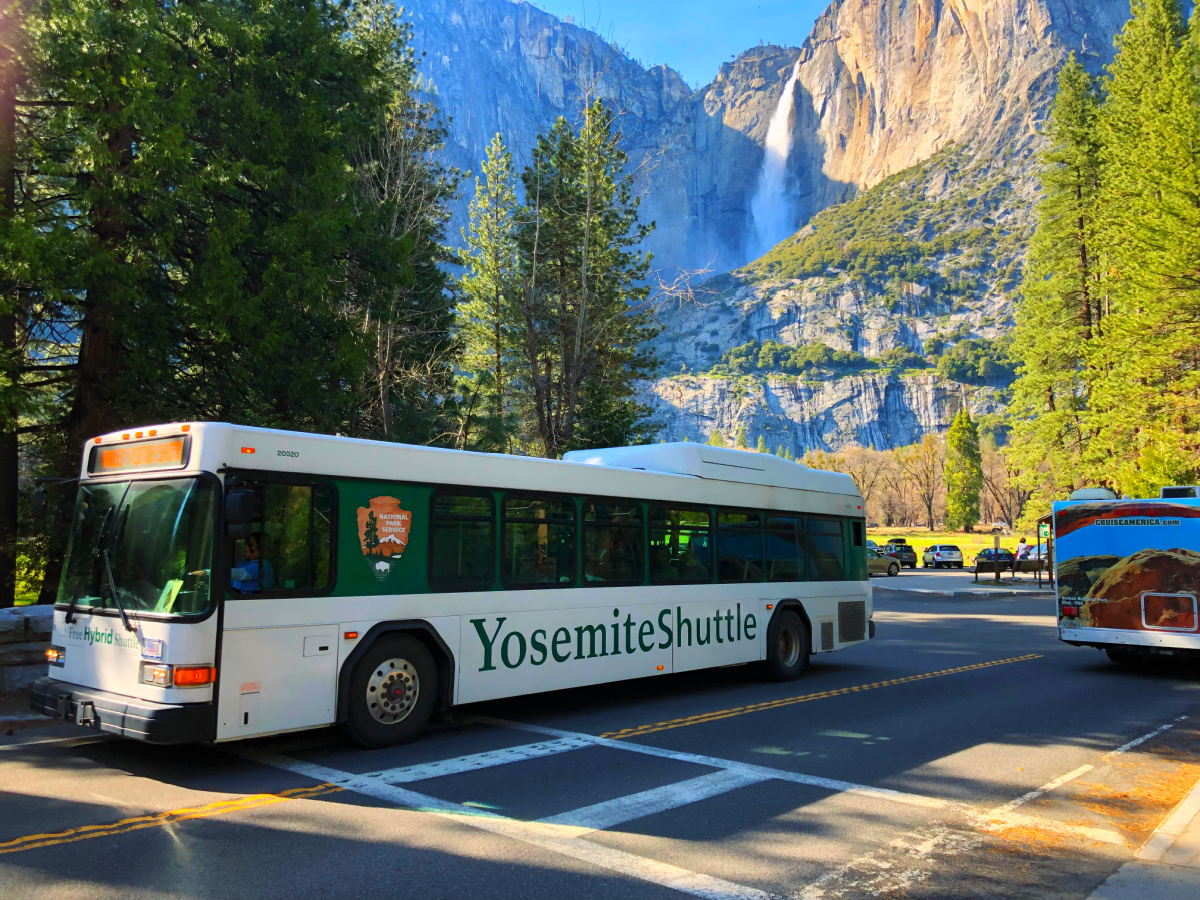
The easiest shuttle stop for the Lower Yosemite Fall Trail is Stop #6: Lower Yosemite Fall.
The Valleywide Shuttle currently serves this stop, and the trailhead, picnic area, and Cook’s Meadow are all nearby. Yosemite’s shuttles are free, and the Valleywide route operates daily.
There is also Stop #7 at Yosemite Valley Lodge/Yosemite Falls Parking, which is useful if you’re combining the falls with a meal at the lodge or if you’ve parked there.
This is another reason Yosemite Falls works so well in a Yosemite Valley itinerary. You don’t have to engineer half your day around getting there.
You can easily combine it with Yosemite Valley Lodge, Cook’s Meadow, Yosemite Village, or a longer walk through the valley.
Restrooms, Water, and Picnic Areas at Yosemite Falls
Yes—there are actual facilities here.
And when you’re traveling with kids, I consider that useful information rather than a boring logistical footnote.
There are restrooms and a water bottle filling station near the western end of the Lower Yosemite Fall loop, across from Yosemite Valley Lodge.
There is also a Lower Yosemite Fall Picnic Area right beside the trail. It has picnic tables, drinking water, trash and recycling facilities, and flush toilets. The picnic area is paved and wheelchair accessible.
So if you’ve packed lunch, this is actually a very easy place to build in a break.
And the setting isn’t exactly terrible.
You are eating lunch underneath Yosemite Falls.
Hard to complain about that.
Can You Eat at Yosemite Valley Lodge?
Yes, and this is probably the easiest option if you want to pair Yosemite Falls with an actual meal instead of a picnic.
Yosemite Valley Lodge is directly across from the western side of the Lower Yosemite Fall area, and it has several dining options.
For a casual meal, Base Camp Eatery serves breakfast, lunch, and dinner. The current menu includes quick-service options, and there is both indoor and outdoor seating.

This is probably what I would choose if I were doing Yosemite Falls in the middle of a sightseeing day.
You don’t have to dress up. You don’t have to build a formal meal into your schedule. You can walk the trail, get sprayed by the waterfall, let your kid climb over every safe log she can find, and then go grab lunch.
There is also a Starbucks at Yosemite Valley Lodge, plus the Mountain Room if you want a nicer dinner. Current operating hours can change seasonally, so I would check before relying on a particular restaurant.
That makes Yosemite Falls a surprisingly convenient anchor for part of your day.
You have the waterfall, bathrooms, drinking water, picnic tables, food, shuttle access, and Yosemite Valley Lodge all clustered together.
For a national park attraction, that’s about as easy as it gets.
Don’t Miss the Views From Yosemite Valley
One mistake would be treating Yosemite Falls as something you only see from the Lower Yosemite Fall Trail.
Some of my favorite views were actually from farther away.
From across Yosemite Valley, you can finally appreciate just how enormous the entire waterfall system is.
Upper Yosemite Fall drops from the top of the granite cliff. The Middle Cascades disappear into the gorge. Lower Yosemite Fall emerges far below.
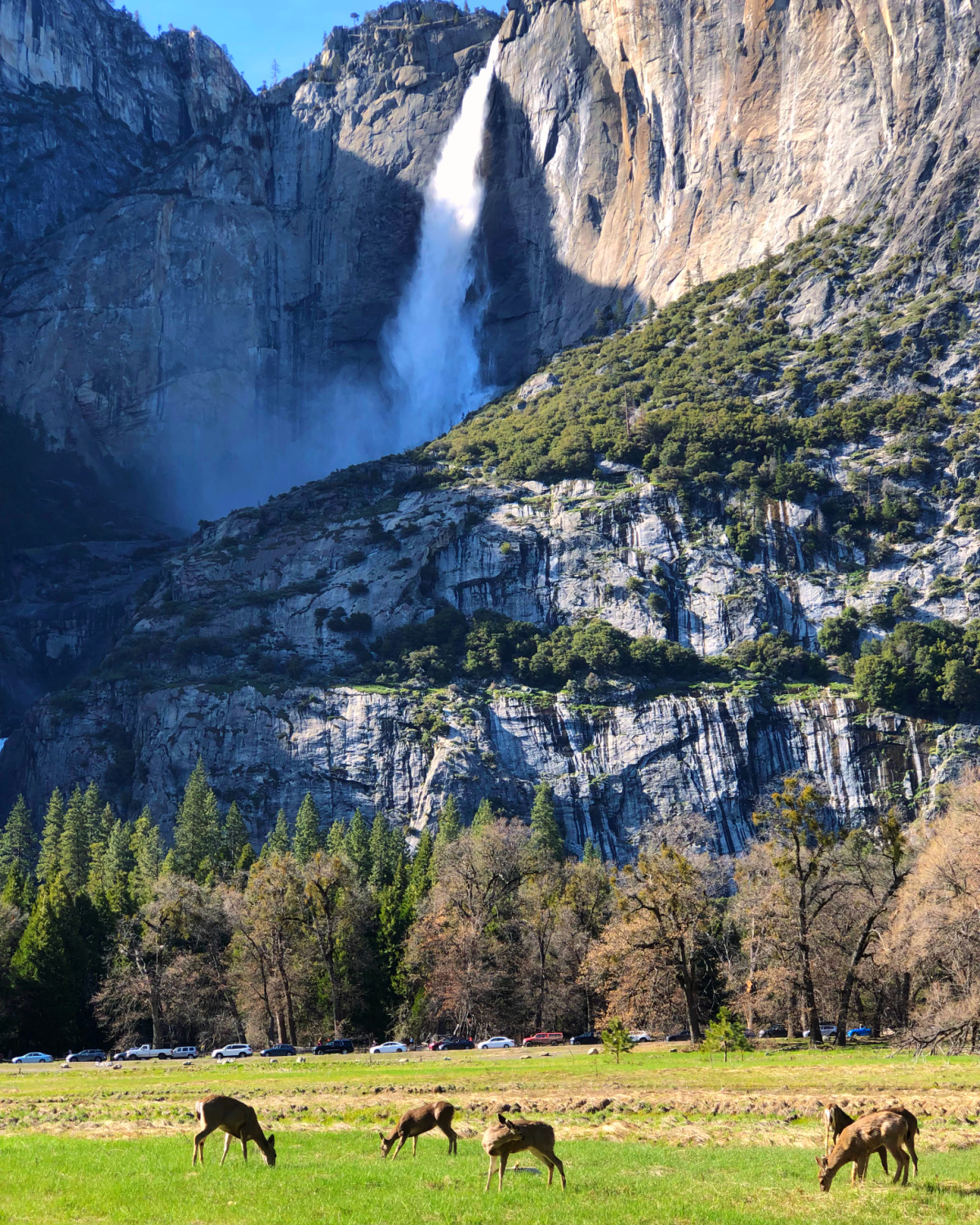
And suddenly that 320-foot waterfall you just stood beside looks tiny.
It is one of those Yosemite scale tricks that your brain has trouble processing.
We also saw deer grazing in the meadow beneath the falls, which was almost comically picturesque.
There we were with one of the world’s great waterfalls pouring down this enormous granite wall, bright green Yosemite Valley in front of us, and deer casually eating grass like this was a completely normal place to spend an afternoon.
Yosemite does that to you.
After a while you start expecting every direction you turn to look like a postcard.
What About Hiking to Upper Yosemite Fall?
There is an entirely different Yosemite Falls experience available for people looking for a serious hike.
And this is the part I have not done.
We visited the base of Lower Yosemite Fall and explored the valley around it, but I have not hiked the Upper Yosemite Fall Trail.
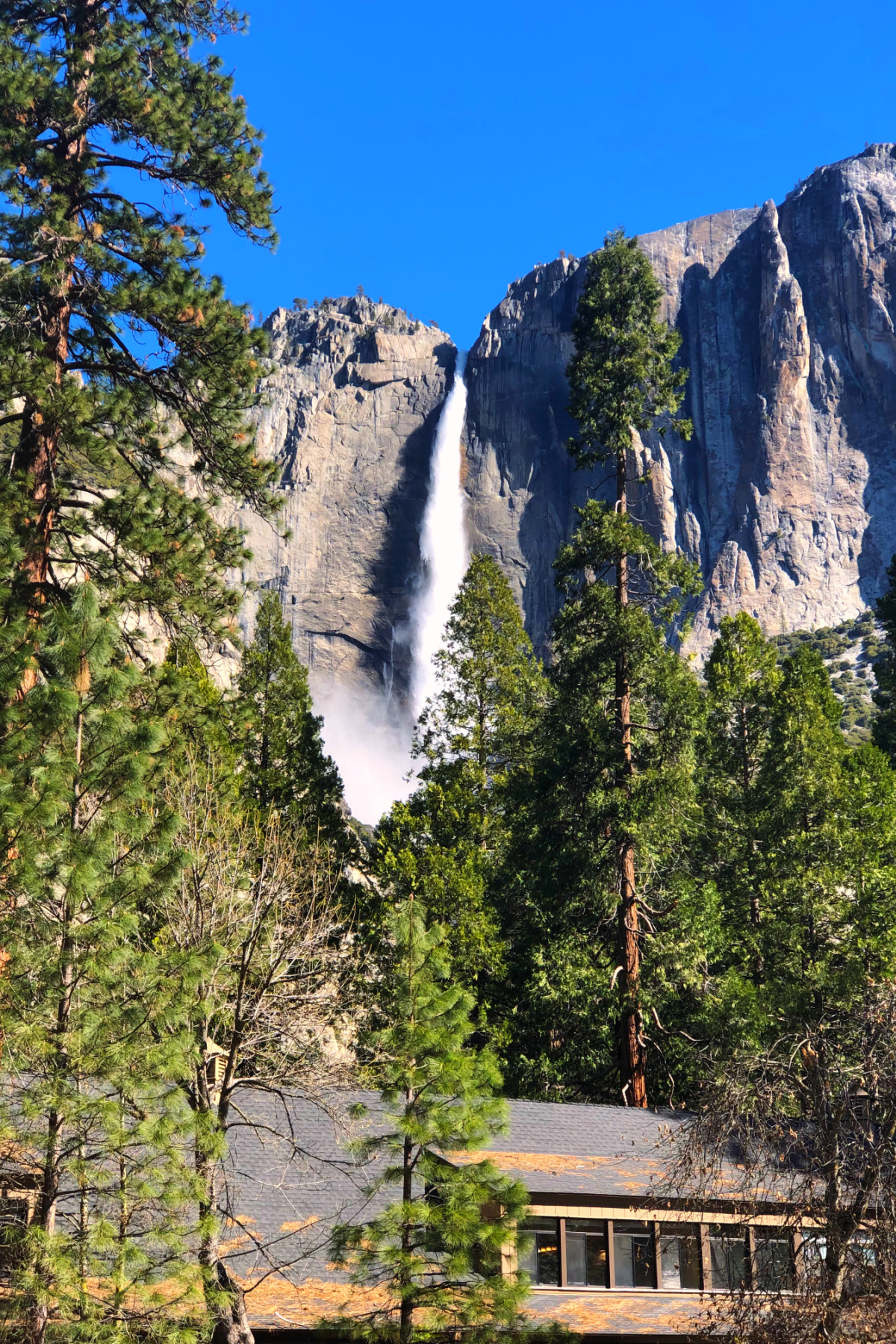
That hike is very different from the easy Lower Yosemite Fall loop.
The trail climbs thousands of feet from Yosemite Valley toward the top of Upper Yosemite Fall. This is a strenuous, all-day undertaking rather than an extension of your casual waterfall walk.
So please don’t see the words “Yosemite Falls Trail” somewhere online and assume you’re looking at the same hike.
You basically have two completely different choices.
The Lower Yosemite Fall Trail is the short, easy, mostly accessible experience I’ve been describing throughout this post.
The Upper Yosemite Fall Trail is for hikers who actually want the mountain.
If you’re physically prepared for that kind of hike, the reward is a completely different perspective over Yosemite Valley and eventually the top of the waterfall.
But you absolutely do not need to hike Upper Yosemite Fall to feel like you’ve really experienced Yosemite Falls.
I didn’t.
Standing on that footbridge beneath Lower Yosemite Fall, surrounded by spray and roaring water with rainbows forming over Yosemite Creek, felt plenty spectacular to me.
How Much Time Should You Allow for Yosemite Falls?
You can technically walk the Lower Yosemite Fall loop in about 30 minutes.
I wouldn’t.
If you’re simply trying to check Yosemite Falls off a list, sure. Walk to the bridge, take a photo, finish the loop, and move on.
But this is one of those places where slowing down makes the experience so much better.
I would plan on at least an hour, and potentially longer if you’re visiting with kids, taking photos, stopping at the bridge, or exploring some of the safe areas along the trail.
We definitely weren’t trying to set any speed records.
My daughter was busy turning fallen trees into balance beams and investigating boulders. I was taking approximately four million pictures of Yosemite Falls. Then we reached the bridge and had absolutely no reason to hurry away from a double rainbow.
Sometimes an easy hike takes a long time because it’s difficult.
This one takes a long time because you keep stopping to look at things.
What Should You Bring to Yosemite Falls?
You don’t need specialized hiking gear for the Lower Yosemite Fall Trail.
For most visitors, comfortable walking shoes are perfectly adequate. But during spring runoff, I would definitely bring a light rain jacket or another layer you don’t mind getting wet.
The spray near Lower Yosemite Fall can be significant when the waterfall is running strongly.
And even on a sunny day, Yosemite Valley temperatures can feel different in the shade beneath the trees or when you’re standing in cold waterfall mist.
A few other useful things to have:
- Water, especially if you’re continuing to explore Yosemite Valley afterward
- Sunscreen and sunglasses
- A light layer, even on a beautiful spring day
- A stroller for younger kids if needed
- Your camera or phone, because you are going to use it
- A little patience if you’re visiting during a busy time
I would also wear shoes with decent traction even though the main trail is paved. Wet pavement, pine needles, and areas near the creek can still be slippery.
Can Kids Do the Lower Yosemite Fall Trail?
Absolutely.
In fact, I think this is one of the best places in Yosemite for families with younger children.
There is almost no barrier to entry.
The trail is short. It is mostly flat. There are bathrooms nearby. Food is nearby. You can use a stroller. And the reward is enormous.
But what I remember most about visiting with my daughter wasn’t how easy the trail was.
It was how much she found to do.
There were logs to balance on. Rocks to investigate. Giant trees to stand underneath. Water rushing through the forest. Places where Yosemite Falls suddenly appeared between the trees.
At one point, she essentially designed her own little obstacle course out of the landscape.
That remains one of my favorite memories from Yosemite.
And honestly, that’s something I’ve learned over and over again while traveling with kids.
Sometimes you take them somewhere because you think the waterfall is going to be the exciting part.
And then they find a log.
A Few Important Safety Tips
Lower Yosemite Fall is very family-friendly.
Yosemite Creek during spring runoff is not.
The water below the falls can be extremely fast and powerful, and the rocks around the creek become slick from spray.
This is not the place to let kids wander close to the water.
Stay on the established trail and viewing areas, especially near the base of the waterfall. Don’t climb over barriers or scramble across wet boulders trying to get a slightly better photograph.
There is absolutely no need.
The views from the footbridge are already spectacular.
It’s also worth remembering that water levels change considerably throughout the year. Yosemite Creek in April or May can look completely different from the same location later in summer.
When we were there, the current was roaring.
There was no question that the water deserved respect.
Is Yosemite Falls Worth Visiting If the Waterfall Is Dry?
Yes—but I would adjust your expectations.
The Lower Yosemite Fall Trail is still a lovely forest walk, and Yosemite Valley doesn’t stop being beautiful just because the waterfall has slowed down.
But Yosemite Falls itself is a seasonal waterfall.
If you’re visiting in late summer or early fall during a dry year, you may see very little water.
That means you aren’t going to have the experience we had in April with pounding water, heavy spray, and Yosemite Creek rushing around enormous boulders.
If seeing Yosemite’s waterfalls is one of your biggest priorities, I would strongly consider a spring trip.
On the other hand, if you’re already visiting Yosemite in late summer, I would still walk through this area.
It’s short. It’s easy. And the forest beneath Yosemite Falls is beautiful in its own right.
Just don’t arrive expecting April conditions in August.
Is Lower Yosemite Fall Worth It If You Don’t Hike?
Yes.
Actually, this may be one of the best places in Yosemite if you don’t hike.
That’s probably my biggest takeaway from visiting Yosemite Falls.
National parks sometimes make people feel like they have to prove something.
You need to hike farther.
Climb higher.
Wake up earlier.
Get somewhere harder to reach.
And Yosemite certainly has extraordinary places that require considerable effort.
But it also has extraordinary places that don’t.
Lower Yosemite Fall is one of them.
You can walk less than a mile through a gorgeous forest and stand near the base of one of the most famous waterfall systems in the world.
That isn’t a consolation prize.
That’s Yosemite.
How to Combine Yosemite Falls With Other Yosemite Valley Stops
Because Yosemite Falls sits right in the heart of Yosemite Valley, it is extremely easy to combine with several other stops.
Cook’s Meadow is one of the most obvious choices.
Walking through the meadow gives you completely different views of Yosemite Falls than you’ll get beneath the trees. This is where you can step back and appreciate the scale of the entire waterfall system.
It is also where we saw deer grazing beneath the falls.
You can also combine Yosemite Falls with Yosemite Village, Sentinel Bridge, the Merced River, and other stops along the valley shuttle route without constantly getting back into your car.
If you’re staying at Yosemite Valley Lodge, this is particularly easy.
You could visit Yosemite Falls early in the morning or in the evening without having to deal with parking at all.
And that’s another reason I like this part of Yosemite so much.
There is an enormous amount to see in a relatively compact area.
Lower Yosemite Fall vs. Upper Yosemite Fall
These really shouldn’t be thought of as two versions of the same hike.
They are completely different experiences.
The Lower Yosemite Fall Trail is about one mile round trip, mostly flat, paved, and appropriate for almost everyone.
The Upper Yosemite Fall Trail is a strenuous hike of roughly 7 miles round trip with around 2,700 feet of elevation gain.
That is a serious hike.
There is also the option to hike partway up the Upper Yosemite Fall Trail to Columbia Rock, which gives hikers a shorter—but still steep—alternative with sweeping views across Yosemite Valley.
We did not hike either one.
And I want to make that very clear because there is a huge difference between describing a hike and actually having done it.
For our family, Lower Yosemite Fall gave us exactly the Yosemite Falls experience we wanted.
If you’re a strong hiker looking for a challenge, the Upper Yosemite Fall Trail is absolutely something to research.
But if you’re looking at photos of Yosemite Falls and wondering whether you have to make that climb in order to really experience it?
No.
Not at all.
My Biggest Tip for Visiting Yosemite Falls
Come when the water is flowing.
Then don’t rush.
Those are probably the two most important pieces of advice I can give you.
Walk slowly through the trees.
Look up when Yosemite Falls appears between the pines.
Let your kids investigate things.
Spend time on the bridge.
Watch Yosemite Creek tumble through the boulders.
And if the sun hits all that waterfall mist just right, keep an eye out for rainbows.
We went to Yosemite Falls because, obviously, it’s one of the iconic things you’re supposed to see in Yosemite National Park.
But the memory I carried away wasn’t just checking Yosemite Falls off a list.
It was my daughter balancing on fallen logs.
It was standing beside a roaring river.
It was getting sprayed by a waterfall in the middle of April.
And it was watching a double rainbow appear through the mist.
For such an easy place to visit, Yosemite Falls gave us one of the most memorable experiences of our entire Yosemite trip.
More Yosemite National Park Guides
If you’re planning a Yosemite trip, these guides can help you build out the rest of your itinerary:
- Yosemite in April — What to expect from spring weather, waterfalls, road closures, and Yosemite Valley conditions.
- Best Things to Do in Yosemite Valley — An overview of the waterfalls, scenic views, easy walks, and classic stops in the heart of Yosemite.
- Best Scenic Viewpoints in Yosemite National Park — Where to find some of Yosemite’s most iconic views, from valley overlooks to higher-elevation viewpoints.
- Best Easy Hikes in Yosemite National Park — Shorter trails and scenic walks that give you a lot of Yosemite without requiring a strenuous trek.
- Best Waterfalls in Yosemite National Park — A broader guide to Yosemite’s waterfall scenery, including which falls are easiest to see and when they are at their best.
- Yosemite Valley Lodge Review — What it’s really like to stay inside Yosemite Valley and why location matters so much in a busy national park.
More National Park Waterfalls Worth Seeing
If Yosemite Falls is your kind of national park stop, these other waterfall guides are worth adding to your list:
- Nooksack Falls — A dramatic Pacific Northwest waterfall with a short, easy walk to the viewpoint.
- Myrtle Falls — One of the prettiest waterfalls near Paradise at Mount Rainier, with Mount Rainier itself often looming in the background.
- Marymere Falls — A beautiful forest waterfall near Lake Crescent in Olympic National Park.
- Sol Duc Falls — One of Olympic National Park’s most photogenic waterfalls, reached by a moderate forest hike.
- Athabasca Falls — A powerful waterfall in Jasper National Park where the force of the water is every bit as impressive as the height.
- Grand Canyon of the Yellowstone — One of Yellowstone’s most spectacular landscapes, with massive waterfalls dropping into a colorful canyon.
- Johnston Canyon — A popular Banff-area hike with waterfalls, catwalks, and canyon scenery along the way.