Visiting the Grand Canyon in March: What Spring Break Is Really Like

Affiliate Disclosure: This post may contain affiliate links. If you make a purchase or booking through these links, I may earn a commission at no additional cost to you.
Planning a Grand Canyon spring break trip? Here’s what visiting the Grand Canyon in March is really like, including snow, cold weather, road closures, hiking conditions, crowds, and what to pack.
Estimated reading time: 28 minutes
Visiting the Grand Canyon during spring break can be absolutely incredible.
But if your spring break falls in March, there is one very important thing you need to know before you start packing:
March at the Grand Canyon can still feel a whole lot like winter.
We learned this firsthand when we visited the South Rim during our spring break trip in March 2024.
When most people think about visiting Arizona for spring break, they probably picture sunshine, blue skies, and pleasantly warm temperatures. And depending on where you are in Arizona, that might be exactly what you get.
The Grand Canyon is different.
The South Rim sits at a much higher elevation than places like Phoenix, which means temperatures can be dramatically colder. Snow is absolutely possible. Roads can temporarily close. Hiking trails can become icy. And the weather can change surprisingly quickly.
During our visit, we experienced all of that.
And you know what?
I would still visit the Grand Canyon in March again.
In fact, I think spring break can be a fantastic time to visit the Grand Canyon. You just need to understand what you’re signing up for and be willing to roll with whatever weather you get.
Is March a Good Time to Visit the Grand Canyon?
Yes, I think March can be a really great time to visit the Grand Canyon.
But I would not go into a March trip expecting traditional spring weather.
Depending on the year, you could arrive to sunshine and relatively mild temperatures. Or you could arrive during an actual snowstorm.
We got a little bit of both.
Our Grand Canyon visit was March 23 through March 25. We stayed for two nights, which gave us part of our arrival day, one full day, and part of our departure day.
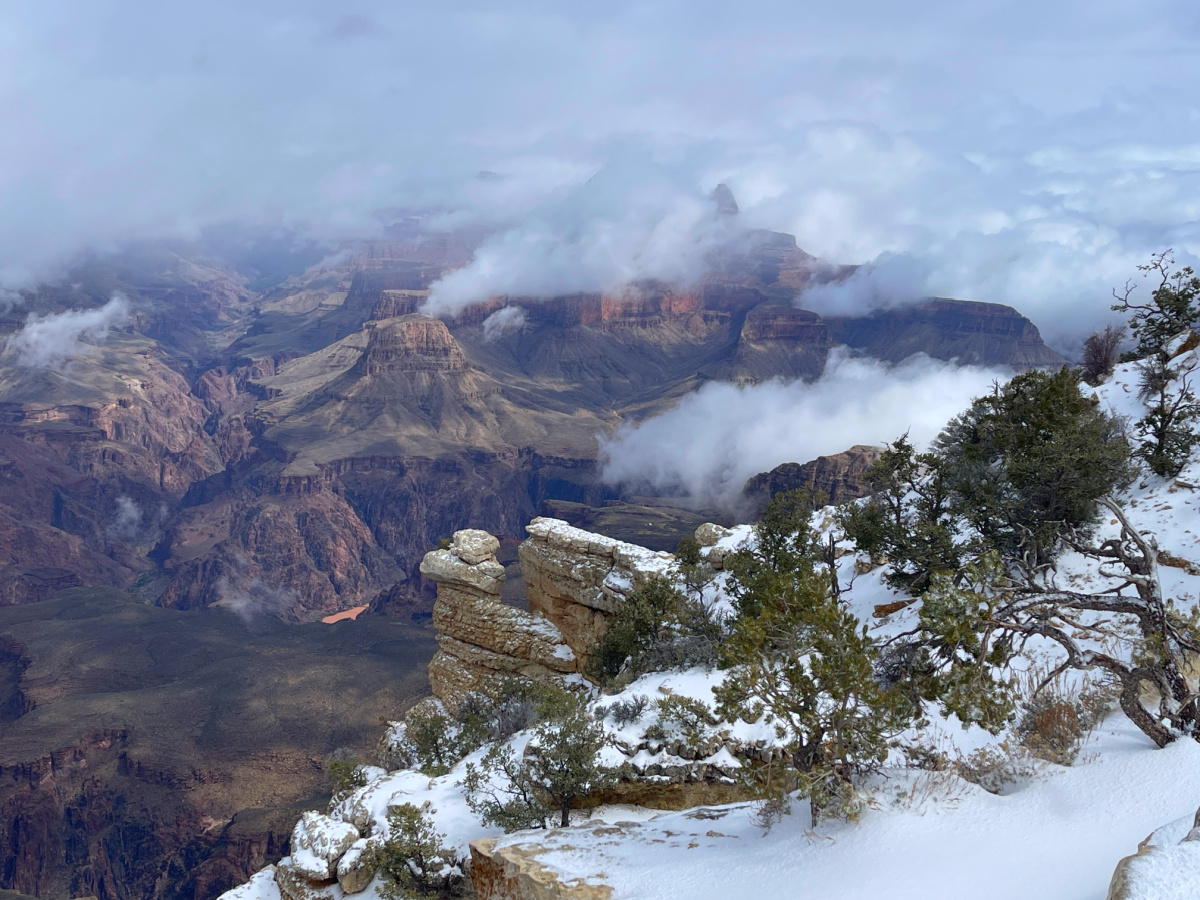
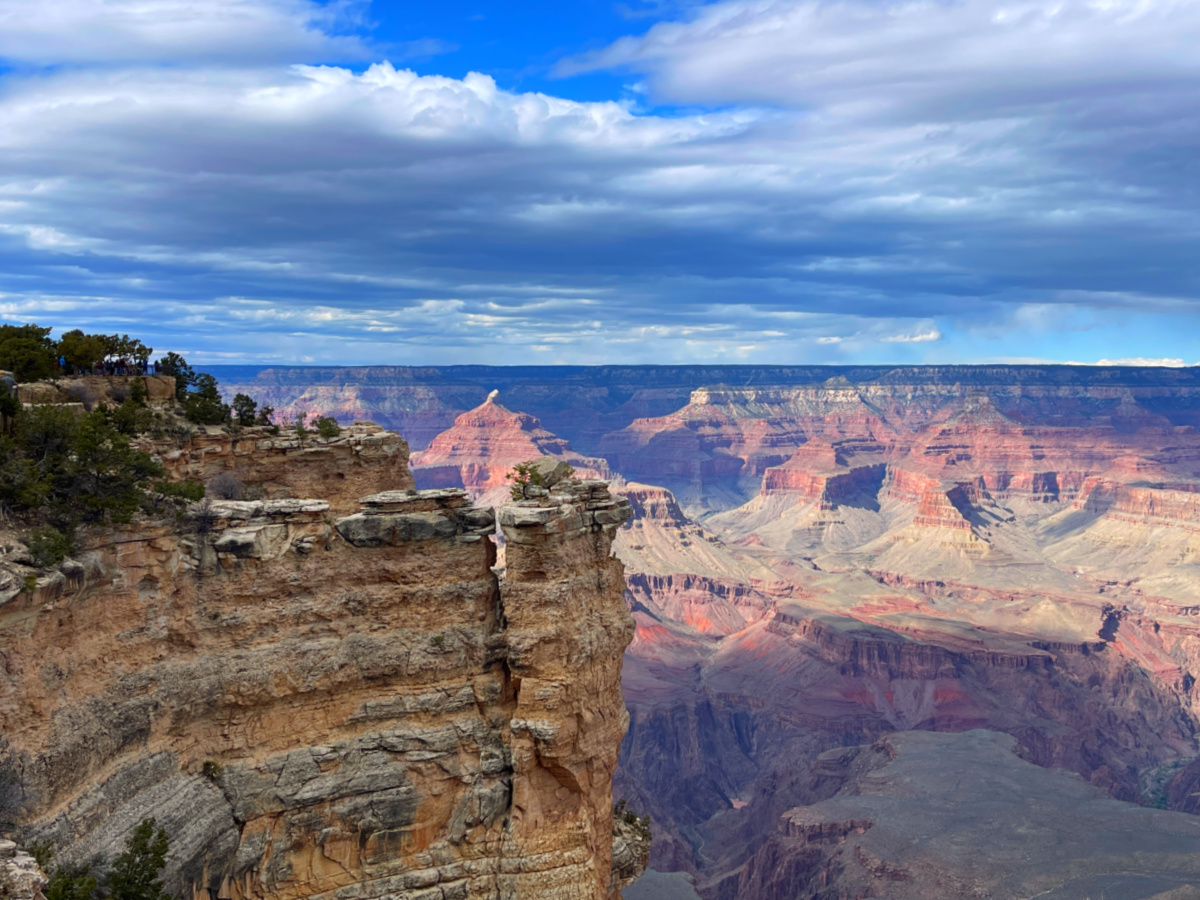
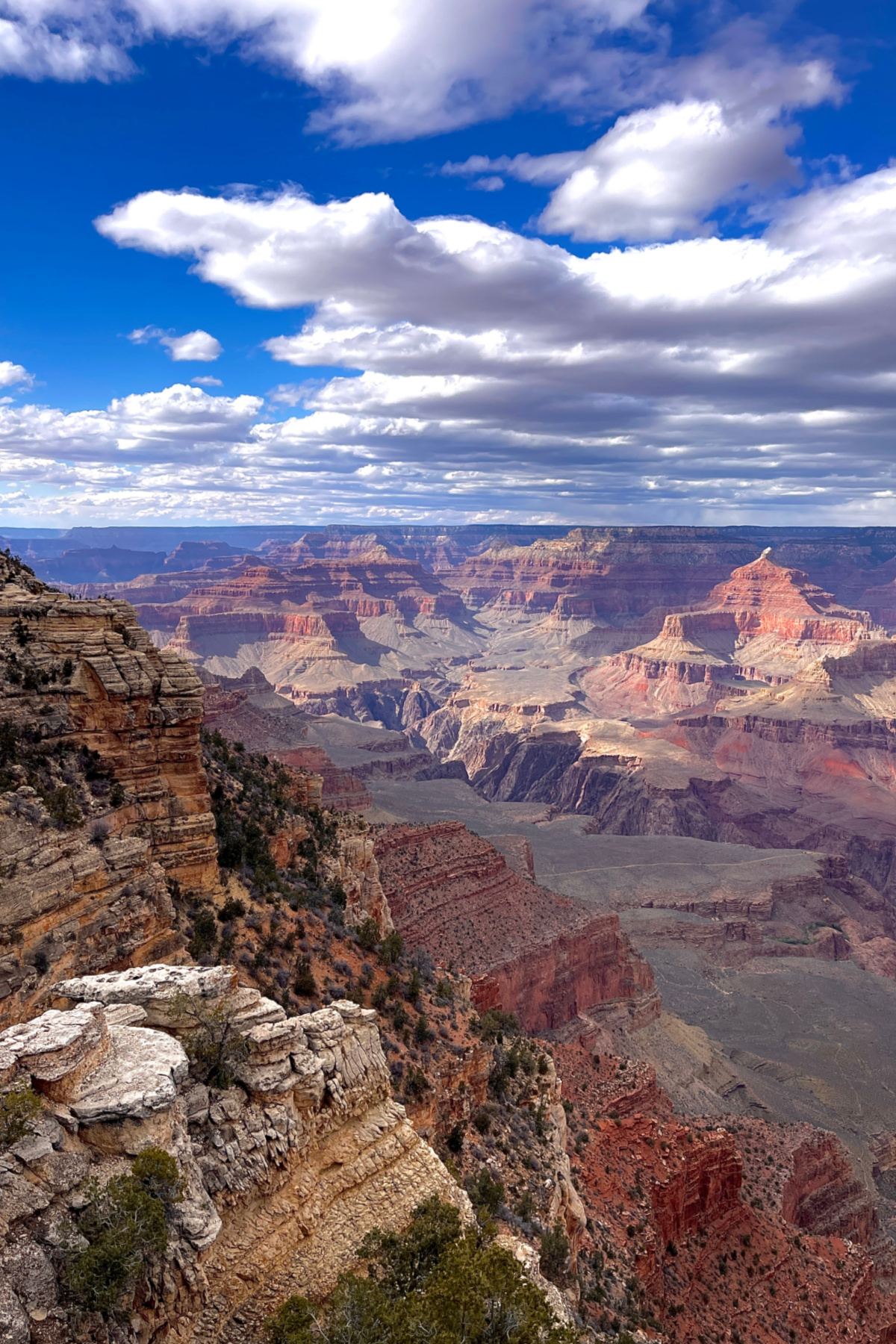
On our first afternoon, the canyon was completely visible. Storm clouds were starting to move in, but we still had beautiful views.
The next day?
Snow.
Real snow.
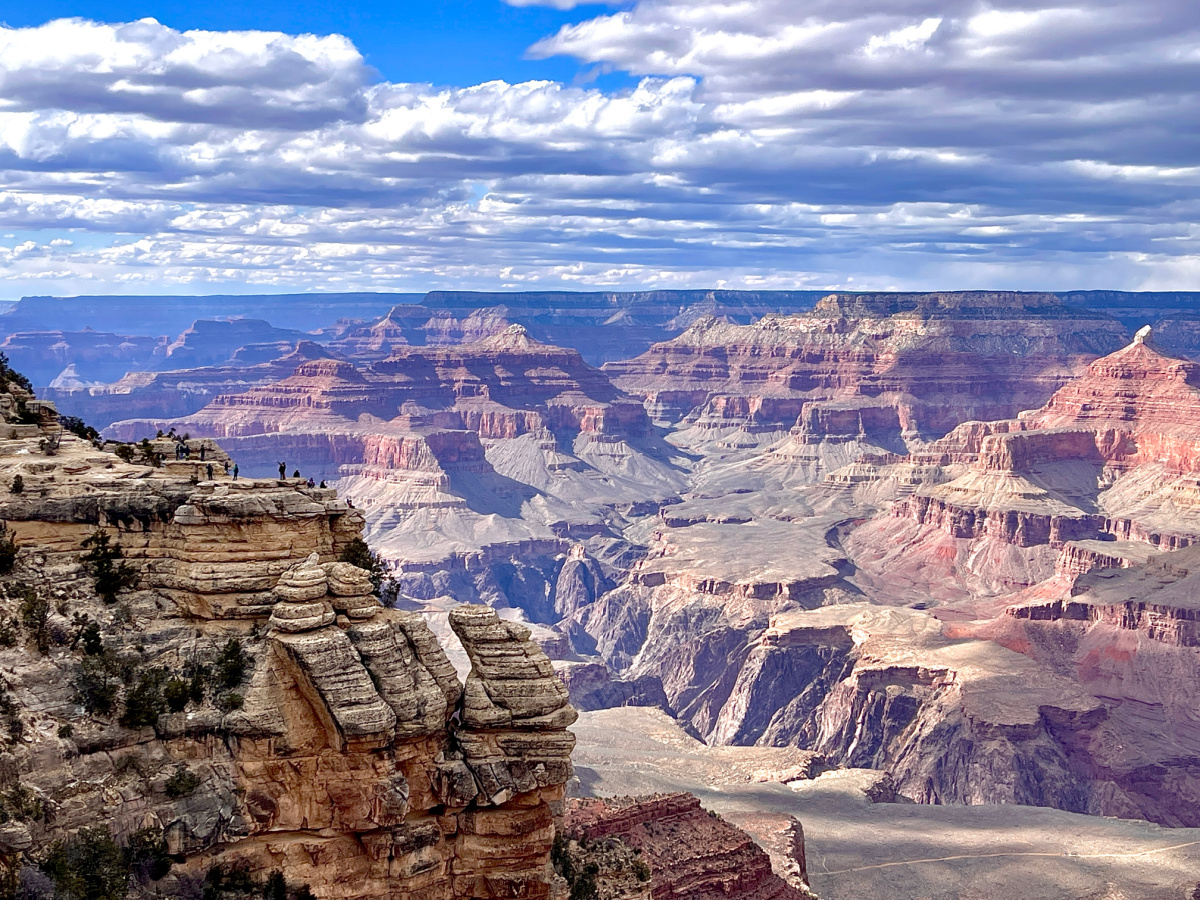
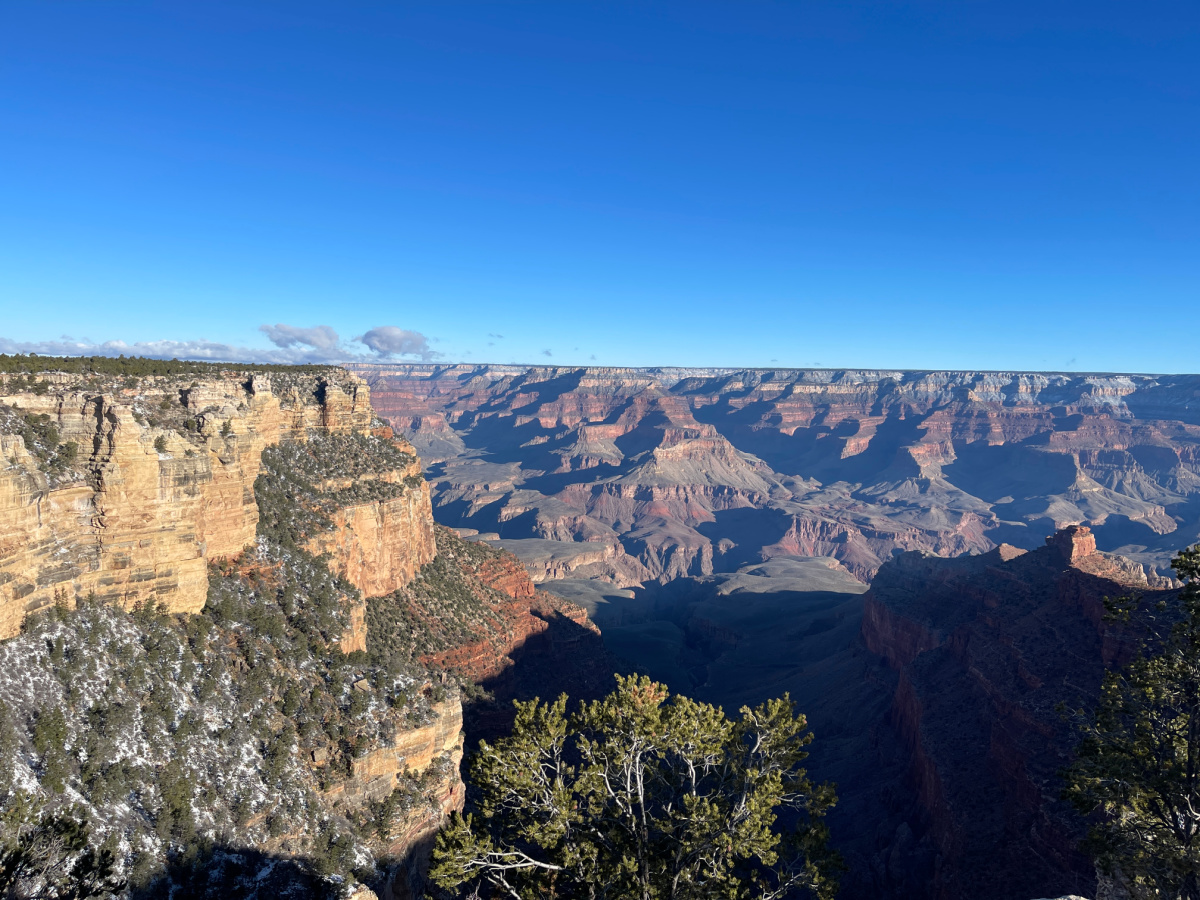
And then, by the following morning, the storm had moved out and the sky was completely blue.
It was almost like visiting three different Grand Canyons in three days.
That unpredictability is probably the most important thing to understand about visiting during spring break.
Spring break can fall at very different times depending on your school calendar, too. A late-April spring break is going to be a very different experience from a mid- or late-March spring break.
If you’re coming in March, I would treat your trip as a winter trip with the possibility of spring weather rather than the other way around.
We Were Not Prepared for How Cold It Was
This was probably our biggest packing mistake.
We knew the Grand Canyon would be cooler than Phoenix.
We did not fully appreciate just how much cooler it could be.
Pretty much as soon as we arrived, we realized that the clothes we had packed were not warm enough.
So one of our first Grand Canyon purchases ended up being extra sweatshirts, hats, and gloves.
Now, I am certainly not opposed to bringing home Grand Canyon souvenirs.
But I would have preferred not to buy emergency winter clothing because we underestimated the weather.
If you’re visiting the Grand Canyon in March, bring the warm clothes.
Even if the forecast looks reasonably pleasant when you leave home, pack layers. Pack a warm jacket or sweatshirt. Pack gloves. Pack a hat. Bring shoes that can handle cold or wet conditions.
You may not need all of it.
But if the weather changes while you’re there, you’ll be very glad you brought it.
And remember that even on a sunny day, the mornings and evenings can be quite cold.
You are standing on the edge of a canyon at around 7,000 feet of elevation. Wind can make it feel even colder, especially when you’re standing at an overlook waiting for sunrise or sunset.
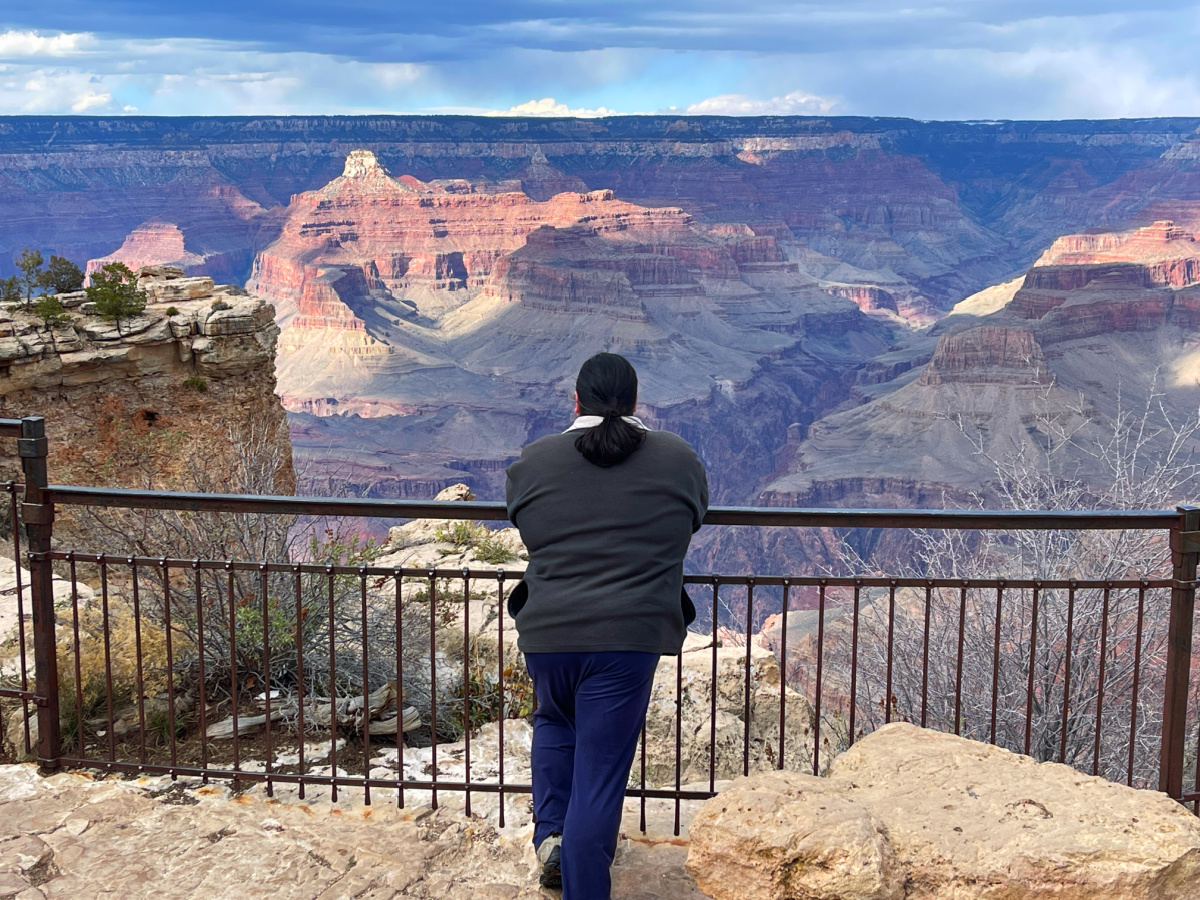
Our First Afternoon at the Grand Canyon
The funny thing is that when we first arrived, the weather still looked pretty good.
We had driven up from the Phoenix area and reached the South Rim in the afternoon.
We headed over toward the Grand Canyon Visitor Center and Mather Point area and got our first real look at the canyon.
The storm clouds were already beginning to roll in, but the canyon itself was still clearly visible.
And honestly?
The clouds made everything even more dramatic.
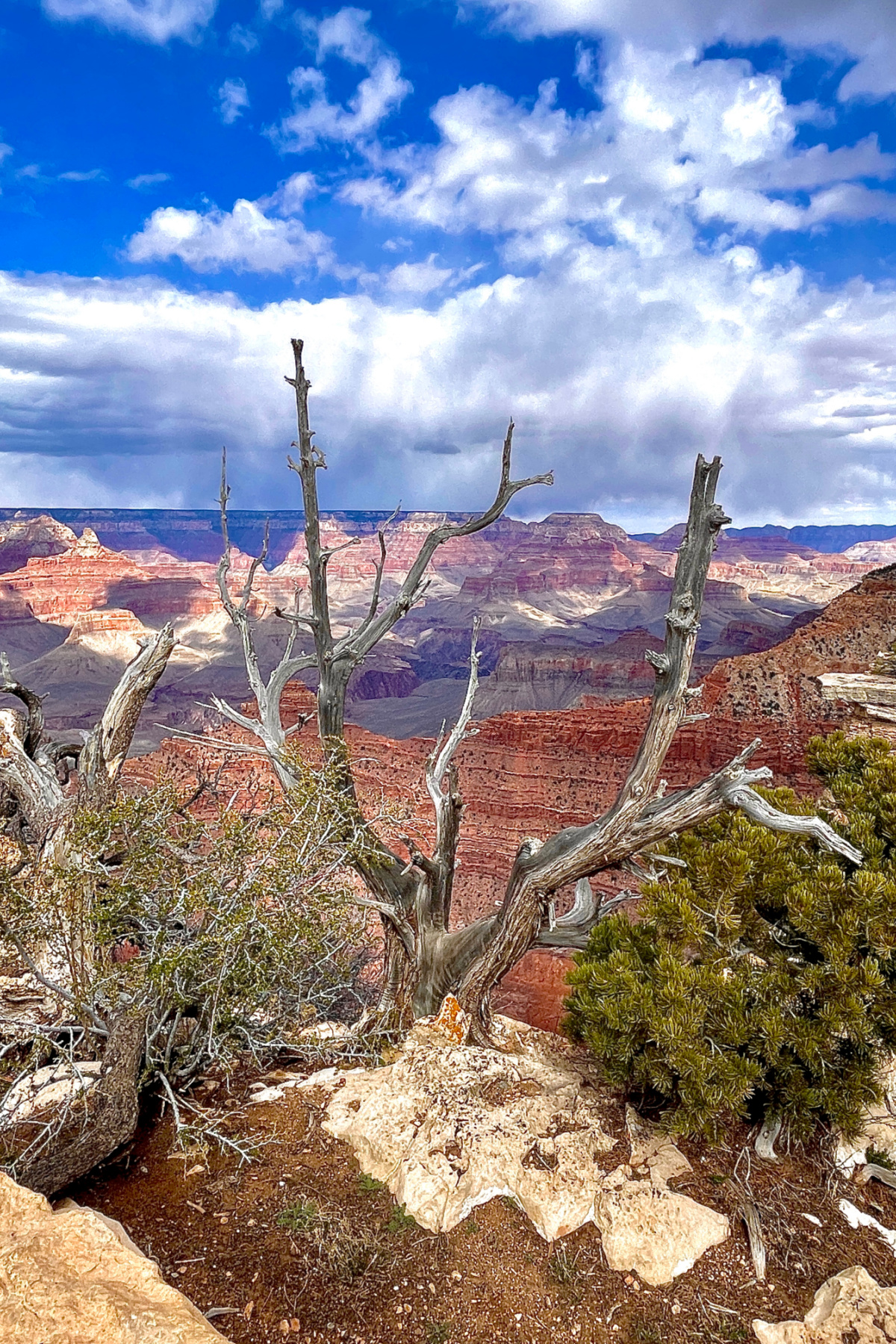
There is something almost surreal about seeing the Grand Canyon for the first time anyway, but watching a storm begin to build over it made the whole scene feel even bigger.
We explored the area around Mather Point, checked into Maswik Lodge, and then spent the rest of the afternoon and evening soaking up as much of the canyon as possible.
Maswik Lodge ended up being a really convenient place to stay.
We had originally hoped to stay at El Tovar, but we weren’t able to get a room there. Maswik was a great alternative because it was still very close to the rim.
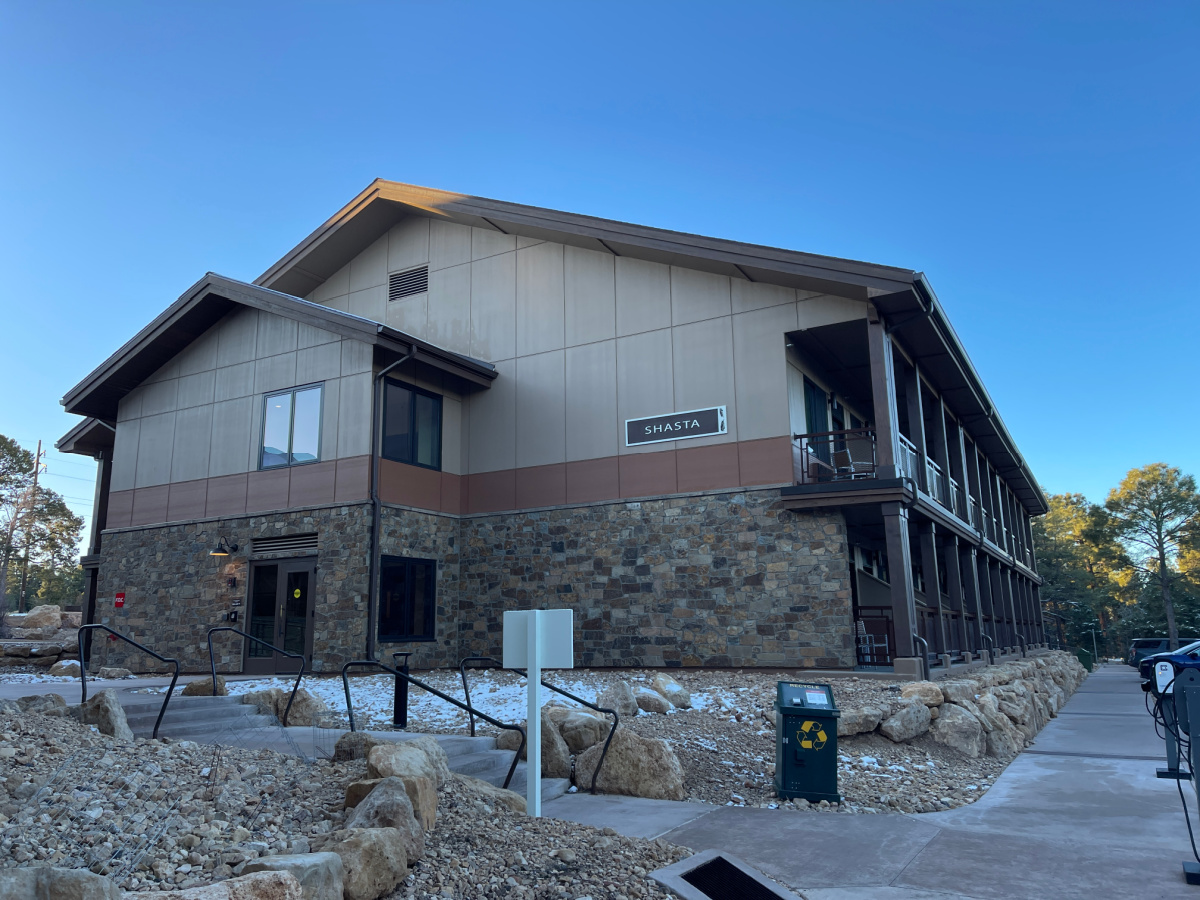
We could easily walk over to the historic village area, which made it especially convenient for meals and sunset viewing.
That evening, we had dinner at the El Tovar Dining Room, which was one of the experiences I had really wanted to include in our trip.
After dinner, we continued watching the sunset around the El Tovar area and also took the shuttle toward Hopi Point.
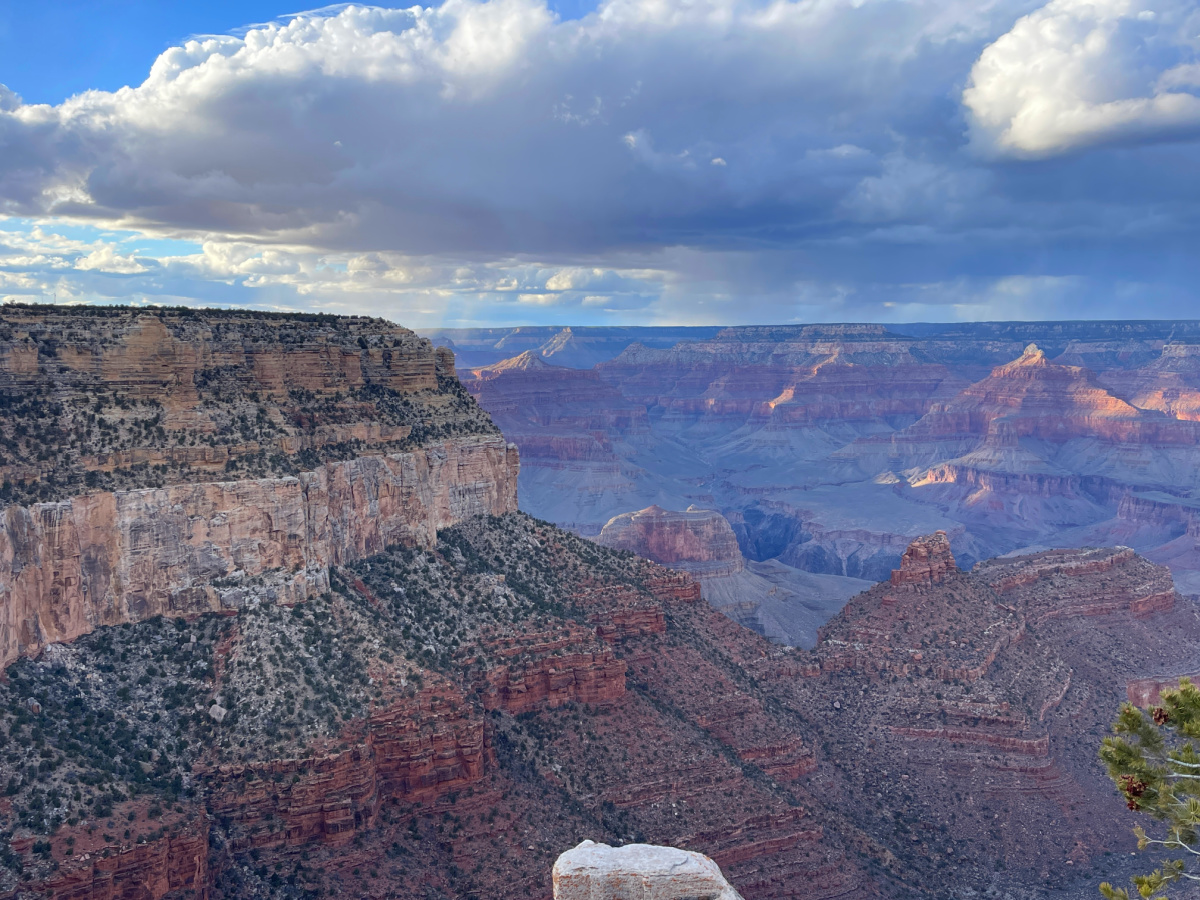
The canyon was still visible, but you could tell something was coming.
The clouds were thickening.
The temperature was dropping.
And by the next morning, the Grand Canyon looked completely different.
And Then We Woke Up to Snow
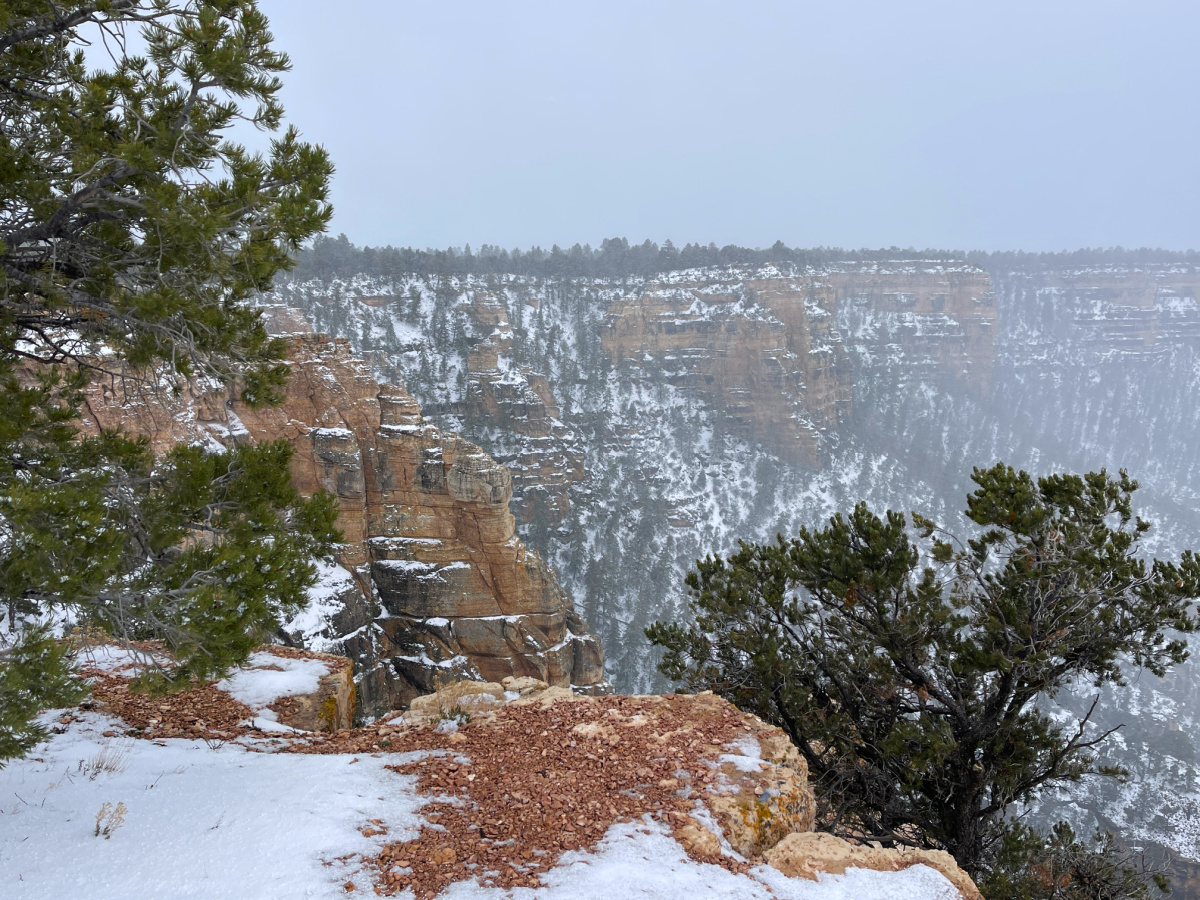
The next morning, it was snowing.
Not a few decorative flakes floating around in the air.
Actual snow.
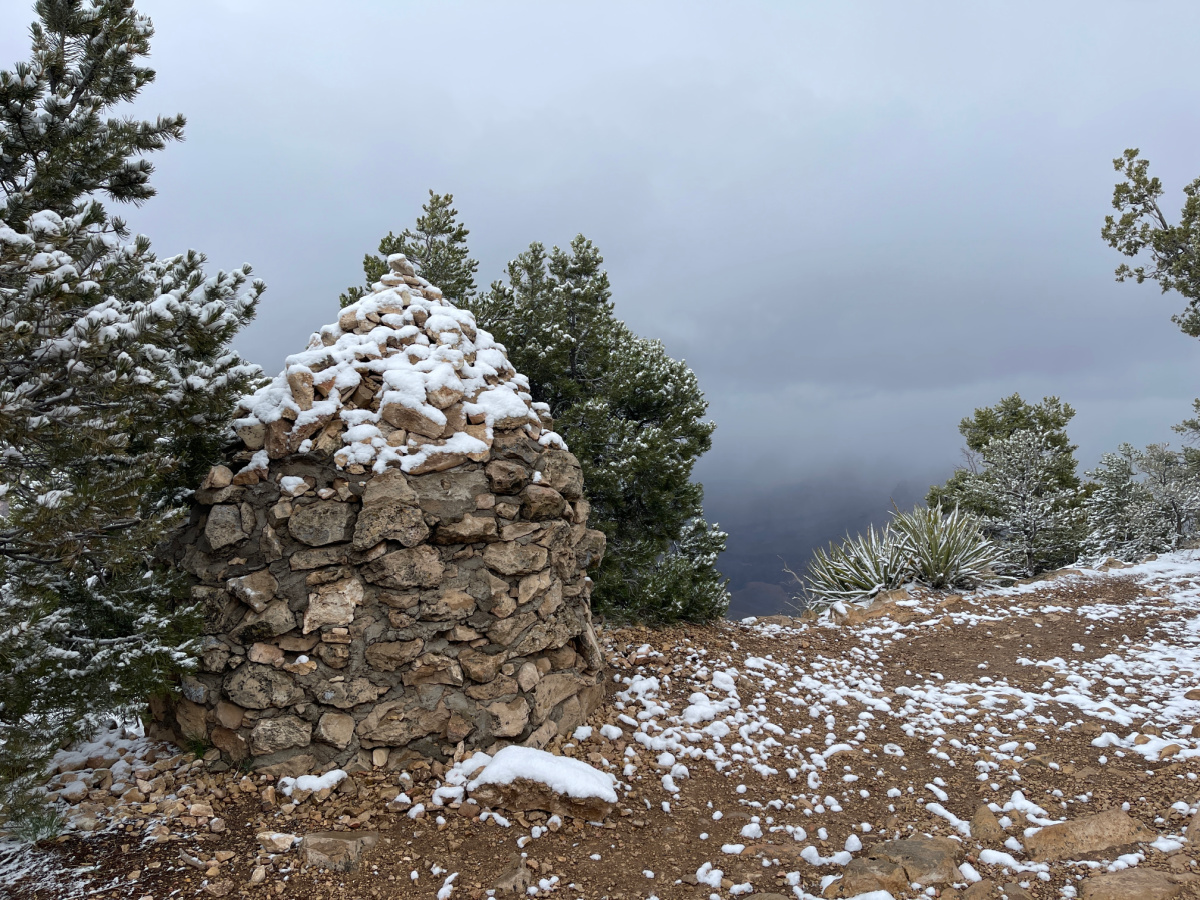
There were several inches accumulating in places around the parking lots and buildings, and the entire South Rim had transformed overnight.
Trees were covered in snow.
The roads were snowy and slick.
Visibility across the canyon came and went depending on the clouds.
And suddenly our carefully planned Grand Canyon day became a completely different kind of adventure.
One of the strangest parts was how empty everything felt.
This was spring break.
Under normal circumstances, you would expect places like the Grand Canyon Visitor Center and Mather Point to be busy.
Instead, we pulled into the visitor center area and it felt almost deserted.
There were only a handful of cars.
The snowstorm had clearly scared a lot of people away.
And while I certainly wouldn’t plan a Grand Canyon vacation around hoping for bad weather, there was something kind of amazing about seeing such a popular place feel almost completely empty.
We had the snow.
We had the clouds.
We had the canyon appearing and disappearing through the storm.
And for part of the day, it felt like we had the place almost to ourselves.
Seeing the Grand Canyon in a Snowstorm Is Weirdly Magical
The snowstorm definitely disrupted our plans.
But I also don’t want to make it sound like the entire day was miserable.
It wasn’t.
It was actually pretty incredible.
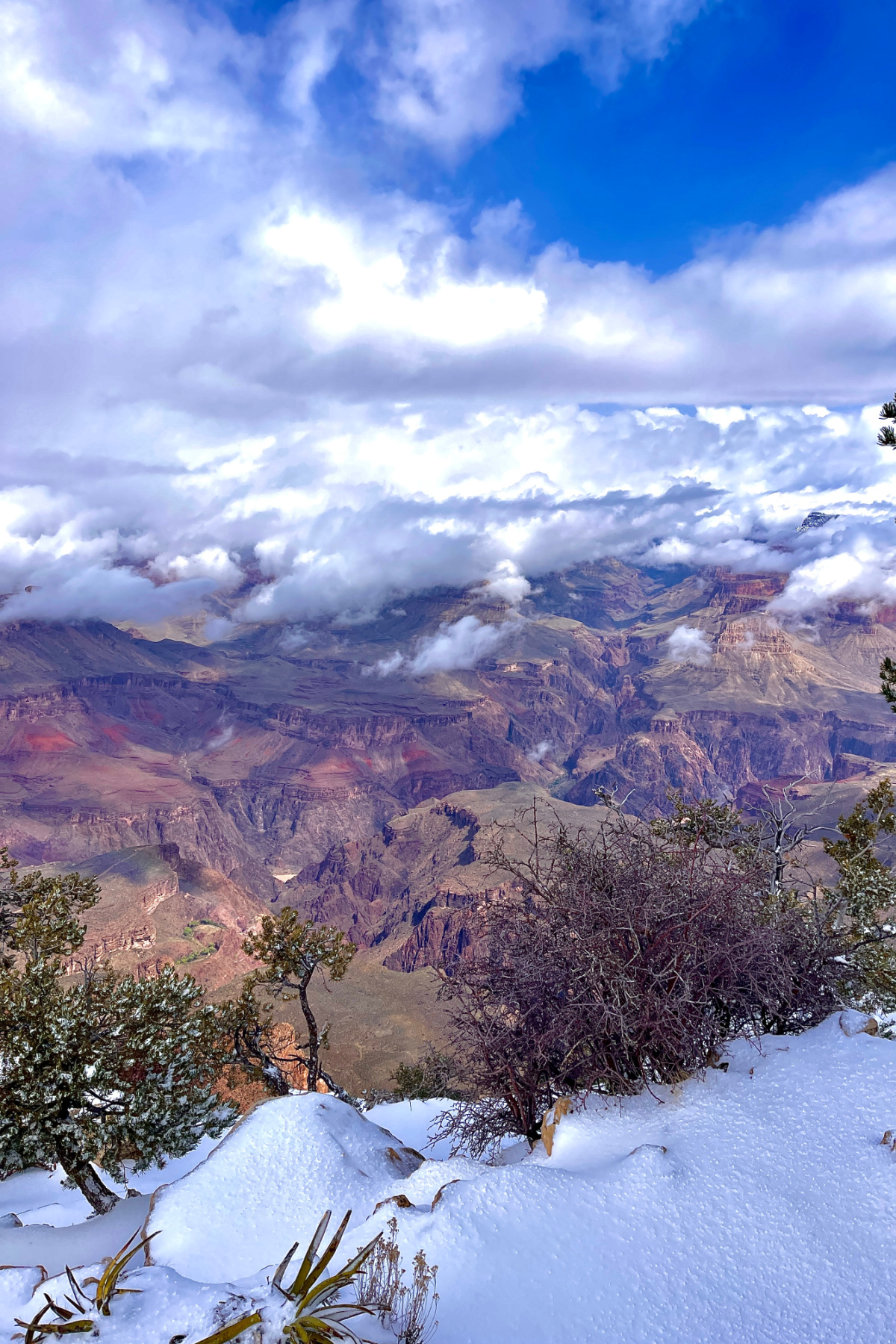
At one point, we were near the Yavapai area and could barely see the canyon because the clouds were so thick.
Then the clouds would shift, and suddenly part of the canyon would appear.
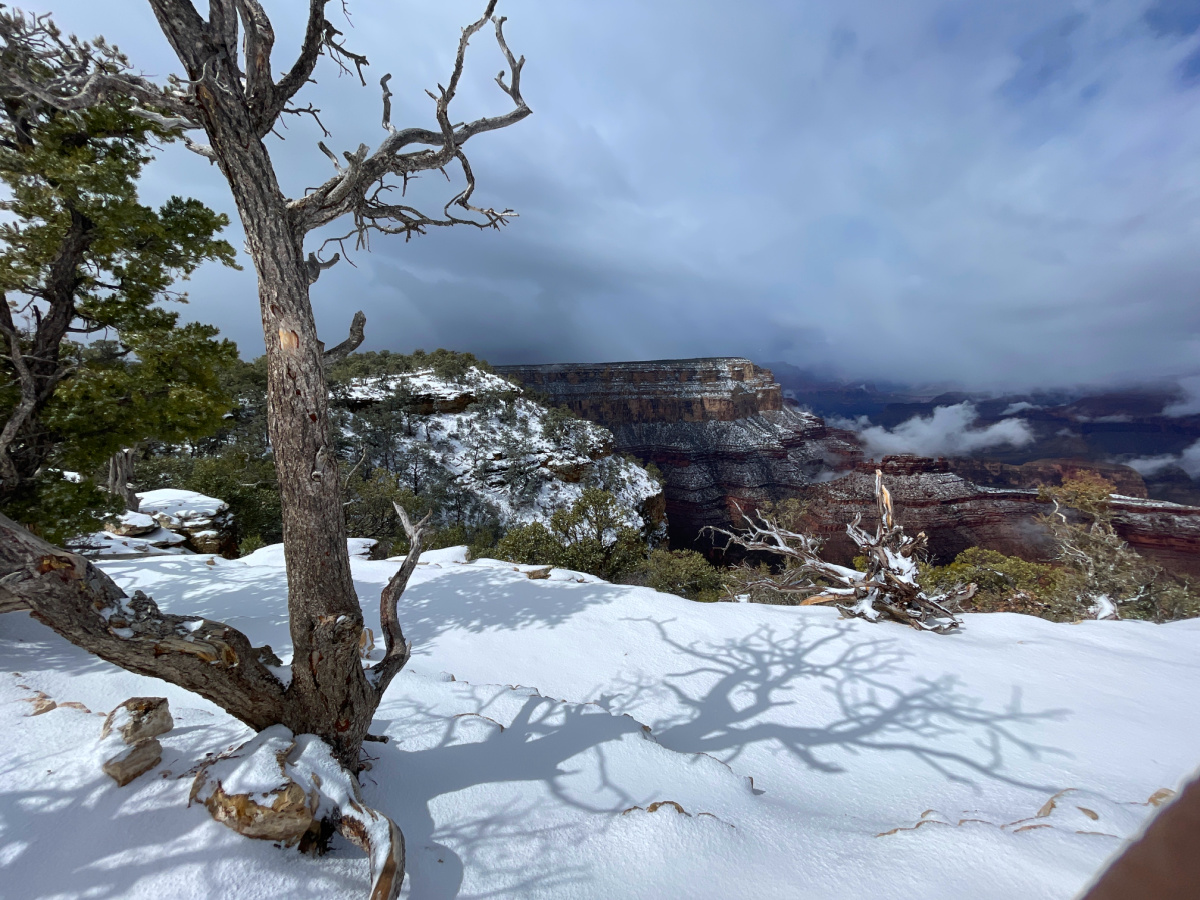
Then disappear again.
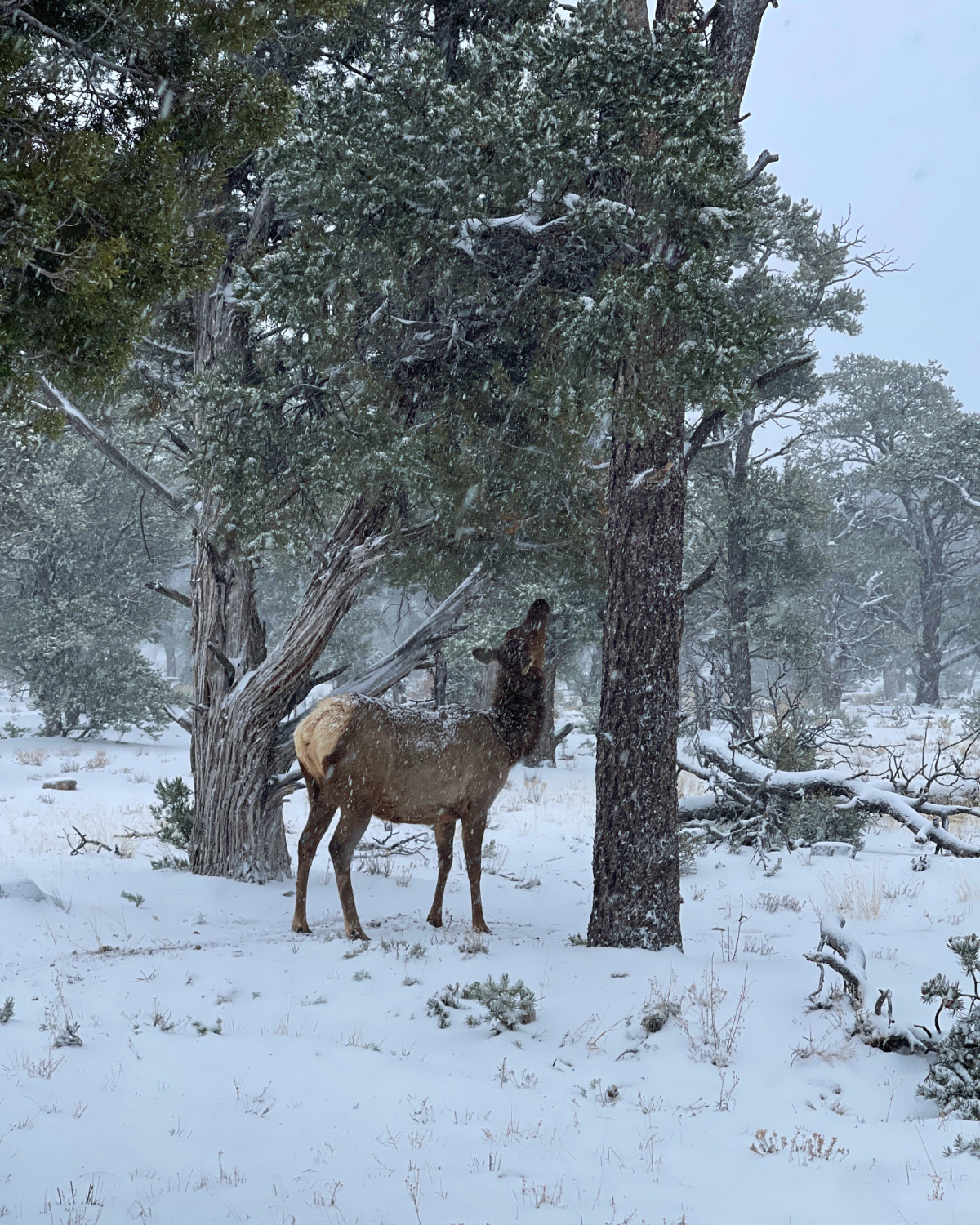
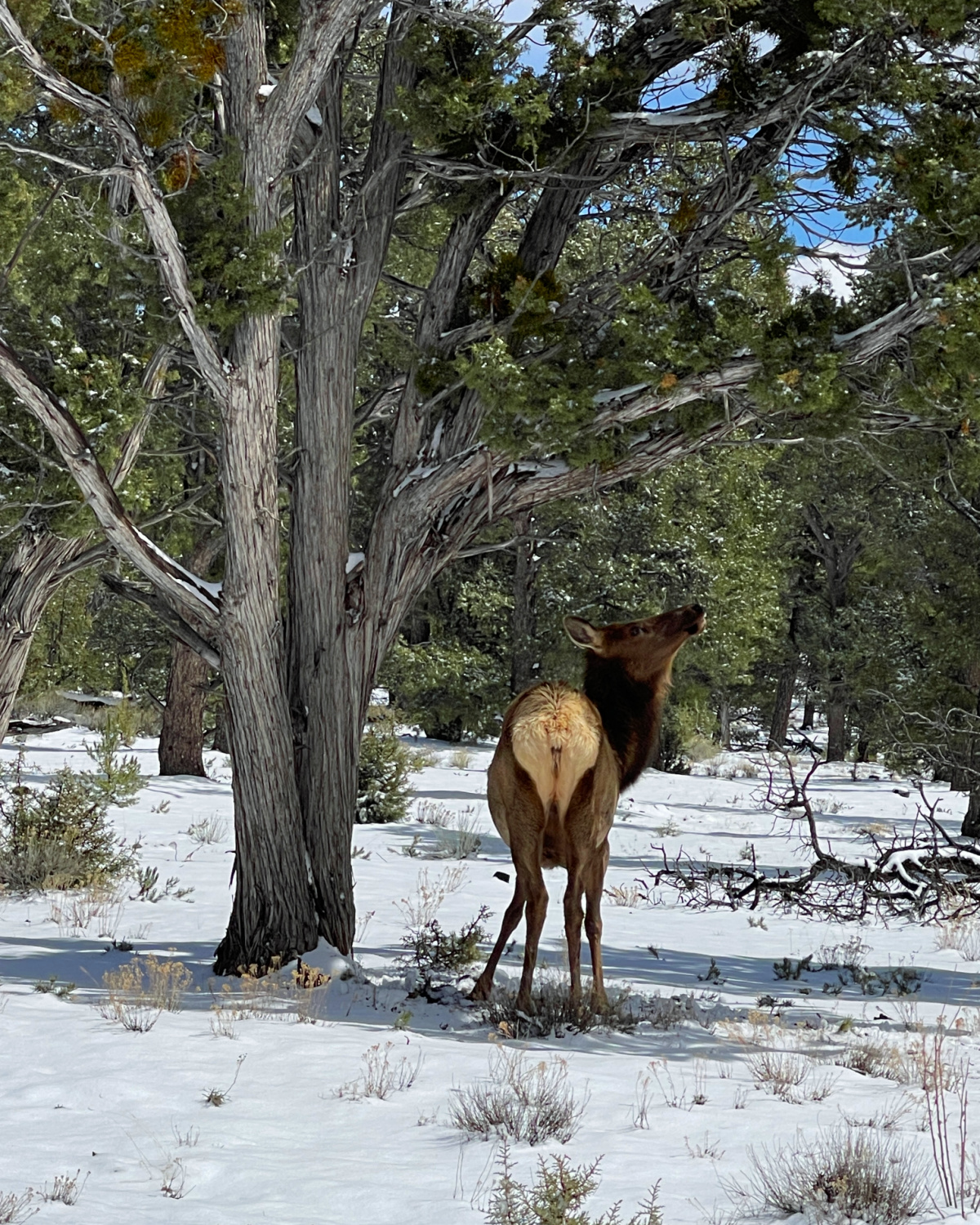
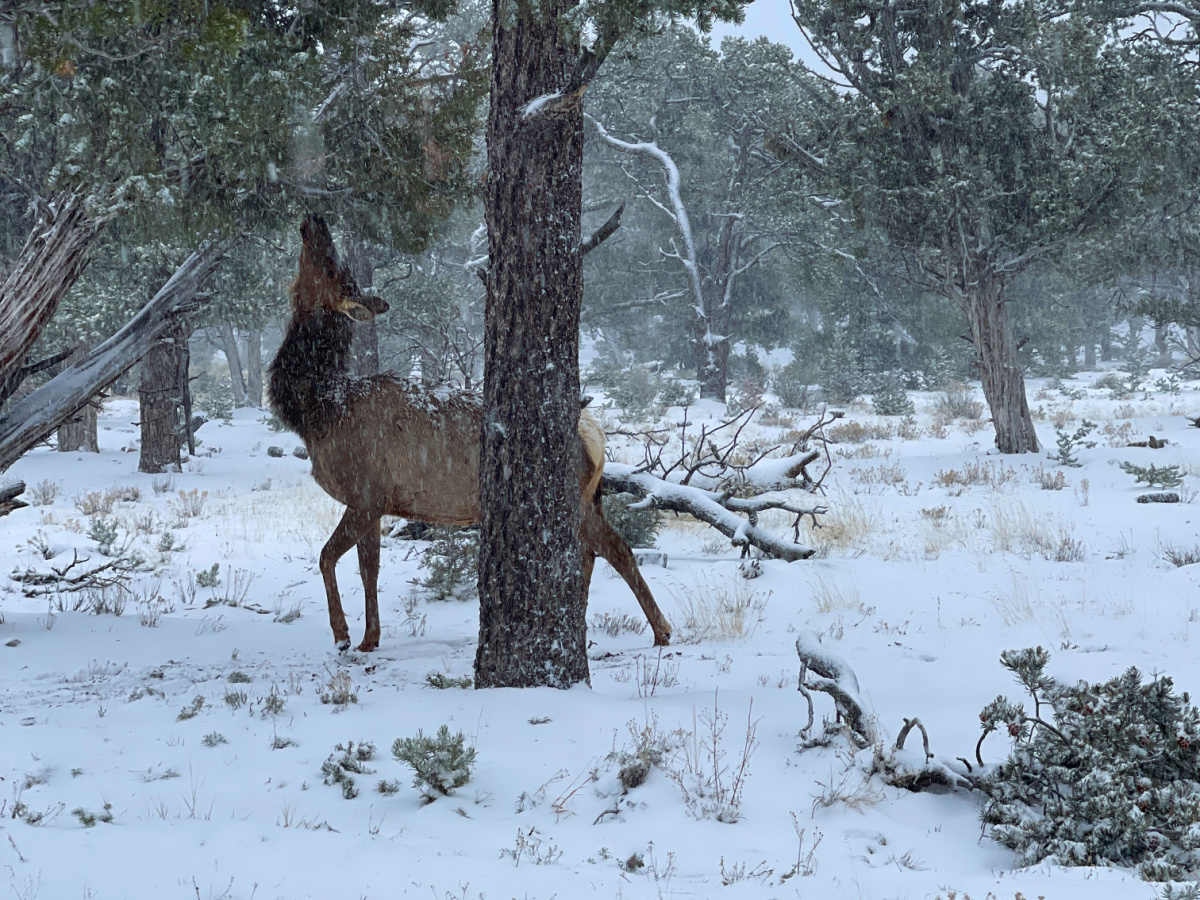
We also saw wildlife out in the snow, including what I believe was an elk or deer calmly eating from the trees.
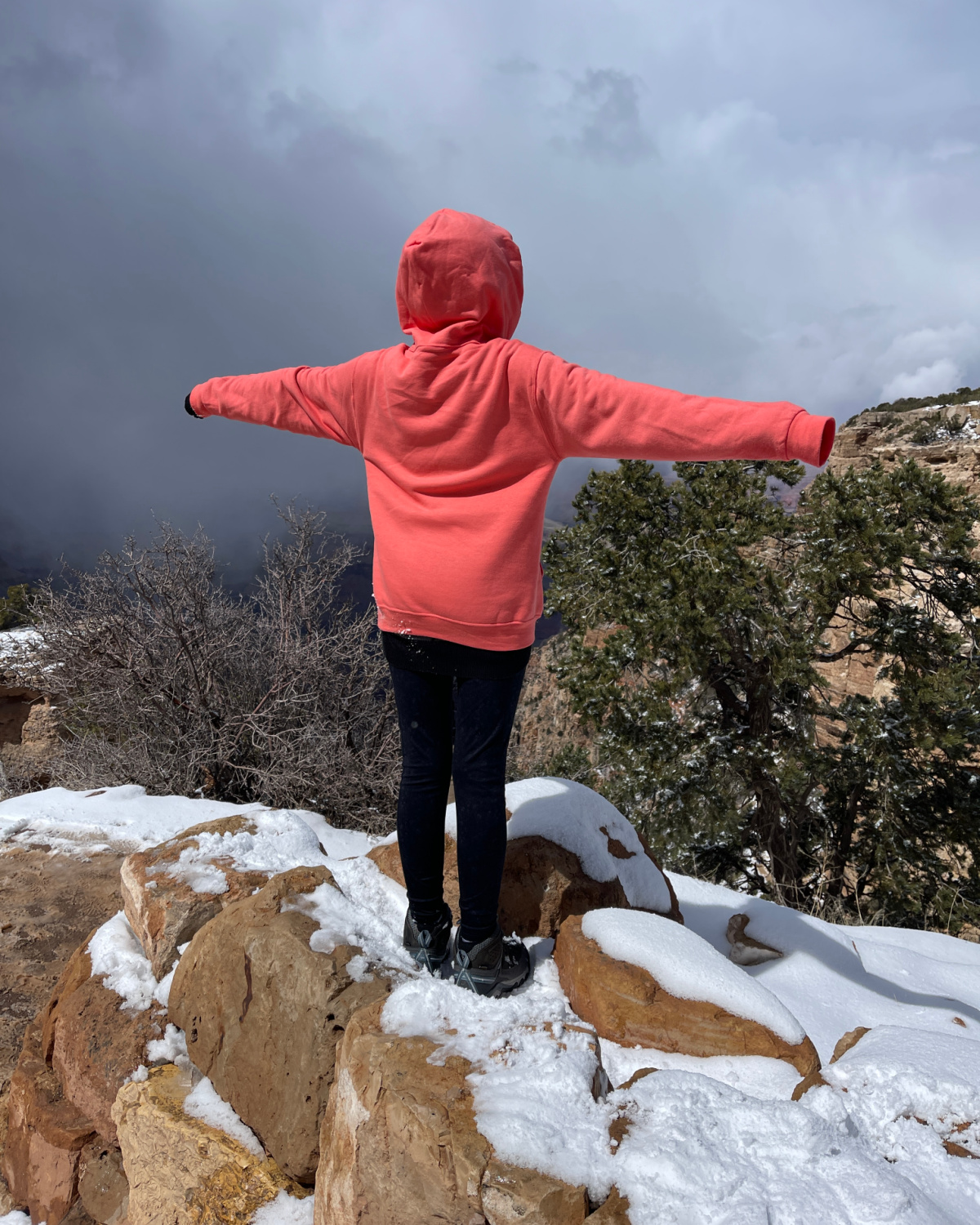
And from my daughter’s perspective, the day was perfectly wonderful because there was snow to play in.
There were snowballs.
There were snowy trees.
There was a Grand Canyon covered in winter weather.
It was certainly not the experience we had imagined when we planned our Arizona spring break trip.
But how many people get to say they had a snowball fight at the Grand Canyon?
That is the thing about traveling during the shoulder season.
Sometimes the weather takes away the experience you thought you were going to have.
But sometimes it gives you a completely different one.
And if you’re willing to be flexible, that different experience can still be pretty fantastic.
How the Snowstorm Changed Our Grand Canyon Plans
This is probably the biggest lesson from our March visit.
The snow did not ruin our trip.
But it absolutely changed it.
And if you’re planning a Grand Canyon spring break trip, I think that is the mindset to have from the beginning.
You can make an itinerary.
You can have reservations.
You can know exactly which overlooks you want to see and which hikes you want to do.
But if the weather turns, the Grand Canyon may rewrite your plans for you.
That is exactly what happened to us.
We Still Took the Shuttle to Hermits Rest
One thing we decided pretty quickly was that we were still going to explore.
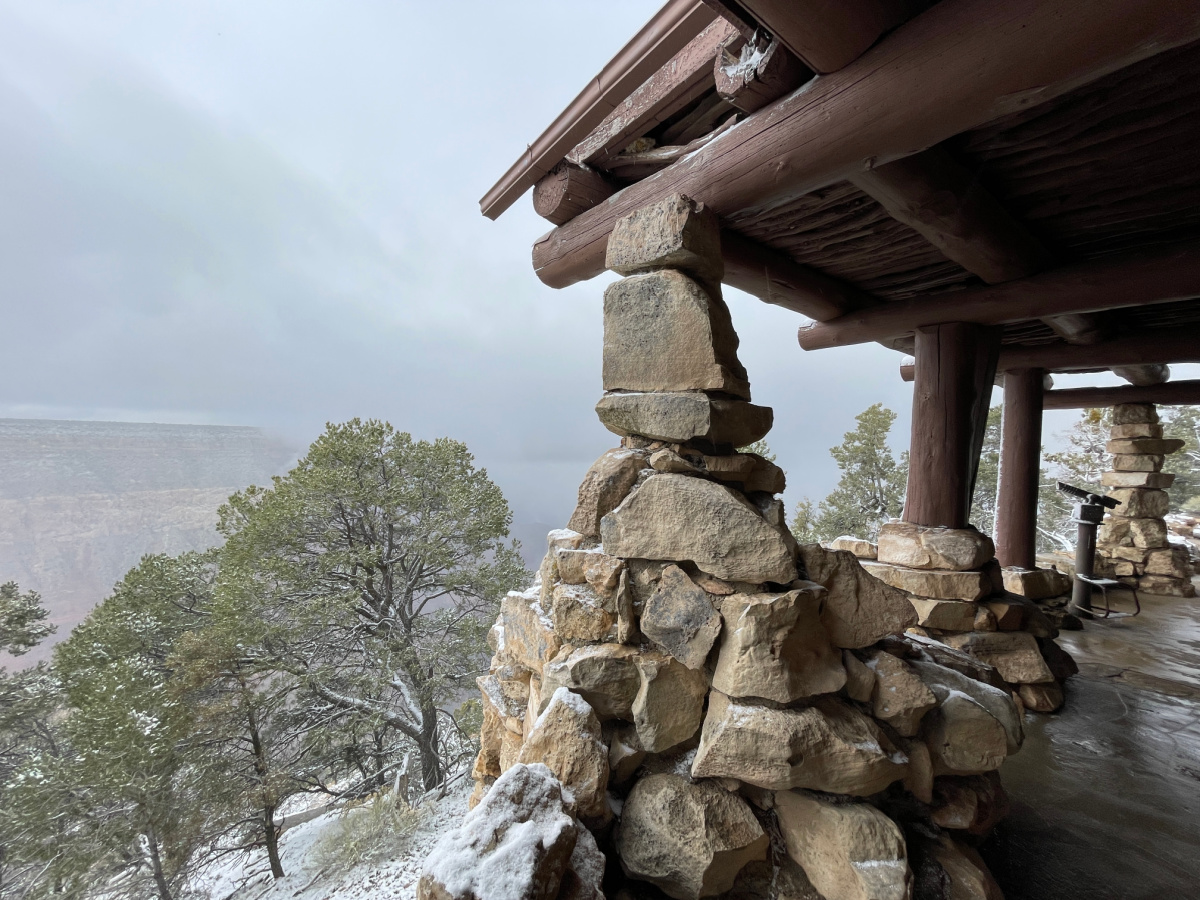
So even though it was snowing and visibility was not great, we took the shuttle along Hermit Road toward Hermits Rest.
Under clear conditions, this is one of the best areas of the South Rim for stopping at viewpoints and seeing the canyon from different angles.
During our visit, though, a lot of those views were hidden by clouds and snow.
At times, you could barely see the canyon at all.
Was that disappointing?
Of course.
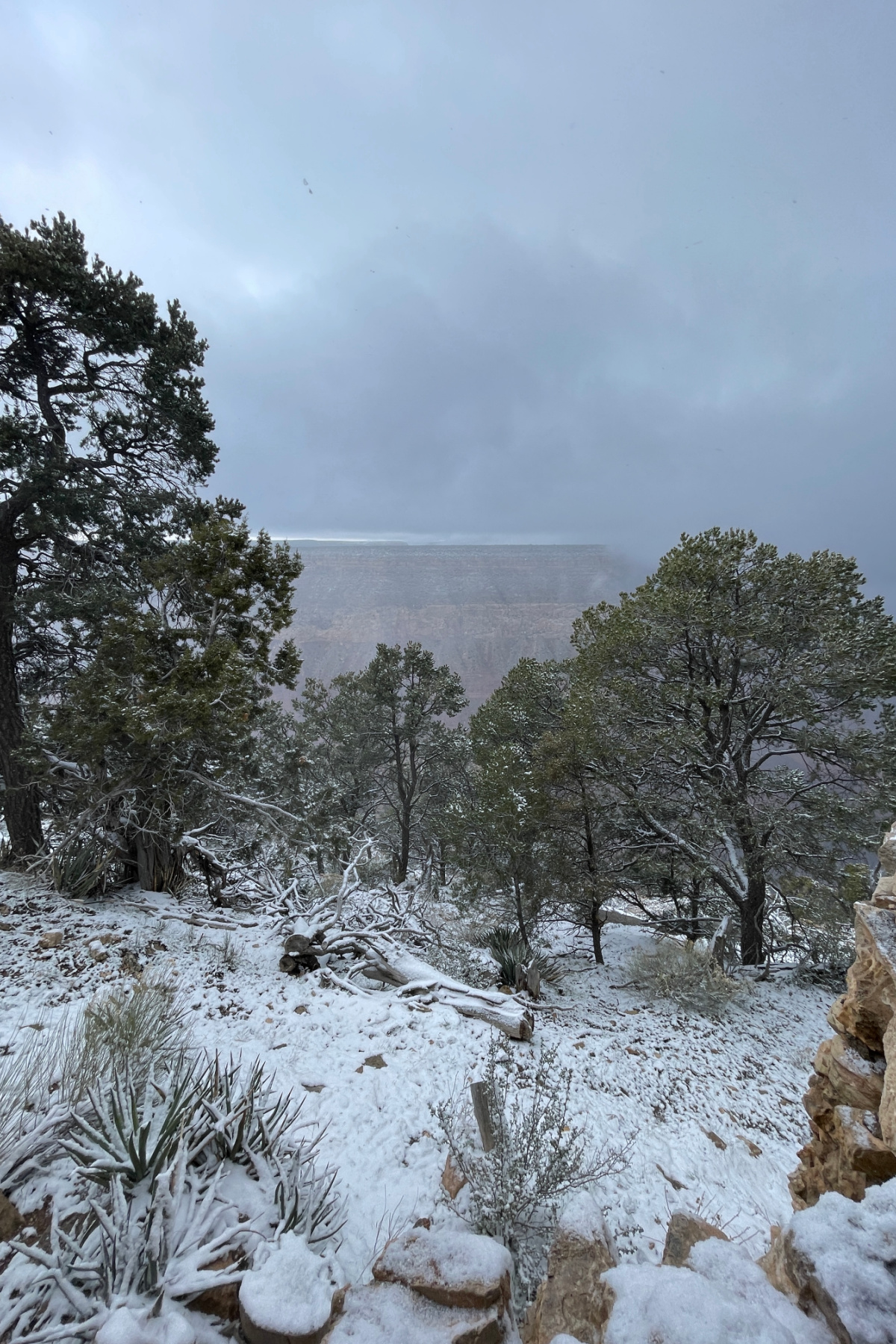
You do not travel all the way to the Grand Canyon hoping to look out over a giant wall of clouds.
But it was also strangely atmospheric.
The snow-covered trees were beautiful, the crowds were incredibly light, and the whole area had a very different feel than I imagine it does during peak summer.
By the time we made it out to Hermits Rest, we were freezing.
Thankfully, hot cocoa exists.
So we warmed up, enjoyed the experience for what it was, and accepted that the canyon views were not going to cooperate that day.
And honestly, that became a theme for the entire trip.
Sometimes you just have to stop trying to force the experience you expected and enjoy the one you actually got.
Yavapai Point Was Almost a Whiteout
We also spent time around Yavapai Point and the Geology Museum area.
This should have been one of those classic Grand Canyon moments where you stand inside and look out through the windows at a huge panoramic view.
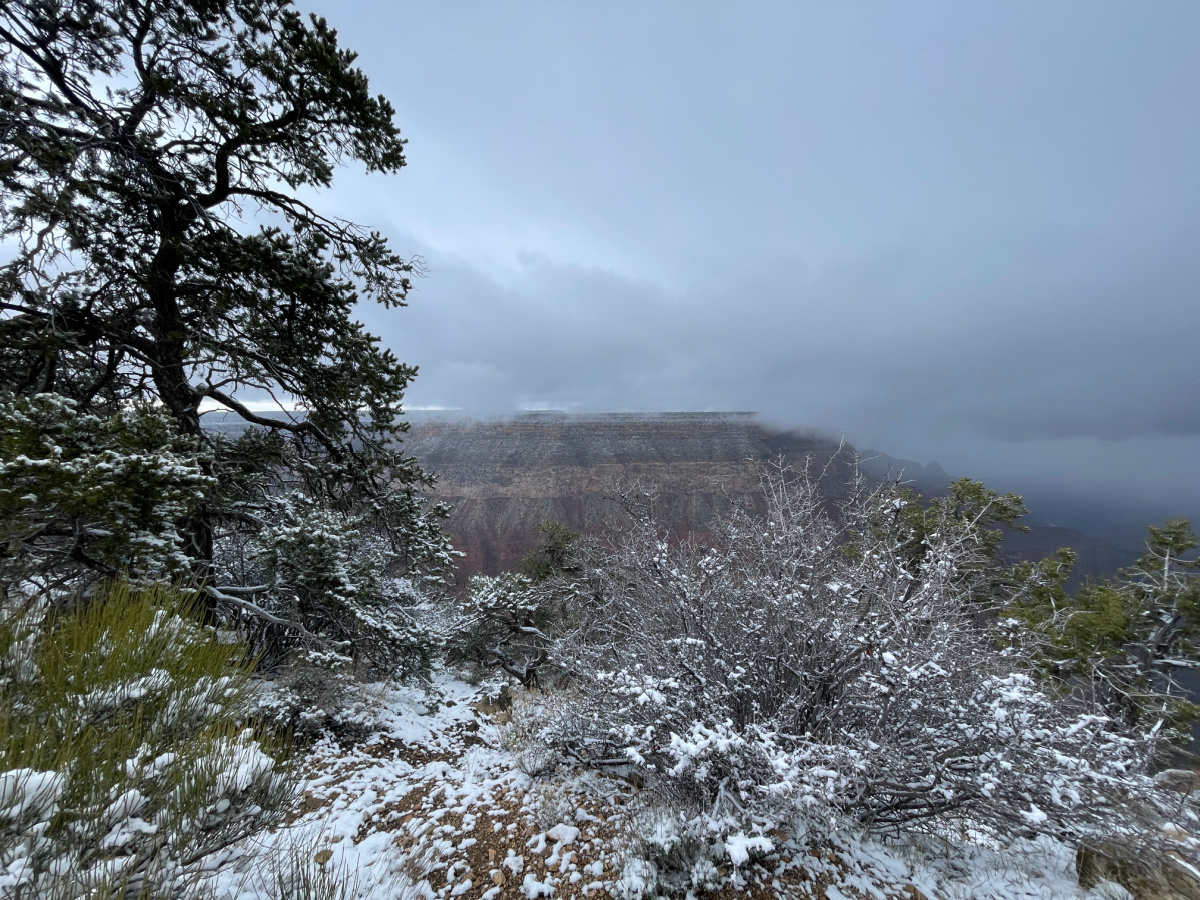
Instead, when we first arrived, there was barely anything to see.
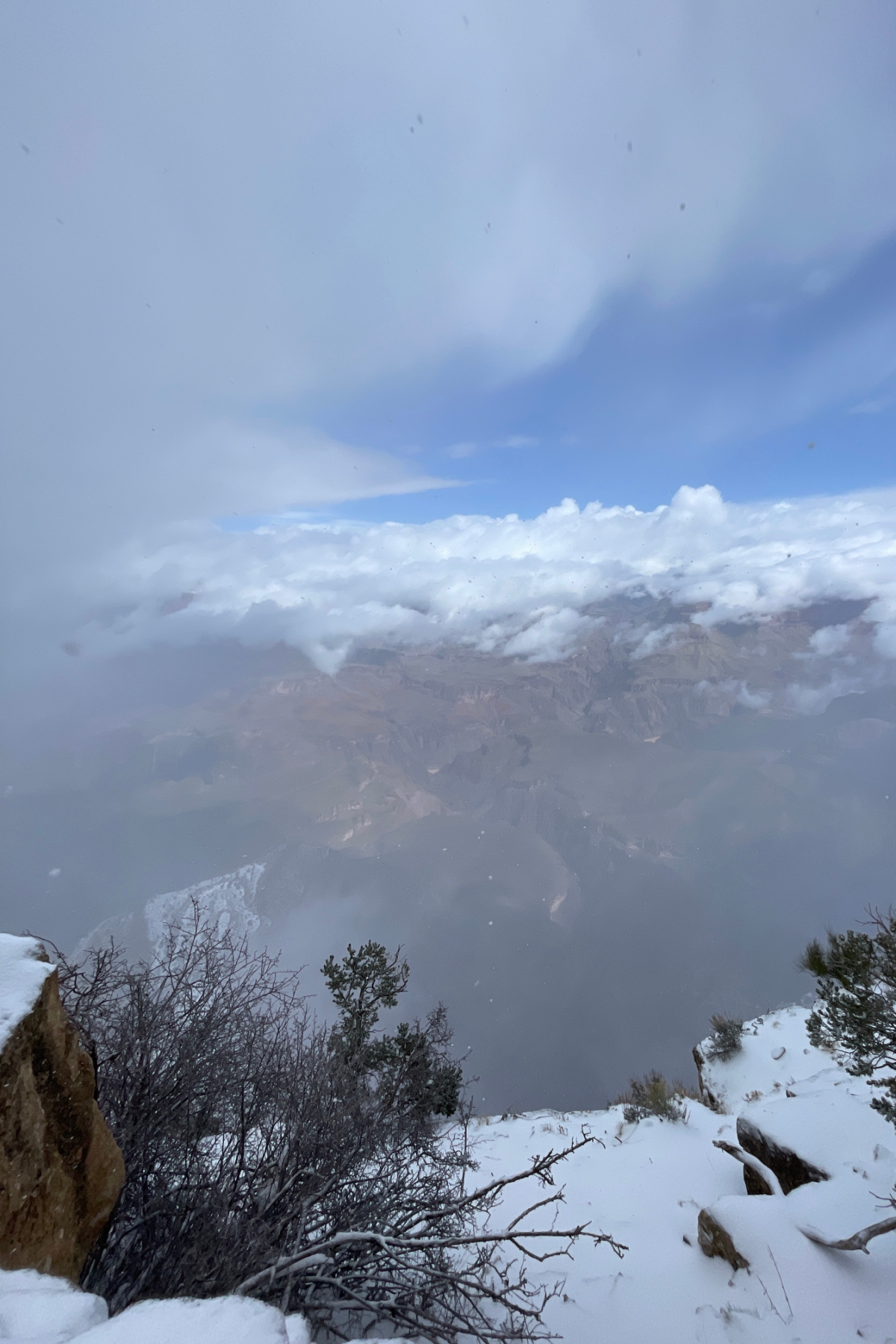
The clouds were so thick that much of the canyon had disappeared.
It was almost funny.
Here we were standing at one of the most famous landscapes in the country, and the landscape had basically vanished.
But the weather kept shifting.
That was one of the most interesting parts of the day.
The canyon would disappear behind clouds.
Then a section would suddenly open up.
Then the clouds would move again.
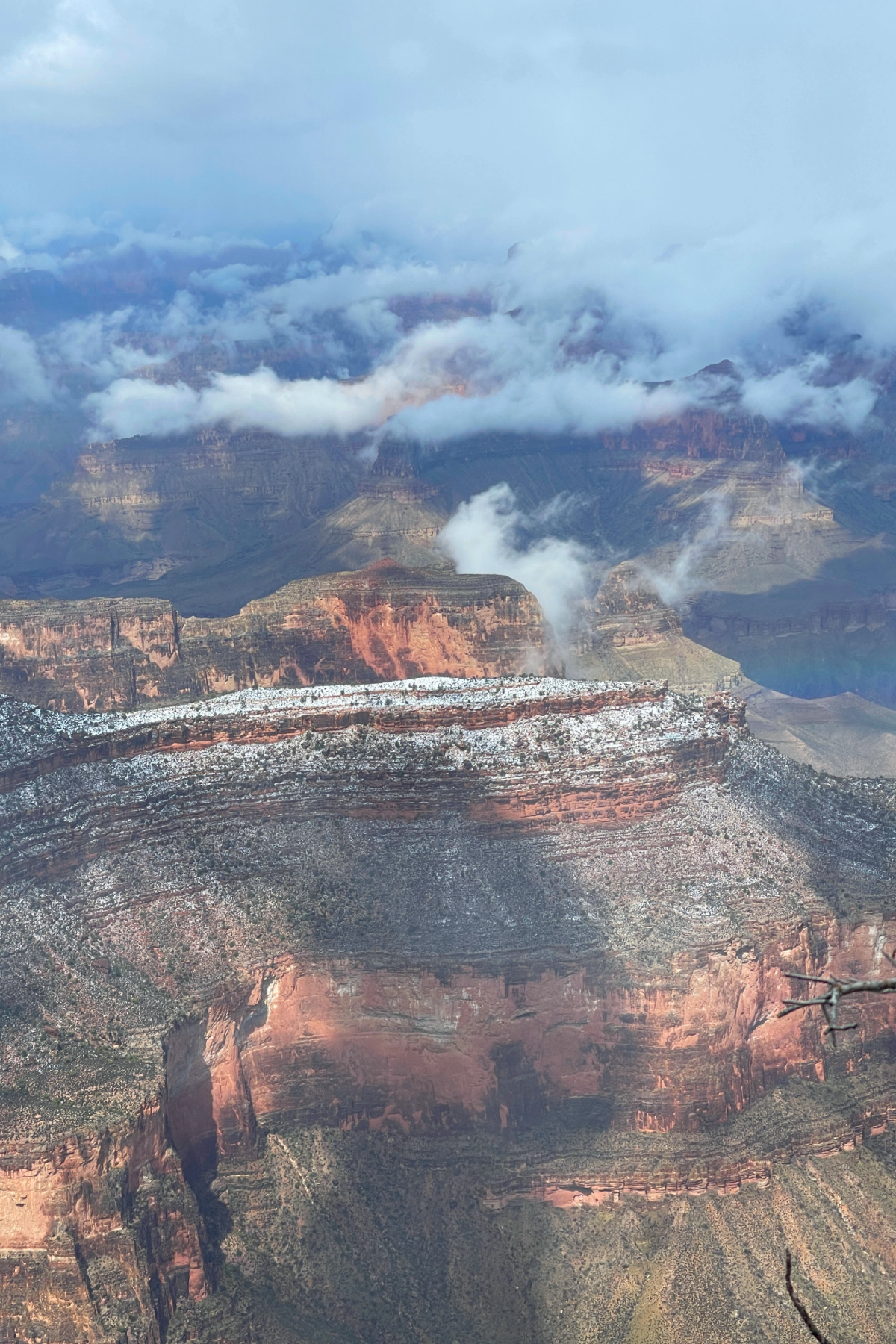
So even though we never got the perfect, uninterrupted view we had hoped for, we got to watch the canyon change minute by minute.
It was beautiful in a completely different way.
We Started Down the South Kaibab Trail — But Turned Around
One of the activities I was most looking forward to was hiking part of the South Kaibab Trail.
Our goal was Ooh Aah Point.
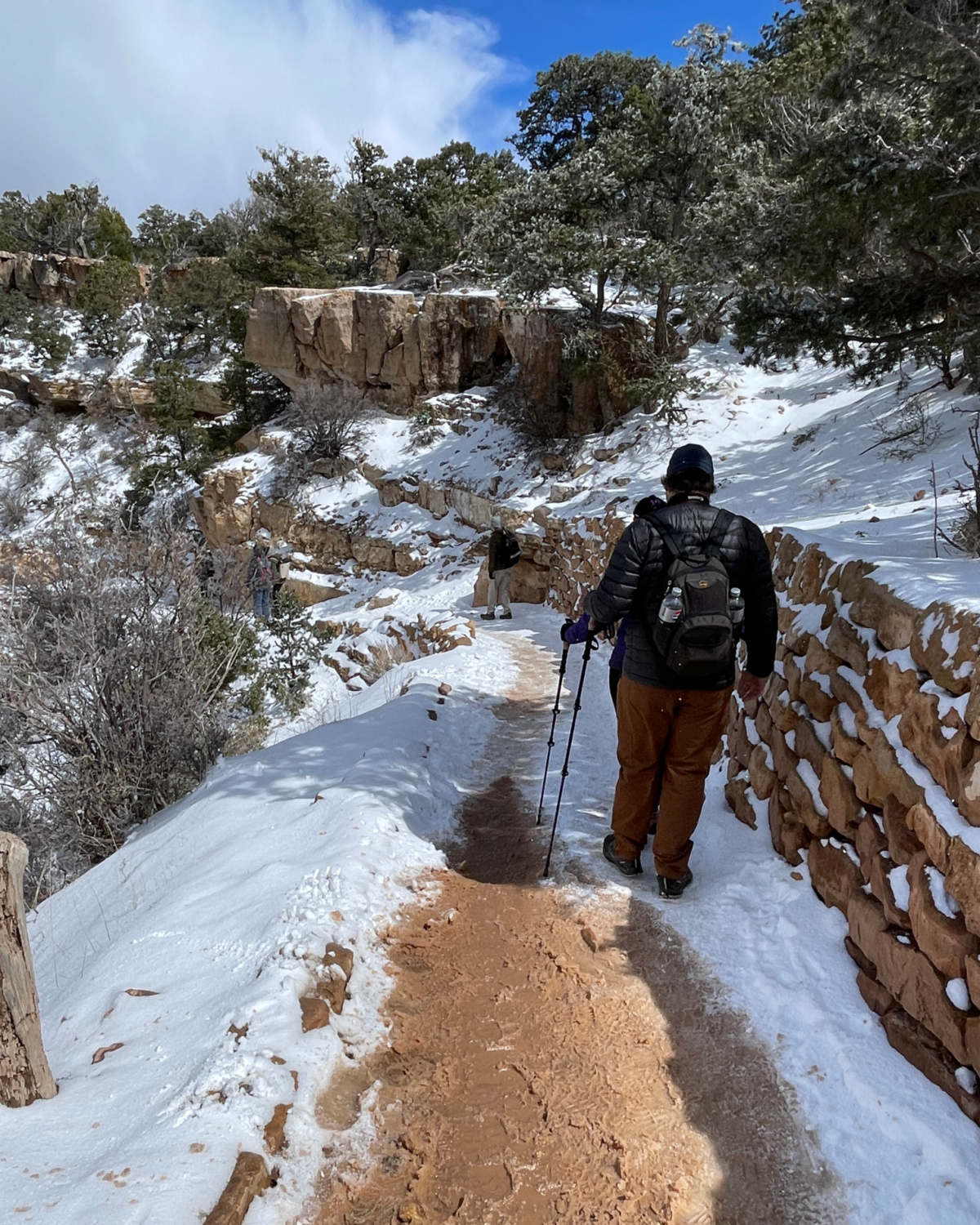
This is one of the most popular shorter hikes below the rim because you can get a very different perspective of the canyon without committing to a massive all-day hike.
We started down the trail.
And then we quickly realized that the conditions were much slicker than we were comfortable with.
There was snow and ice on the trail, and we did not have hiking poles.
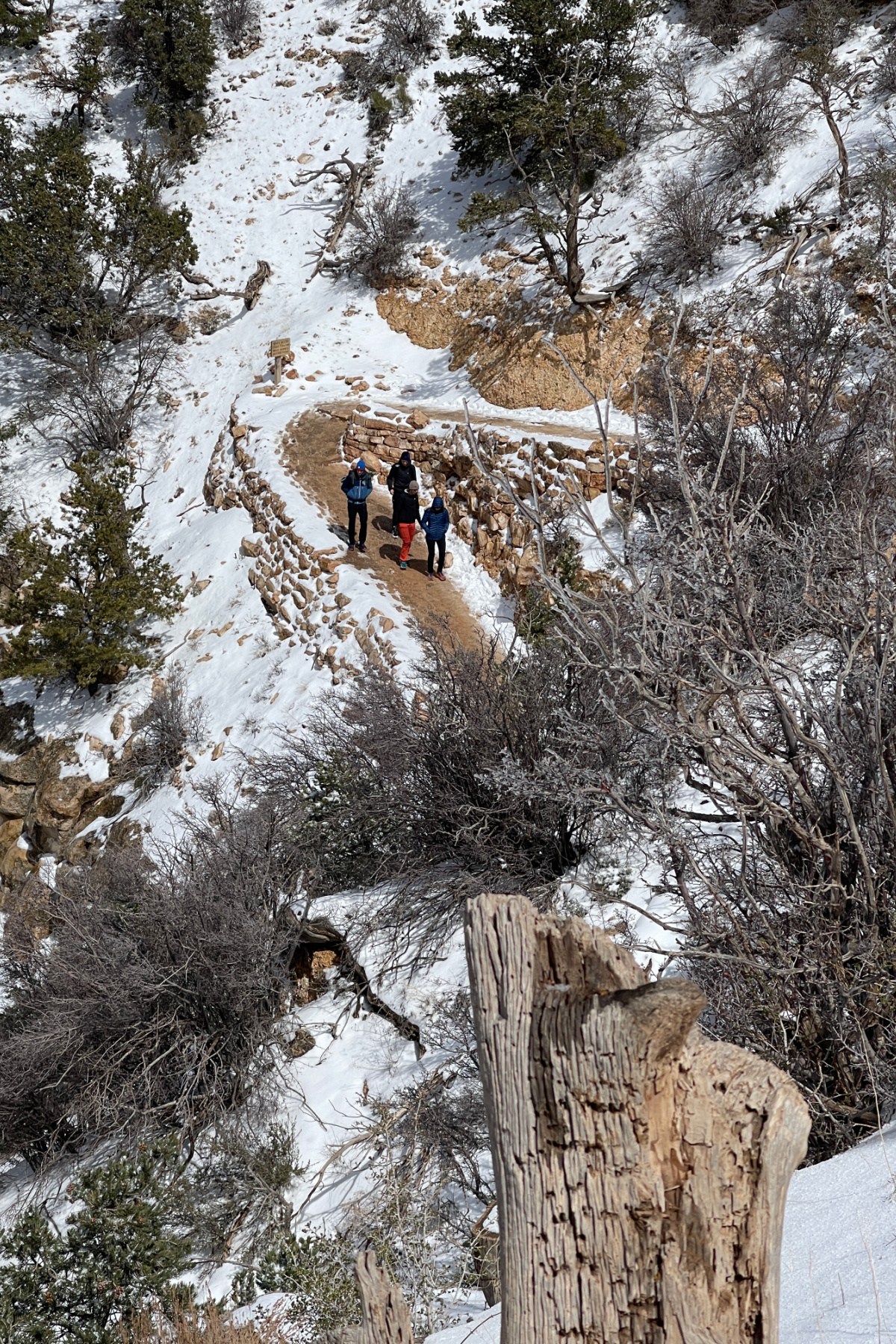
Could we have pushed farther?
Maybe.
But this is not the kind of place where I think it is smart to prove a point.
The trail was slippery, and we decided that getting a little bit of the experience was enough.
So we walked down partway, took in the views we could get, and then turned around.
I was disappointed that we did not make it all the way to Ooh Aah Point.
I still am, a little bit.
But I do not regret turning around.
The canyon will still be there another time.
And one of the most important rules of national park travel is knowing when the conditions are telling you to change your plans.
Our Helicopter Tour Was Canceled
The snowstorm also wiped out one of our biggest splurges.
We had reservations for a Grand Canyon helicopter tour.
I was incredibly excited about it.
And then the weather moved in.
There was absolutely no chance that helicopter was flying.
So the tour was canceled and we were refunded.
That was definitely a bummer.
A helicopter tour over the Grand Canyon had been one of the major experiences we had planned for this trip.
But there really was nothing to debate.
The weather was terrible for flying.
And this is another reason I think spring break travelers need to build flexibility into their expectations.
You can book the experience.
You can plan around it.
You can be excited about it for months.
And then Mother Nature can veto the entire thing.
That does not mean you should not book weather-dependent activities.
It just means you should understand that they may not happen.
The Biggest Disruption Came on Our Departure Day
The snowstorm did not just affect what we could do inside Grand Canyon National Park.
It also changed the next part of our road trip.
Our original plan was to leave the South Rim on March 25 and drive east along Desert View Drive.
We would stop at viewpoints along the way, see Desert View, and then continue toward Page.
It was a really logical itinerary.
We were already headed in that direction.
And we had reservations in Page for an Antelope Canyon tour later that day.
Except Desert View Drive was closed.
Because of the snow and ice, we could not drive east out of the park the way we had planned.
Instead, we had to backtrack south toward Flagstaff and then drive the long way around.
That added a significant amount of time to our day.
Enough time that we could no longer make our Upper Antelope Canyon reservation.
So we had to cancel it.
And that was probably the moment when the snowstorm had the biggest domino effect on our trip.
It was not just that one road was closed.
It changed the route.
That changed the drive time.
That changed what we could do in Page.
One weather event affected an entire day of the itinerary.
And Then We Ended Up at Meteor Crater
This is also where travel flexibility can sometimes reward you.
Because once we knew we were going south toward Flagstaff anyway, we started looking at what else we could do.
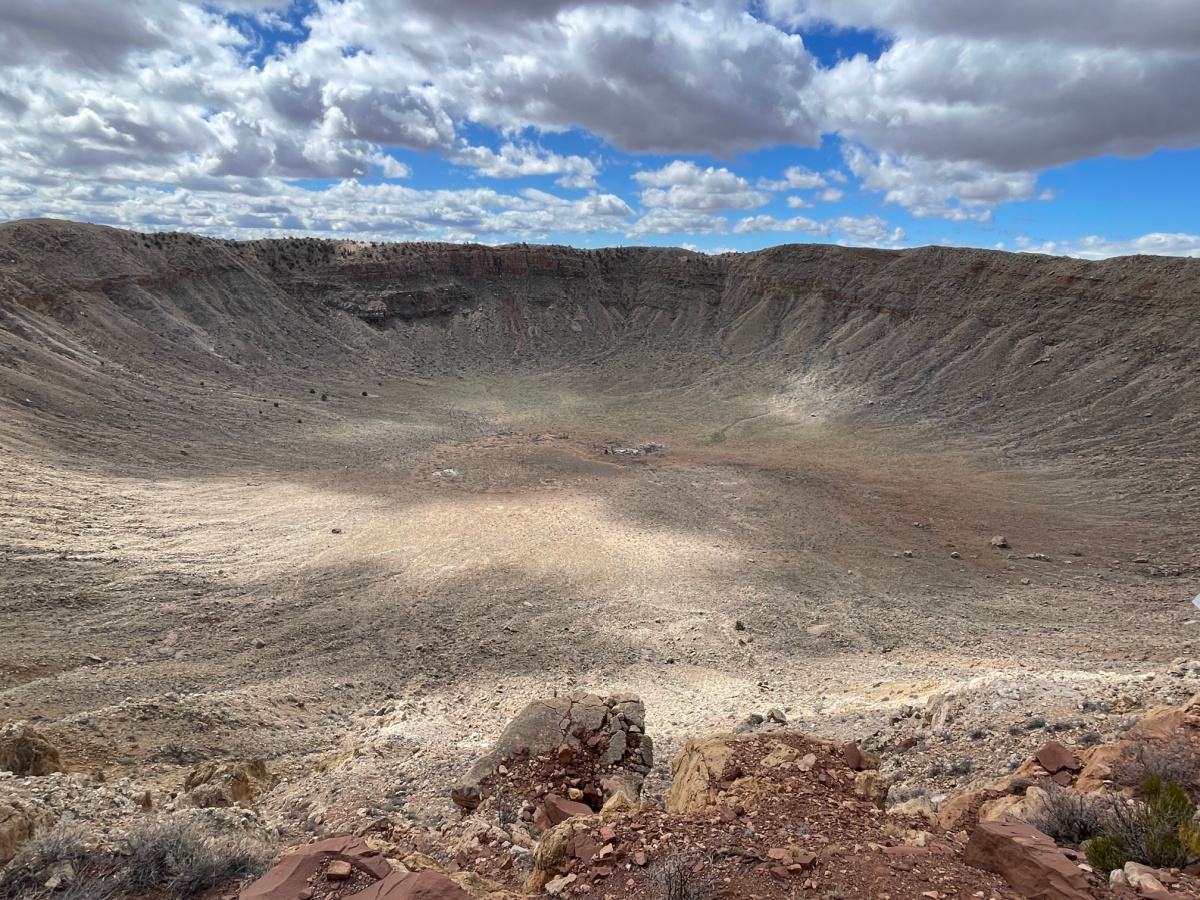
And that is how we ended up at Meteor Crater.
It had not been part of the original plan.
I am not sure we would have had time for it otherwise.
But because our route changed, suddenly it made sense.
And it ended up being really fun.
So yes, we missed Upper Antelope Canyon.
I absolutely would have liked to see it.
But instead, we got an entirely different experience that we probably would have skipped.
That is one of my favorite things about road trips.
Sometimes the side quest becomes part of the story.
Build Extra Flexibility Into a March Grand Canyon Itinerary
This is the piece of advice I would give anyone visiting the Grand Canyon during spring break.
Do not make your itinerary too fragile.
That is especially true if you are traveling in March.
If possible, avoid scheduling an expensive, tightly timed activity several hours away immediately after leaving the Grand Canyon.
You may have no problems at all.
The weather might be perfect.
The roads might be clear.
Everything might run exactly on time.
But if snow moves in and roads close, you may need to completely change your route.
And if your entire day depends on arriving somewhere at a very specific time, that can become stressful very quickly.
If you can, give yourself room.
Leave earlier.
Build in buffer time.
Know which reservations are refundable.
Have a backup activity in mind.
And accept that your Plan B might end up being just as memorable as Plan A.
The Weather Did Not Ruin Our Trip
This is probably the most important thing I want to emphasize.
We lost a helicopter tour.
We did not make it to Ooh Aah Point.
We barely saw the canyon from some of the overlooks.
We missed Desert View completely.
We had to cancel our Upper Antelope Canyon tour.
That sounds like a pretty long list of disappointments.
And yet I would not describe the trip as a failure.
Not even close.
We still saw the Grand Canyon.
We still watched the sunset.
We still saw the canyon appear and disappear through snow clouds.
We still rode the shuttle to Hermits Rest.
We still walked part of the South Kaibab Trail.
We still played in the snow.
We still had dinner at El Tovar.
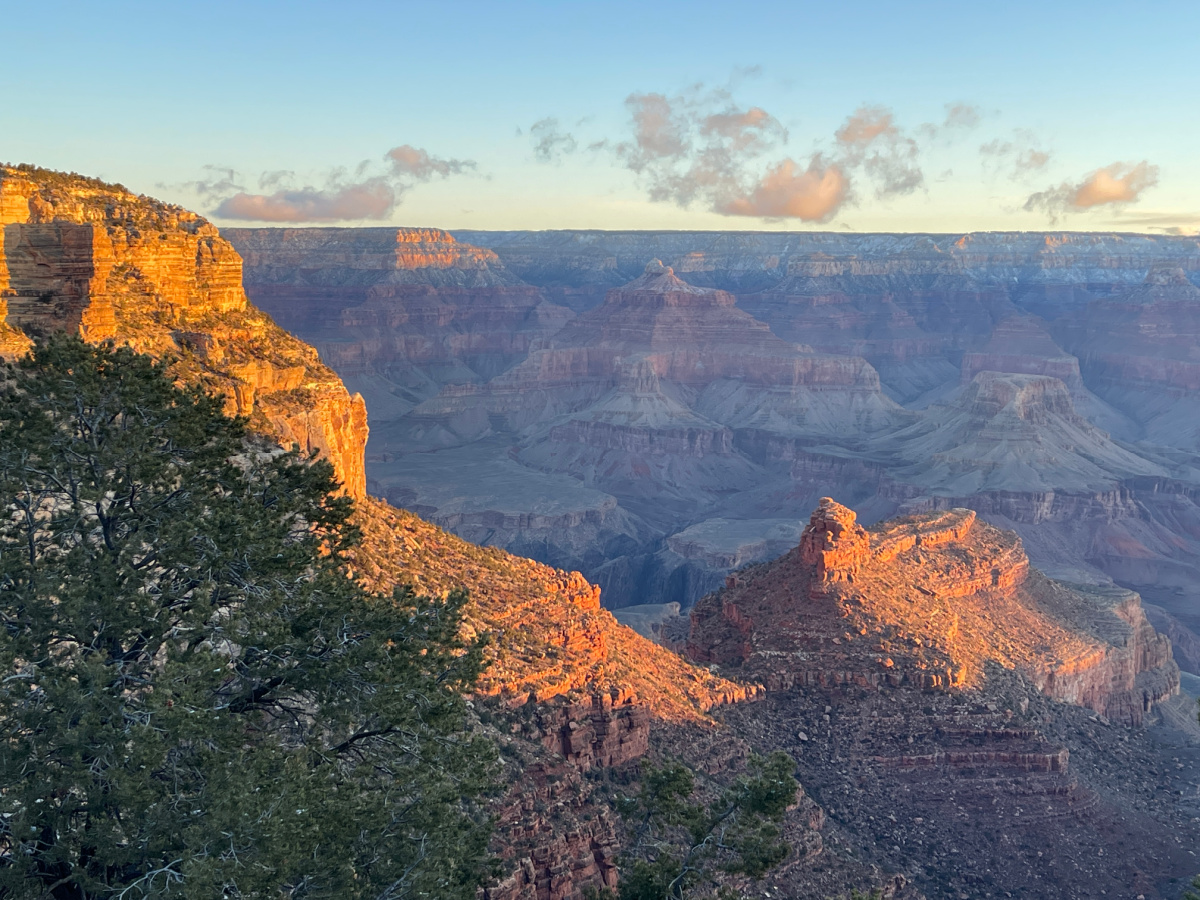
And then, the morning after the storm, we woke up to one of the most beautiful days imaginable.
Not a cloud in the sky.
The canyon was completely visible again.
It felt almost impossible that the day before we could barely see anything.
And honestly, getting to experience both versions of the Grand Canyon made the whole trip more memorable.
Would I have liked perfect weather for all three days?
Sure.
But I also think there was something pretty special about seeing just how dramatic and unpredictable this landscape can be.
There Are Some Real Advantages to Visiting the Grand Canyon in March
After everything I just said about snowstorms, road closures, canceled tours, and icy trails, you might be wondering why I would still recommend visiting the Grand Canyon in March.
Because there were some pretty significant advantages too.
The biggest one for us was the crowds.
Now, I want to be careful here because spring break can absolutely be busy at the Grand Canyon.
But during our visit, it felt dramatically less crowded than I expected.
Part of that was almost certainly because there was snow in the forecast.
When we pulled into the Grand Canyon Visitor Center area during the storm, there were hardly any cars in the parking lot.
Mather Point and the surrounding areas felt almost deserted.
That is not something I would ever expect to experience during the middle of summer.
So while I would not count on having the Grand Canyon to yourself in March, you may find that crowds are lighter than they would be during peak summer travel.
And if bad weather moves in?
Well, apparently a lot of people decide to stay inside.
Lodging and Dining Can Be Easier Too
March can also give you a little more breathing room when it comes to reservations.
We were not able to get a room at El Tovar, which had been my first choice.
But we did get a room at Maswik Lodge, and I was very happy with it.
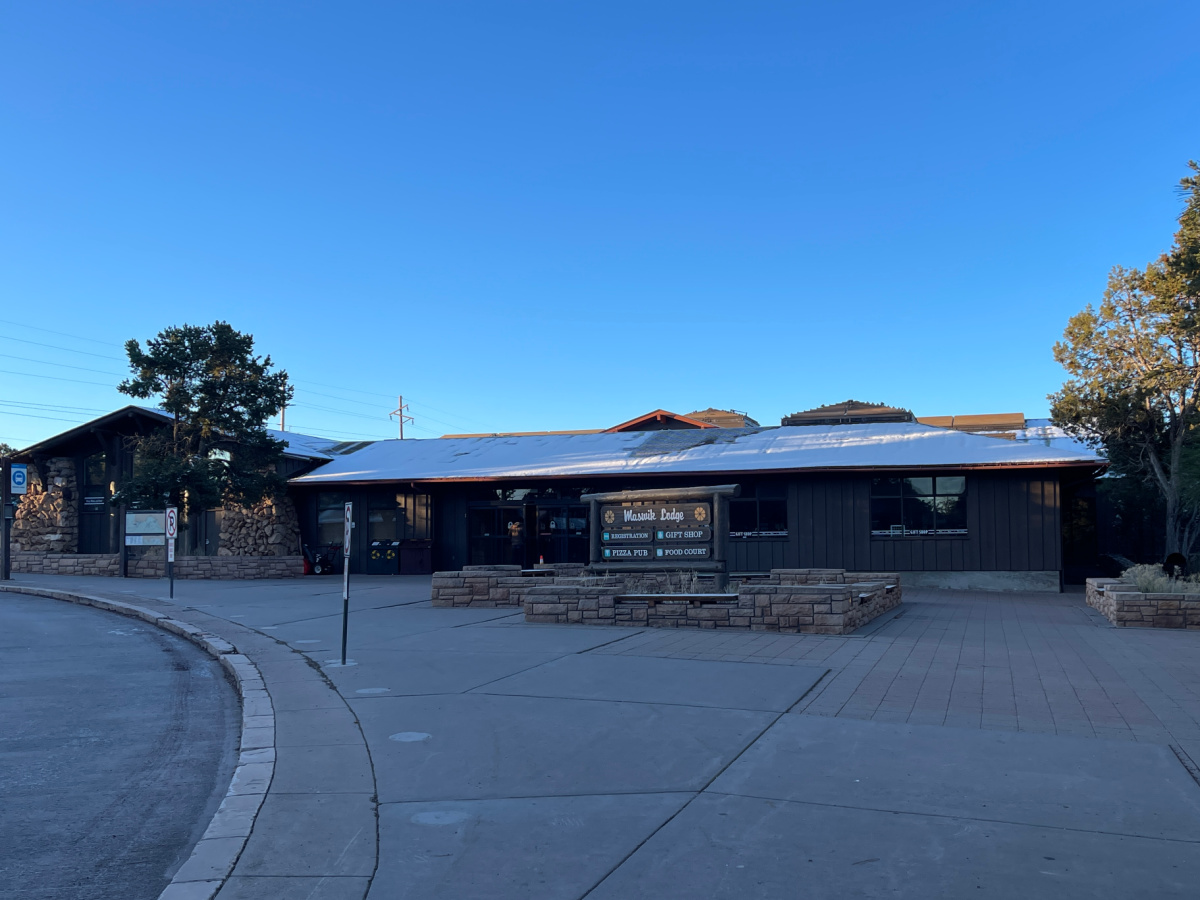
Maswik was comfortable, convenient, and close enough to the rim that we could easily walk over to the historic village area.
We were also able to get dinner reservations at the El Tovar Dining Room.
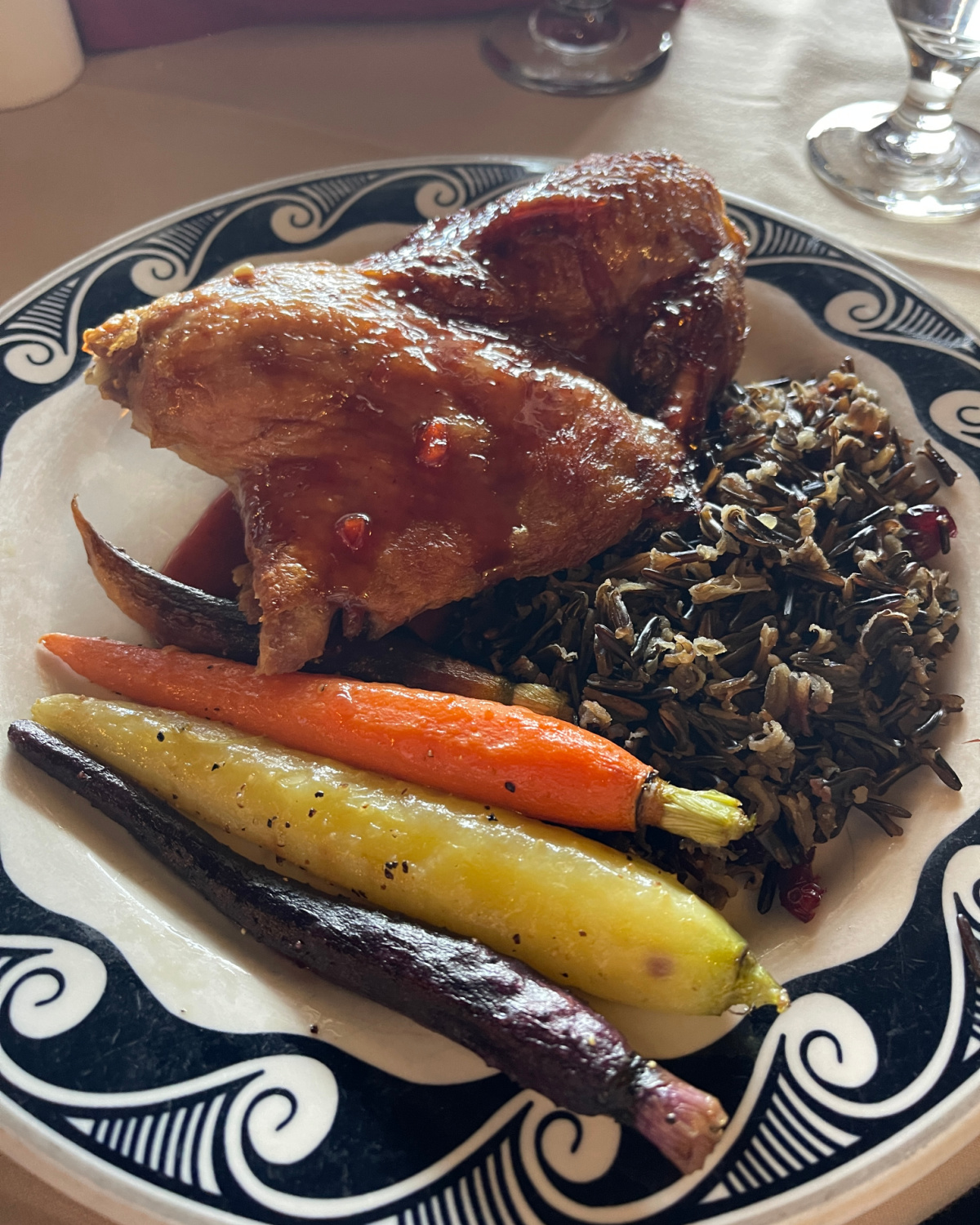
That was something I really wanted to do, and it ended up being one of the highlights of our first evening.
I would still make lodging and dining reservations as early as possible.
But visiting outside the busiest summer season can give you more options than you might have during peak travel months.
Sunrise Is Much More Reasonable in March
This is a small thing.
But honestly?
It is not that small when you are actually on vacation.
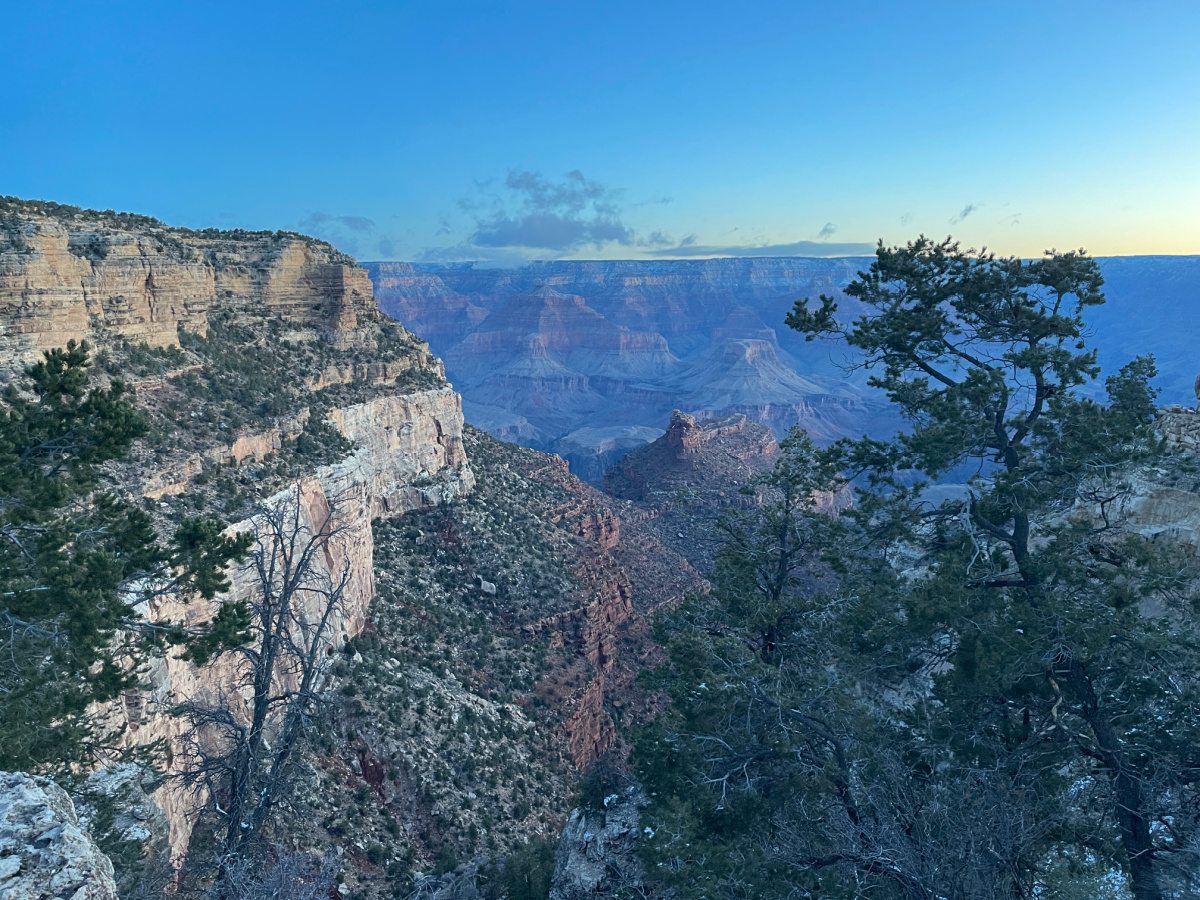
One of the most amazing experiences at the Grand Canyon is watching the sunrise.
And visiting in March means you can experience it without waking up at an absolutely ridiculous hour.
In summer, sunrise can be very early.
That can mean setting an alarm while it still feels like the middle of the night, getting everyone dressed, and heading out before anyone is fully awake.
In March, sunrise is much more manageable.
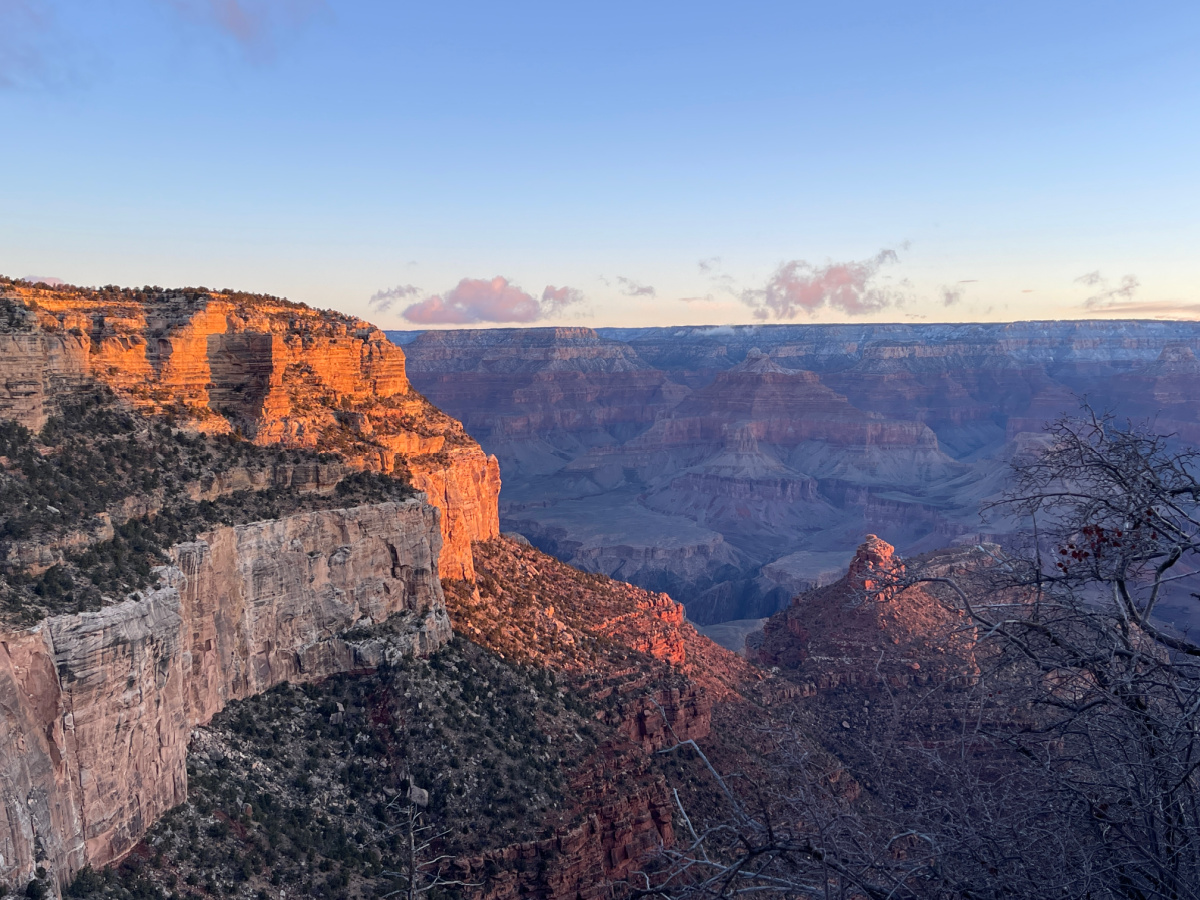
You can wake up at a fairly normal vacation hour, bundle up, head toward the rim, and still catch the whole experience.
That was a huge bonus for us.
The same thing goes for sunset.
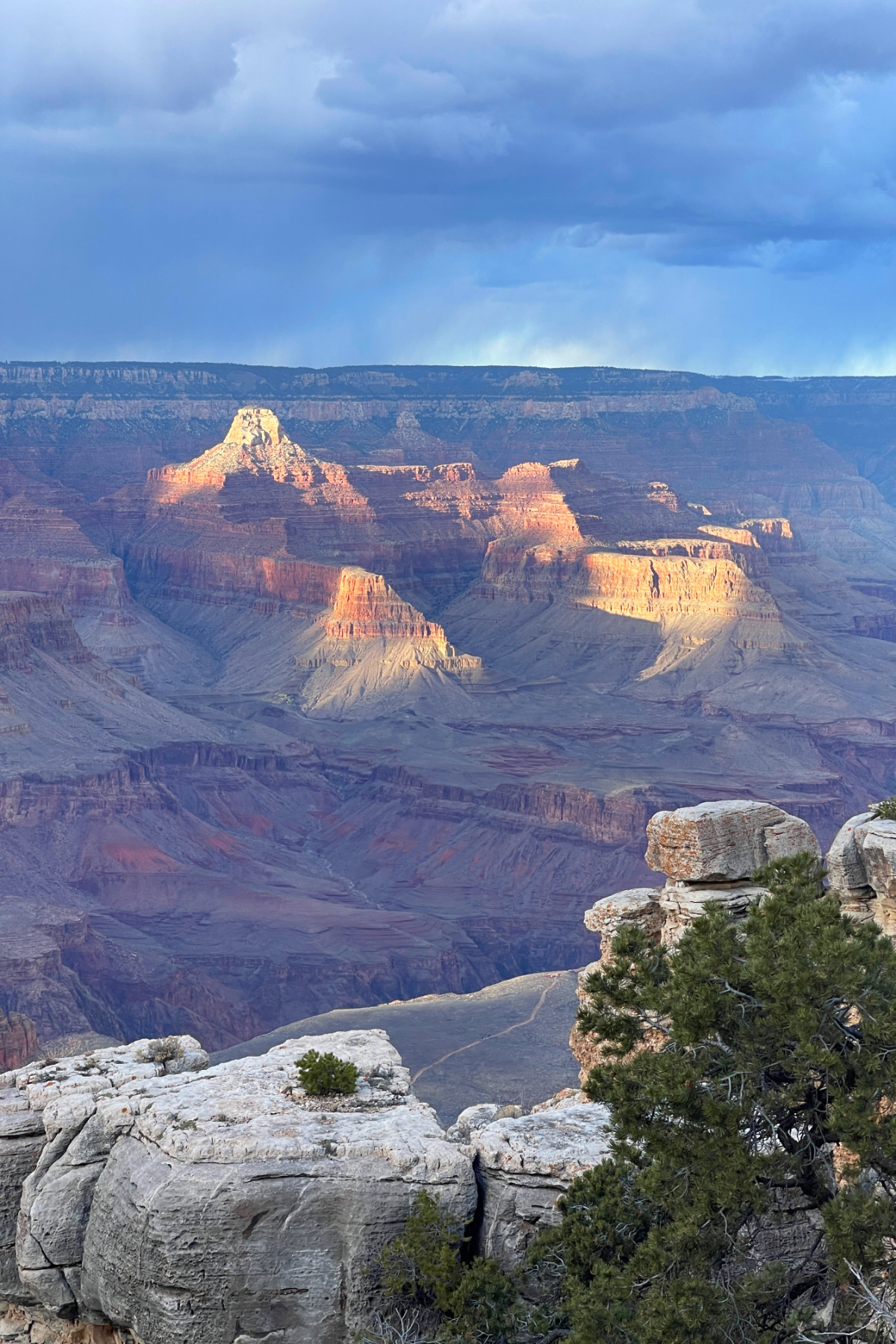
Because the days are shorter, you can enjoy sunset in the early evening instead of waiting until very late.
For families especially, that can make a huge difference.
You can watch the sunset, have dinner, and still get back to your room at a reasonable hour.
What to Pack for the Grand Canyon in March
Okay.
This is where I want you to learn from our mistakes.
Pack for winter.
Even if the forecast looks decent.
Even if you’re coming from Phoenix and it feels ridiculous to have gloves sitting in your suitcase.
Even if you’re thinking, “It’s Arizona. How cold can it really be?”
Very cold.
Here are the things I would absolutely bring for a March Grand Canyon trip:
- A warm jacket or heavy sweatshirt
- Layers you can easily add or remove
- Gloves
- A warm hat
- Comfortable shoes with good traction
- Waterproof shoes or boots if snow is in the forecast
- Warm socks
- Sunglasses
- Sunscreen
- A refillable water bottle
- Trekking poles if you plan to hike below the rim
And yes, you need sunscreen even when it is cold.
You are still at high elevation, and if the sun comes out after a storm, it can be surprisingly intense.
I would also keep some of your warm weather gear easily accessible in the car.
Do not bury your gloves underneath four suitcases.
Ask me how I know.
We ended up buying sweatshirts, hats, and gloves after arriving because we simply had not packed enough warm clothing.
They made great souvenirs.
But they were definitely more expensive than bringing the clothes we already owned.
If You Plan to Hike, Be Prepared for Ice
This deserves special attention.
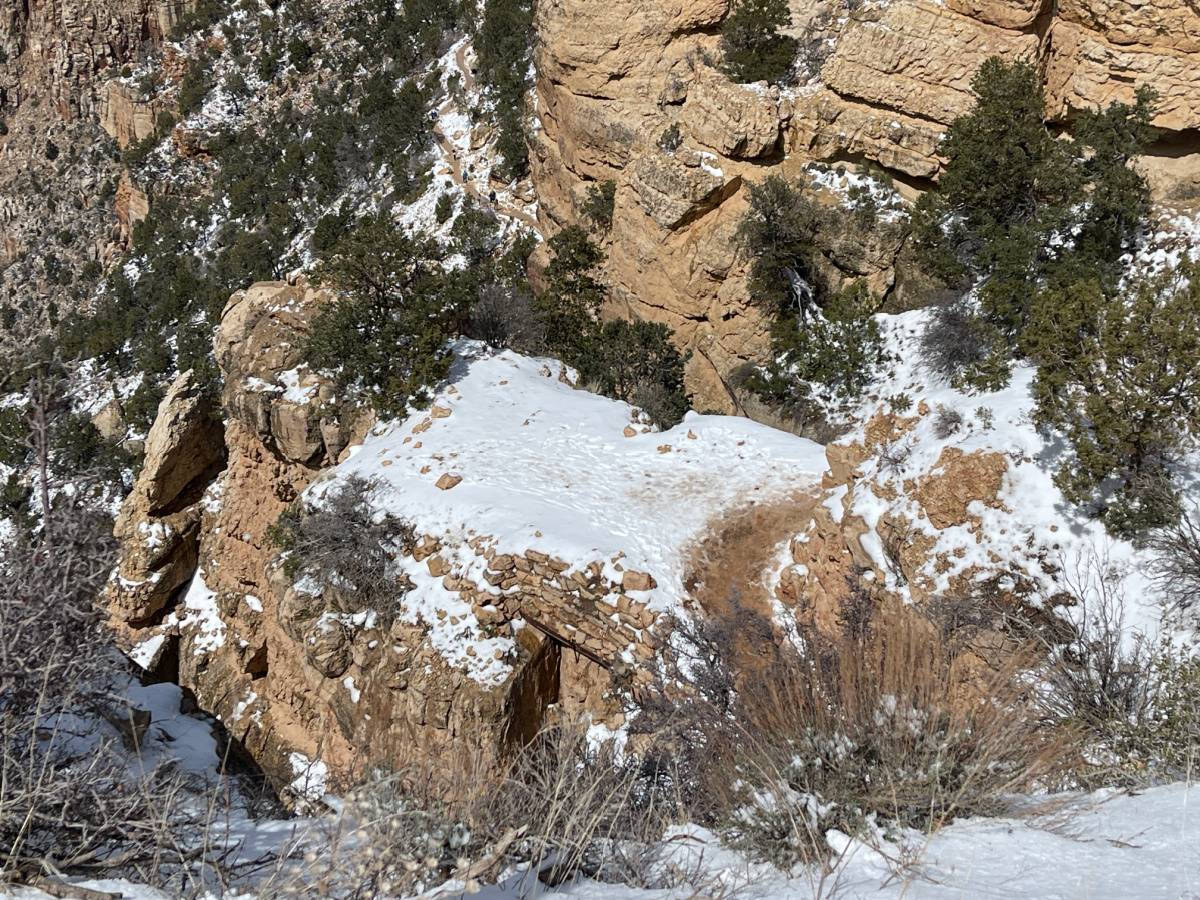
A trail that looks completely manageable in dry conditions can become much more difficult when snow and ice are involved.
That was exactly what happened to us on the South Kaibab Trail.
Our original goal was Ooh Aah Point.
But once we started down and realized how slick the trail was, we changed our minds.
We did not have hiking poles.
We were not prepared for icy trail conditions.
And there was absolutely no reason to take unnecessary risks just to say we made it to a particular viewpoint.
If you’re hiking at the Grand Canyon in March, check trail conditions before heading out.
And be willing to turn around.
There is no shame in deciding the trail is not safe for you that day.
The Grand Canyon is not going anywhere.
Check Road Conditions Every Day
This is another lesson we learned the hard way.
Do not assume that because a road was open yesterday, it will be open today.
Weather at the Grand Canyon can change quickly.
And if there is snow or ice, temporary road closures can completely change your plans.
That is especially important if you’re leaving the Grand Canyon and driving somewhere else.
We had planned to drive east along Desert View Drive toward Page.
When the road closed, we had to backtrack south and reroute.
That added hours to our drive.
If we had known earlier that morning exactly how much the closure would affect our route, we might have adjusted some of our plans sooner.
So during a March trip, I would check current road conditions every morning before you head out.
And if snow is coming, keep checking.
Have a Plan B
Actually, have several.
This may be the biggest secret to enjoying a shoulder-season national park trip.
You need to be flexible.
Maybe your helicopter tour gets canceled.
Maybe a road closes.
Maybe a trail is icy.
Maybe you show up at an overlook and cannot see anything.
That does not mean the day is ruined.
It just means you need another idea.
For us, one of those backup adventures became Meteor Crater.
It was not originally part of our itinerary at all.
But when our route changed, suddenly we had the opportunity to visit.
And it ended up being a really interesting stop.
I have found this to be true on so many road trips.
Sometimes the unexpected detour becomes one of the things you remember most.
So, Is Spring Break a Good Time to Visit the Grand Canyon?
Yes.
I really think it is.
But you need to go with realistic expectations.
March is not guaranteed sunshine.
It is not guaranteed mild temperatures.
It is not guaranteed clear roads.
And it is definitely not guaranteed that every activity you planned will happen exactly the way you imagined.
But you may get lighter crowds.
You may have an easier time finding lodging and dining reservations.
You can enjoy sunrise and sunset at much more reasonable hours.
And you might get to experience the Grand Canyon in a way that summer visitors never do.
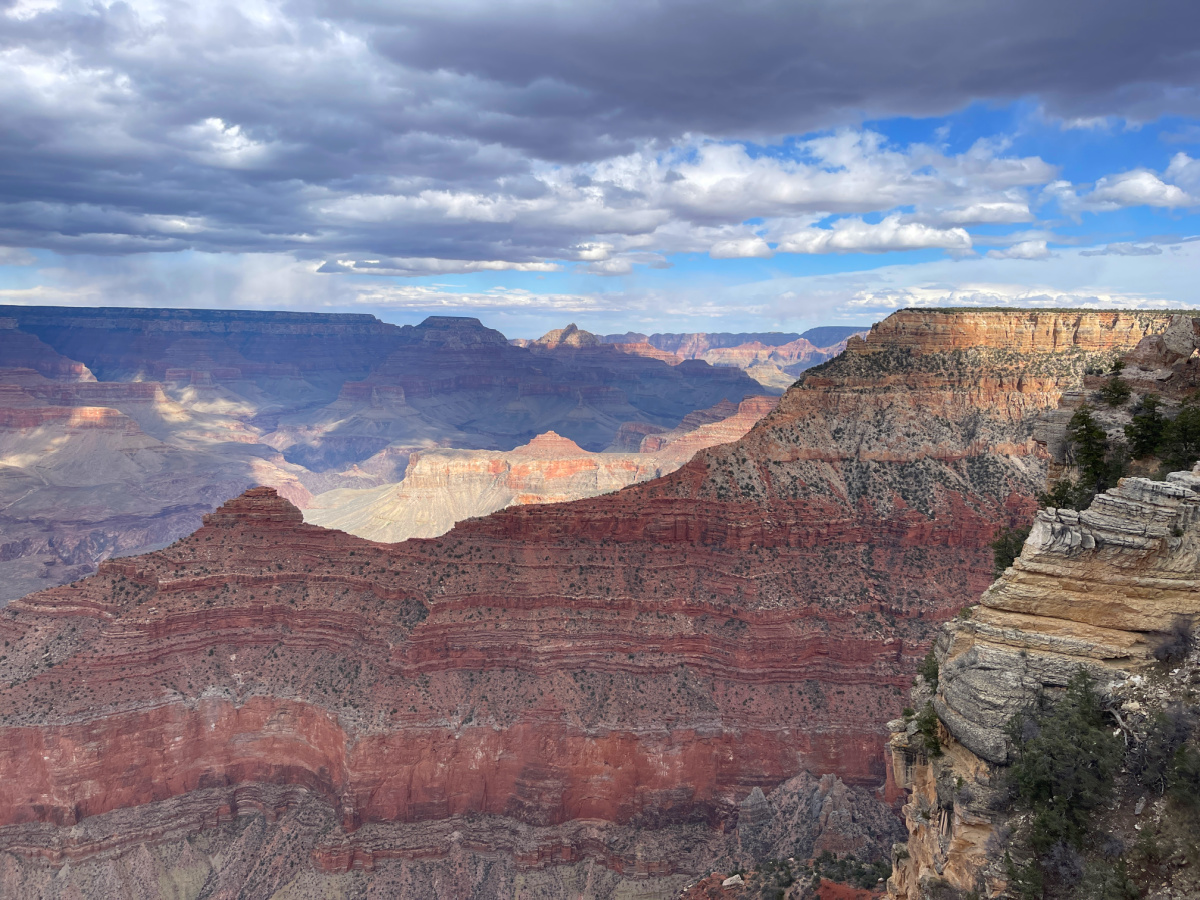
We saw the canyon beneath dramatic storm clouds.
We saw it covered in snow.
We watched sections of the canyon appear and disappear through the clouds.
We had a snowball fight.
We drank hot cocoa at Hermits Rest.
And then, the very next morning, we woke up to a completely blue sky and crystal-clear views.
That is the Grand Canyon in March.
Unpredictable.
Sometimes inconvenient.
Occasionally frustrating.
And still absolutely incredible.
Would I Visit the Grand Canyon in March Again?
Yes.
Without hesitation.
I would just pack differently.
I would bring more winter gear.
I would have hiking poles.
I would build more buffer time into the itinerary.
I would avoid scheduling a tightly timed activity several hours away immediately after leaving the park.
And I would go into the trip knowing that the weather might completely change our plans.
Because that is really the key.
Spring break can be one of the best times to visit national parks.
But spring break travel rewards flexibility.
Sometimes you get sunshine.
Sometimes you get snow.
Sometimes you get both within 48 hours.
And sometimes the trip you actually experience ends up being even more memorable than the one you planned.
More Grand Canyon Planning
If you’re planning a trip to the South Rim, these guides can help you figure out what to prioritize once you get there.
Grand Canyon South Rim Guide
Start here for the big-picture overview of visiting the South Rim, including what to see, where to stay, how to get around, and how to make the most of your time.
Best Grand Canyon Viewpoints Without Hardcore Hiking
You do not have to hike deep into the canyon to experience incredible views. This guide covers some of the best overlooks and easy-access viewpoints for travelers who want the scenery without a strenuous hike.
More National Park Spring Break Ideas
The Grand Canyon is not the only national park that can be fantastic during spring break. Depending on where you go, you may find lighter crowds, dramatic seasonal scenery, or a completely different experience than you would during summer.
Yosemite in April
April can be an amazing time to see Yosemite, especially if you want waterfalls, cooler temperatures, and a spring landscape that still feels a little wild and unpredictable.
Olympic National Park During Spring Break
Olympic is another great shoulder-season option, especially if you do not mind a little rain. Spring brings moody beaches, lush forests, and fewer crowds than you are likely to encounter in summer.
Utah’s Mighty Five National Parks for Spring Break
Zion, Bryce Canyon, Capitol Reef, Arches, and Canyonlands can all work beautifully for a spring break road trip. Just keep in mind that conditions can vary dramatically between parks because of elevation, and popular parks like Zion can still be extremely busy during school vacation weeks.