Grand Canyon Sunrise and Sunset Tips: Why Sunrise Completely Surprised Me

Affiliate Disclosure: This post may contain affiliate links. If you make a purchase or booking through these links, I may earn a commission at no additional cost to you.
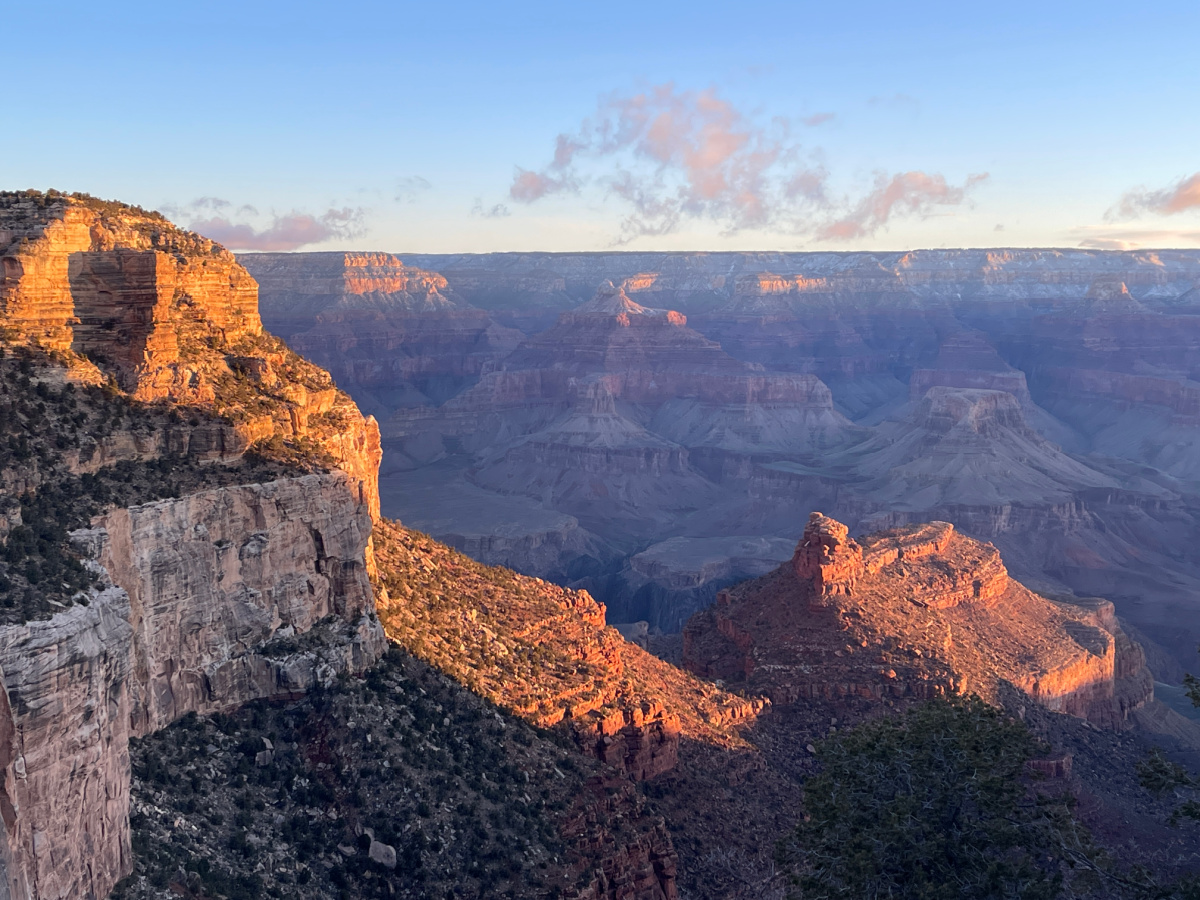
Planning sunrise or sunset at the Grand Canyon? See the best viewpoints, timing tips, shuttle advice, and what sunrise really looks like minute by minute.
Estimated reading time: 24 minutes
I knew sunrise and sunset were supposed to be beautiful at the Grand Canyon.
Of course they were. It is the Grand Canyon.
But I was not prepared for how much I would love sunrise.
We had already seen the canyon during the day, and the evening before I had watched the sunset after dinner at El Tovar before taking the shuttle out to Hopi Point for twilight. It was beautiful, especially with dramatic storm clouds moving across the canyon.
But sunrise was different.
It was quieter. More peaceful. And watching the first sunlight gradually illuminate the canyon was one of the most memorable experiences of our entire Grand Canyon trip.
Honestly, it was one of the most peaceful experiences I have ever had in a national park.
Is Sunrise at the Grand Canyon Worth It?
Yes. Absolutely.
And I say that as someone who does not naturally leap out of bed before sunrise while on vacation.
My husband and daughter had zero interest in getting up early, so they stayed asleep. Because we were staying right in Grand Canyon Village, that didn’t matter.
I rolled out of bed, threw on warm clothes and shoes, and walked to the rim by myself.
Within about five minutes, I was standing at the edge of the Grand Canyon.
No driving.
No parking.
No complicated logistics.
No convincing the rest of my family to participate.
That experience alone made me appreciate one of the biggest advantages of staying inside Grand Canyon National Park. If seeing sunrise is important to you, being able to simply walk to the rim makes the entire thing ridiculously easy.
And once I got there, I was very glad I had made the effort.
What Grand Canyon Sunrise Actually Looks Like
One thing I didn’t fully understand before experiencing sunrise at the Grand Canyon is that the magic isn’t necessarily watching the sun itself pop over the horizon.
The real show happens across the canyon.
At first everything is blue and muted. Then one cliff catches the light. A few minutes later another formation turns orange. Shadows move. Colors change. Huge sections of the canyon gradually emerge from the darkness.
And it happens surprisingly fast.
I took photos throughout the morning, so you can actually see how dramatically the canyon changed in less than half an hour.
6:13 AM — The Canyon Before Sunrise
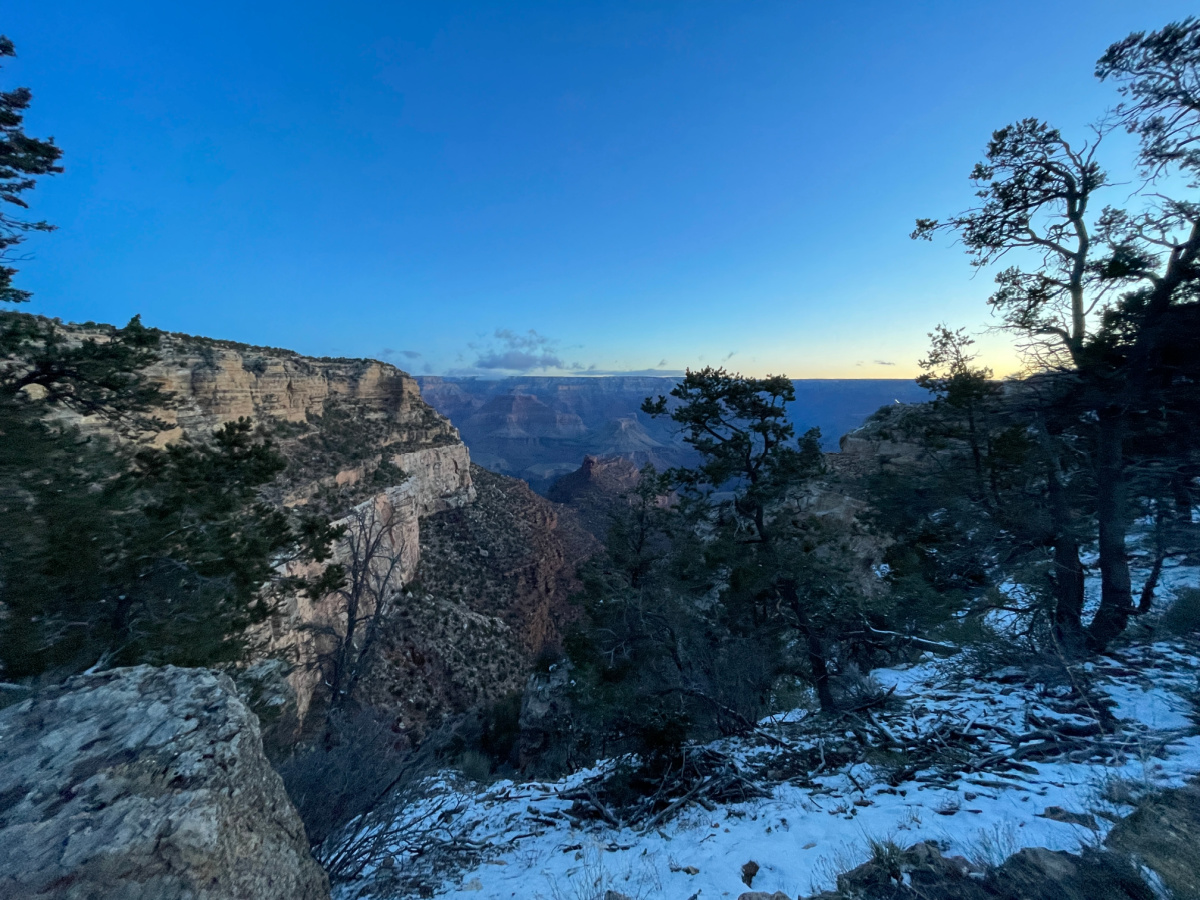
When I reached the rim, it wasn’t completely dark anymore.
This was that strange pre-dawn period when you can clearly see the landscape, but everything is still bathed in cool blue light.
The canyon looked enormous and quiet.
There was still snow on the ground from the March weather, and it was COLD. This was definitely not a morning when you wanted to wander outside in a light sweatshirt and hope for the best.
But it was already beautiful.
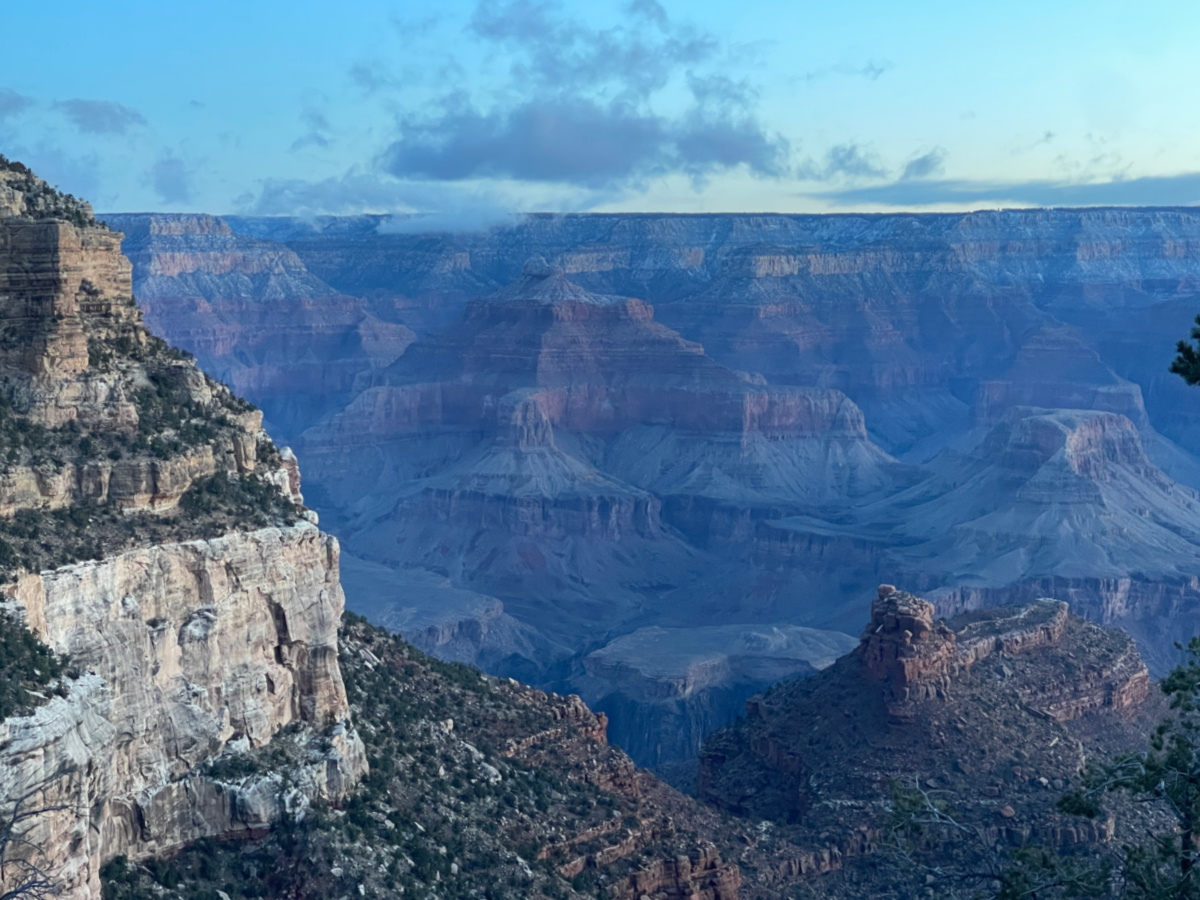
The canyon walls were visible, but almost everything was still in shadow. Instead of the reds and oranges you normally associate with the Grand Canyon, the landscape looked blue, purple and gray.
And there were very few people around.
That was one of the best parts.
I wasn’t squeezing into a crowded overlook or trying to claim a spot along the railing. There were other early risers, but there was plenty of room to wander along the rim and enjoy the view.
It felt incredibly peaceful.
6:19 AM — Just Before the Canyon Started to Glow
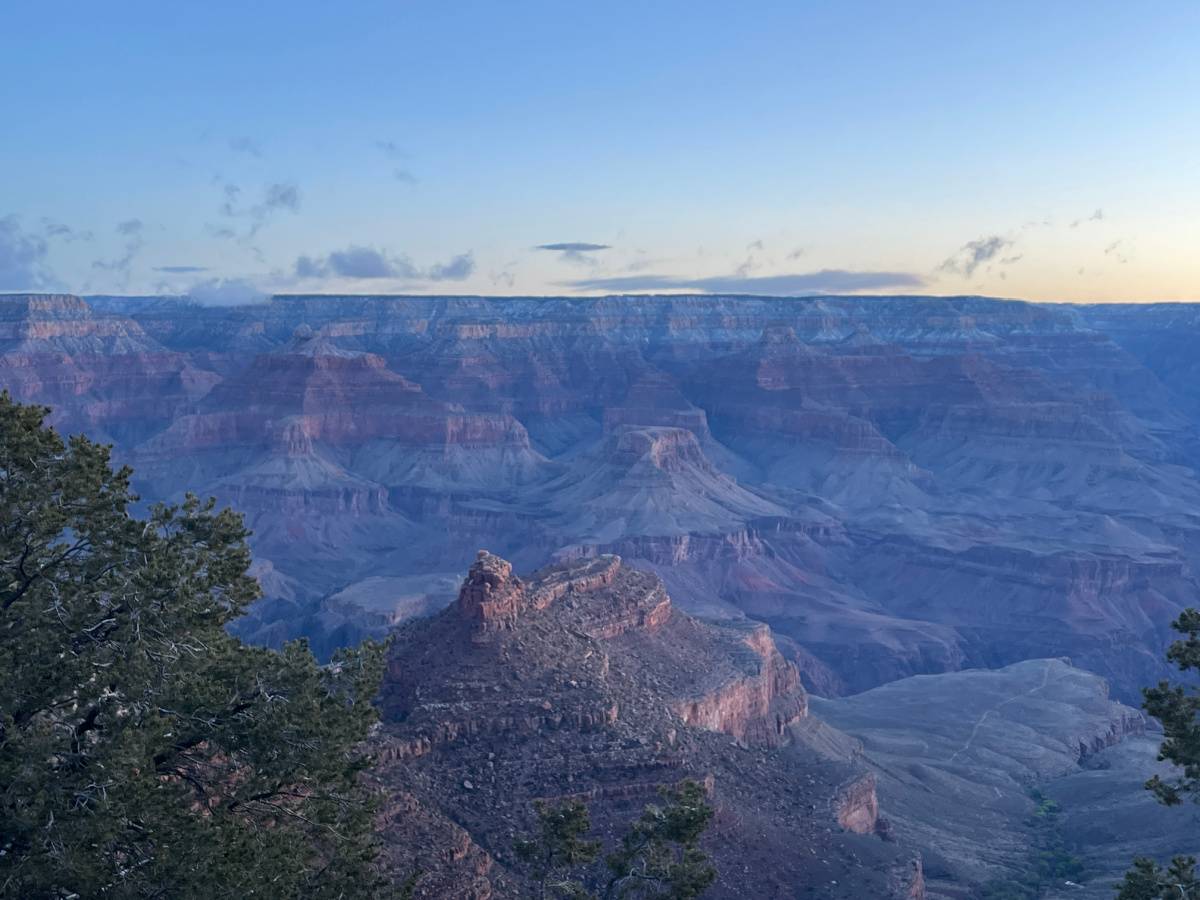
Only a few minutes later, the sky was noticeably brighter.
The canyon was still mostly in shadow, but you could tell something was about to happen.
This is one reason I would not recommend arriving at the rim at the exact moment of sunrise.
Come earlier.
The pre-sunrise light is part of the experience.
You get to watch the landscape slowly wake up instead of walking up after the transformation has already started.
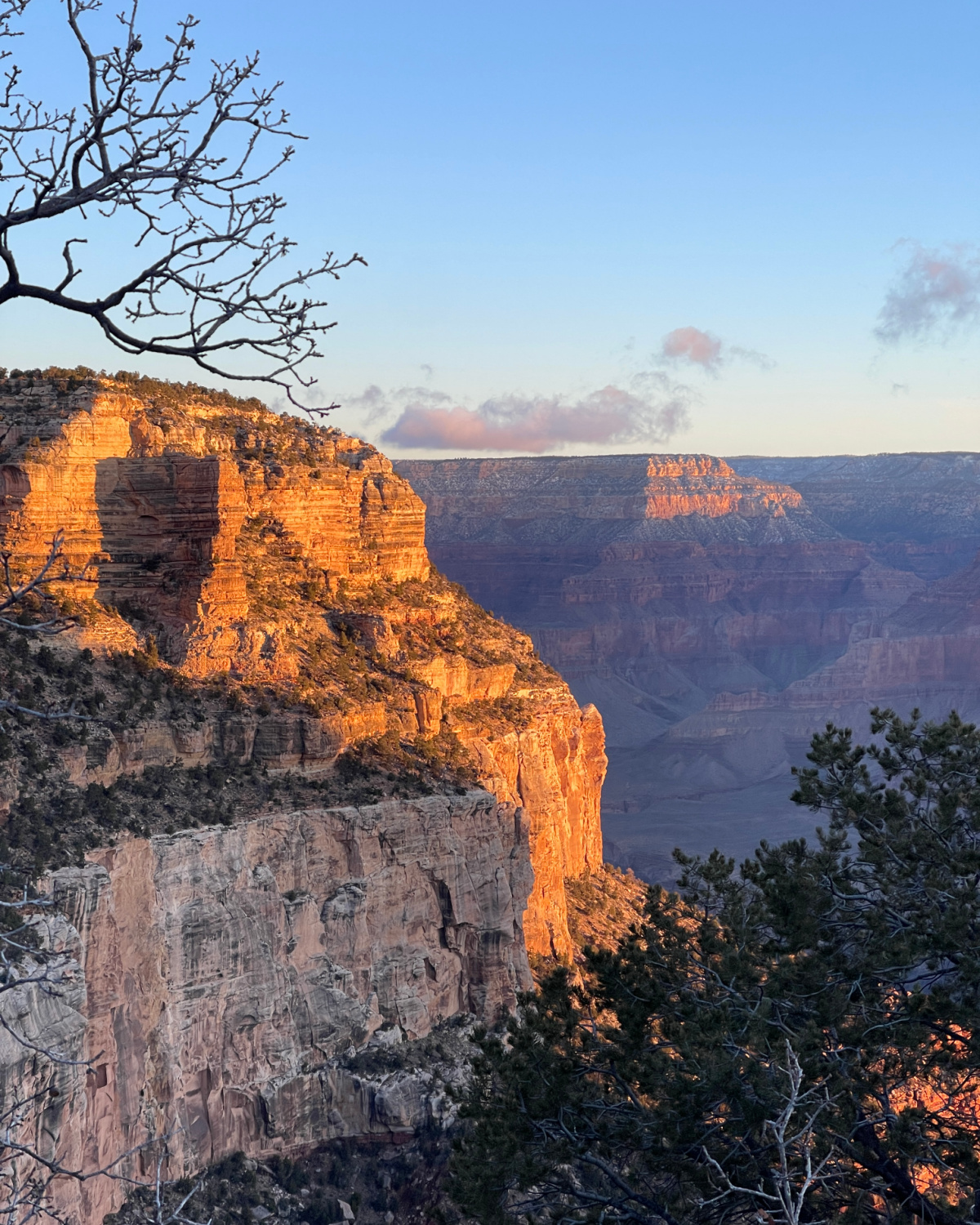
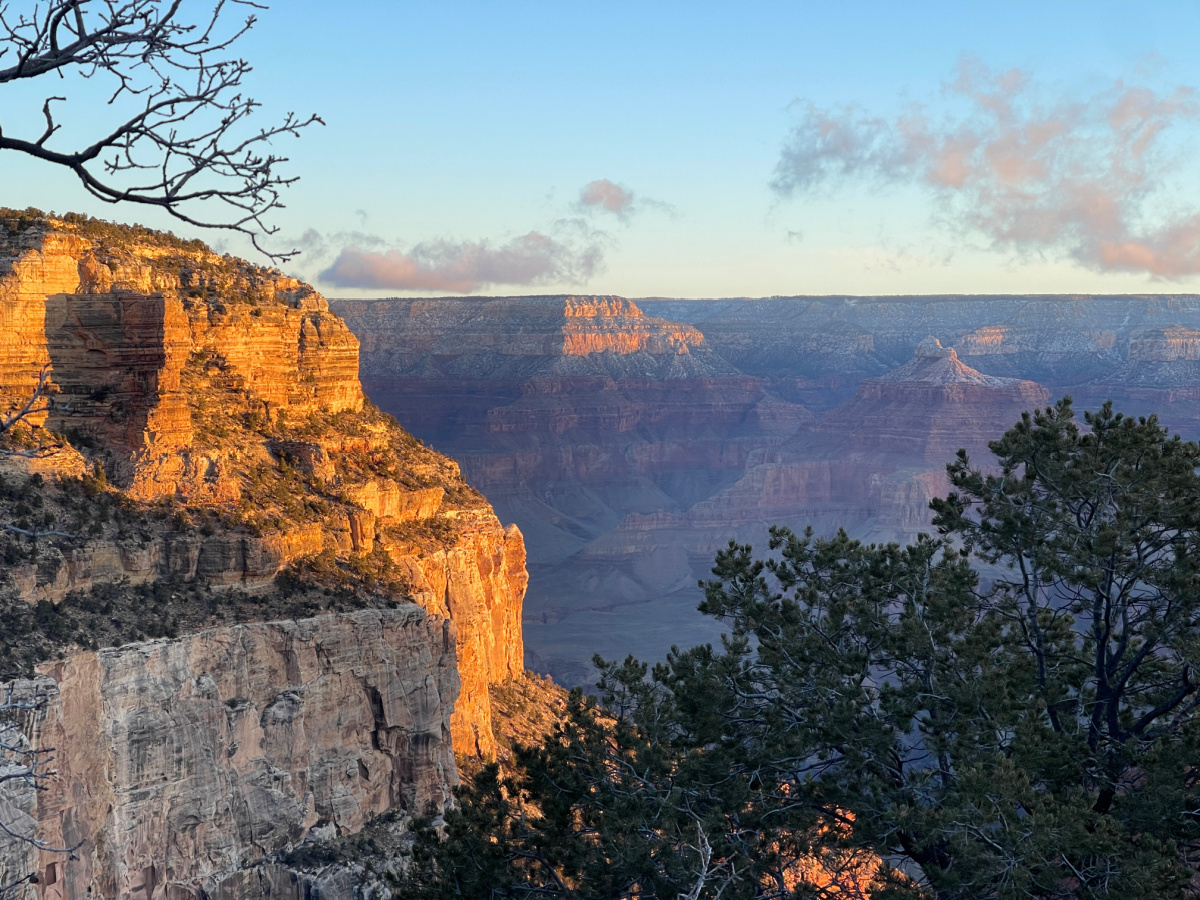
6:28 AM — And Then the Canyon Lit Up
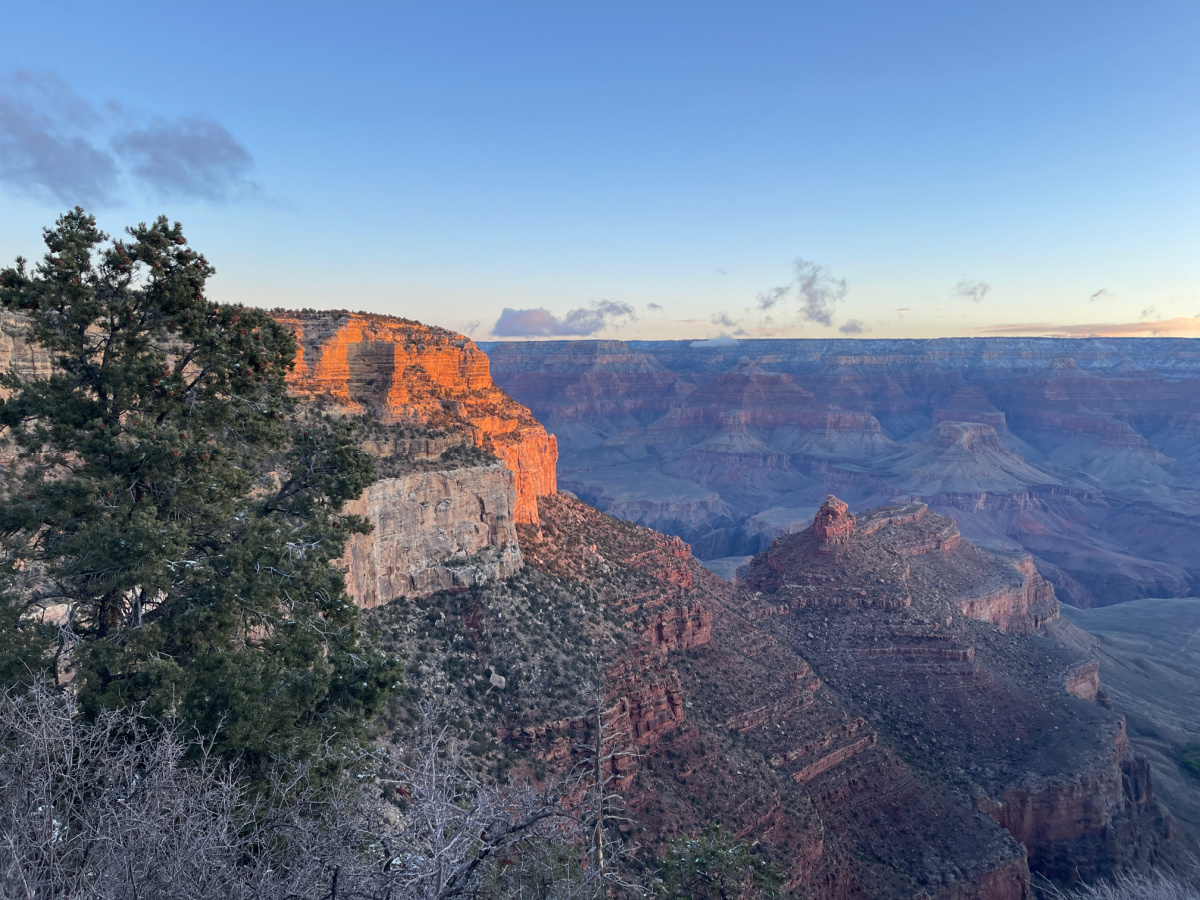
This was the moment that got me.
Suddenly the cliff on the left caught the direct sunlight and turned bright orange.
Everything behind it was still blue and purple.
The contrast was incredible.
It was almost like someone had flipped on a spotlight.
Just minutes earlier, that same cliff had blended into the rest of the canyon. Now it was glowing.
6:29 AM — The Light Starts Moving
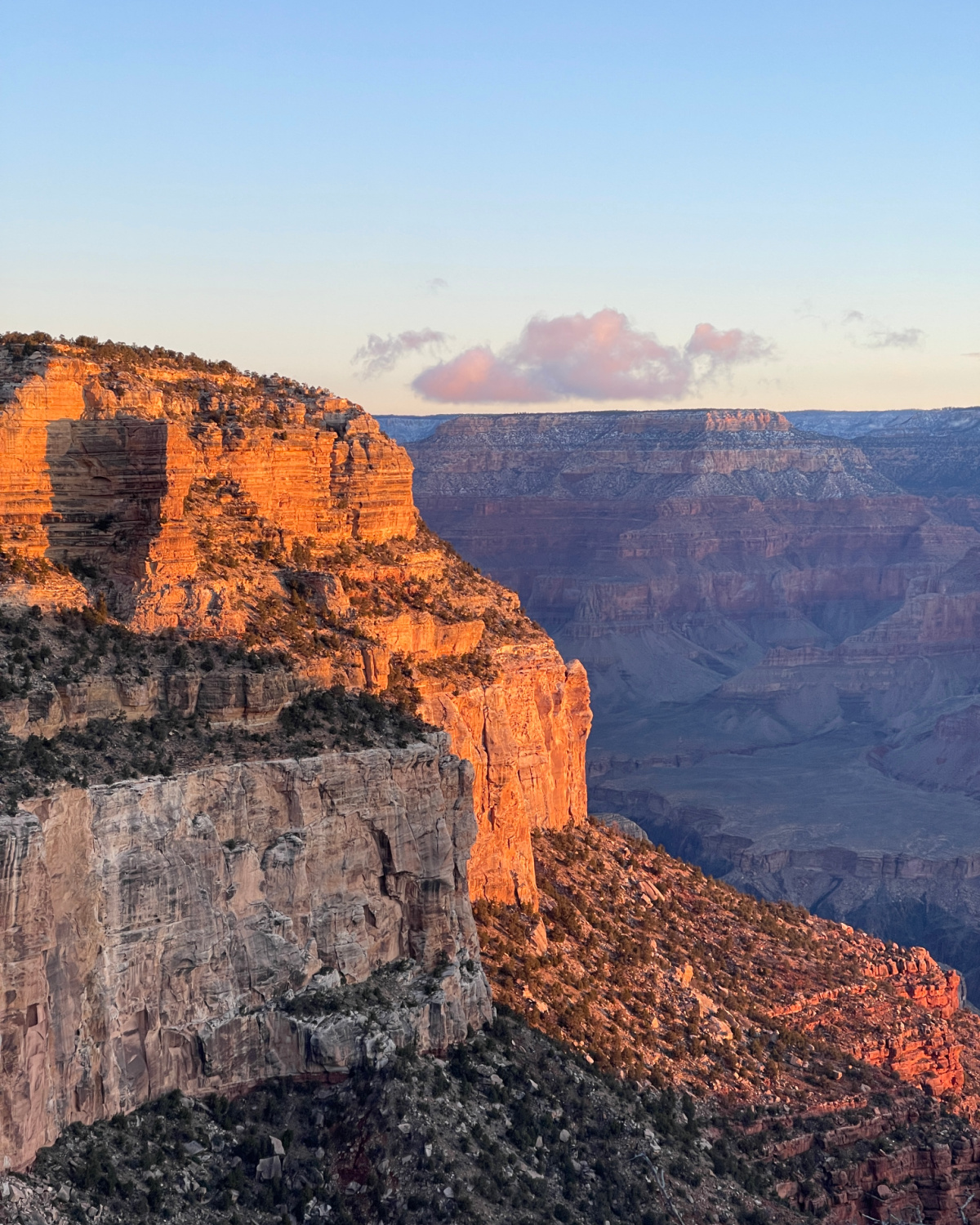
This is what makes sunrise at the Grand Canyon so much more interesting than simply watching the sun come up.
The landscape keeps changing.
The sunlight moves across different cliffs and rock formations while other parts of the canyon remain completely shadowed.
Every few minutes, the view looks different.
And because the canyon is so enormous, you aren’t watching one single patch of light.
You are watching sunlight gradually reach miles and miles of landscape.
6:32 AM — More of the Canyon Comes Alive
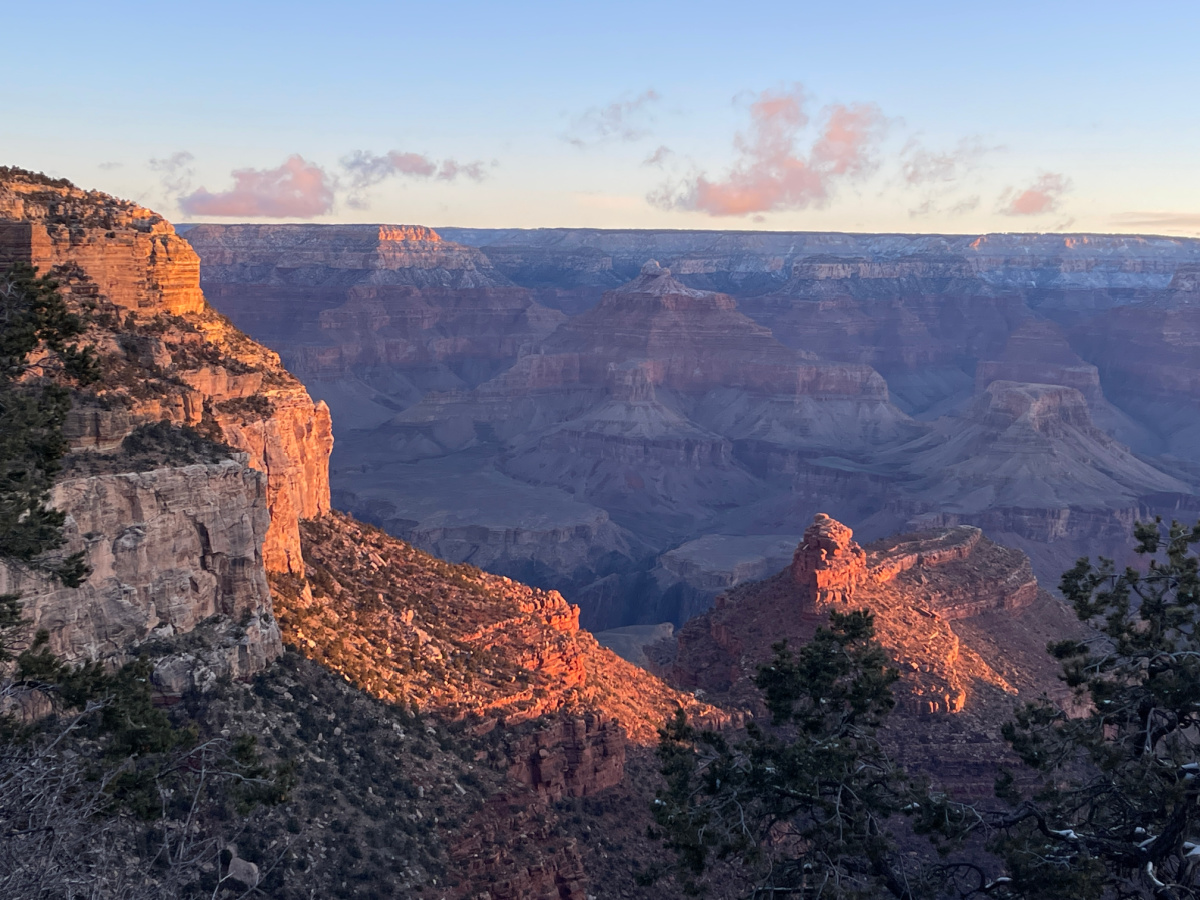
Within just a few more minutes, the light had spread across additional formations.
Now the warm orange areas were beginning to contrast dramatically with the darker canyon below.
This is one of the reasons I took so many pictures.
Every time I looked up, something had changed.
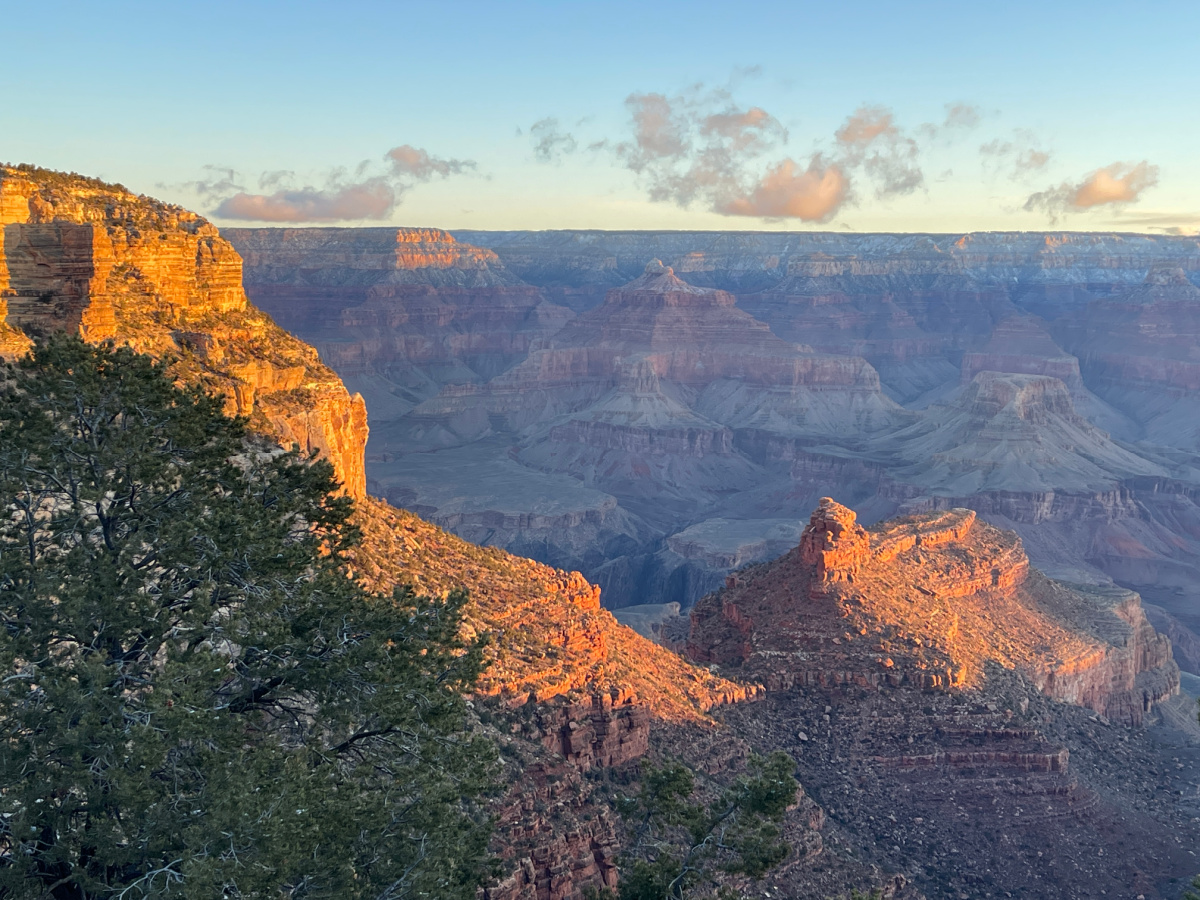
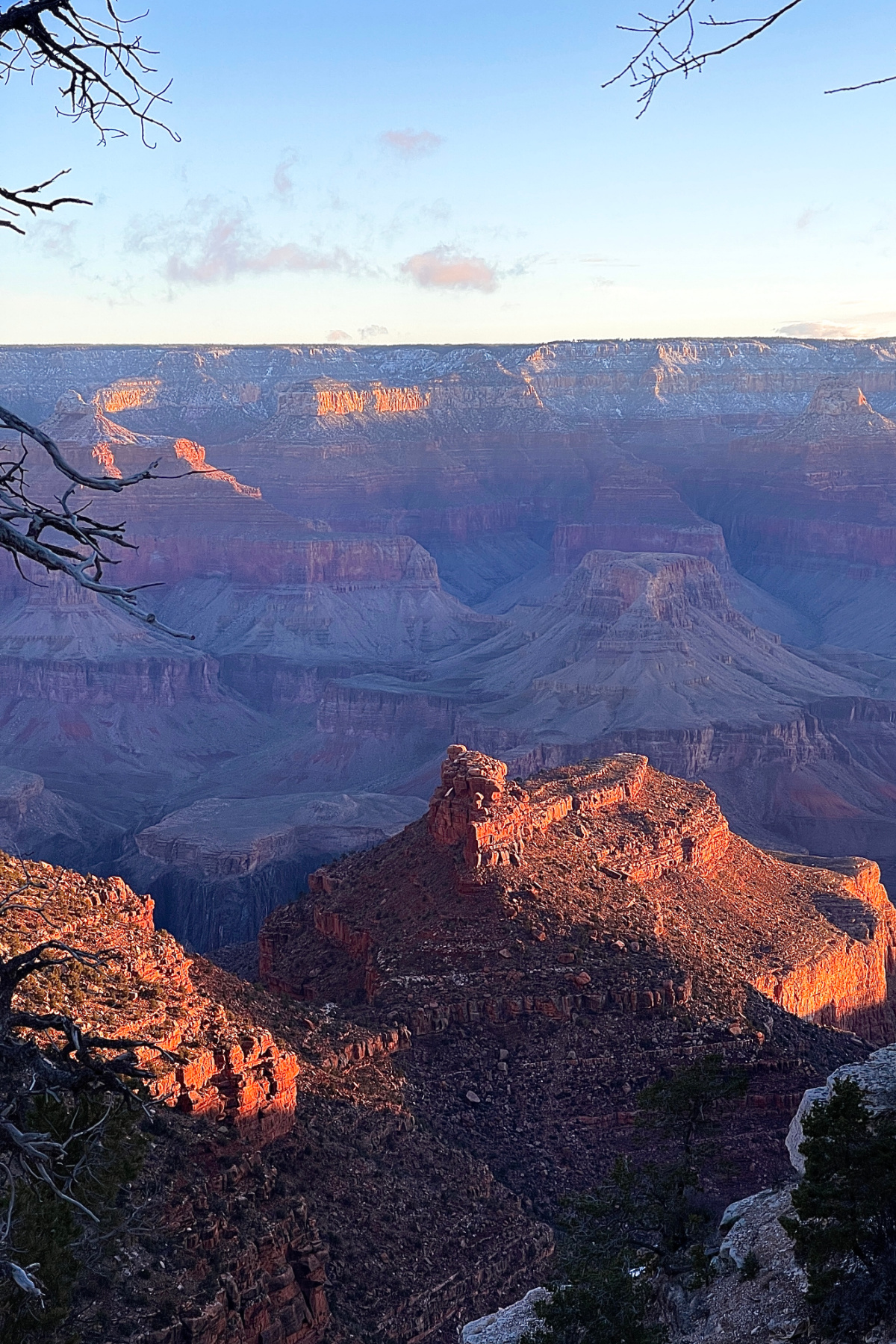
6:34 AM — A Completely Different View
At this point, we were only about 20 minutes past my first photograph.
Look at the difference.
The canyon that had been almost entirely blue before sunrise was now filled with warm orange light.
Some formations were glowing.
Others were still shaded.
And soft pink clouds were beginning to catch the morning light too.
This was when I realized that sunrise at the Grand Canyon wasn’t just pretty.
It was spectacular.
The Best Part of Grand Canyon Sunrise Was the Peace
The photographs are beautiful, but they don’t really capture my favorite part of the morning.
It was quiet.
There were people around, but not enough to make the experience feel crowded.
I could wander.
I could stop wherever I wanted.
I didn’t have to keep track of anyone else.
I wasn’t trying to get somewhere.
I wasn’t checking another Grand Canyon viewpoint off a list.
For a little while, I was simply standing at the rim watching the canyon change.
That kind of experience is increasingly rare at popular national parks.
And at the Grand Canyon, one of the most visited national parks in the country, I certainly wasn’t expecting to feel like I had so much space.
If you enjoy the quieter moments in national parks, this alone is a reason to consider getting up early.
Even if nobody else in your family wants to come with you.
6:36 AM — The Light Reaches Farther Across the Canyon
By 6:36 AM, the change was even more dramatic.
More distant formations were catching the sunlight, while deep sections of the canyon were still sitting in cool shadow.
That contrast was probably my favorite part of the entire sunrise.
The Grand Canyon is beautiful in full daylight, obviously. But during sunrise, you get to see the landscape in layers.
One ridge glows orange.
Another stays blue.
A distant formation catches the light a few minutes later.
The canyon keeps revealing itself.
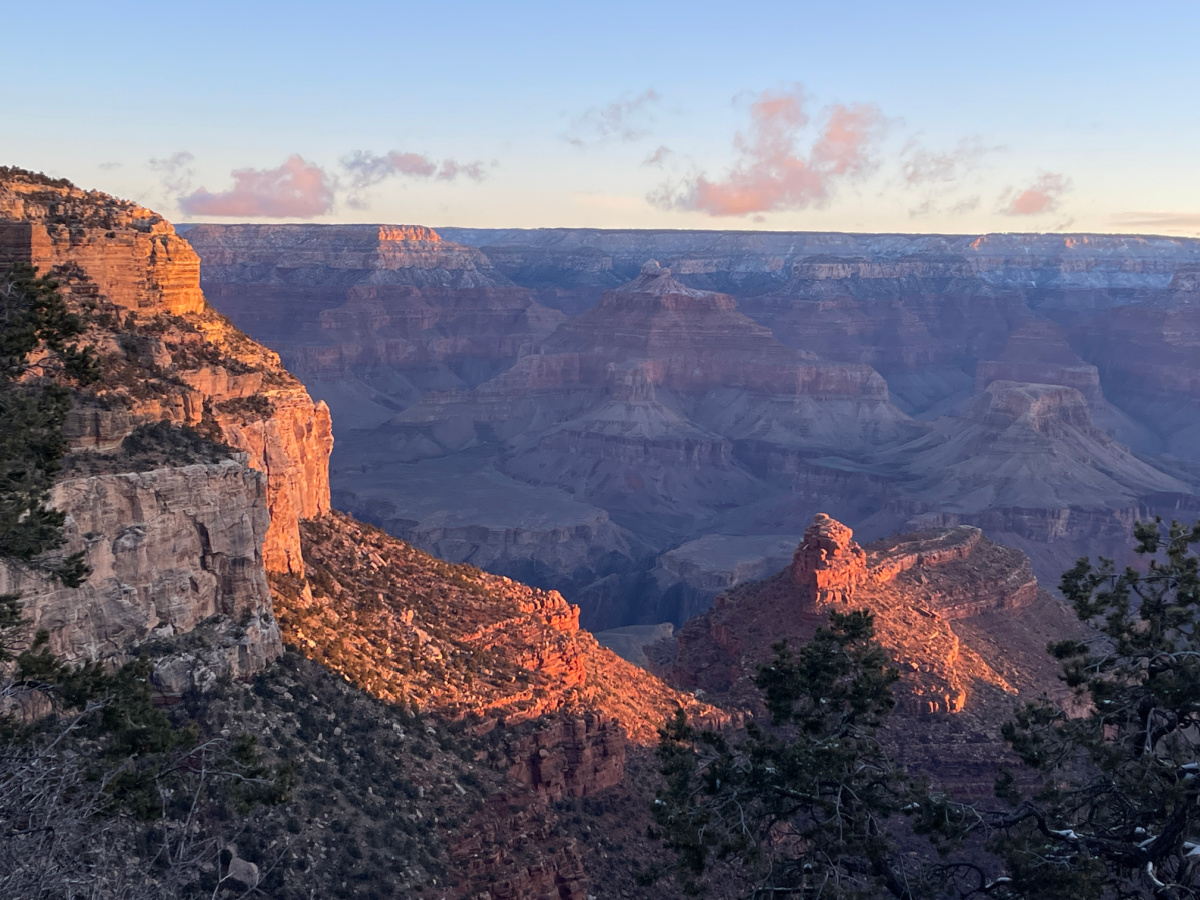
6:39 AM — Twenty-Six Minutes Later
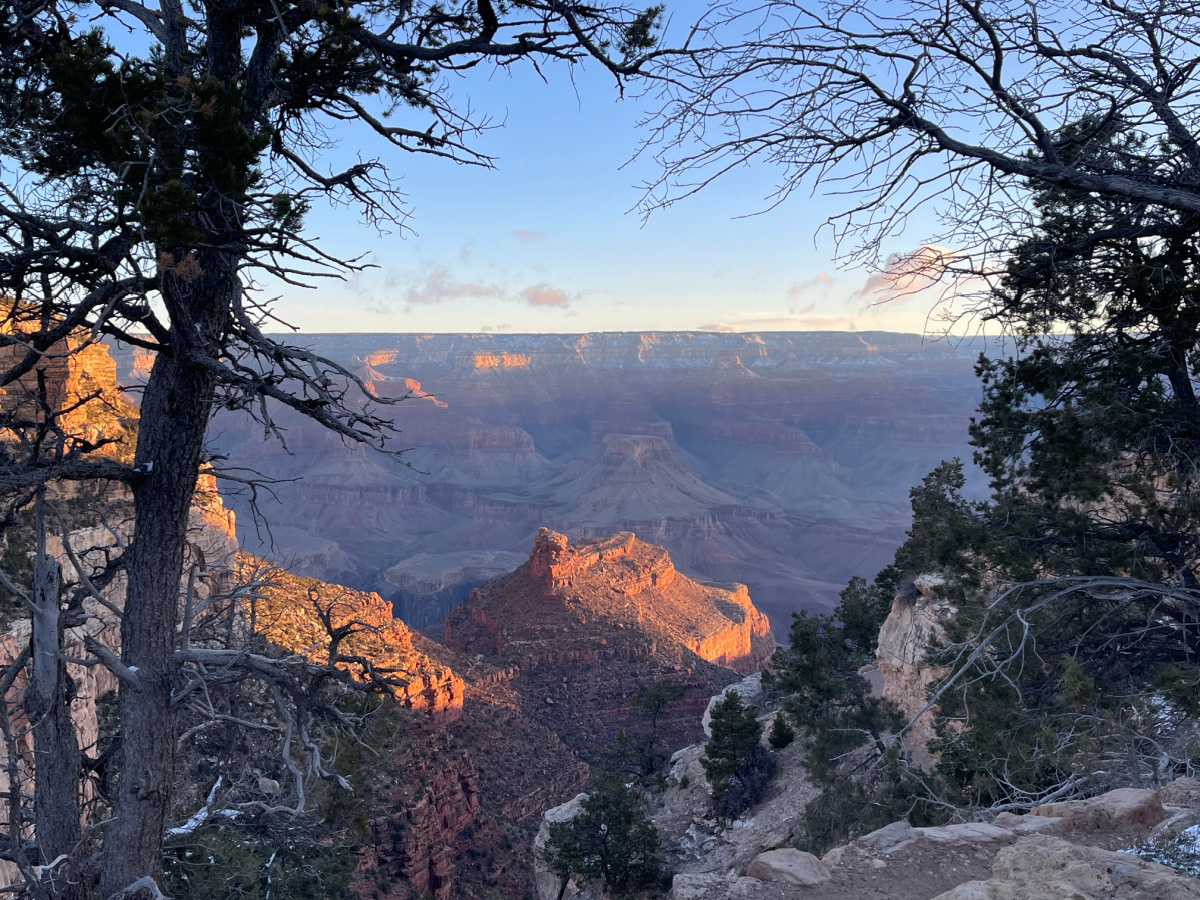
This was one of my last sunrise photos.
Less than half an hour had passed since my first photograph at 6:13 AM.
And the canyon looked completely different.
The soft blue pre-dawn landscape had become a mix of warm orange cliffs, pink clouds and deep purple shadows.
That is what surprised me most about sunrise at the Grand Canyon.
It wasn’t one big dramatic moment.
It was a progression.
And if I had shown up right at sunrise, snapped a picture and left, I would have missed half of it.
How Early Should You Arrive for Sunrise at the Grand Canyon?
I would plan to get to the rim at least 20 to 30 minutes before sunrise.
You don’t need to be standing there in complete darkness for an hour unless that is your thing.
But you definitely want to arrive early enough to see the pre-dawn light.
That blue-hour period was beautiful on its own, and it made the first orange sunlight feel even more dramatic.
Then stay afterward.
Seriously.
Do not watch the sun come up and immediately leave.
Some of the best light I saw happened during the 10 to 20 minutes after sunrise, when the sunlight started spreading across the canyon.
If you can give yourself 45 minutes to an hour total, you will have a much better chance of seeing the full progression.
Dress Warmer Than You Think You Need To
This is especially important in spring.
We visited in March, and it was COLD.
There was snow on the ground, and the temperatures at the rim felt very different from what many people probably picture when they think about Arizona.
The South Rim sits at a high elevation, and early morning temperatures can be chilly even when the daytime weather is comfortable.
So bring layers.
Wear a warm jacket.
And if it is winter or early spring, gloves and a hat are not a ridiculous idea.
I was very glad I hadn’t treated this like a casual Arizona morning.
You Do Not Need the “Perfect” Sunrise Viewpoint
This may be my favorite practical takeaway from the entire morning.
You do not need to overcomplicate sunrise.
I did not take a shuttle to a famous overlook.
I did not drive across the park.
I did not research the exact perfect angle weeks in advance.
I walked from our hotel to the rim.
That was it.
And the sunrise was incredible.
There are certainly specific viewpoints that are known for sunrise, and photographers may want to be more strategic.
But if your goal is simply to experience a beautiful Grand Canyon sunrise, don’t convince yourself that you have to make it complicated.
Sometimes the best viewpoint is the one that gets you out of bed.
Why Staying in Grand Canyon Village Made Sunrise So Easy
This experience made me appreciate staying inside Grand Canyon Village even more.
Sunrise would have been a completely different proposition if I had needed to wake up the entire family, get everyone dressed, get into the car and drive into the park before dawn.
Instead, my husband and daughter slept.
I got up.
I walked to the rim.
I watched the sunrise.
Then I could go back.
That convenience matters.
If seeing sunrise is high on your Grand Canyon wish list, staying near the rim gives you one enormous advantage: you can decide at the last minute to do it without turning it into a major family operation.
And if the rest of your travel group wants to sleep?
Let them.
What About Sunset at the Grand Canyon?
Sunset is absolutely worth seeing too.
Our sunset experience was very different from sunrise, partly because a snowstorm was moving into the area.
We had dinner at El Tovar and stepped outside afterward to see the canyon in the late-day light.
The sky was dramatic.
Huge clouds were building over the canyon, and breaks in the clouds allowed sunlight to illuminate isolated rock formations.
It was almost like watching spotlights move across the landscape.
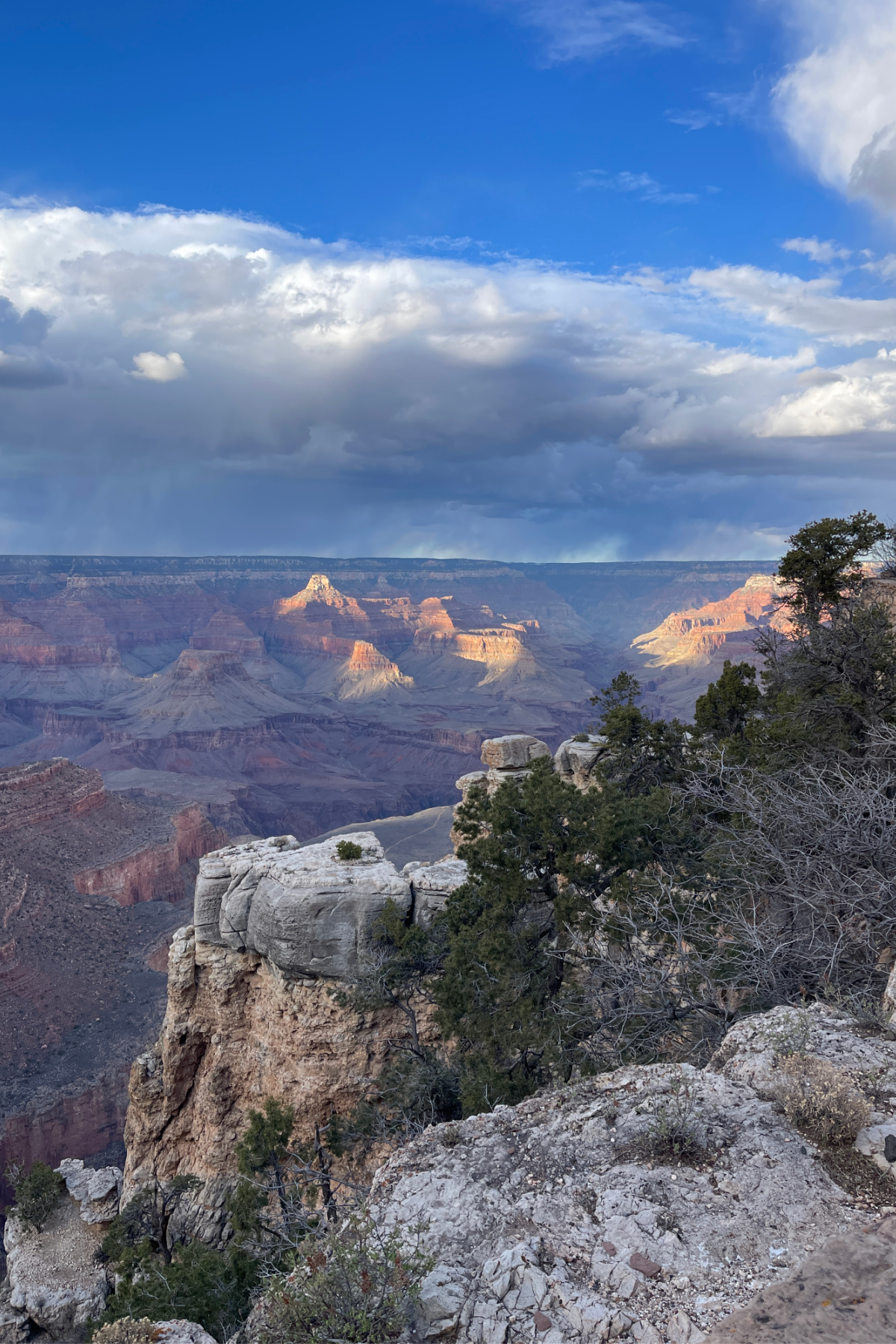
Instead of the entire canyon glowing evenly, individual formations would suddenly light up while everything around them stayed shaded.
The storm clouds made it moody.
Not textbook.
But beautiful.
Sunset Outside El Tovar
One of the lovely things about eating at El Tovar is how easy it is to step outside and walk straight to the rim afterward.
We didn’t need to drive anywhere to catch the evening light.
We finished dinner, walked outside and were immediately looking out over the canyon.
That is another reason staying and dining inside Grand Canyon Village can make these sunrise and sunset experiences so much easier.
You can build them naturally into your day.
And because the weather was changing rapidly, I was especially glad we had gone outside when we did.
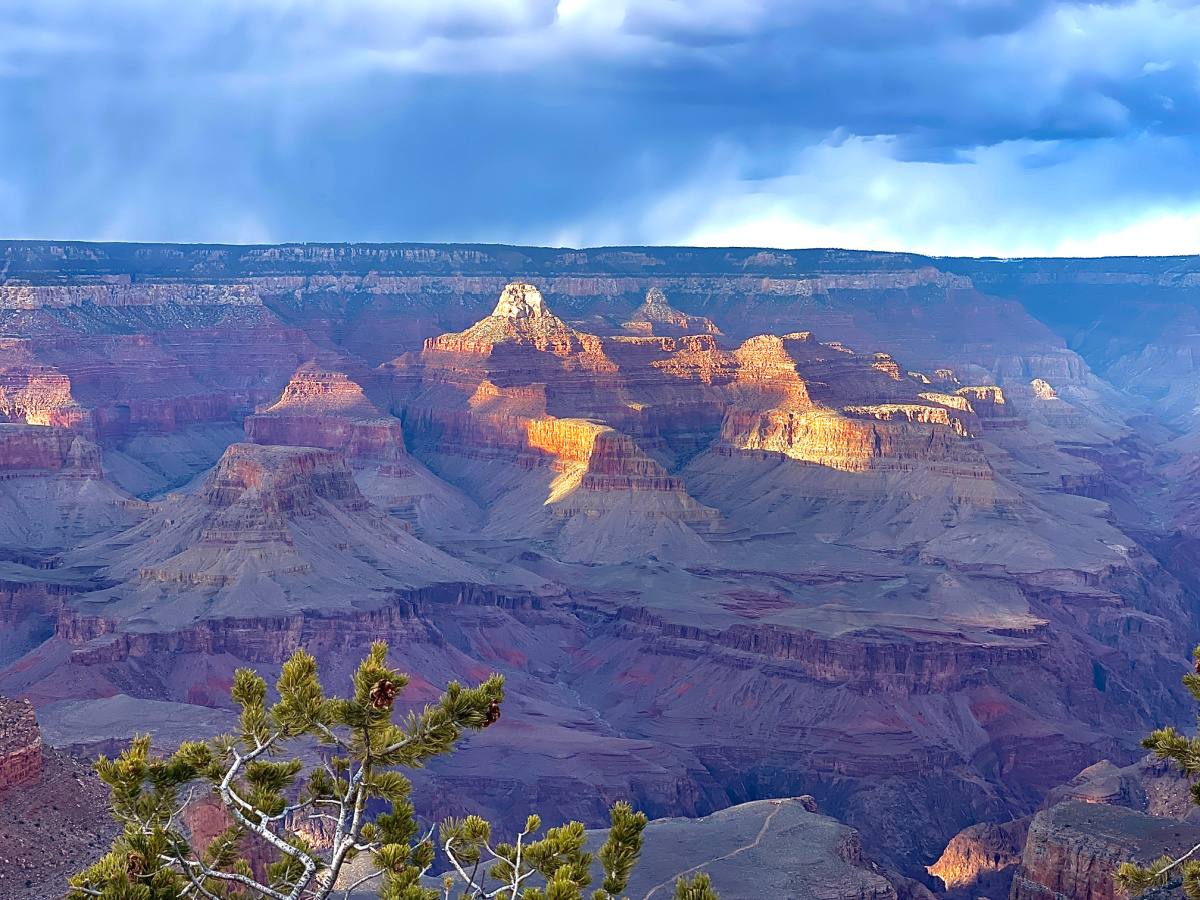
The sunlight breaking through the clouds created these glowing patches across the canyon.
It was very different from the sunrise the following morning.
Sunrise slowly illuminated more and more of the canyon.
Sunset that evening felt almost random.
A formation would glow.
Then the light would disappear.
Another area would brighten.
Then clouds would move in again.
Then I Took the Shuttle to Hopi Point for Twilight
After watching the sunset near El Tovar, I decided I wasn’t quite finished.
So I hopped on the Hermit Road shuttle and rode out to Hopi Point.
By the time I arrived, the actual sunset was basically over.
This was twilight.
And again, the canyon looked completely different.
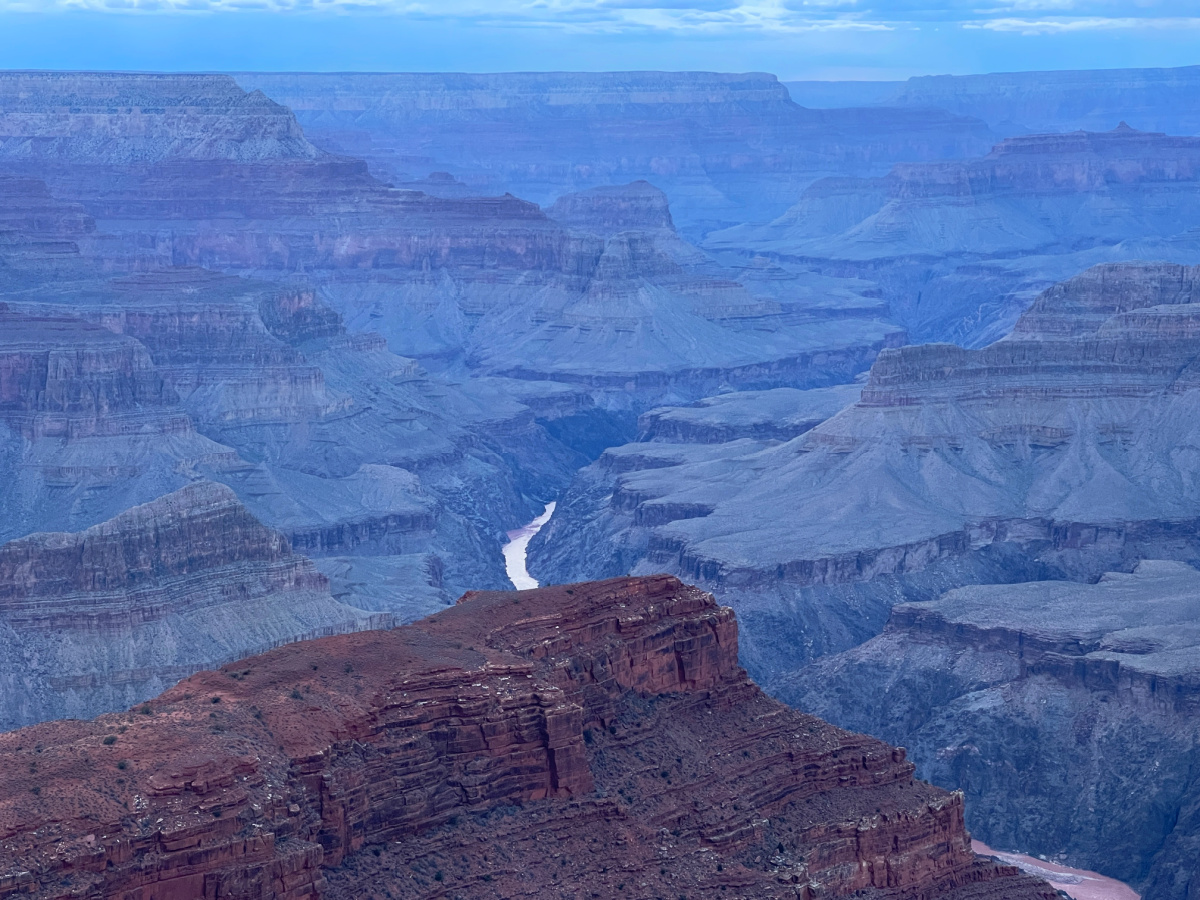
The warm golden light was mostly gone.
Everything had shifted toward blue and purple.
The clouds looked heavier.
The canyon felt moodier.
And the Colorado River stood out far below, catching the remaining light.
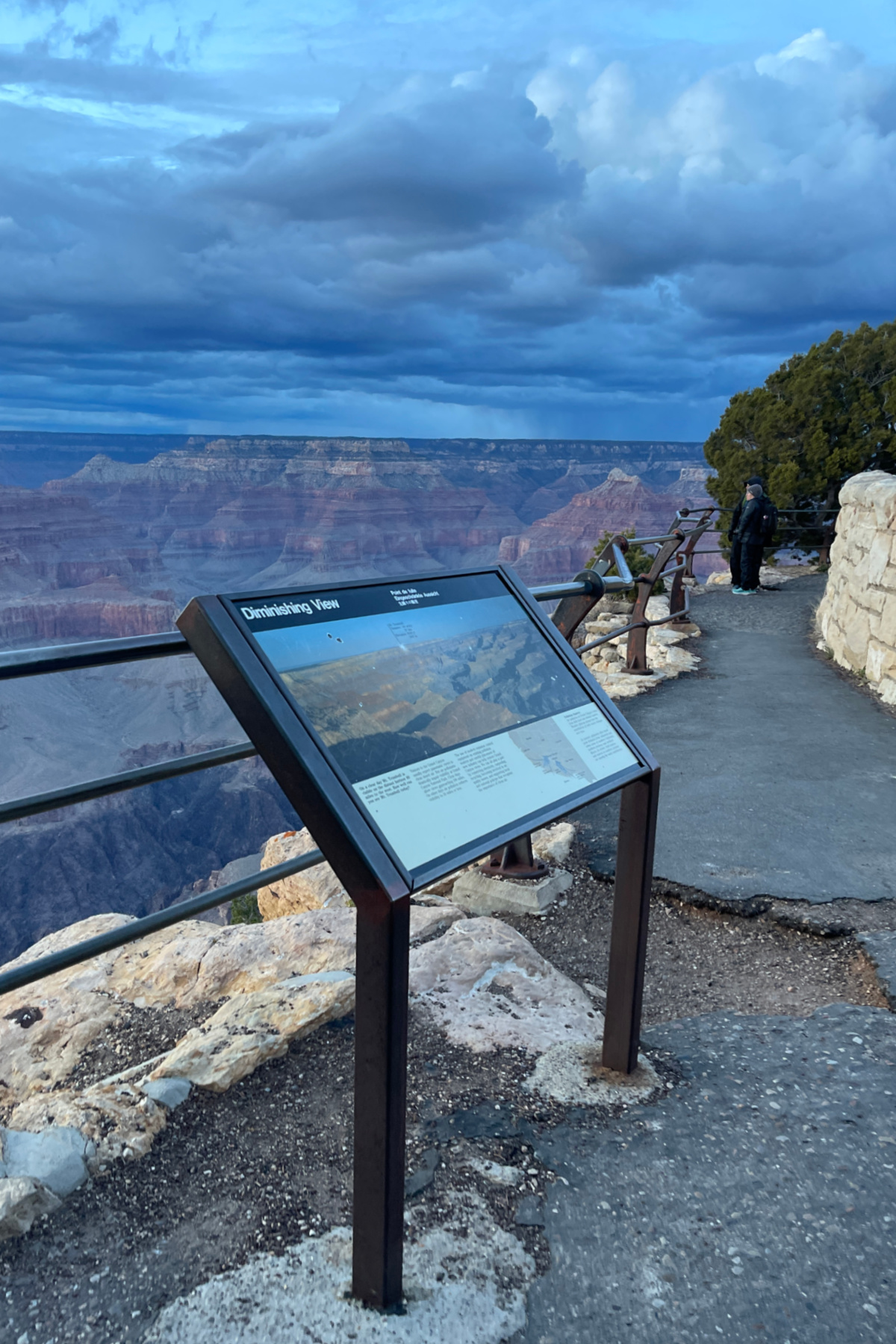
6:44 PM — Twilight at Hopi Point
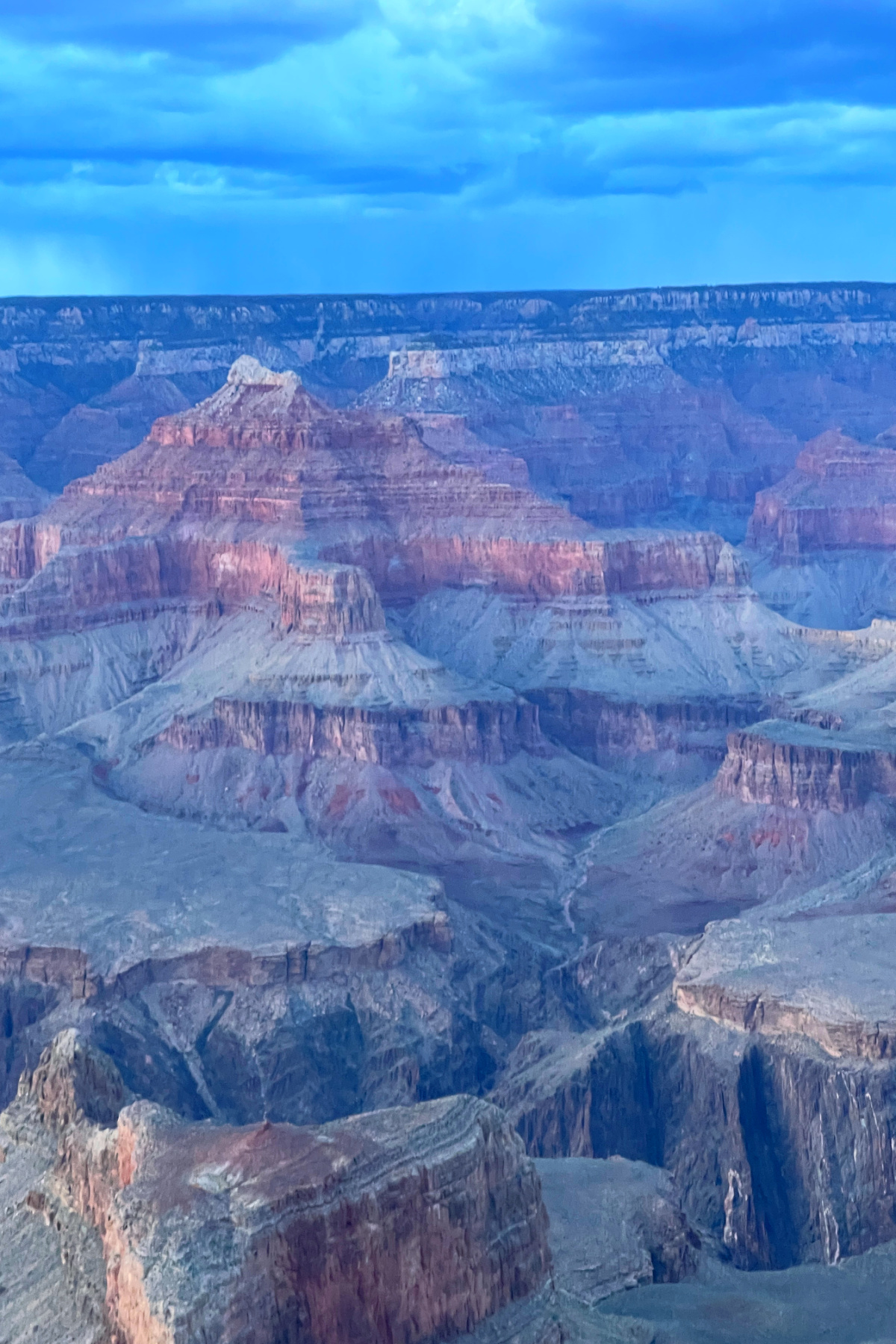
At this point, the canyon had almost none of that golden sunset color left.
Instead, the layered rock formations took on muted blues, purples and grays.
I actually really liked it.
It wasn’t dramatic in the same way sunrise had been, but it had a completely different atmosphere.
This is why I would encourage you not to leave immediately after sunset.
Twilight is part of the experience too.
6:55 PM — The Canyon Gets Dark Fast
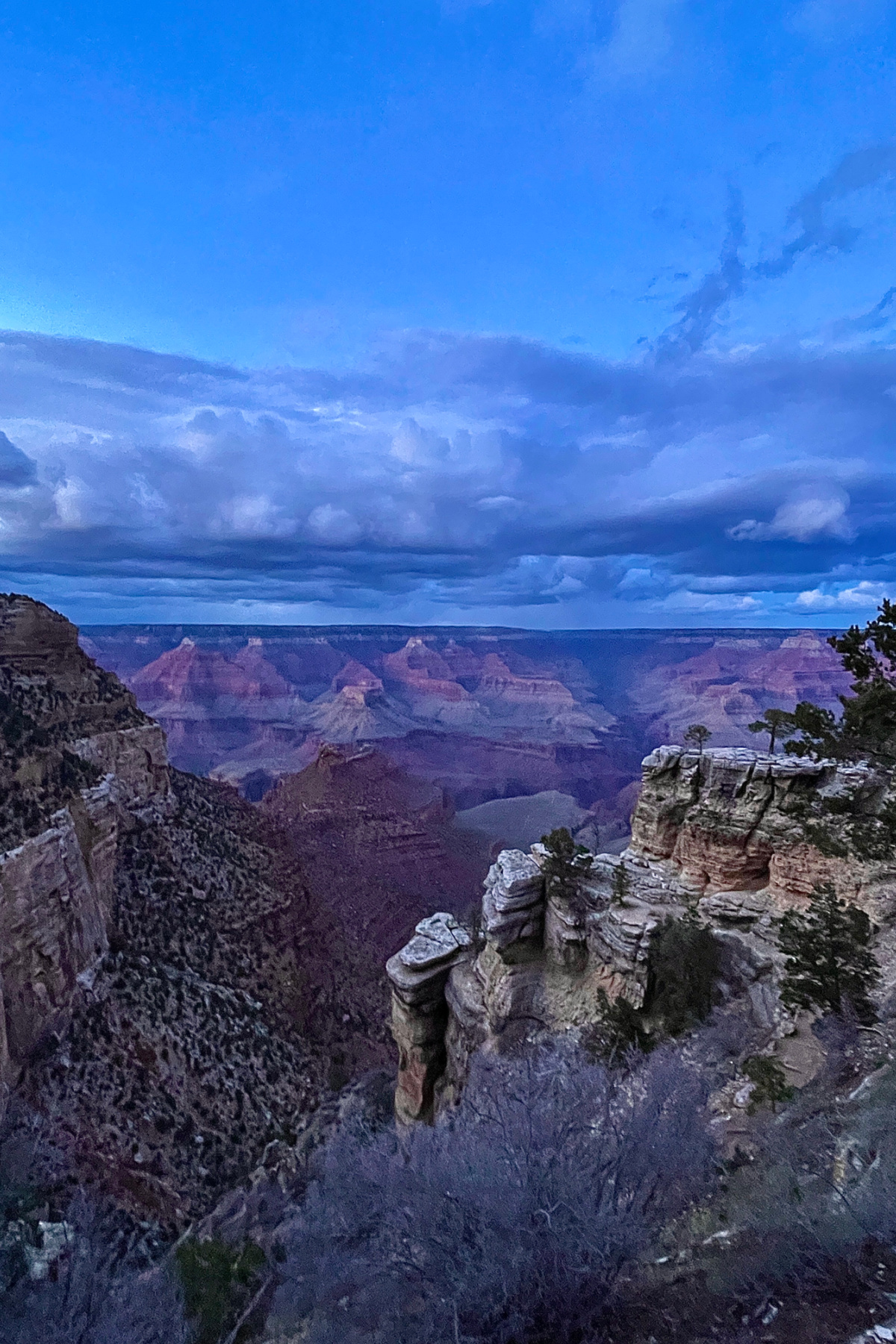
Just about ten minutes later, darkness was starting to take over.
This is one of those situations where photographs make the point better than words.
The canyon loses detail quickly.
The sky deepens.
The colors flatten.
And suddenly you realize the day is over.
If you are watching twilight from one of the Hermit Road overlooks, remember that you still need to get back.
Pay attention to shuttle schedules and don’t wait until you are standing alone in total darkness wondering how you are going to return to Grand Canyon Village.
Sunrise vs. Sunset at the Grand Canyon: Which Is Better?
See both if you can.
I genuinely mean that.
Sunset and sunrise show you two completely different versions of the Grand Canyon.
Sunset can be dramatic, especially when clouds and changing weather create interesting light.
Twilight can be incredibly atmospheric.
But if you asked me to choose just one?
Sunrise.
No contest.
Maybe we simply had unusually beautiful sunrise conditions.
Maybe the incoming storm affected our sunset.
But based on our trip, sunrise was far more memorable.
It was quieter.
It felt more peaceful.
And watching the first sunlight gradually illuminate the canyon was something I did not expect to find nearly as moving as I did.
So yes, I know you are on vacation.
I know getting out of bed before sunrise sounds terrible.
Do it anyway.
You can always go back to bed.
Best Places to Watch Sunrise at the Grand Canyon
If you want to be more strategic than I was, there are several well-known sunrise viewpoints along the South Rim.
The National Park Service specifically recommends Mather Point and Yaki Point for sunrise. Yaki Point is especially popular with photographers because the morning light hits formations below and to the west, while the eastern sky brightens behind the canyon.
But I would still make one important distinction.
If you are staying inside Grand Canyon Village, don’t assume you have to travel somewhere else for sunrise.
You may get a spectacular experience simply by walking to the rim near your hotel.
That is exactly what I did.
And for me, the convenience of being able to walk outside before dawn without dealing with transportation was worth more than chasing the theoretically perfect viewpoint.
If you are already awake and willing to travel, absolutely experiment with different viewpoints.
But if getting to Mather Point or Yaki Point is going to be the difference between seeing sunrise and staying in bed?
Walk to the rim.
Best Places to Watch Sunset at the Grand Canyon
For sunset, Hopi Point is one of the classic choices.
It sits along Hermit Road and has wide views in multiple directions, which makes it particularly good for watching the evening light move across the canyon.
It is also very popular.
So don’t expect solitude there during busier times of year.
Other Hermit Road viewpoints, including Mohave Point and Pima Point, also have expansive canyon views and can be less congested than Hopi Point.
On the eastern side of the South Rim, viewpoints along Desert View Drive can also be excellent for both sunrise and sunset.
The most important thing is finding a viewpoint with an open panorama rather than obsessing over one supposedly perfect location.
Weather, clouds and atmospheric conditions can completely change which viewpoint looks best on any particular evening.
Our sunset is a perfect example.
The storm clouds determined the show.
How the Hermit Road Shuttle Works for Sunset
If you want to watch sunset or twilight from Hopi Point during most of the year, you will probably be using the Hermits Rest Route, also known as the Red Route.
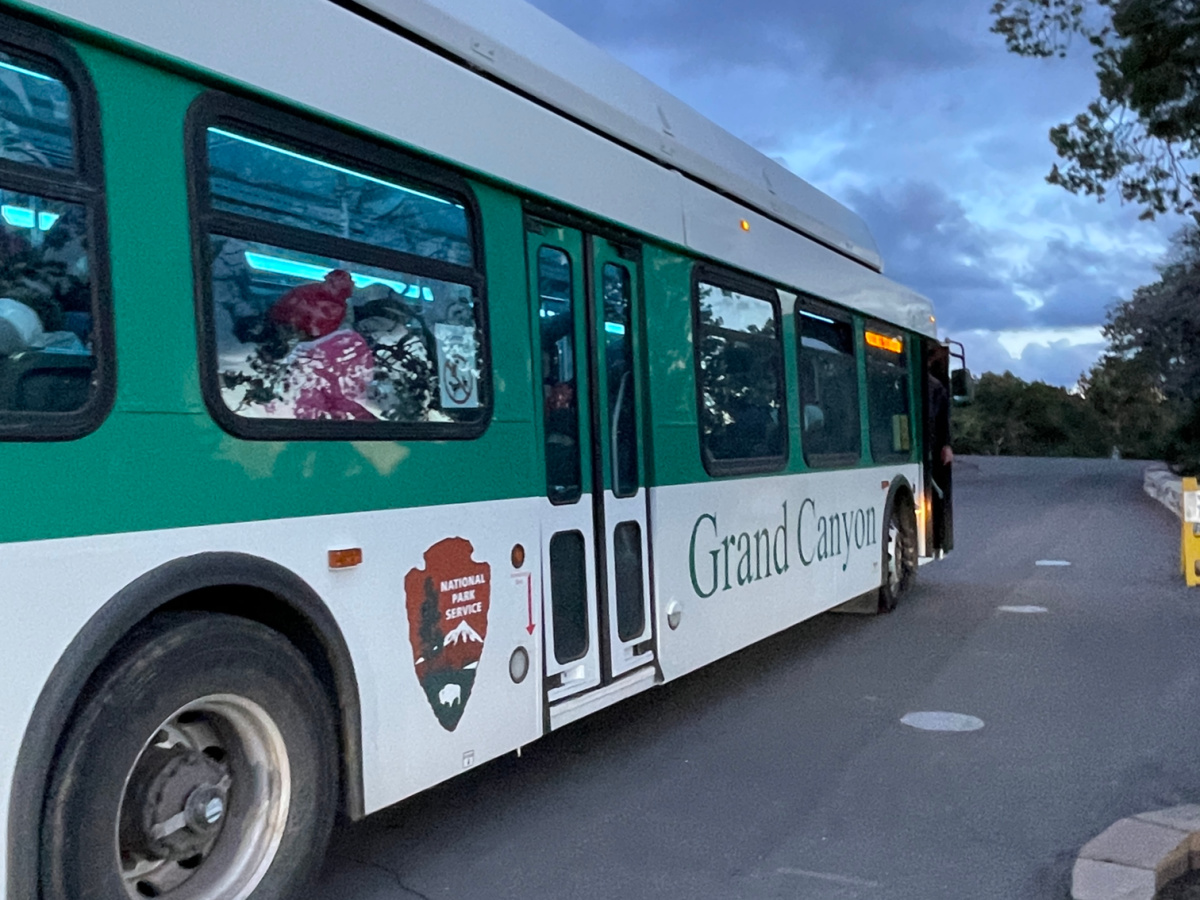
Hermit Road is generally closed to private vehicles from March 1 through November 30, so the free park shuttle is the primary way visitors reach overlooks including Hopi Point during that period.
That is exactly what I did.
After dinner at El Tovar and watching the late-day light near Grand Canyon Village, I hopped on the shuttle and rode out to Hopi Point for twilight.
The shuttle made it incredibly easy.
One important thing to know: the return route does not stop at every overlook.
So before you get off somewhere along Hermit Road, look at the current shuttle map and know where you can board for the return trip.
Also check the current operating schedule before your visit.
Shuttle routes and hours vary by season, and weather can affect service.
Don’t Forget About Twilight
One of my biggest sunset tips is very simple:
Don’t leave immediately when the sun goes down.
The canyon continues changing afterward.
Our actual sunset experience near El Tovar had warm patches of light breaking through the clouds.
By the time I reached Hopi Point, those warm colors had disappeared.
The canyon was blue.
Then purple.
Then progressively darker.
It was an entirely different atmosphere.
If you have the time, stay for twilight.
Just make sure you have a safe and reliable way back afterward.
Sunrise and Sunset Times Change Dramatically by Season
Do not assume sunrise is always ridiculously early or sunset is always late.
The time of year makes a huge difference.
Summer sunrise can happen shortly after 5 AM, while winter sunrise can be well after 7 AM.
Sunset shifts just as dramatically.
Before your trip, look up the exact sunrise and sunset time for your dates.
Then work backward.
For sunrise, I would personally aim to be at the rim around 30 minutes before the official sunrise time.
For sunset, arrive early enough to settle in before the best light starts, and don’t automatically leave the moment the sun disappears.
The National Park Service actually recommends arriving about 30 minutes before sunrise and remaining for an hour or more afterward.
After watching my own photos change between 6:13 and 6:39 AM, I completely understand why.
Remember That Arizona Does Not Observe Daylight Saving Time
This is one of those little details that can cause unnecessary confusion.
Most of Arizona, including Grand Canyon National Park, stays on Mountain Standard Time year-round.
That means the relationship between Arizona time and surrounding states changes during daylight saving time.
If you are road-tripping through Arizona and Utah, or crossing between different areas of the Southwest, double-check the local time.
You do not want to miss sunrise because your phone, watch or brain is operating in the wrong time zone.
Weather Can Completely Change the Experience
This may be the biggest lesson from our particular Grand Canyon trip.
You can plan the perfect sunset.
You can research the best overlook.
You can know exactly when the sun is supposed to disappear.
And then the weather does whatever it wants.
Our sunset happened as a spring snowstorm was moving toward the South Rim.
The clouds blocked some of the light.
But they also created dramatic shafts of sunlight across the canyon.
By twilight, the landscape had become moody and blue.
Then the following morning, the sunrise was spectacular.
So if the forecast looks imperfect, don’t automatically give up.
Clouds can ruin a sunset.
They can also make one incredible.
And even if one evening doesn’t work out exactly as planned, try again the next morning if you can.
Grand Canyon Sunrise Photography Tips for Regular People
You do not need professional photography equipment to capture a beautiful Grand Canyon sunrise.
Every photo in my sunrise sequence was taken while I was simply standing along the rim watching the light change.
The most important thing is to keep taking pictures.
Don’t take one photo and assume you have captured sunrise.
Take another five minutes later.
Then another.
Move slightly along the rim.
Photograph both wide landscapes and individual formations.
Pay attention to what the light is doing rather than concentrating only on the sun itself.
And if you are using a phone, don’t be afraid to tap on different parts of the scene to adjust the exposure.
The canyon has extreme contrasts during sunrise and sunset. Bright cliffs can sit right next to deep shadows.
Sometimes exposing for the bright rock will preserve those glowing orange details better than allowing your camera to brighten the entire canyon.
Most importantly, put the camera down occasionally.
You are there to experience it too.
My Grand Canyon Sunrise and Sunset Tips
If I could boil everything down to a few pieces of advice, they would be these:
- See both sunrise and sunset if your itinerary allows.
- Stay near the rim if you can. It makes sunrise dramatically easier.
- Arrive before sunrise rather than right at sunrise.
- Stay after both sunrise and sunset because the light keeps changing.
- Dress much warmer than you think you need to.
- Check current shuttle schedules before heading to Hermit Road.
- Don’t stress about finding the one perfect viewpoint.
- Expect weather to affect what you see.
- Keep taking photographs as the light changes.
- If everyone else wants to sleep through sunrise, go without them.
That last one worked out pretty well for me.
Is Sunrise or Sunset Better at the Grand Canyon?
For us?
Sunrise.
Easily.
Our sunset was beautiful and dramatic, and I am glad we saw it.
Twilight at Hopi Point was absolutely worth the shuttle ride too.
But sunrise was the experience that stayed with me.
Maybe it was the quiet.
Maybe it was having so much of the rim almost to myself.
Maybe it was watching that first orange light suddenly hit a cliff that had been blue just minutes earlier.
Probably all of it.
Whatever the reason, sunrise ended up being one of my favorite moments of our entire Grand Canyon trip.
So if you are staying near the South Rim and debating whether getting out of bed that early is worth it?
Set the alarm.
Put on warm clothes.
Walk to the rim.
And watch the canyon wake up.
More Grand Canyon Trip Planning
If you’re planning a trip to the South Rim, these Grand Canyon guides can help you figure out what to see, how much time you need, and what to expect during different times of year.
Grand Canyon South Rim Guide
Start with my Grand Canyon South Rim Guide for an overview of the viewpoints, transportation, lodging, things to do, and practical tips that will help you plan your visit.
Best Grand Canyon Viewpoints Without Hardcore Hiking
You do not need to hike deep into the canyon to experience incredible views. My Grand Canyon Viewpoints Without Hardcore Hiking guide covers some of the best overlooks you can reach by walking short distances, driving, or using the park shuttle.
Visiting the Grand Canyon in March
Spring at the Grand Canyon can be beautiful, but it can also be surprisingly wintry. Our March trip included snow, cold temperatures, road closures, and rapidly changing weather. My Grand Canyon in March guide explains what we experienced and what I would do differently next time.