Fort McHenry National Monument: A Guide to the Birthplace of the Star-Spangled Banner

Affiliate Disclosure: This post may contain affiliate links. If you make a purchase or booking through these links, I may earn a commission at no additional cost to you.

Visit Fort McHenry National Monument in Baltimore, the historic shrine where the Star-Spangled Banner was born. This guide covers what you’ll actually see, what’s worth your time, and why this quiet spot on the harbor still carries so much weight.
Fort McHenry National Monument doesn’t look dramatic when you first arrive. There’s no towering monument or grand façade. Just a low, star-shaped fort sitting quietly along Baltimore Harbor.
That calm is misleading.
This is where American forces held off a British attack during the War of 1812. It’s where the defense of Baltimore came down to a very long night. And it’s where Francis Scott Key witnessed the moment that inspired the Star-Spangled Banner. What happened here shaped how the country would later remember itself. And this event directly inspired our national anthem.
Visiting Fort McHenry today isn’t flashy. It’s thoughtful. And it is a great place to visit with kids, as a history buff, or anyone visiting Baltimore.

Related: 50+ Kid Friendly Things to Do in Baltimore
Where Fort McHenry Sits- and Why It’s location Mattered
Fort McHenry sits where the Patapsco River opens into the Chesapeake Bay. If you’re standing on the ramparts and looking out over the water, you’re looking straight at what British ships would have seen in 1814.
That location wasn’t accidental.
Baltimore was one of the busiest ports on the East Coast at the time, deeply tied to trade and shipping. British forces already had their sights set on it. Washington, D.C. had been burned. Baltimore was next.
If British warships could push past Fort McHenry and enter Baltimore Harbor freely, the city would be wide open.
There wasn’t a lot of margin for error.

Related: While in Baltimore visit the USS Constellation, another historic site!
The Night Everything Came Down to Waiting
The Battle of Baltimore wasn’t quick. And it wasn’t neat.
British warships entered the Chesapeake Bay and began a sustained bombardment that lasted roughly 25 hours. They stayed just out of range, firing rockets and shells toward the fort. These weren’t warning shots or symbolic gestures. British warships used explosive rockets designed to intimidate, exhaust, and overwhelm.
Those rockets- the ones lighting up the sky- are the same ones later described as the “rockets’ red glare.”
At the same time, British forces attempted a land assault, hoping to pressure American defenses from more than one direction. It was loud, confusing, and relentless. Major Armistead, who commanded American forces at Fort McHenry, held his position through the terror of flight, the battle’s confusion, and the very real possibility that the fort would not still be standing by morning.
Out on the water, British ships kept firing.
Inside the fort, American forces waited.
There wasn’t much else they could do.

Related: Kid Friendly Guide to the Maryland Science Center
Morning Changed Everything
Eventually, the firing slowed.
And then the sun came up.
When daylight broke. Literally, by the dawn’s early light, the American flag was still flying above Fort McHenry.
That one detail changed everything.
After hours of bombardment, smoke, and uncertainty, the sight of the American flag confirmed that the defense of Fort McHenry had worked. The British attack failed. Baltimore Harbor was still protected.
It’s hard to overstate how much that moment mattered. Not just strategically, but emotionally.

Related: Check out why you have to visit the National Aquarium in Baltimore’s Inner Harbor!
Francis Scott Key Was Watching From the Water
Francis Scott Key wasn’t stationed at the fort. He wasn’t firing cannons or manning defenses.
He was a lawyer who had boarded a British ship to negotiate the release of an American prisoner. Because of the ongoing British attack, he wasn’t allowed to leave. He spent the night watching the bombardment from the water, surrounded by British ships, with no idea how things would end.
All night long, he watched the sky over Baltimore Harbor light up with rockets and explosions.
When morning came, he looked toward the fort.
The American flag was still there. Its bright stars and whose broad stripes were visible in the early light.
Later, Key wrote his thoughts down on the back of a letter. That rough draft became a poem called “Defence of Fort M’Henry.” A local printer published it, Baltimore newspapers picked it up, and it eventually made its way into American culture as the national anthem of the United States.
Today, we know it as The Star-Spangled Banner.
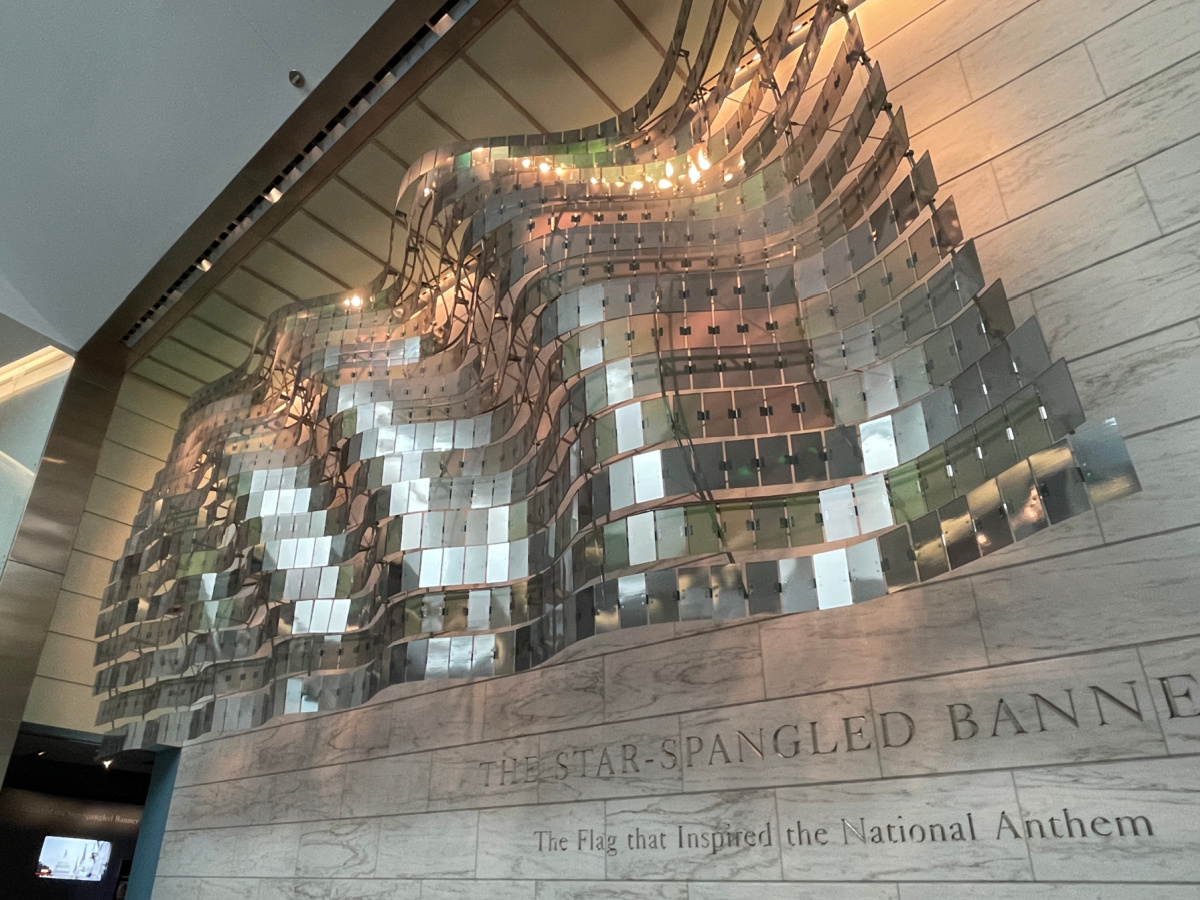
Pro-Tip: If you want to experience everything about the Star-Spangled Banner, add a trip to the National Museum of American History in Washington DC. Here you can see the actual flag from the battle that inspired the national anthem!
What It’s Like to Walk Fort McHenry Today
The Fort Itself
The first thing you notice when you walk inside the fort is the shape. Fort McHenry’s star design isn’t decorative. It allowed American forces to defend the fort from multiple angles, and that becomes obvious once you start moving around.

You can see where cannons were placed, where soldiers lived, and how carefully the site was laid out. Nothing feels random.
Standing on the ramparts and looking out over the water, it’s easy to picture British warships anchored in the distance. That view alone explains a lot.

The Flag
The original flag that inspired Francis Scott Key is preserved at the National Museum of American History in Washington, D.C. But seeing the flag flying here still feels different.
It’s not staged and it’s not dramatic.
It’s just there.. and that’s kind of the point.

Related: Visiting Baltimore with kids? Don’t skip the Port Discovery Children’s Museum!
Don’t Skip the Visitor Center
The Fort McHenry visitor center is run by the National Park Service, and it’s worth your time.
Inside, you’ll find exhibits explaining the Battle of Baltimore, short films that give context to the British attack and American defense, displays about James McHenry, and information on how the fort was used during the Civil War and later world war periods.
The ranger talks are especially good. They’re conversational, not scripted, and often shaped by whatever questions visitors happen to ask that day.


Fort McHenry Didn’t Freeze in Time
It’s easy to think of Fort McHenry as a one-night story. It isn’t.

During the Civil War, the fort served as a military prison and played a role in keeping Baltimore- a city with divided loyalties- under Union control. As you walk the grounds, you can see how the fort was adapted over time as military needs changed.

It continued to evolve through later conflicts as well. Those layers matter. They remind you this place wasn’t preserved because of one moment. It stayed relevant for generations.

Related: The B&O Railroad Museum is another great historic site in Baltimore
Planning Your Visit
Location:
Fort McHenry sits just south of Baltimore’s Inner Harbor. It’s easy to reach by car, and you can also arrive by water taxi if you want to approach from the harbor itself.
How Much Time You’ll Need:
Most people spend between 1.5 and 2.5 hours here. Longer if you attend ranger programs. Shorter if you focus on the outdoor areas.
Tickets & Details:
Admission is reasonable, and the layout works well for families. For current hours and pricing, always check the official National Park Service gov website before visiting.
When to Go:
Spring and fall are ideal. Summer can be warm, but breezes off the Chesapeake Bay help. Early mornings and late afternoons are usually quieter.


The Grounds and a Local Tip
One thing that surprised me about Fort McHenry National Monument is just how nice it is to walk around. Not “historic-site nice,” but actually pleasant.

There’s a flat path that runs right along the water, perfect for wandering without a plan. It’s stroller-friendly, kid-friendly, and easy if you just want to stretch your legs. When I visited with my daughter in the spring, the cherry blossom trees were in full bloom, and they were honestly one of the highlights of our time in Baltimore.

The trees were donated to the park, and when they’re flowering, the whole area feels calm and joyful instead of serious and museum-like. We ended up lingering way longer than expected, just walking, talking, and soaking it in. It’s the kind of place that works just as well for a quiet mom-and-kid walk as it does for a history stop.

Local tip: late March through early April is usually the best window to catch the cherry blossoms here, though timing can shift a bit depending on the weather.
Why This Place Still Works
Fort McHenry isn’t about memorizing lyrics or reciting dates.
It’s about standing in a place where American forces held the line when the outcome wasn’t guaranteed. It’s about waiting through a long night and seeing what’s still standing in the morning.
In a city now known for its waterfront, food scene, and sports teams, this site quietly explains why Baltimore has always mattered.

Related: The Maryland Zoo in Baltimore is another family favorite place to visit!
Final Thoughts
Some historic places feel distant.
Fort McHenry doesn’t.
It’s not flashy. It’s not overwhelming. But it stays with you — especially once you understand what unfolded here, and how close it all came to ending very differently.
If you’re visiting Baltimore, Fort McHenry isn’t just worth seeing.
It’s worth slowing down for.