California Academy of Sciences: A Complete Guide for Families

Planning a visit to the California Academy of Sciences? Explore the aquarium, rainforest, planetarium, natural history exhibits, family tips, and more.
Estimated reading time: 28 minutes
I knew the California Academy of Sciences was a science museum before we visited. What I did not realize was that calling it a “science museum” barely begins to describe this place.
There is an aquarium here. Not a couple of fish tanks tucked into a science exhibit, either, but a legitimate aquarium with enormous coral reef displays, penguins, tidepool animals, jellyfish, and tens of thousands of live animals.
There is also a four-story indoor rainforest filled with tropical plants, butterflies, birds, amphibians, and other animals. And there is also a planetarium. There are dinosaur skeletons, enormous whale skeletons, African wildlife dioramas, exhibits about California’s natural environment, and all kinds of other science and natural history displays.
Basically, the California Academy of Sciences feels like several different museums rolled into one.
We visited the Academy during a family trip to San Francisco in 2019, when our daughter was elementary-school age, and this ended up being one of those attractions that was much more impressive than I expected it to be.
And even though we visited several other science and nature attractions on that trip—including another major aquarium—I never felt like we were just seeing the same thing over again. The California Academy of Sciences has such an unusual combination of experiences that it really does stand on its own.
If you are visiting San Francisco with kids, I would plan on spending at least half a day here. There is a lot to see.
What Is the California Academy of Sciences?
The California Academy of Sciences is located in Golden Gate Park and combines four major attractions under one roof: Steinhart Aquarium, Morrison Planetarium, Osher Rainforest, and the Kimball Natural History Museum.
That combination is what makes the Academy so unusual.
You can spend part of your visit looking at tropical fish and coral, walk into a humid rainforest with butterflies flying around you, watch a planetarium show, and then wander through traditional natural history galleries filled with skeletons and wildlife displays.
The Academy itself describes the museum as the only place in the world combining an aquarium, planetarium, rainforest, and natural history museum under one living roof. Today, the complex is home to nearly 60,000 live animals in addition to its extensive museum collections.
That variety also makes the California Academy of Sciences particularly good for families.
If you have one child obsessed with animals, another who loves space, and somebody else who could spend an hour looking at dinosaurs, there is a pretty good chance everyone will find something here they love.
Steinhart Aquarium
The biggest surprise for me was probably Steinhart Aquarium.
I knew there was an aquarium inside the California Academy of Sciences. I just wasn’t expecting it to be this substantial.
Today, Steinhart Aquarium is home to nearly 60,000 animals representing more than 800 species, with exhibits ranging from tropical coral reefs to the marine ecosystems of the California coast.
This is not an aquarium that you breeze through in twenty minutes on your way to the rest of the museum.
It is an attraction in its own right.
Philippine Coral Reef
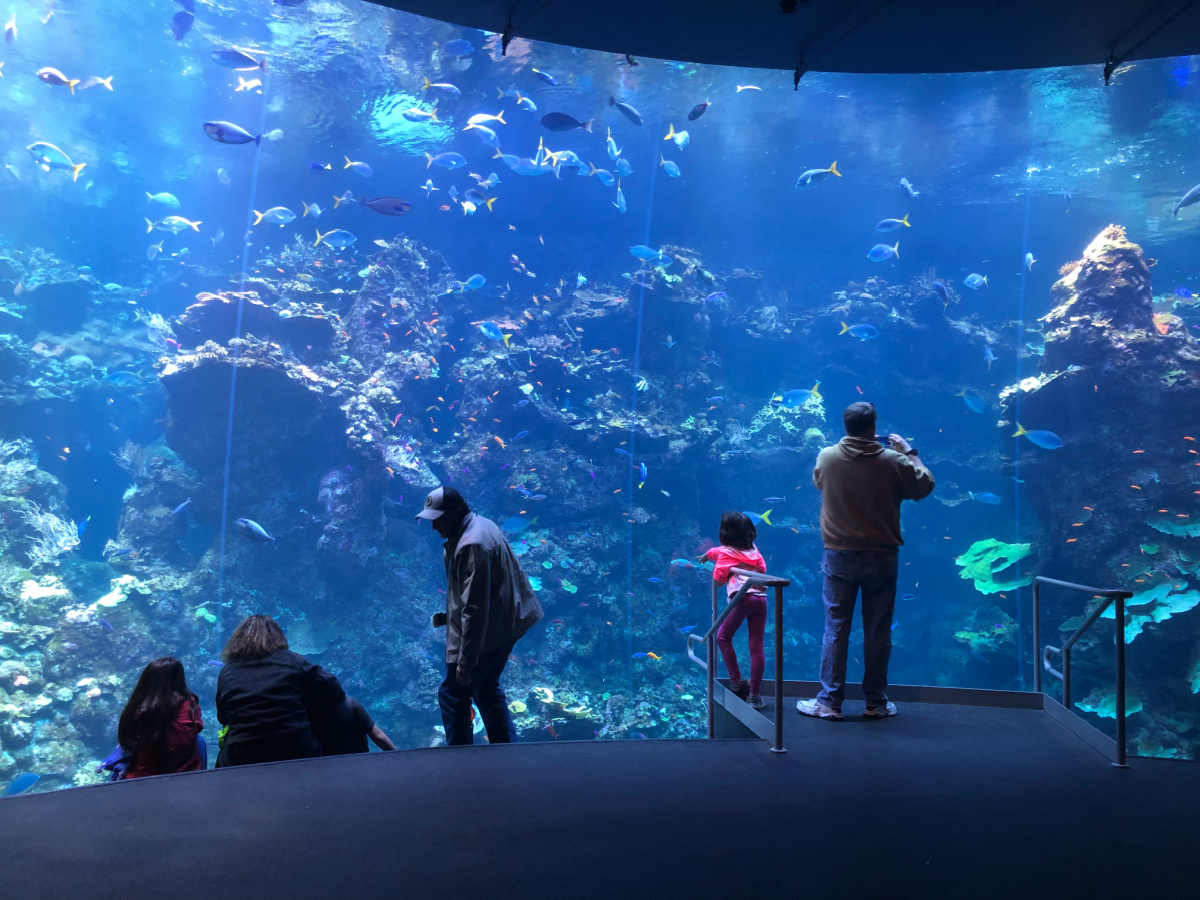
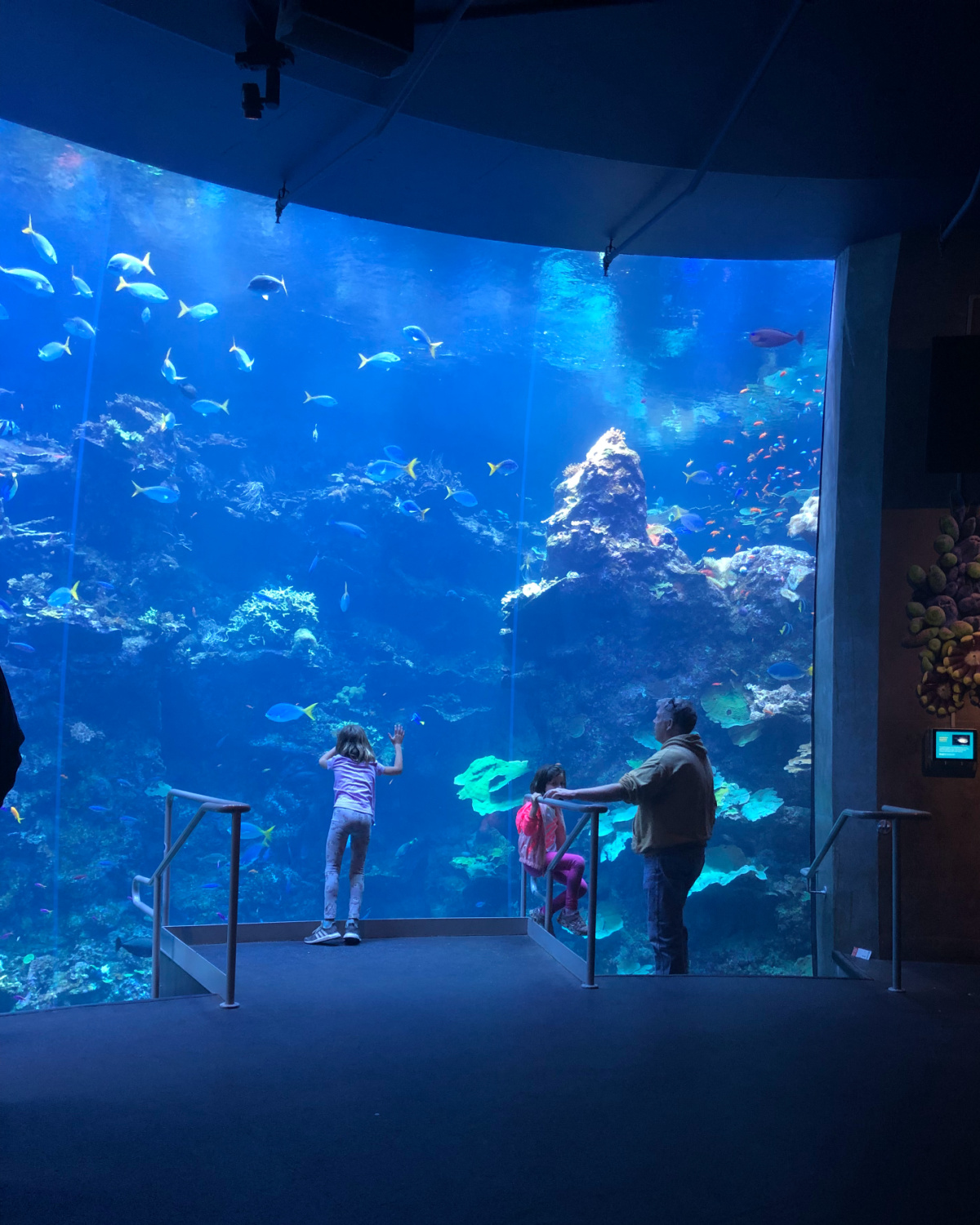
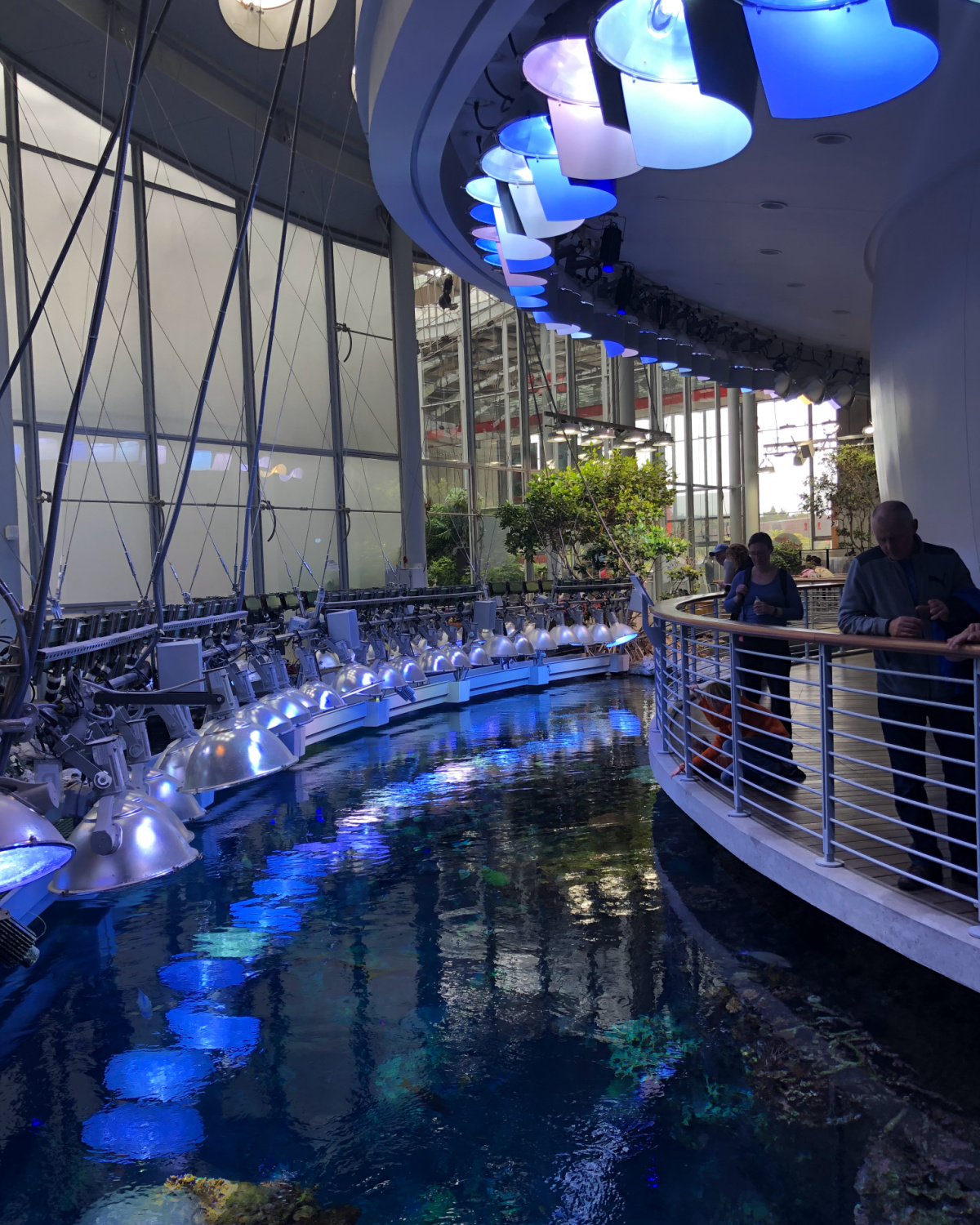
One of the absolute showstoppers is the enormous Philippine Coral Reef.
This was one of those exhibits where you walk into the room and immediately stop.
The viewing window is huge, and the aquarium is filled with coral and seemingly endless schools of colorful tropical fish. When we visited, Lilly stood right in front of the glass while David took pictures, and the humans looked tiny compared with the reef behind them.
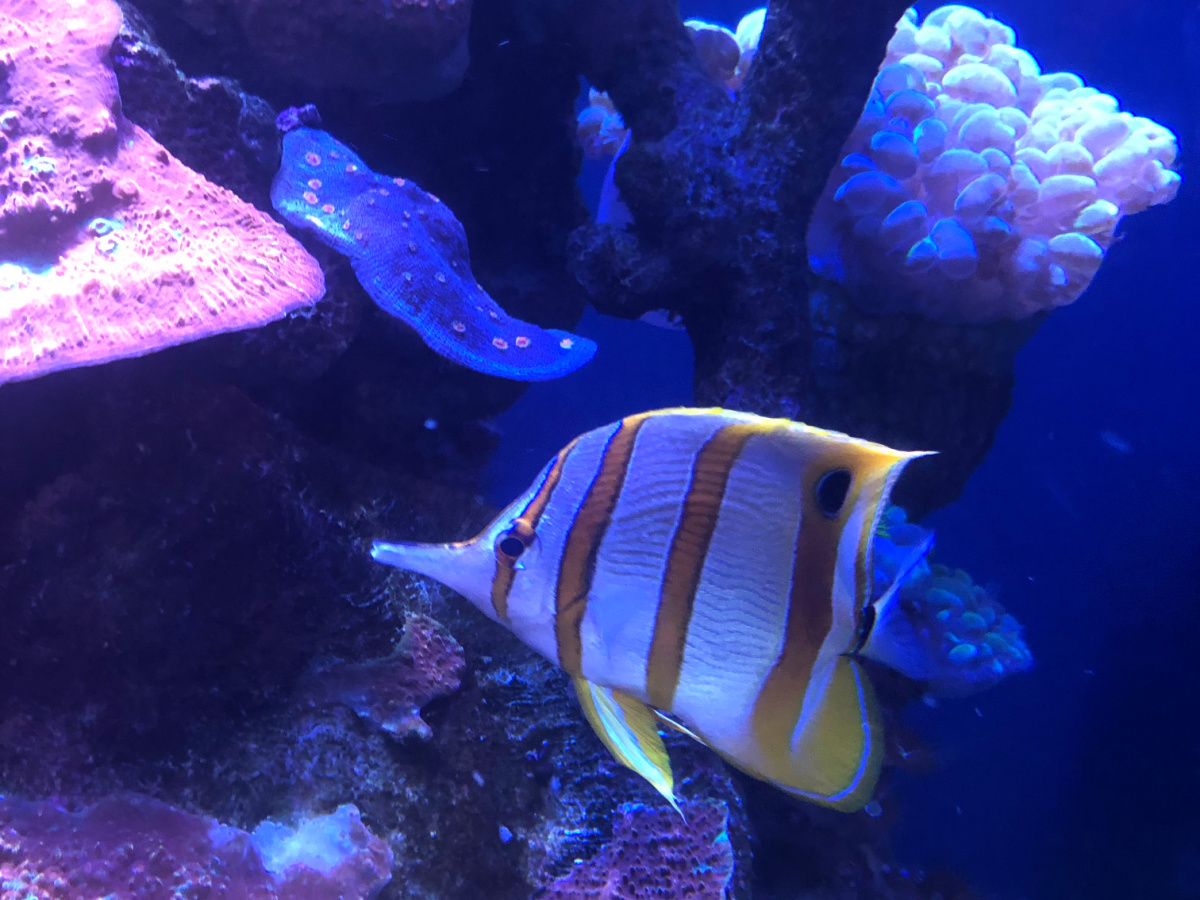
The current Philippine Coral Reef exhibit is a 212,000-gallon living coral reef, and the Academy calls it one of the largest displays of its kind.
Even if you’re planning to visit the Monterey Bay Aquarium elsewhere on your California trip, I wouldn’t skip Steinhart Aquarium because of that. The experience here is different enough that it doesn’t feel redundant.
California Coast
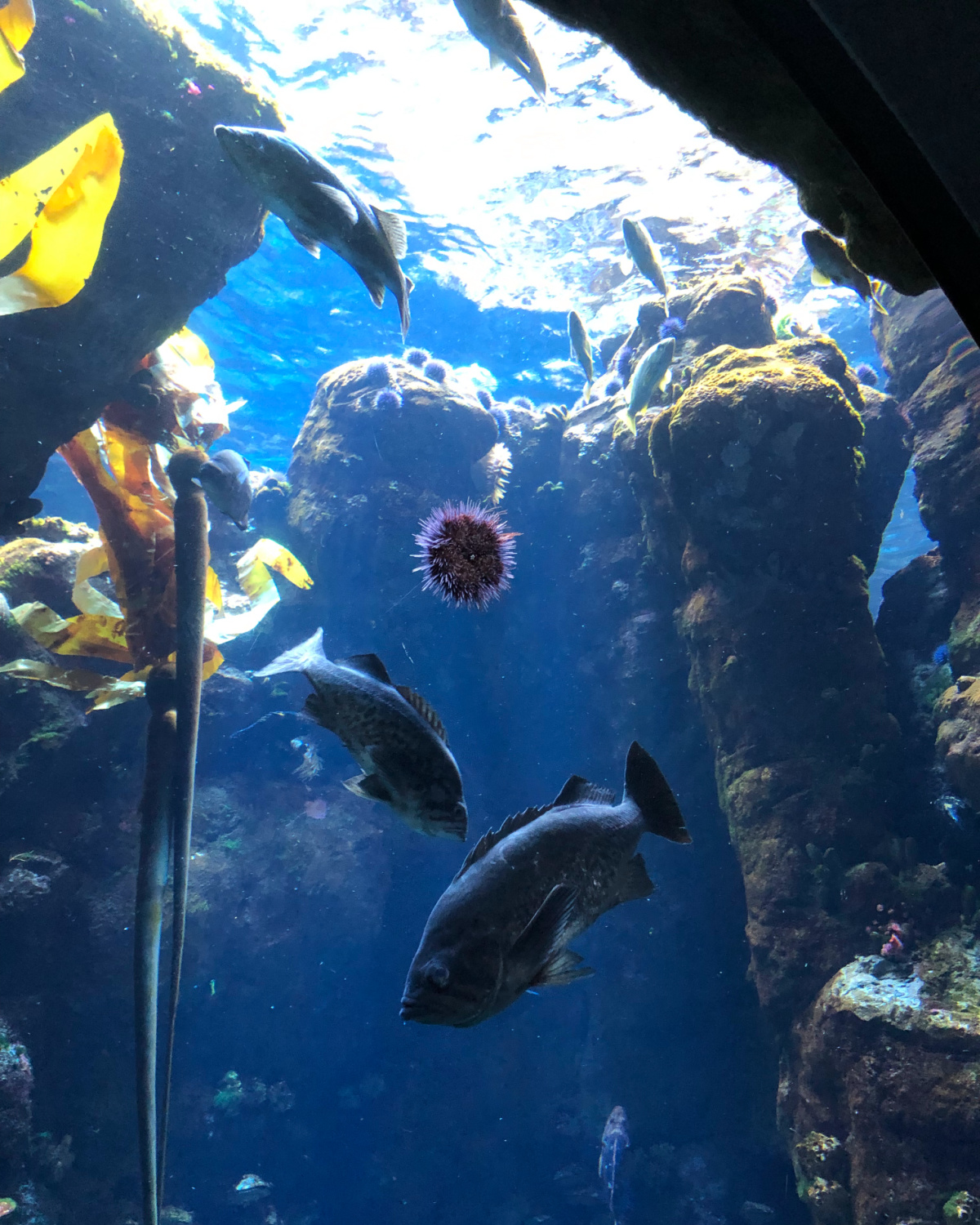
Another section focuses specifically on the marine life found off the California coast.
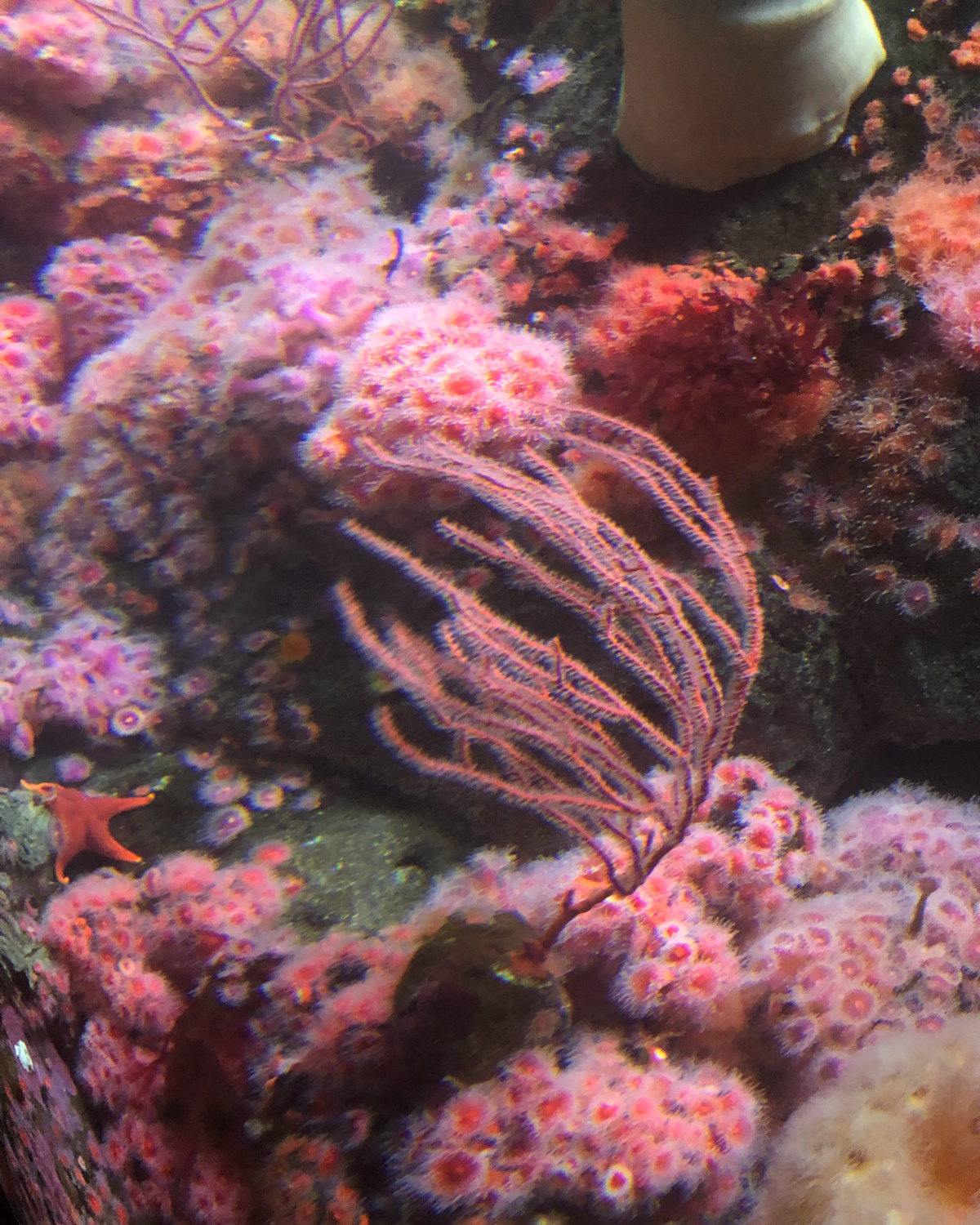
We saw large fish swimming through rocky underwater habitats along with sea urchins, sea stars, anemones, and other creatures you would expect to find along the Pacific coastline.
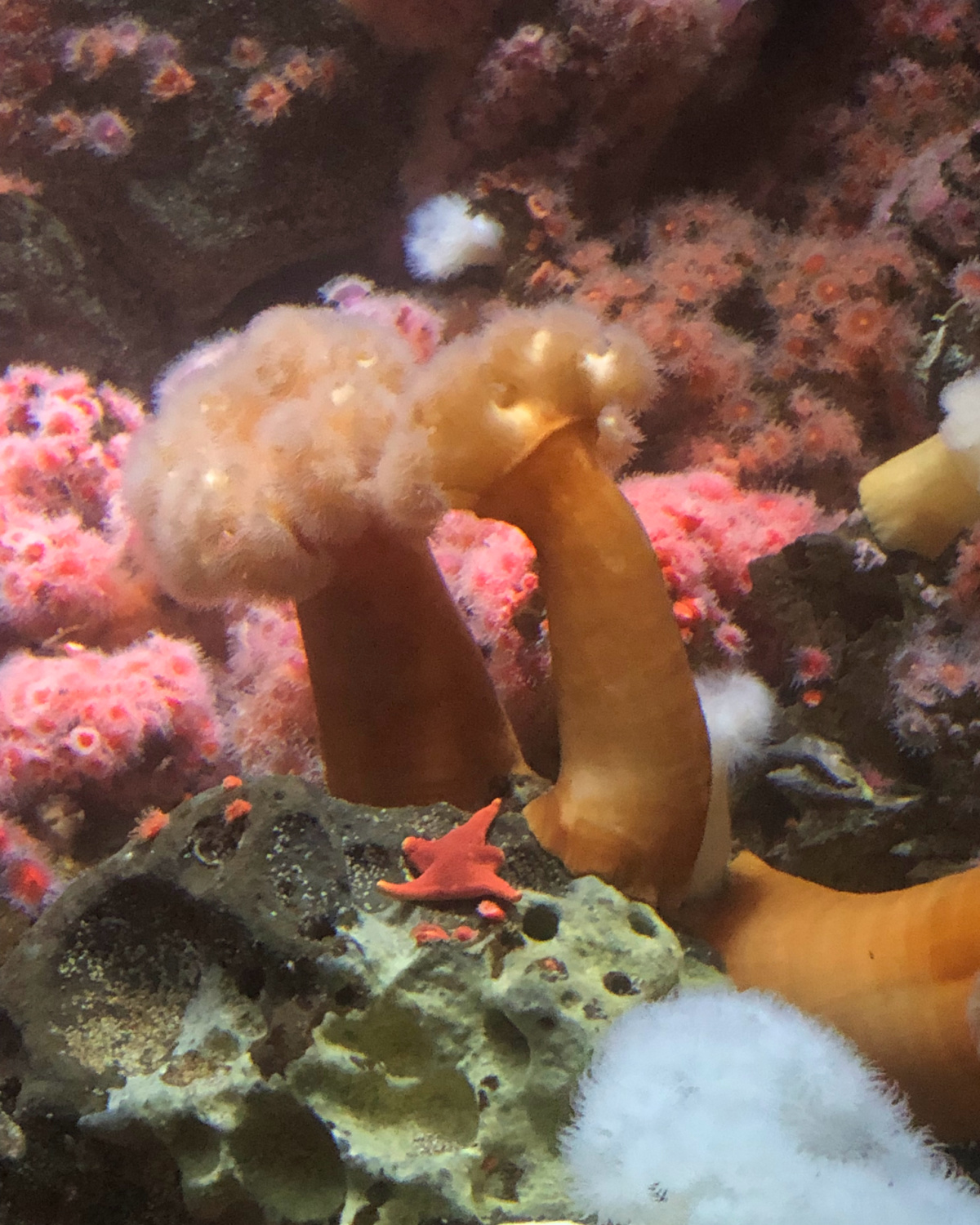
I especially like exhibits like this when we’re traveling because they connect the museum to the destination itself. You’re not simply learning about marine ecosystems somewhere else in the world. You’re seeing the animals and environments found right outside San Francisco.
The Academy’s current California Coast exhibit includes rockfish, eels, anemones, sharks, and other species native to the region.
Tidepools and Smaller Marine Life
Not everything in the aquarium is enormous.
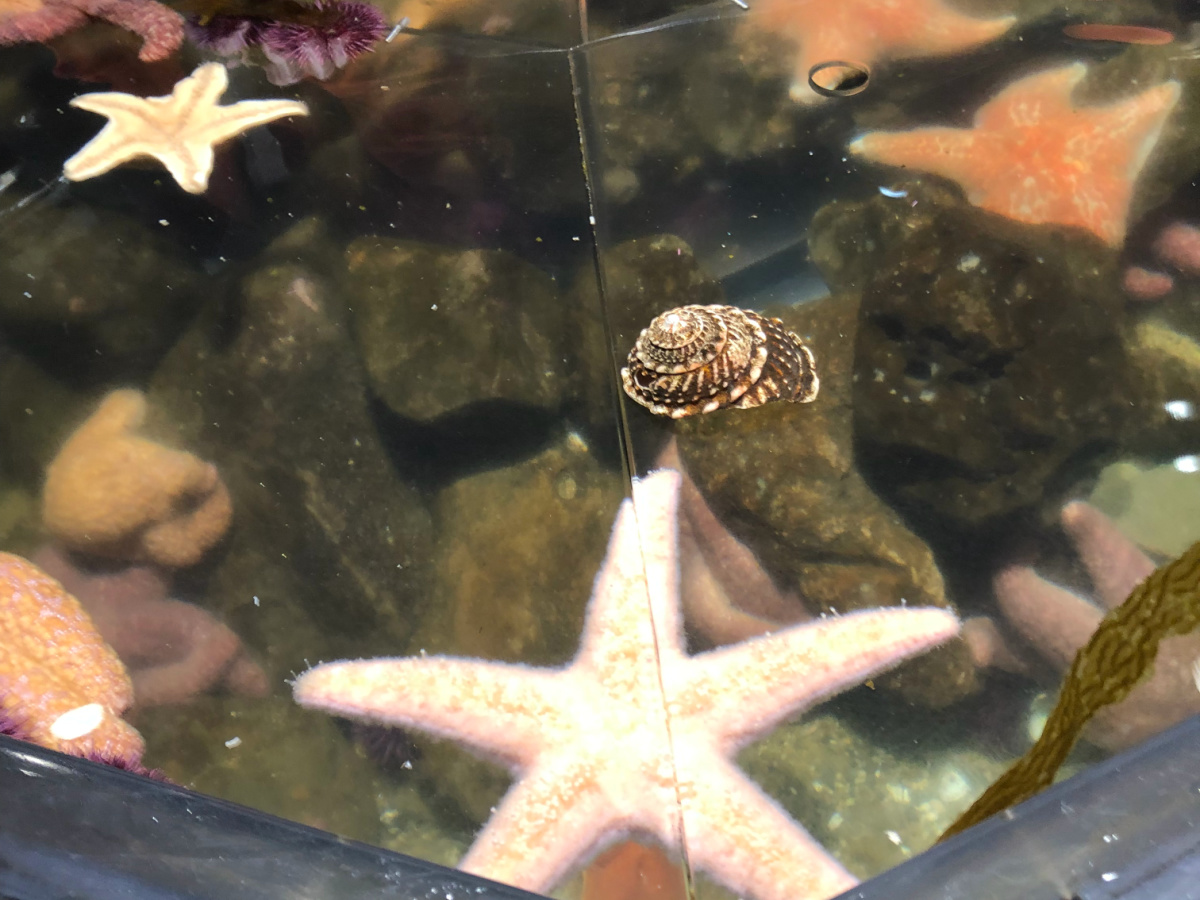
Some of the smaller displays were just as interesting, particularly the tidepool-style exhibits where you could get a much closer look at sea stars, shells, anemones, and other marine life.
When we visited, the Academy specifically highlighted its Discovery Tidepool as one of the experiences that was great for kids.
That was something I appreciated about this museum in general. There was so much to see that it could have been overwhelming, but the Academy actually helped families figure out which exhibits and activities to prioritize.
Jellyfish and Other Aquarium Exhibits
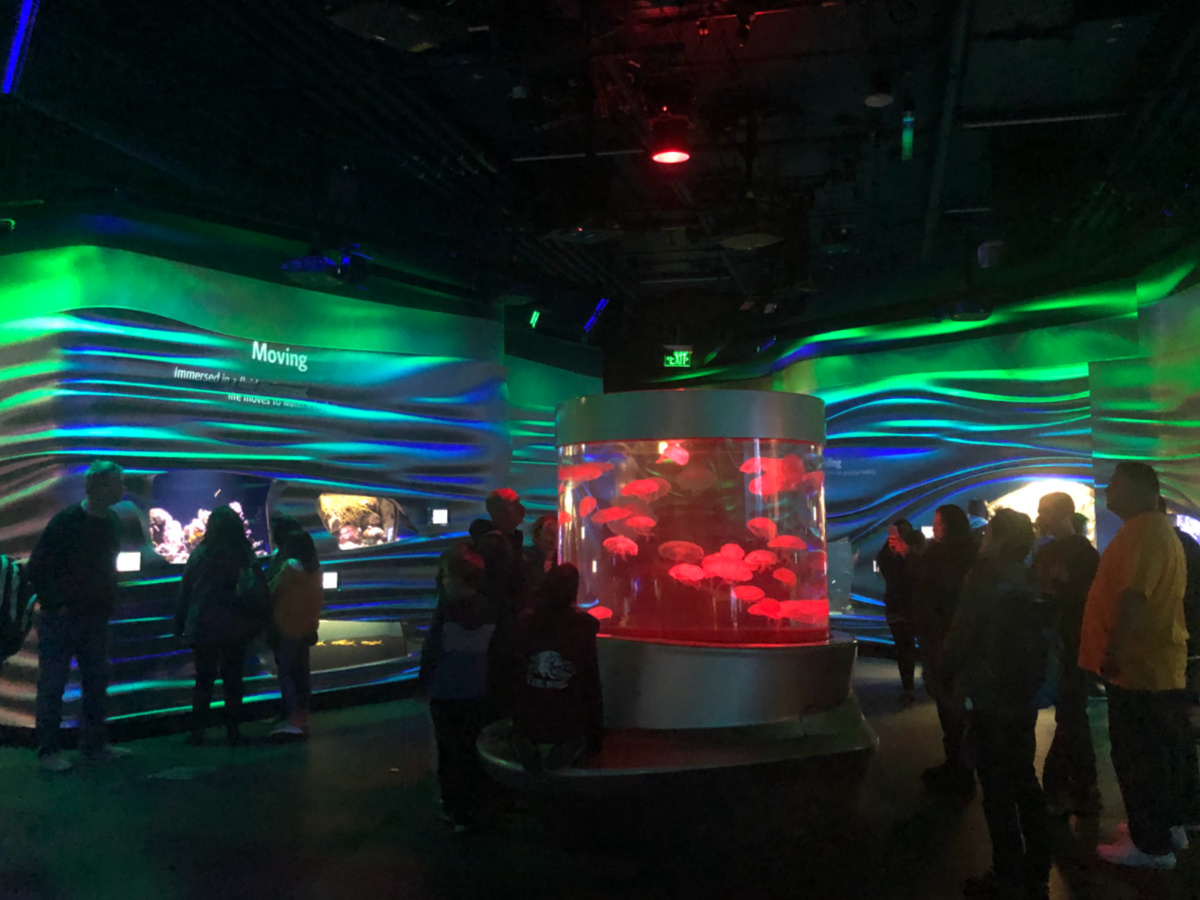
The aquarium also has plenty of those darker, atmospheric spaces that make aquariums so much fun to photograph.
We walked through exhibits illuminated with blue, green, and red lighting, including a beautiful jellyfish display and tanks filled with colorful fish and invertebrates.
And because the aquarium is integrated into the rest of the Academy rather than housed in a separate building, you keep encountering live animals throughout your visit.
Which brings us to one of the strangest—and most memorable—residents.
Meet the Albino Alligator
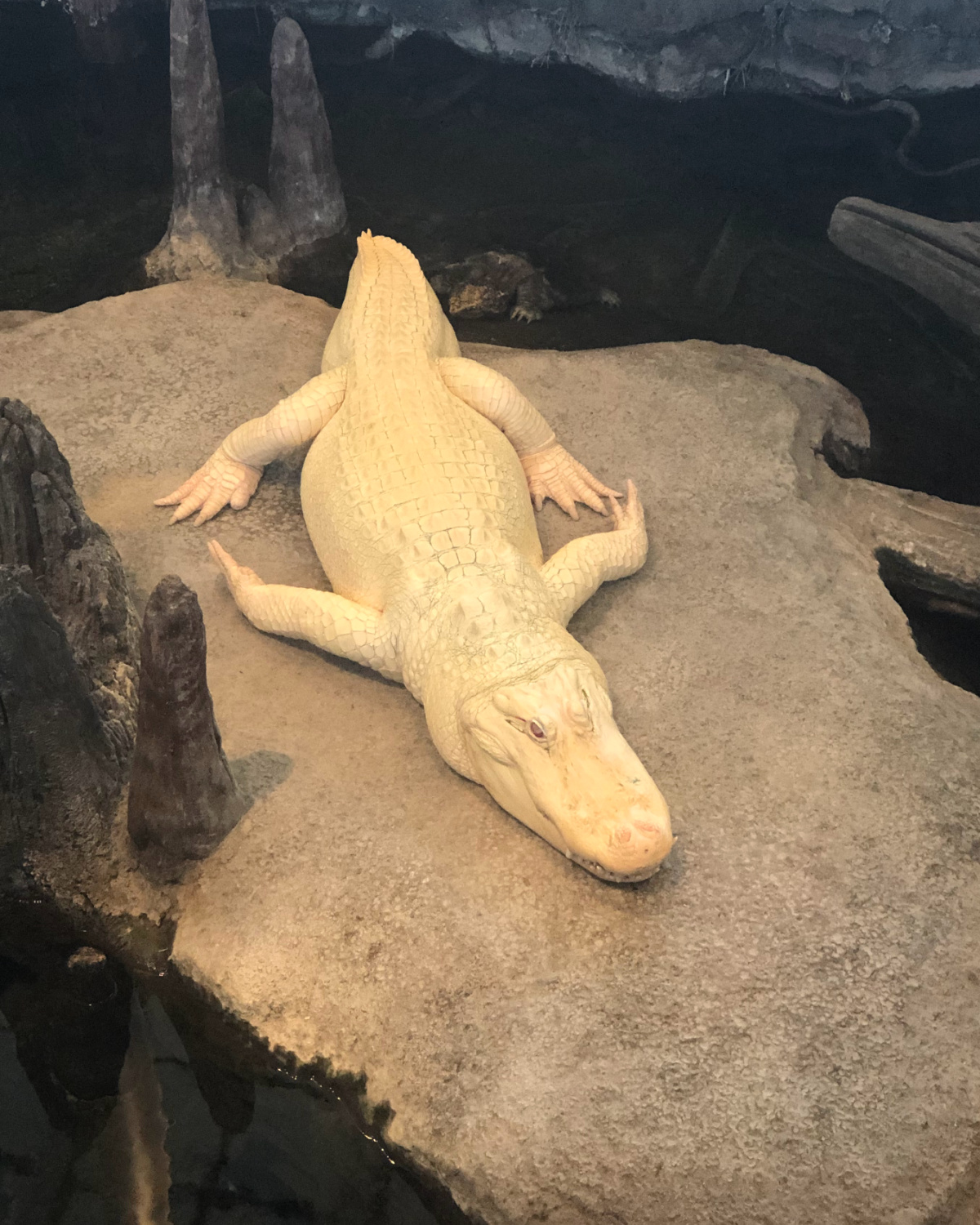
Yes, there is an albino alligator at the California Academy of Sciences.
Claude became one of the Academy’s best-known animals, and he was definitely hard to miss when we visited.
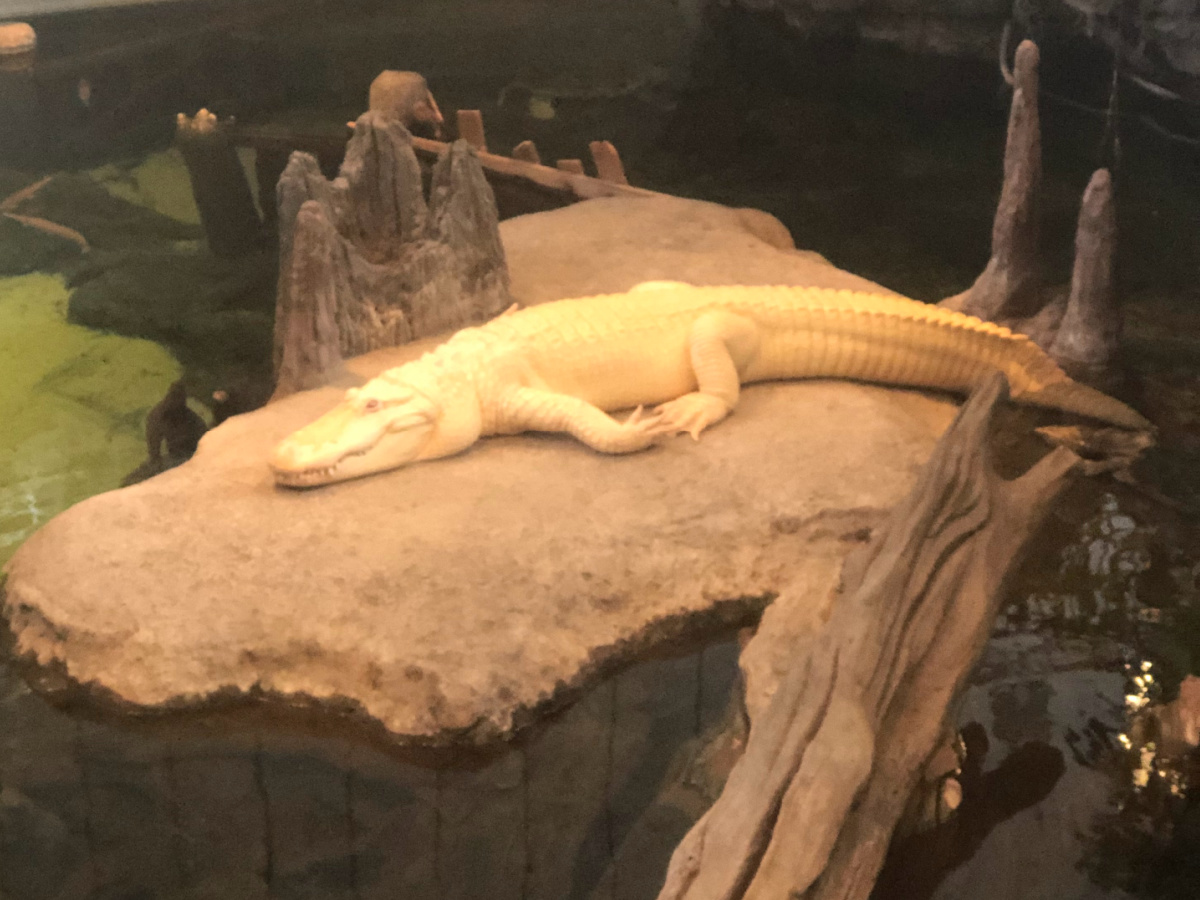
Seeing an almost completely white alligator sprawled out beside the water is one of those things that stops you in your tracks, even after you’ve already seen enormous coral reefs and tropical fish.
The Swamp area also includes freshwater fish and alligator snapping turtles, so Claude isn’t the only reason to stop here.
This is another good example of why the Academy doesn’t fit neatly into one category. You might go from a coral reef to an alligator to a rainforest without ever leaving the building.
Osher Rainforest
The other experience I would consider an absolute must-do is Osher Rainforest.
You can’t miss it.
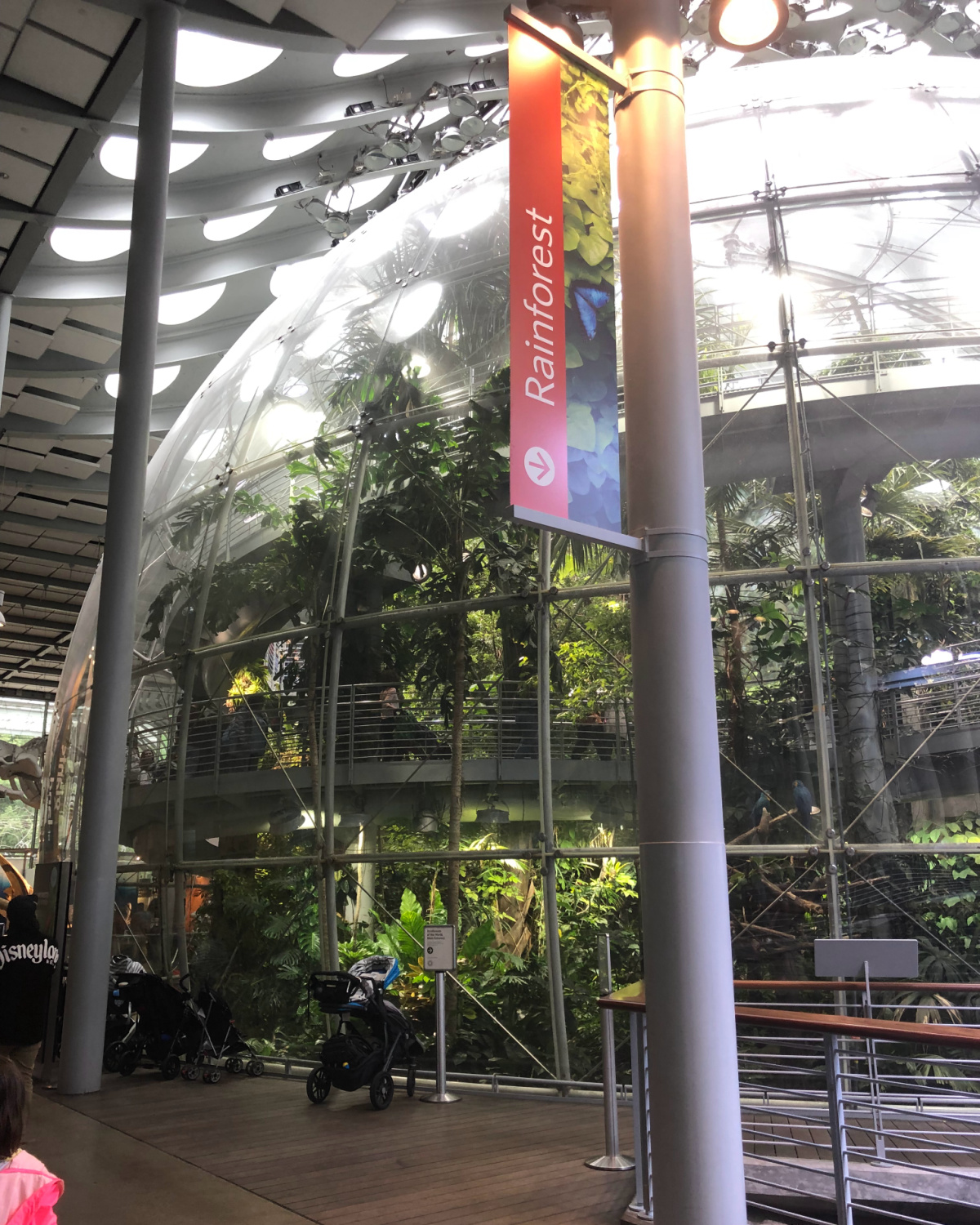
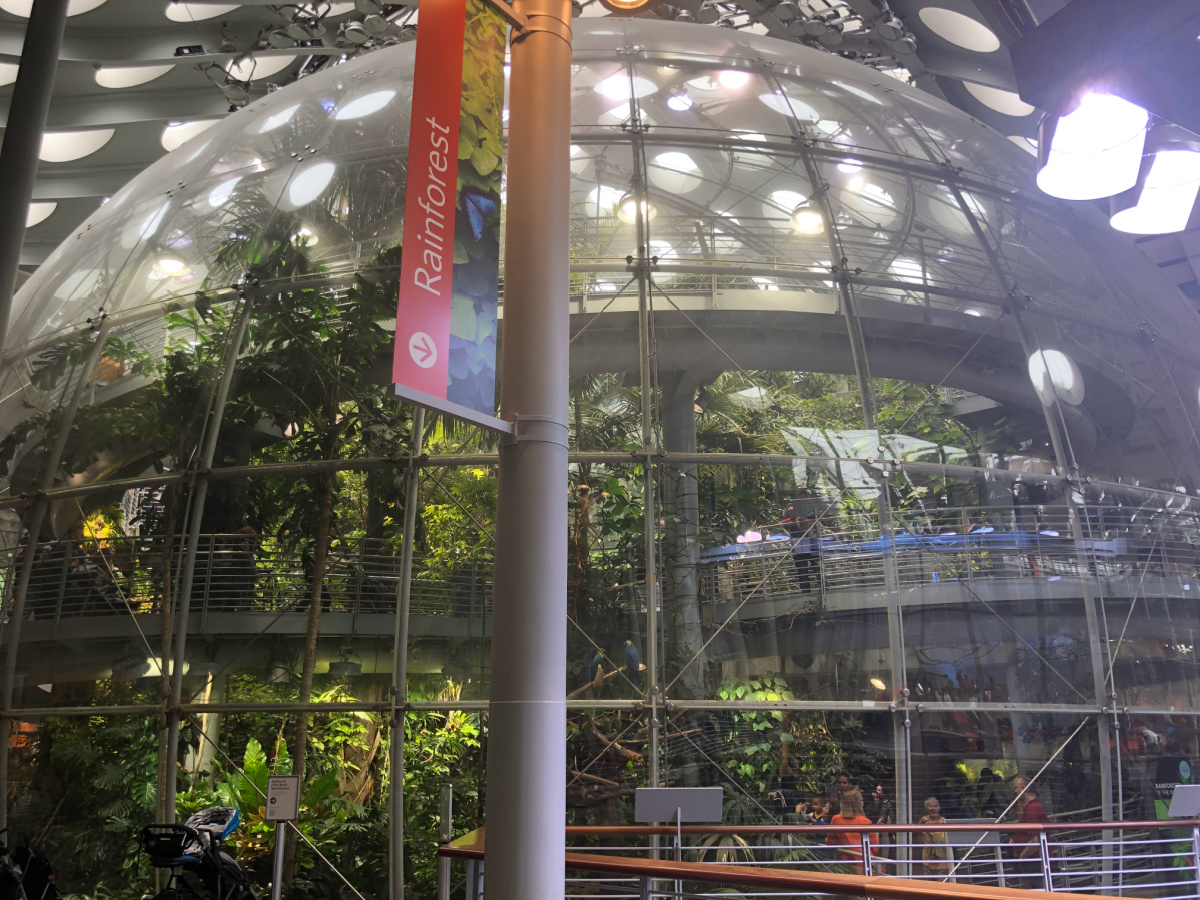
The rainforest is housed inside an enormous glass dome rising through the museum. Even before you go inside, it is one of the most visually striking parts of the building.
Then you step through the doors and enter a completely different environment.
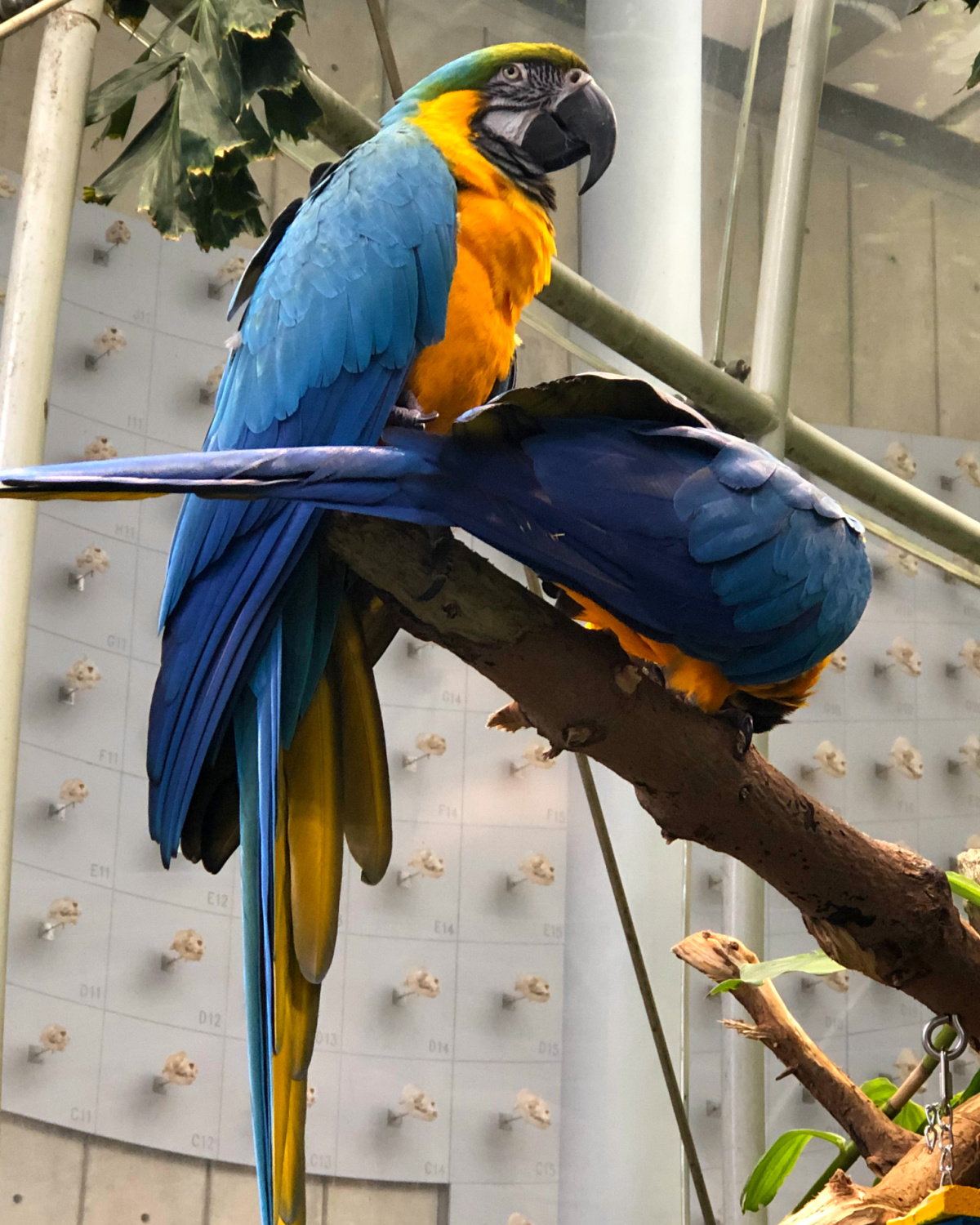
The rainforest rises four stories, with a walkway gradually carrying visitors higher through the vegetation. Birds and butterflies fly freely through the space, while amphibians, reptiles, insects, and other tropical animals live throughout the habitat.
We saw everything from tiny frogs hiding among the leaves to gorgeous butterflies and brilliantly colored macaws.
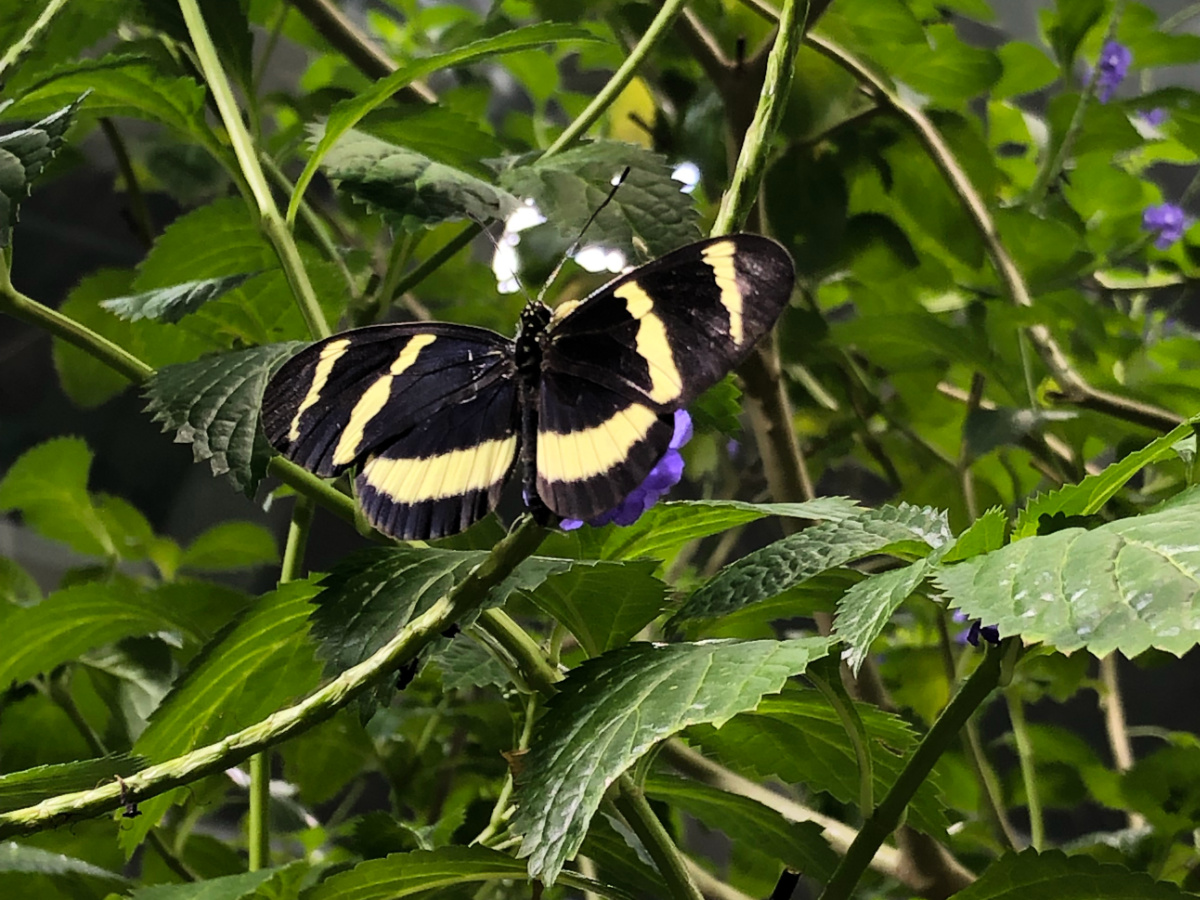
And this is not a little conservatory that you walk through in five minutes.
You gradually wind your way upward through the habitat, which gives you a chance to look at the rainforest from several different levels. The experience changes as you climb toward the canopy.
It’s humid, lush, and very immersive.
Take Your Time in the Rainforest
This is one place where I would resist the temptation to rush.
Some of the animals are obvious. You’re probably going to notice a giant colorful bird sitting on a branch.
Others require a little more patience.
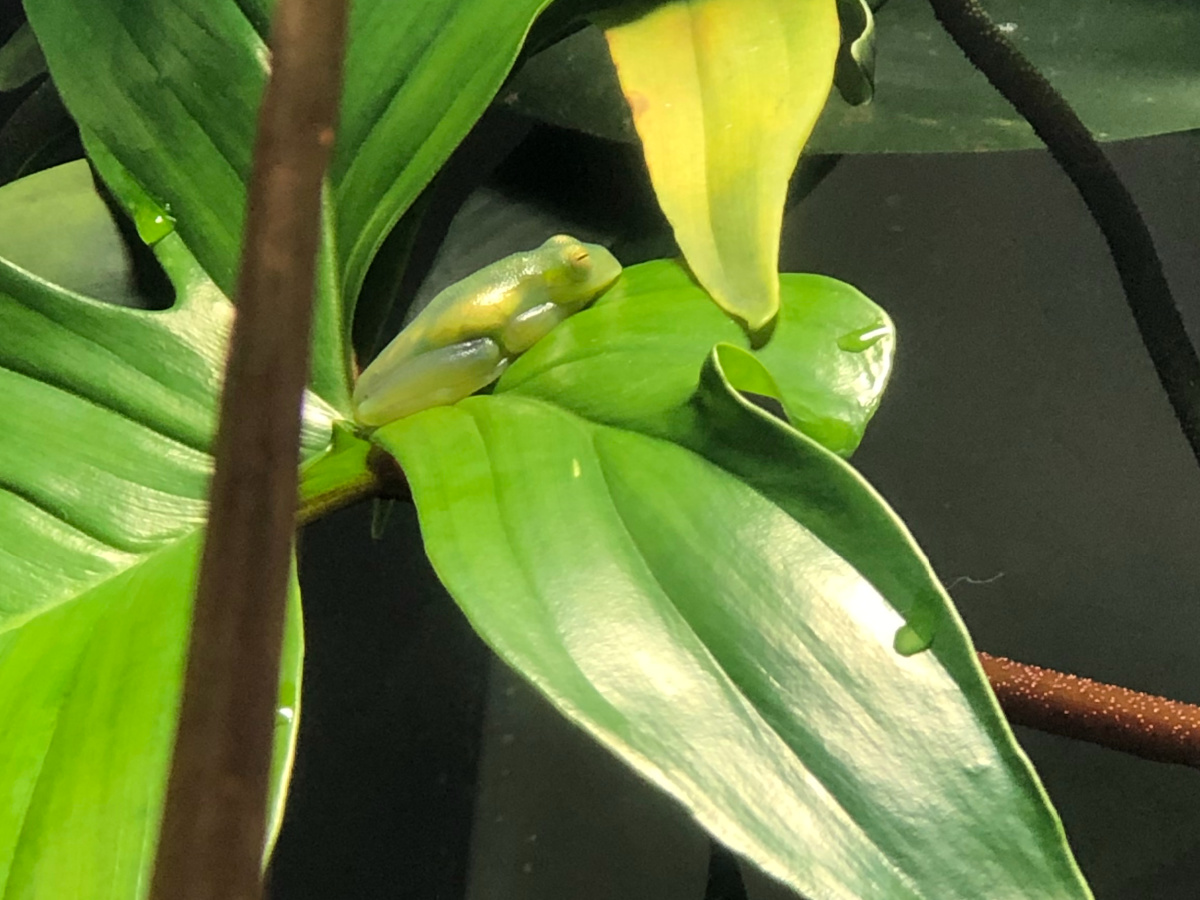
One of my favorite photographs from our visit is of a tiny green frog almost disappearing against a group of bright green leaves. Butterflies can land practically anywhere. There are all kinds of little creatures tucked among the vegetation.
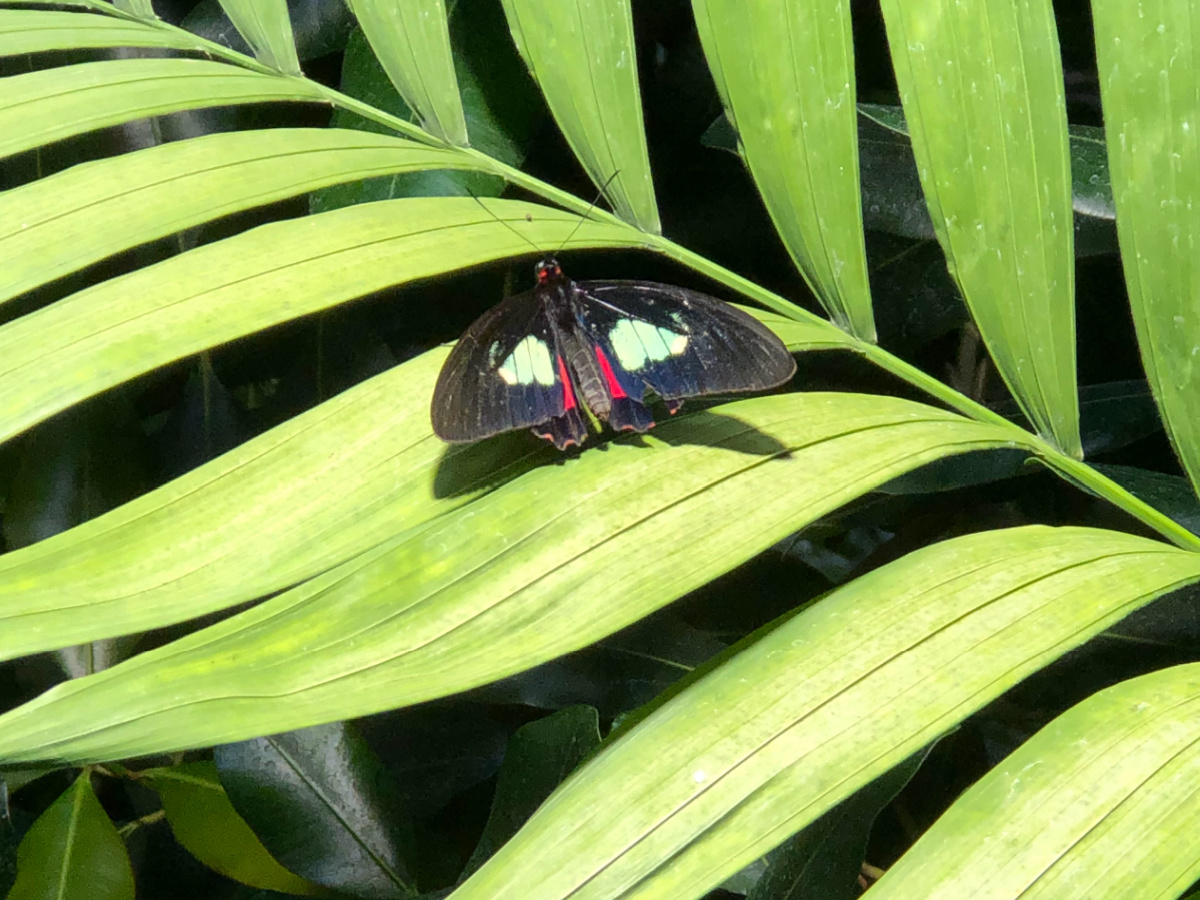
Kids who love animals could easily spend quite a while searching for them.
And once again, the Academy does a really good job of making the experience feel like more than just looking at displays. You’re actually moving through the habitat.
Morrison Planetarium
After exploring animals on land and underwater, you can go in a completely different direction at Morrison Planetarium.
We did attend a planetarium show during our visit. I don’t have photographs from inside because, well, it’s a planetarium. You’re sitting in a dark theater looking at a giant dome. Taking pictures isn’t exactly the point.
But it is absolutely worth including in your plans.
Morrison Planetarium has a 75-foot-diameter dome and uses digital projections based on scientific data to create immersive journeys through space and other scientific subjects. Reservations are required for shows and are available on a first-come, first-served basis. The Academy currently does not admit children under four and notes that some presentations may not be appropriate for children younger than seven.
The specific programs change over time, so check the schedule for your visit rather than planning around a particular title.
As an example of the kinds of programs you might see, current shows include Timescapes, which explores California’s ancient past and possible future, and Living Worlds, which looks at what scientists can learn from Earth as they search for life elsewhere in the universe.
I would make a planetarium reservation fairly early in your visit rather than assuming you’ll be able to walk into whichever show you want later in the day.
And then, once you come back out into the museum, there is still an entire natural history museum waiting for you.
Natural History Exhibits at the California Academy of Sciences
One of the things that surprised me most about the California Academy of Sciences was how much traditional natural history is mixed in with the aquarium, rainforest, and planetarium.
You can go from watching tropical fish swim through a massive coral reef to standing underneath a whale skeleton or walking past African wildlife dioramas.
It is one of the reasons the Academy feels so different from a typical science center.
There is plenty of hands-on science here, but there are also the kinds of specimens and exhibits you would expect to find in a major natural history museum.
Tusher African Hall
Tusher African Hall is probably the clearest example.
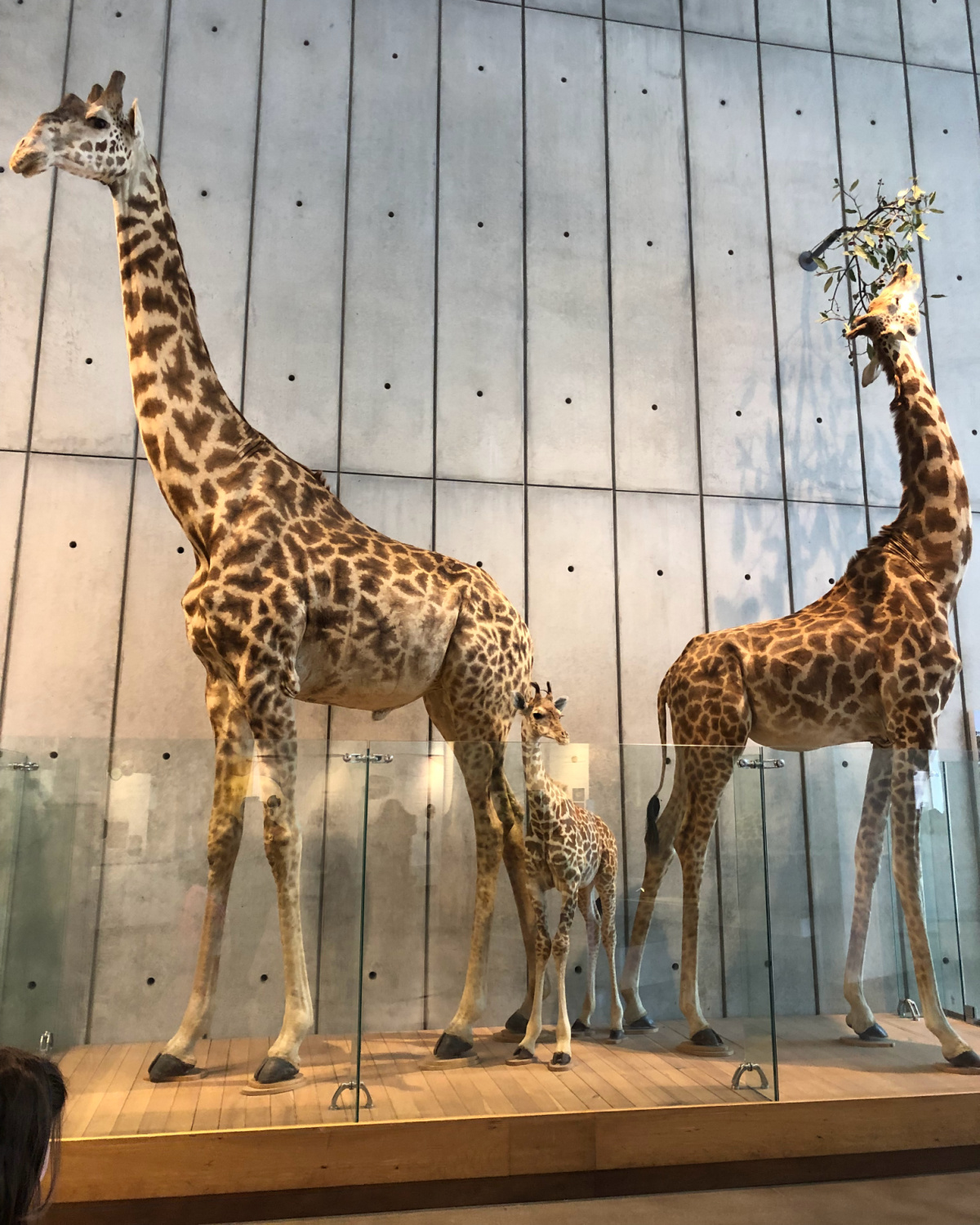
The hall features large dioramas filled with African wildlife, including giraffes, zebras, lions, and other animals displayed in recreated natural habitats.
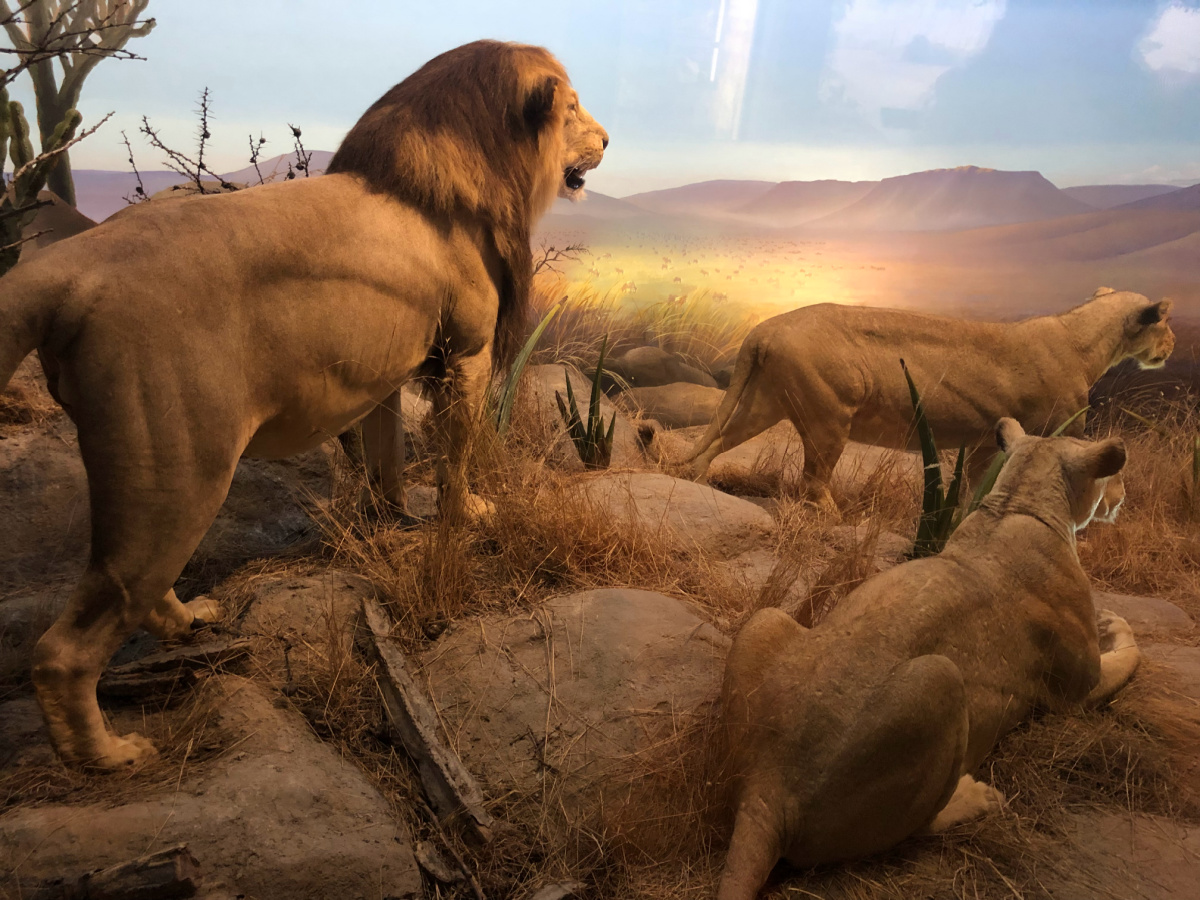
These are classic natural history museum exhibits, but they are beautifully done.
When we visited, some of the displays were enormous. The giraffes alone towered over the gallery, and the lions, zebras, and other animals made the space feel much more substantial than I had expected.
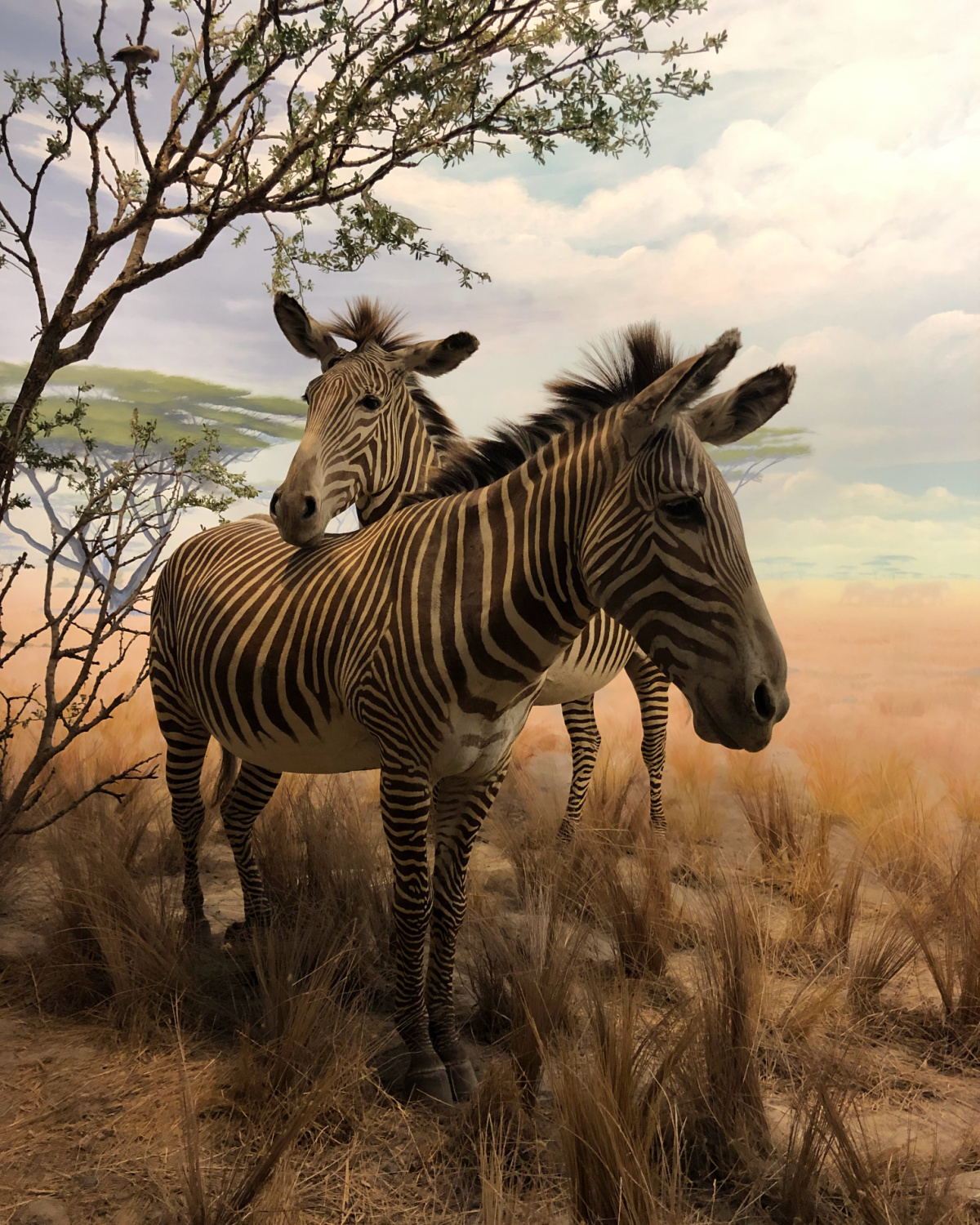
If your kids enjoy the animal halls at places like the Smithsonian National Museum of Natural History, they will probably enjoy this section too.
And then, right in the middle of all those traditional museum displays, you get live penguins.
See the African Penguins
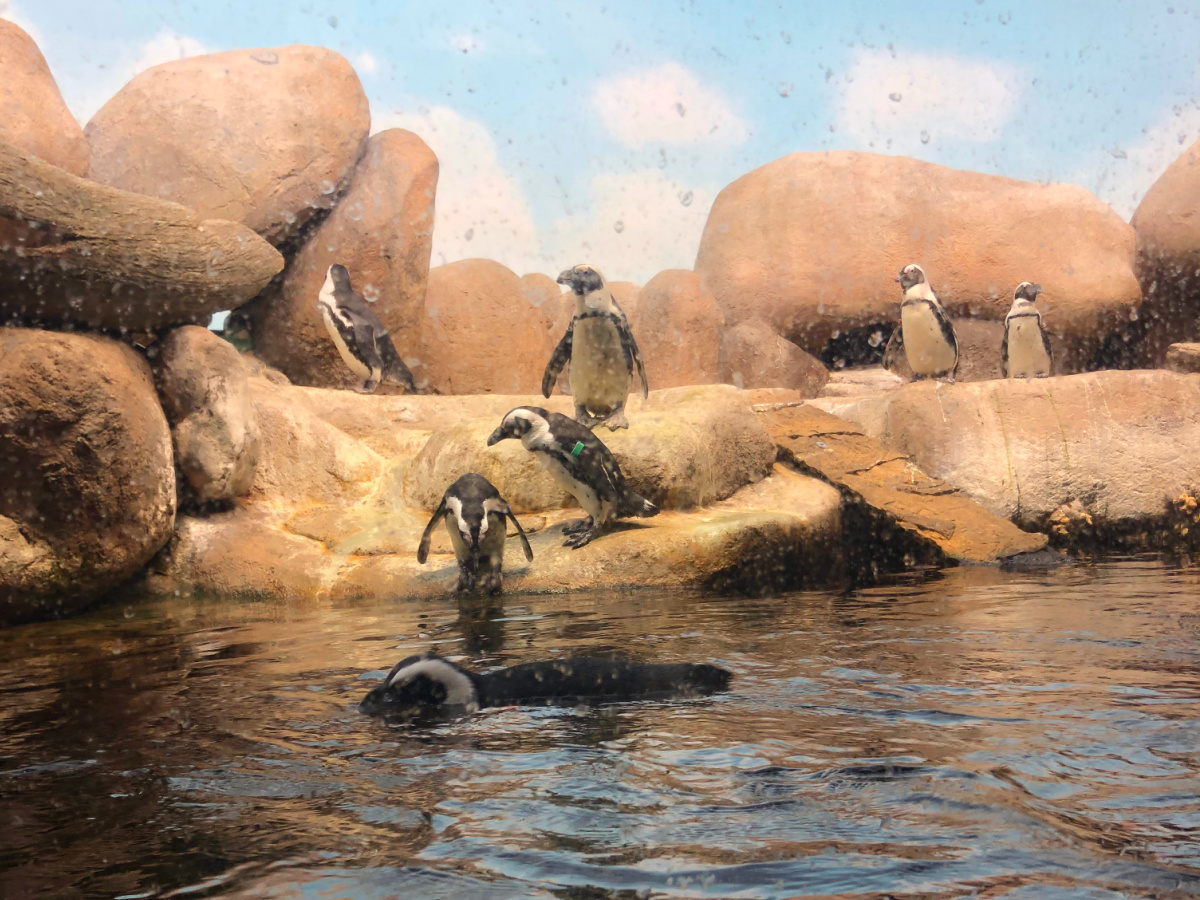
The African penguins are one of the most popular live-animal exhibits in this part of the museum.
We spent some time watching them swimming, waddling around the rocks, and generally doing what penguins do best: being ridiculously entertaining.
When we visited, the Academy specifically highlighted penguin feedings as one of its recommended activities for families.
That is worth paying attention to.
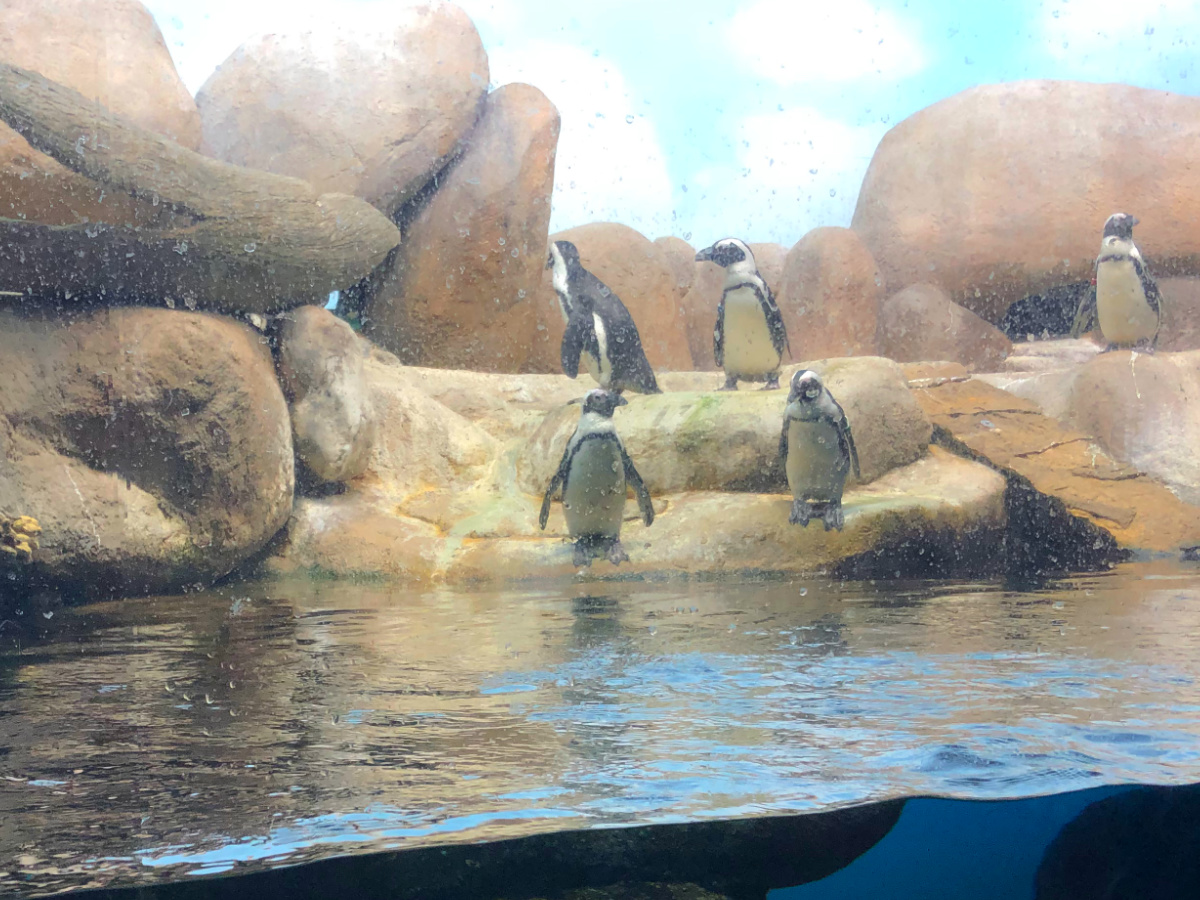
The Academy offers a variety of scheduled programs and animal presentations throughout the day, so check the daily schedule when you arrive. If seeing a feeding or animal presentation is important to you, it makes sense to build the rest of your visit around those scheduled times.
The penguin habitat is another good example of how seamlessly the Academy blends a natural history museum with a living animal collection.
You can literally be looking at African wildlife dioramas one minute and watching live penguins swim the next.
Dinosaurs and Prehistoric Life
And yes, there are dinosaurs.
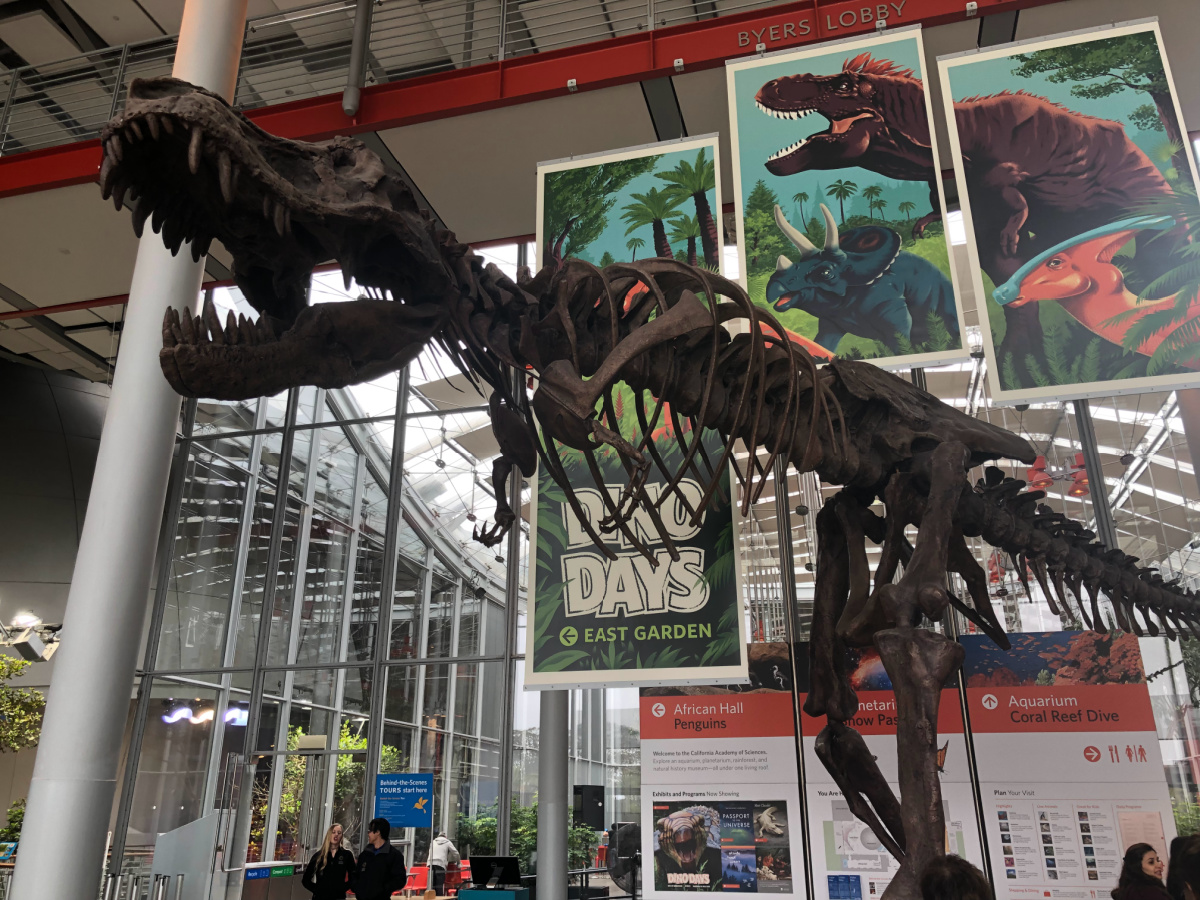
When we visited, there was a large dinosaur skeleton prominently displayed in the museum, along with dinosaur-themed exhibits nearby.
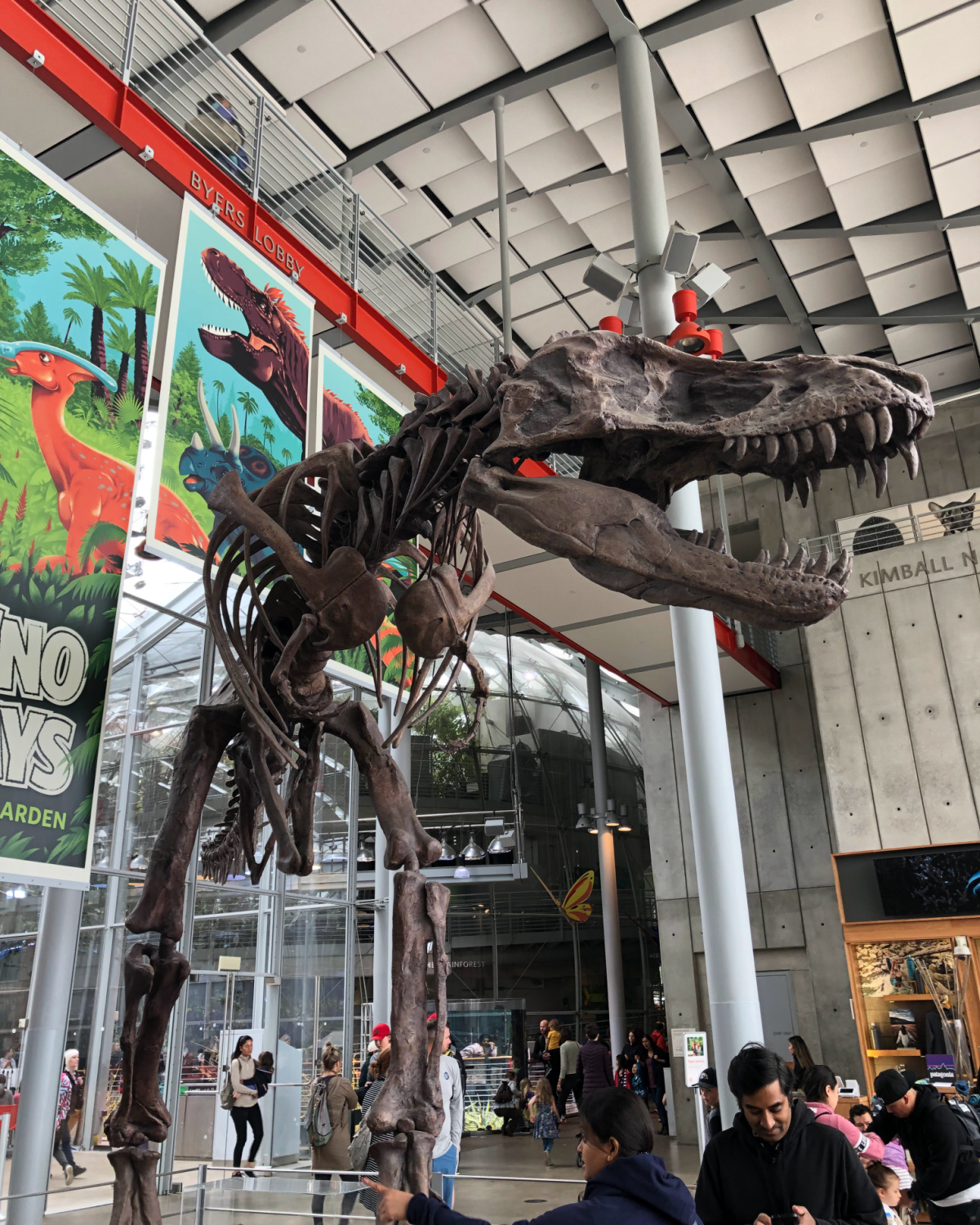
Dinosaurs are always an easy win with kids, but they also help reinforce just how wide-ranging this museum is.
You’re not visiting a museum devoted exclusively to marine science, ecology, astronomy, or natural history.
You’re getting pieces of all of them.
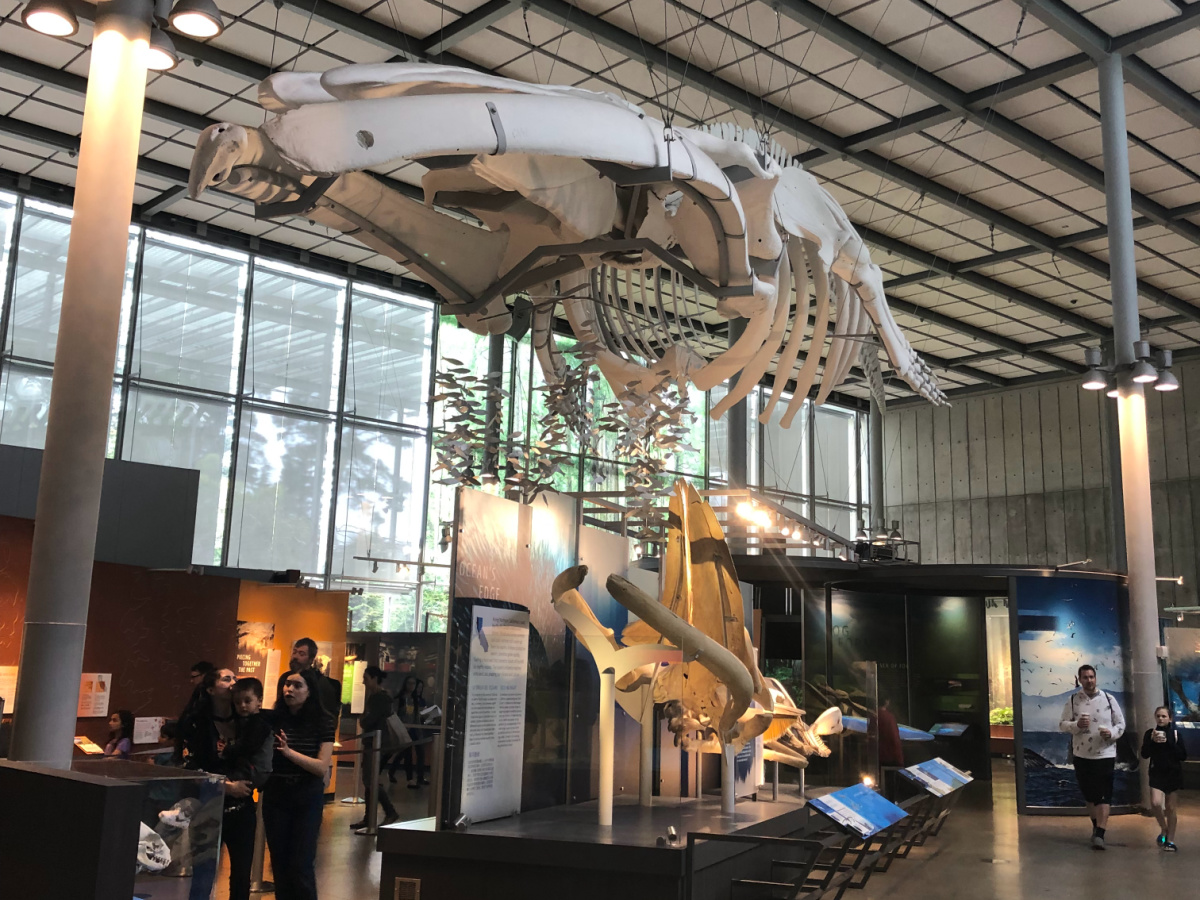
Because special exhibitions change over time, the exact dinosaur displays you see may be different from what we saw in 2019. But if you are visiting with a dinosaur-loving child, it is worth checking the current exhibition lineup before your trip.
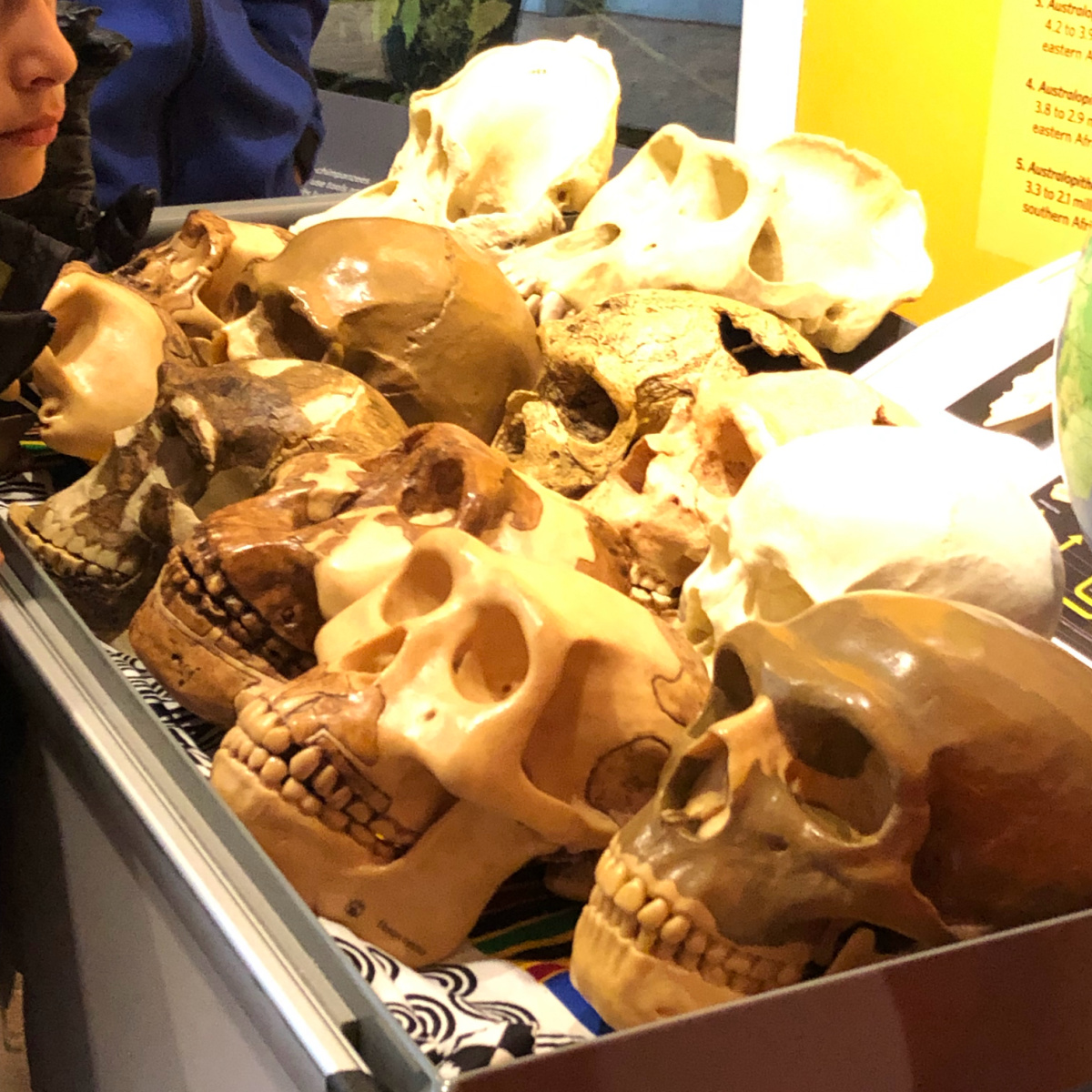
Giants of Land and Sea
Another exhibit that really stood out during our visit focused on the natural forces and environments of Northern California.
This included some truly enormous specimens.
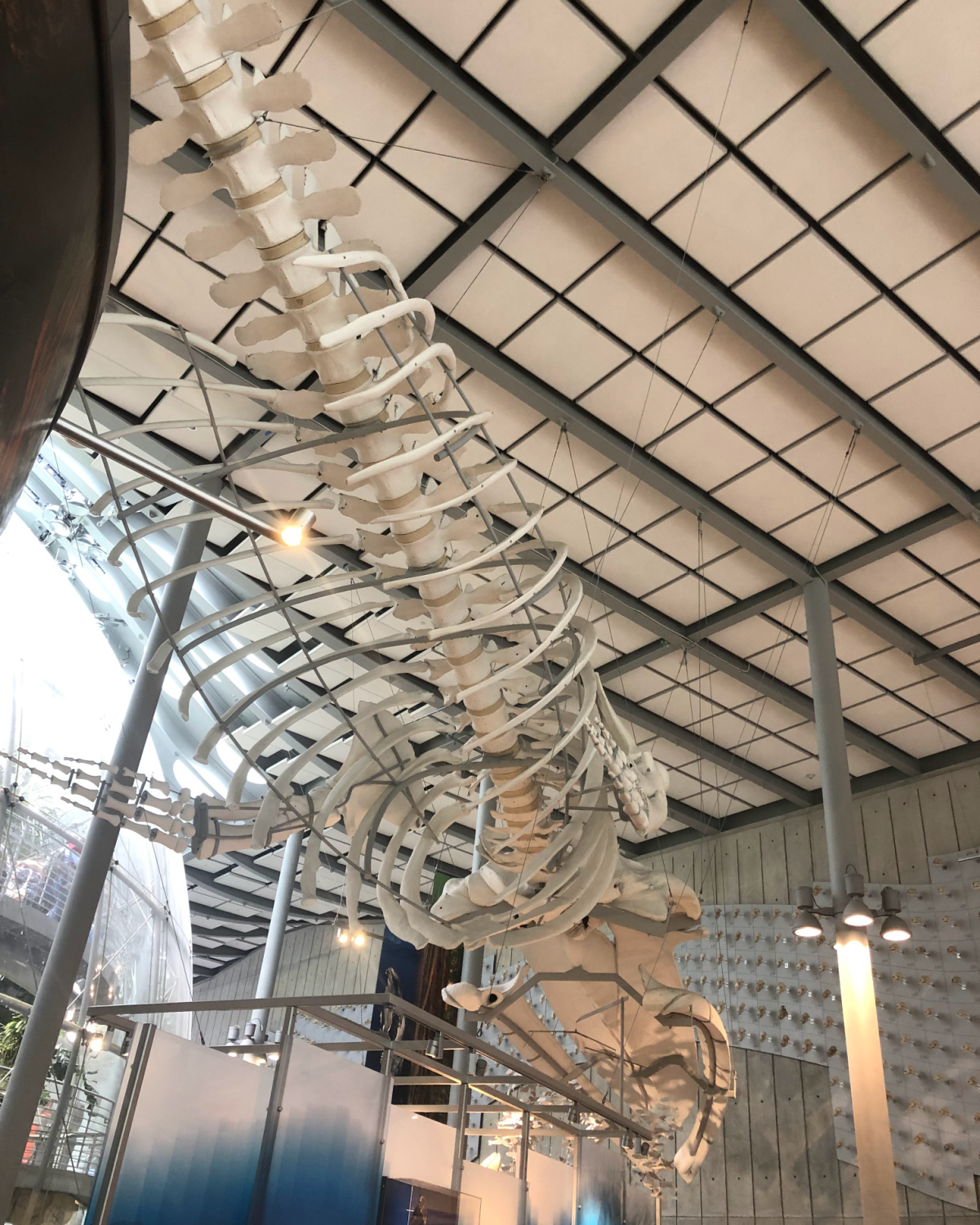
We saw massive whale skeletons suspended overhead along with an enormous cross-section of an ancient tree.
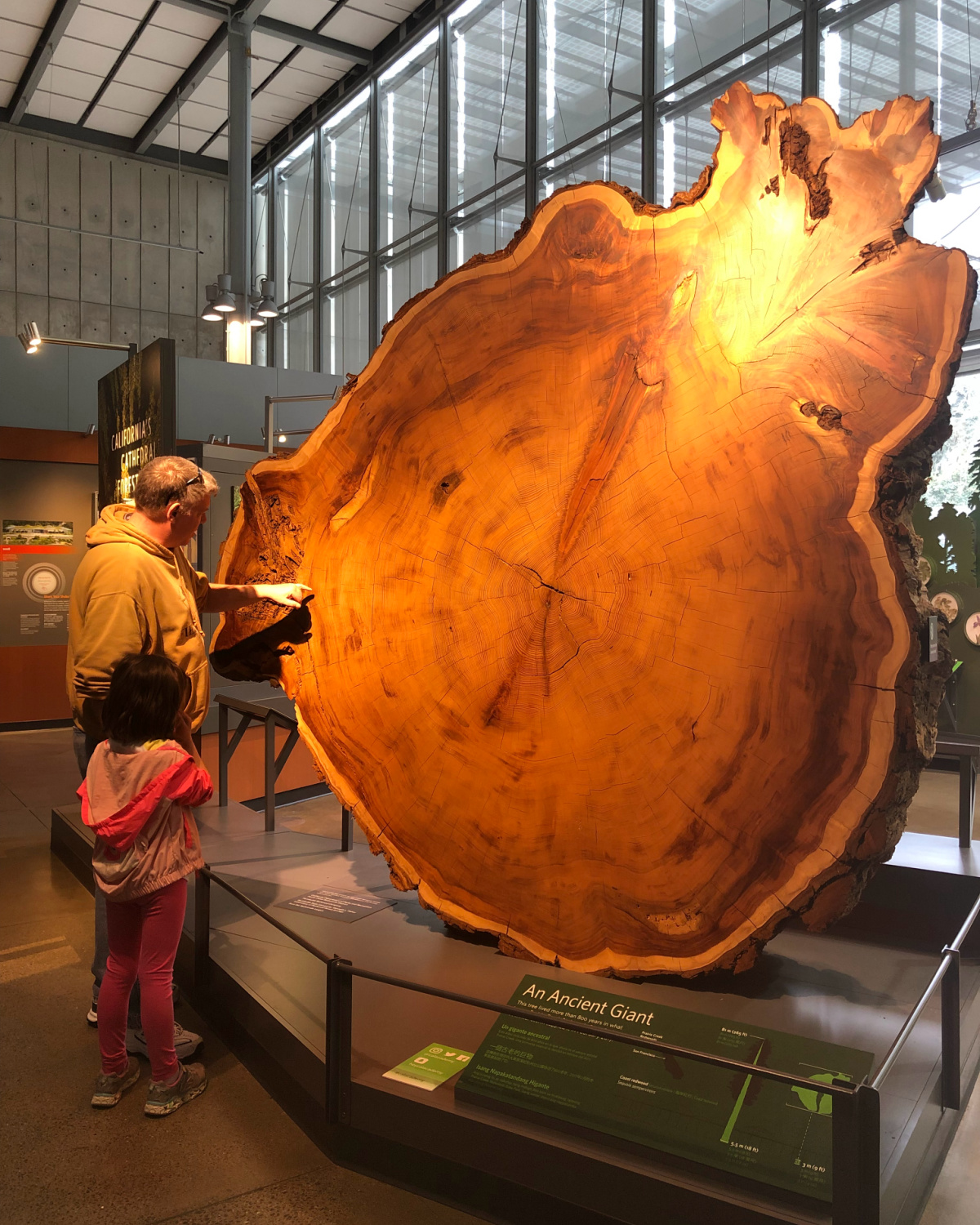
The tree section was particularly impressive because you could stand right beside it and get a sense of just how enormous these trees can become.
This is also where the Academy starts connecting its exhibits more directly to California itself.
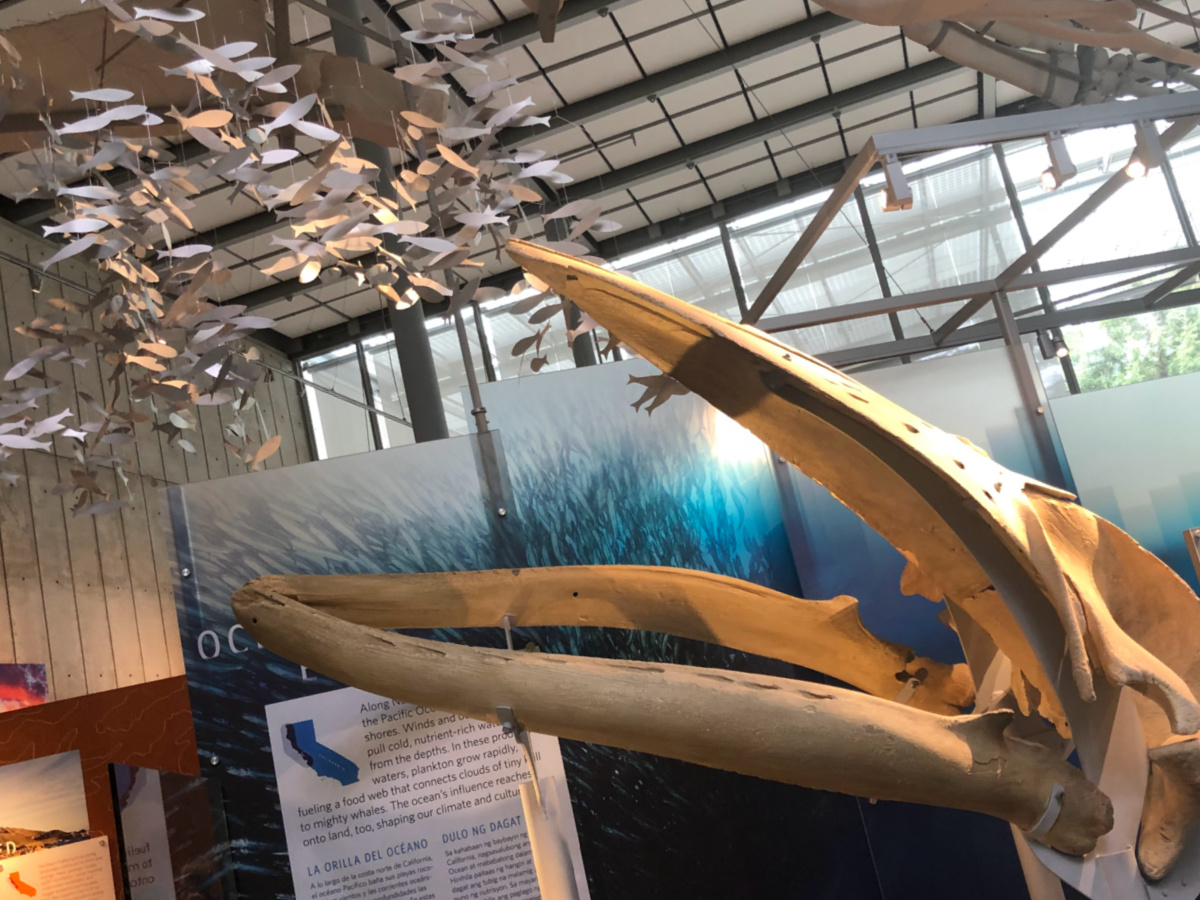
Rather than focusing only on wildlife from faraway ecosystems, the museum explores the geology, forests, coastline, and natural forces that have shaped Northern California.
For families who are visiting places like Muir Woods, the redwood forests, or the California coast during the same trip, these exhibits add some useful context.
Earthquakes, Tectonic Plates, and California Geology
You really can’t have a major science museum in San Francisco without talking about earthquakes.
The Academy includes exhibits exploring geology, tectonic plates, earthquakes, and the forces that continue shaping California.
This was another section I remember appreciating because it felt so connected to where we actually were.
California sits along an incredibly active tectonic boundary, so learning about earthquakes here feels much more immediate than seeing the same subject covered in a museum somewhere else.
For kids, this is also one of those subjects that naturally lends itself to interactive science exhibits.
Volcanoes, earthquakes, moving continents, and shifting plates are inherently dramatic.
And after spending part of your visit looking at living animals, this gives you another completely different type of science to explore.
Don’t Miss the Living Roof
The Living Roof is one of the architectural features that makes the California Academy of Sciences itself interesting.
The museum roof is covered with rolling green hills planted with native vegetation, creating a living ecosystem on top of the building.
We did not explore the Living Roof during our visit. I’m pretty sure it was raining that day, which made wandering around on the roof considerably less appealing.
But if you visit on a nice day, I would absolutely add it to your plans.
The rooftop gives you a completely different perspective on the Academy building, including the rounded skylights and domes rising out of the landscape.
It is also another example of how sustainability has been incorporated into the design of the museum rather than treated as a separate exhibit.
Just keep the San Francisco weather in mind.
A sunny morning can turn into a cool, foggy afternoon surprisingly quickly, and the rooftop is obviously more enjoyable when the weather cooperates.
Why the California Academy of Sciences Is So Good for Kids
This is one of those museums that works exceptionally well for families because there isn’t just one type of experience.
Kids who lose interest in museum cases can go watch penguins.
Kids who aren’t fascinated by fish may love dinosaurs.
A child who has had enough of natural history can walk into a rainforest filled with butterflies.
Then everybody can sit down for a planetarium show.
That constant change of scenery helps enormously.
But there was something else I thought the Academy did particularly well when we visited: it actually helped parents figure out what to prioritize.
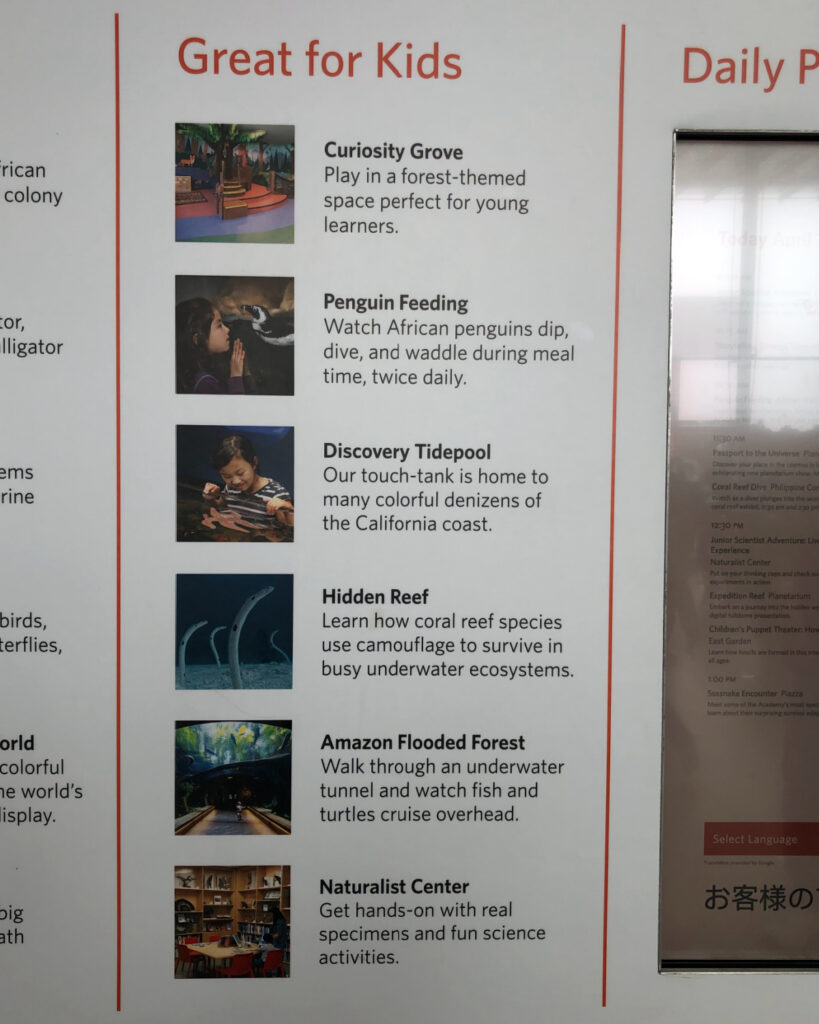
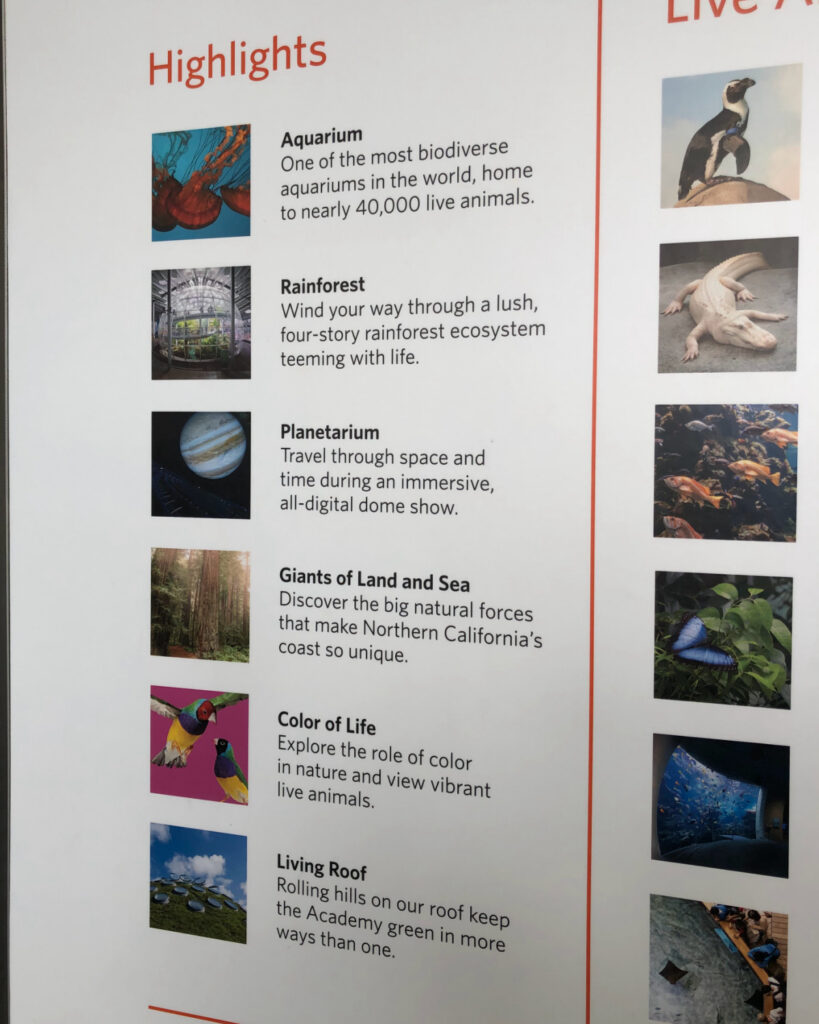
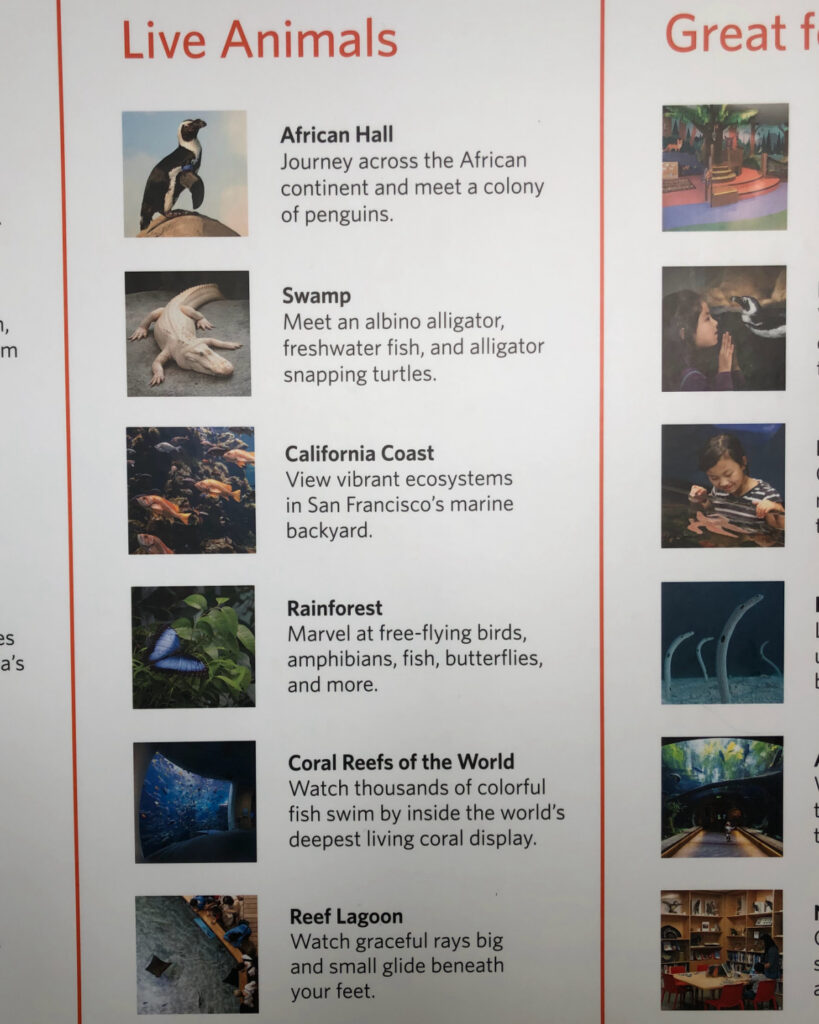
We saw signage identifying museum highlights, live animal experiences, and attractions that were especially good for kids.
The family recommendations included things like penguin feedings, tidepool experiences, the rainforest, hands-on science activities, and kid-focused spaces.
That sounds simple, but it is incredibly useful in a museum this large.
When you’re visiting with kids, you don’t necessarily want to study a museum map for fifteen minutes and determine which of dozens of exhibits will work for your family.
The Academy essentially gives you a shortcut.
Is the California Academy of Sciences Good for Younger Kids?
Yes, but younger children will probably experience the museum differently than older kids.
Preschoolers and younger elementary-age children may be happiest watching live animals, exploring the rainforest, looking for butterflies, seeing the penguins, and spending time around the aquarium.
The Academy also has spaces and activities specifically designed with younger children in mind.
Older elementary-age kids can start getting much more out of the science and natural history components.
Our daughter was elementary-school age when we visited, and it was a fantastic age for the museum.
She was young enough to be completely delighted by penguins, butterflies, colorful fish, and dinosaurs but old enough to engage with some of the science too.
Teens and adults should not feel like this is primarily a children’s museum, though.
There is far too much depth for that.
The aquarium, rainforest, planetarium, architecture, natural history displays, and California-focused science exhibits make this interesting even without children.
How Long Should You Spend at the California Academy of Sciences?
I would plan on at least four hours.
Half a day is very easy to spend here.
If you want to explore the aquarium and rainforest thoroughly, see a planetarium show, watch an animal feeding, visit the natural history exhibits, eat lunch, and spend some time on the Living Roof, you could easily stay longer.
A family that moves quickly might cover the highlights in three hours.
I wouldn’t recommend planning that way unless you’re squeezed for time.
There is simply too much here.
For most first-time visitors, I think four to five hours is a much more realistic amount of time.
And if your family really loves science museums, aquariums, or animals, you could easily make this most of your day.
Is the California Academy of Sciences Worth It?
Yes.
This was one of the attractions on our San Francisco trip that exceeded my expectations.
Part of that was because I didn’t fully understand what the California Academy of Sciences was before we arrived.
I expected a science museum.
Instead, we got an aquarium, a rainforest, a planetarium, a natural history museum, live animals, dinosaurs, geology, and California-focused science exhibits all in the same place.
That variety is what makes it special.
And importantly, I don’t think visiting the Academy feels redundant even if your Bay Area itinerary also includes other major science or aquarium attractions.
Monterey Bay Aquarium is an aquarium.
The Exploratorium is an interactive science museum.
The California Academy of Sciences is its own strange and wonderful combination of both of those things plus a natural history museum, rainforest, and planetarium.
If you’re visiting San Francisco with kids, I would put it very high on the list.
Tips for Visiting the California Academy of Sciences
A few things can make your visit considerably easier.
Arrive earlier in the day if you can. There is enough to see that you’ll appreciate having some flexibility rather than watching the clock all afternoon.
Check the daily schedule when you arrive. Planetarium shows, animal feedings, demonstrations, and other scheduled programs can affect how you structure your visit.
Plan your planetarium show early. If reservations are required during your visit, don’t wait until the end of the day to figure it out.
Do the rainforest before you’re tired. It is one of the signature experiences and deserves more than a rushed walk-through.
Give the aquarium plenty of time. Steinhart Aquarium is much larger than you might expect if you think of it as simply one section of the museum.
Dress in layers. San Francisco weather can be chilly even when the rainforest itself is warm and humid.
Don’t skip the natural history galleries. It is tempting to concentrate entirely on the aquarium and rainforest, but the African Hall, giant skeletons, geology, and other museum exhibits are a major part of what makes the Academy so interesting.
If you’re visiting with kids, look for the family recommendations. The Academy does a good job helping parents identify exhibits and programs that work especially well for children.
Visiting on a Rainy San Francisco Day
The California Academy of Sciences is also one of my favorite kinds of travel attractions: something that works beautifully when the weather does not.
It was rainy during our visit, and that didn’t really matter.
Almost everything we wanted to do was indoors.
We explored the aquarium, walked through the rainforest, watched a planetarium show, wandered through the natural history exhibits, saw the penguins, and spent hours inside the museum.
The only major thing we skipped was the Living Roof.
So if rain shows up in your San Francisco forecast, this is an excellent attraction to move into that part of your itinerary.
You aren’t settling for a backup activity.
You’re spending the day at one of the best family attractions in the city.
Planning Your Visit to the California Academy of Sciences
The California Academy of Sciences is located in Golden Gate Park at 55 Music Concourse Drive. As of 2026, the museum is open Monday through Saturday from 9:30 a.m. to 5 p.m. and Sunday from 11 a.m. to 5 p.m., with last entry at 4 p.m. Hours can change for holidays and special events, so it is worth checking before you go.
General daytime admission includes the museum’s major exhibits and shows. Current ticket prices vary by age and by whether you are visiting during a peak period, and the Academy also offers an Anytime Admission option for visitors who want more flexibility. Children two and under are free.
One important thing to know is that Morrison Planetarium requires a separate showtime reservation even though the planetarium is included with admission. The Academy currently has guests reserve a show after arrival by scanning a QR code in the lobby, and reservations are first-come, first-served. If seeing the planetarium is important to you, I would take care of that as soon as you arrive. Children under four are not admitted to planetarium shows.
Parking and Getting There
If you are driving, the easiest option is the Music Concourse Garage, an underground garage located very close to the museum entrance. The Academy notes that the garage can fill quickly on weekends, holidays, and school breaks, so arriving early is a good idea. Free street parking is also available in parts of Golden Gate Park, but it can be difficult to find on busy days.
One San Francisco-specific tip I would take seriously: do not leave valuables in your car. The Academy specifically warns visitors about vehicle break-ins and recommends taking belongings with you rather than leaving them visible—or even assuming they are completely safe in the trunk. Lockers are available inside the museum.
Food at the California Academy of Sciences
You do not necessarily need to leave the museum for lunch.
The Academy currently has the Academy Café, with indoor and outdoor seating and a mix of meals, snacks, coffee, and grab-and-go choices. The emphasis is on local, seasonal, and sustainable ingredients, and there are enough options that families can reasonably plan to eat during a longer museum visit rather than breaking up the day.
That can be particularly helpful if you are spending four or five hours here. There is so much to see that leaving Golden Gate Park for lunch and then returning would eat up a significant chunk of your day.
Accessibility
The California Academy of Sciences is very accessible overall.
The main entrance is wheelchair accessible, and visitors can also enter by elevator from the underground garage. ADA-compliant ramps or alternate entrances are available for major attractions including Osher Rainforest and Morrison Planetarium, and accessible restrooms are located throughout the building.
That is worth knowing because the museum covers several levels and the rainforest in particular involves moving gradually upward through the dome. You do not have to be able to navigate stairs to experience it.
Should You Buy San Francisco CityPASS?
For us, yes. Absolutely.
We used San Francisco CityPASS during our family trip, and San Francisco is one of the cities where I genuinely think CityPASS can make a lot of sense.
The California Academy of Sciences is currently one of the attractions included with San Francisco CityPASS, and daytime admission includes the regular exhibits and shows.
The current San Francisco CityPASS includes admission to four attractions. The California Academy of Sciences is one of the choices, along with attractions such as the Exploratorium, Aquarium of the Bay, SFMOMA, San Francisco Zoo, the Walt Disney Family Museum, the de Young Museum and Legion of Honor, and a San Francisco Bay cruise. CityPASS currently advertises savings of up to 45 percent compared with purchasing eligible admissions separately.
And this is one of those cases where I would not dismiss the pass as just another tourist bundle.
We got our money’s worth.
If you are already planning to visit several of San Francisco’s major attractions, I would absolutely price out CityPASS before buying individual tickets. The California Academy of Sciences by itself is already a relatively expensive attraction, so combining it with several other places you genuinely want to visit can make the math work quickly.
The key is whether you would actually visit the included attractions anyway. I would never recommend adding things to an itinerary just because they’re on a pass.
But for a first family trip to San Francisco, there are enough excellent attractions included that CityPASS can be a very good deal.
And because we used it ourselves in San Francisco, this is one travel pass I can personally recommend checking before your trip.
Final Thoughts on Visiting the California Academy of Sciences
The California Academy of Sciences was one of the biggest surprises of our San Francisco trip.
I knew it was supposed to be a good museum.
I just hadn’t realized how much museum was actually packed inside it.
The aquarium alone would be worth seeing.
The rainforest alone would be memorable.
Add the planetarium, penguins, African wildlife, dinosaur displays, giant whale skeletons, California geology, and everything else, and you have an attraction that can keep a family busy for hours.
If your kids love animals, science, dinosaurs, space, or basically anything in the natural world, there is probably something here for them.
And even if you’re already planning to visit another aquarium or science museum during your California vacation, I wouldn’t automatically cut this one.
The California Academy of Sciences really does feel like its own thing.
For our family, it was absolutely worth the visit.
More California Family Travel Ideas
Planning more time in Northern California? These guides pair well with a visit to the California Academy of Sciences.
- Golden Gate Bridge
- Muir Woods National Monument
- Bay Area Discovery Museum
- 3 Days in Yosemite National Park
- Muir Woods and Sausalito Day Trip
More Aquariums, Science Museums, and Natural History Museums
If your family loves science, animals, and natural history, you may also enjoy: