Muir Woods National Monument: A First-Timer’s Guide to California’s Giant Redwoods

Plan your first visit to Muir Woods National Monument with tips for trails, parking reservations, costs, timing, food, kids, and photographing the redwoods.
Estimated reading time: 35 minutes
If you are visiting San Francisco and want to see truly enormous redwood trees without turning your trip into a major hiking expedition, Muir Woods National Monument is one of the easiest and most rewarding places to do it.
I will admit something right up front: before our visit, I thought Muir Woods was part of Redwood National Park.
It is not.
Redwood National and State Parks are much farther north along the California coast. Muir Woods is a separate National Park Service site just north of San Francisco, within Golden Gate National Recreation Area. But that distinction did not make the experience feel any less spectacular.
We visited Muir Woods in April 2019 as part of our first non-Disney family vacation. Our daughter was six years old, and although my husband and I had previously visited Big Basin Redwoods State Park, she had never seen trees like this before.
This was her introduction to the really big trees.
And honestly, Muir Woods was a fantastic place for it.
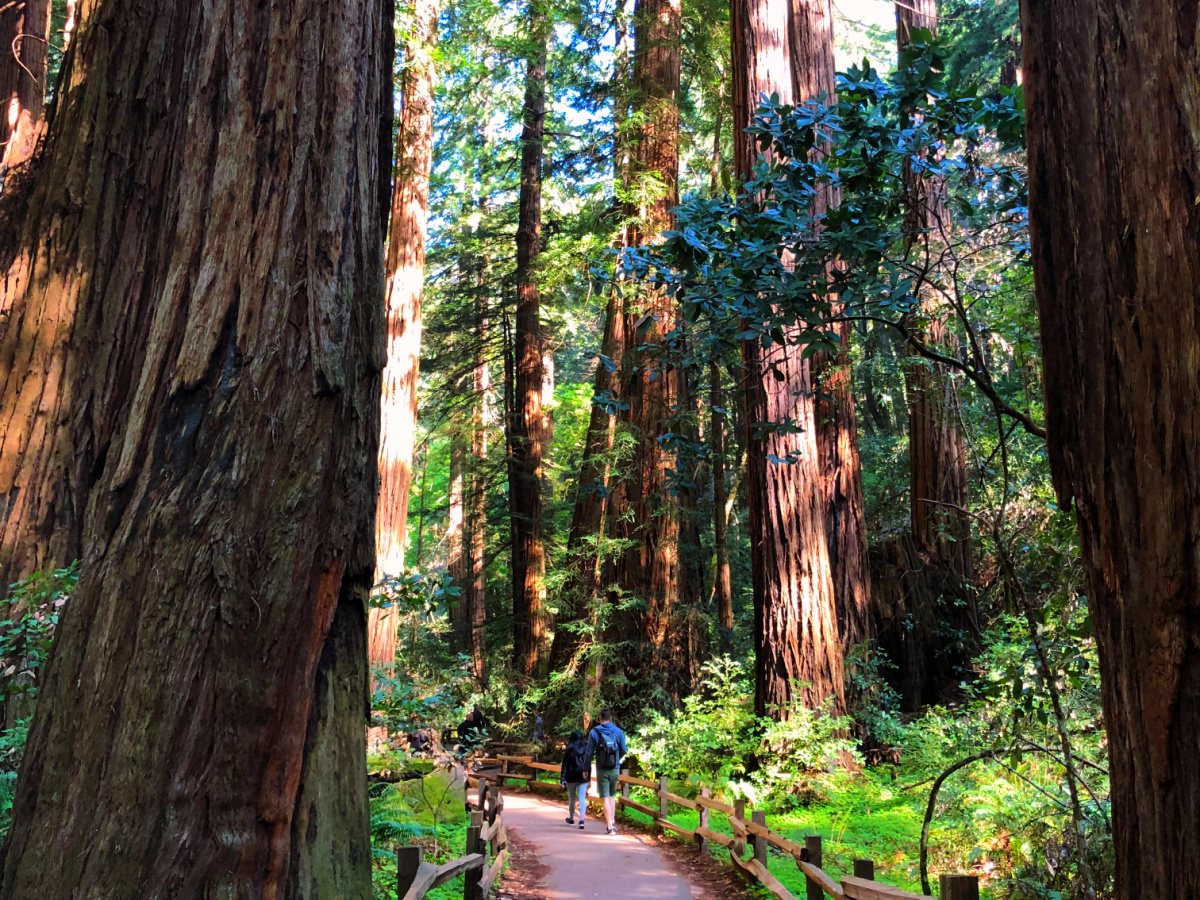
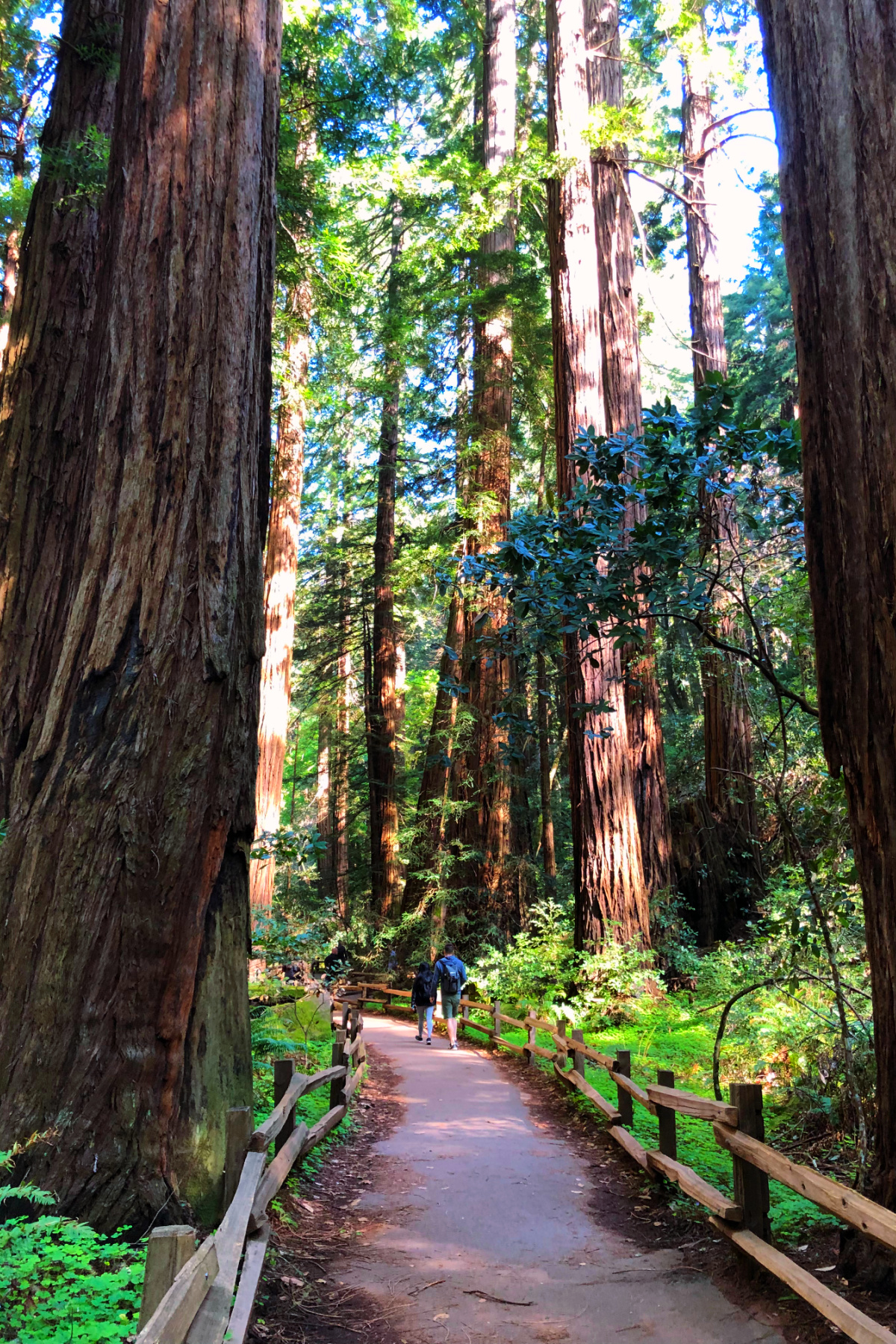
The trails through the main grove are wide, mostly level, and easy to follow. You do not need to commit to a strenuous hike. You do not need an entire day. You can spend a couple of hours wandering underneath ancient coast redwoods, looking up until your neck hurts, exploring the forest floor, and getting an extraordinary sense of just how tiny human beings are compared with these trees.
That accessibility is one of the biggest reasons I think Muir Woods works so well for families, casual hikers, and anyone incorporating nature into a San Francisco vacation.
It is beautiful without making you work terribly hard for it.
Is Muir Woods Worth Visiting?
Yes. Especially if you are already spending time in the San Francisco Bay Area.
Muir Woods protects an old-growth coast redwood forest only about 11 miles north of the Golden Gate Bridge. The drive itself can take longer than that distance suggests because the roads approaching the monument are winding, but geographically, this is incredibly close to San Francisco.
That makes Muir Woods an easy natural complement to the city.
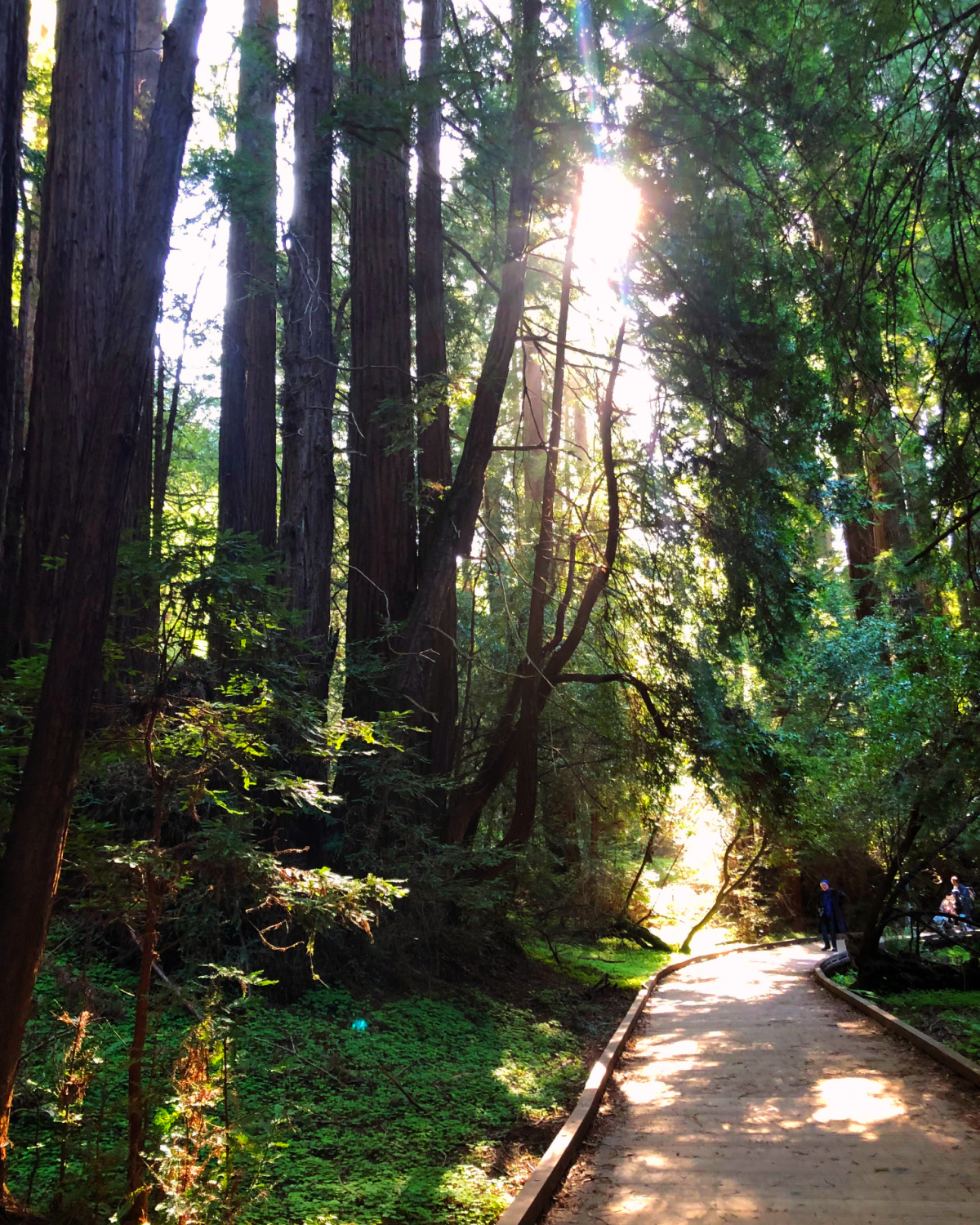
You can spend the morning beneath 200-foot-plus redwoods and still be back in San Francisco later that day.
It also works beautifully as part of a larger Northern California itinerary. On our trip, we visited Muir Woods before continuing on to Yosemite National Park. Those are two completely different landscapes, and seeing both on the same vacation gave our daughter a wonderful introduction to just how varied California can be.
I had also visited Big Basin Redwoods State Park years earlier, before the devastating 2020 CZU Lightning Complex Fire burned most of the park. I loved Big Basin, so I do not say this to diminish it at all.
But for a first-time family redwood experience, I actually preferred Muir Woods.
It felt easier to explore, more immediately dramatic, and incredibly accessible for a young child.
What Makes Muir Woods So Special?
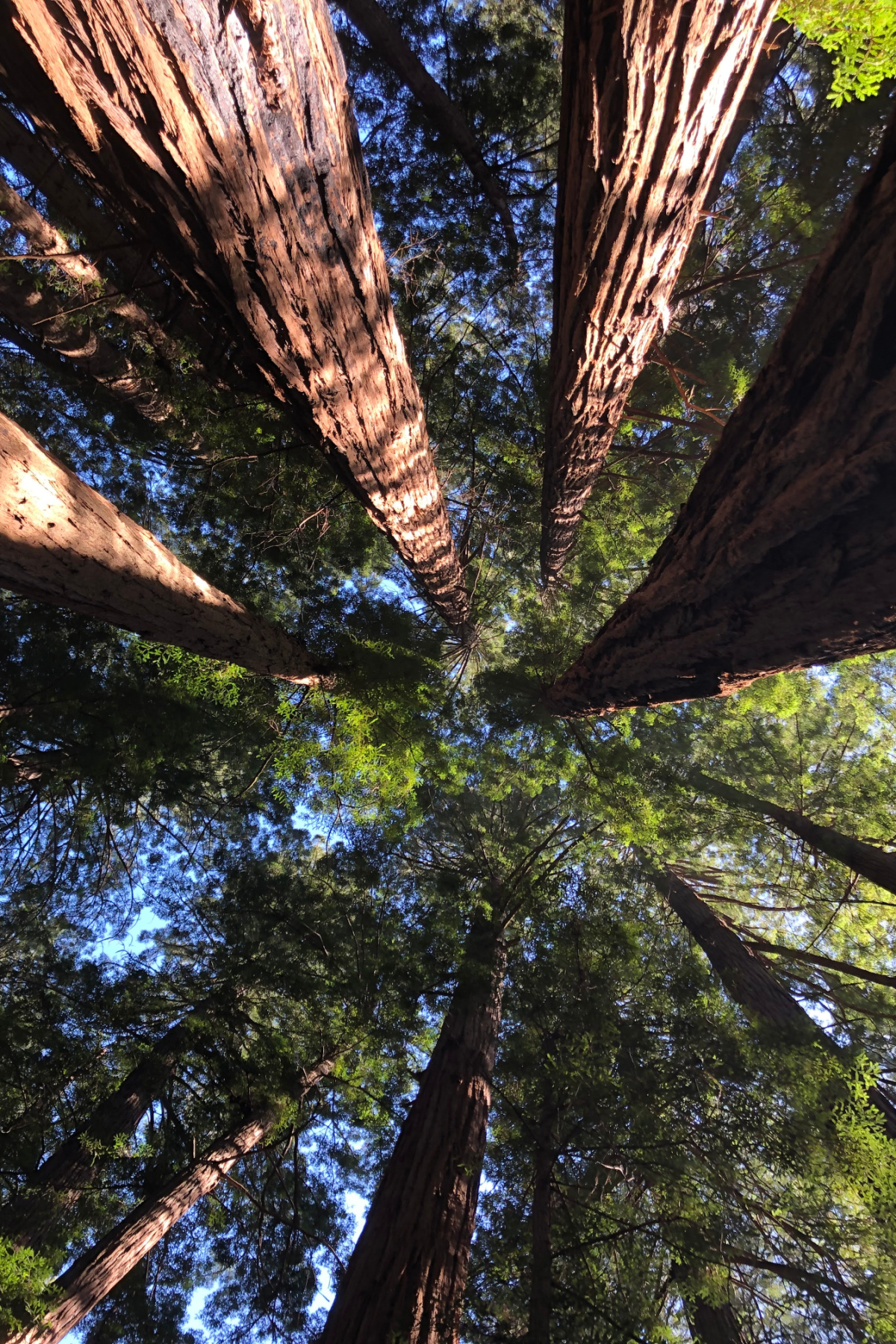
At first, you notice the height.
It is almost impossible not to.
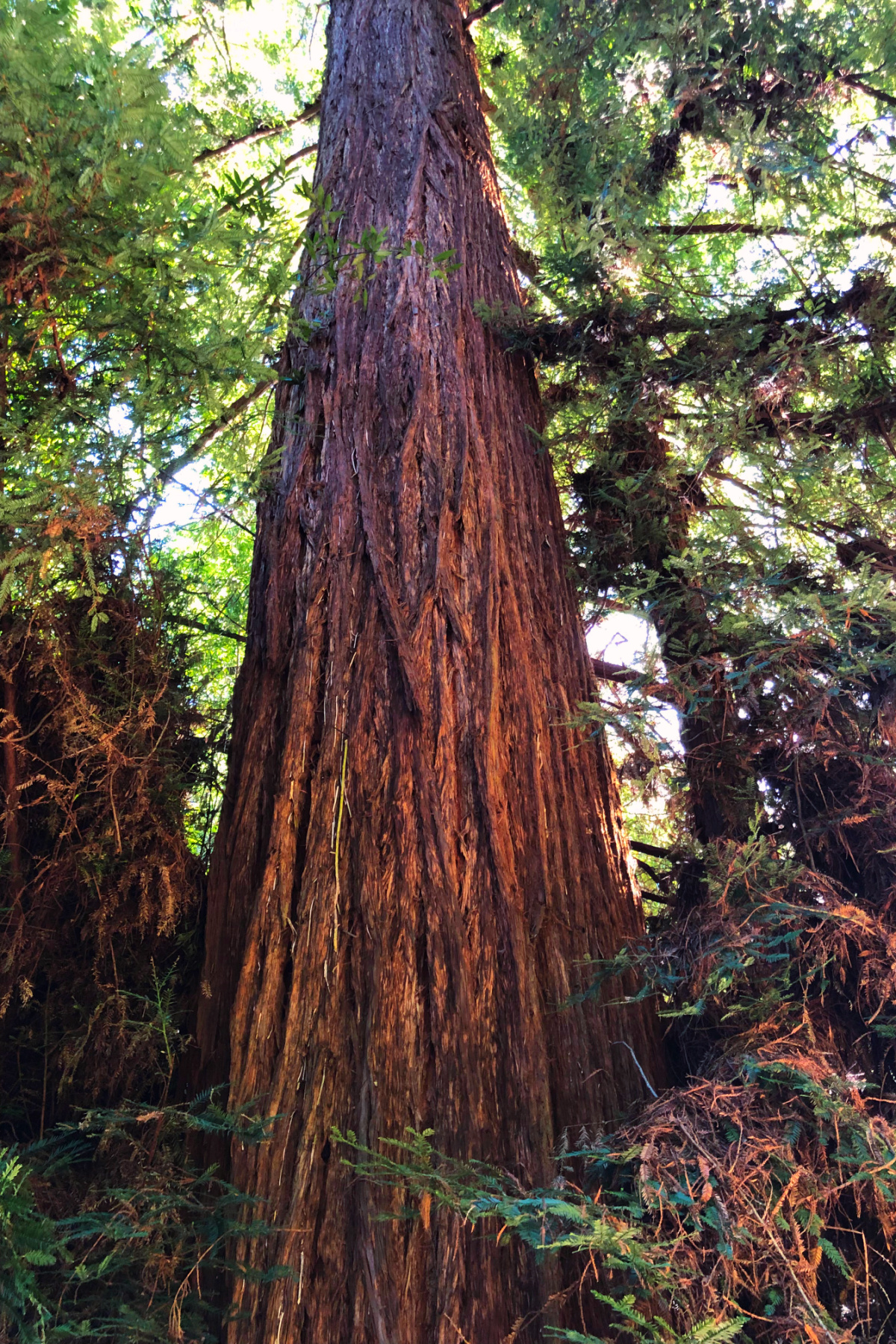
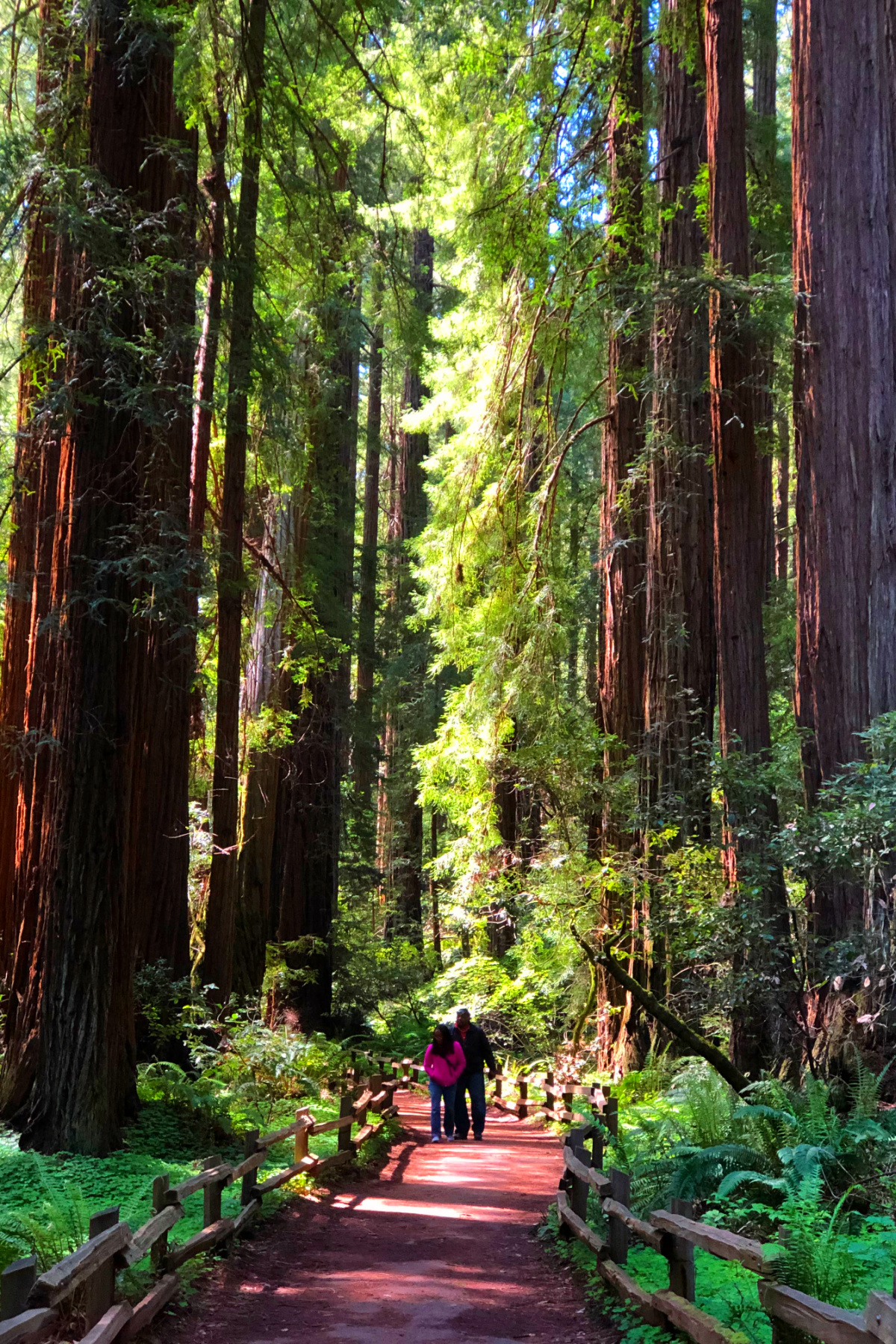
You walk beneath these massive reddish-brown trunks that seem to disappear into the canopy, and every few minutes you find yourself tilting your head backward again.
But Muir Woods is not beautiful simply because the trees are tall.
The entire forest feels lush.
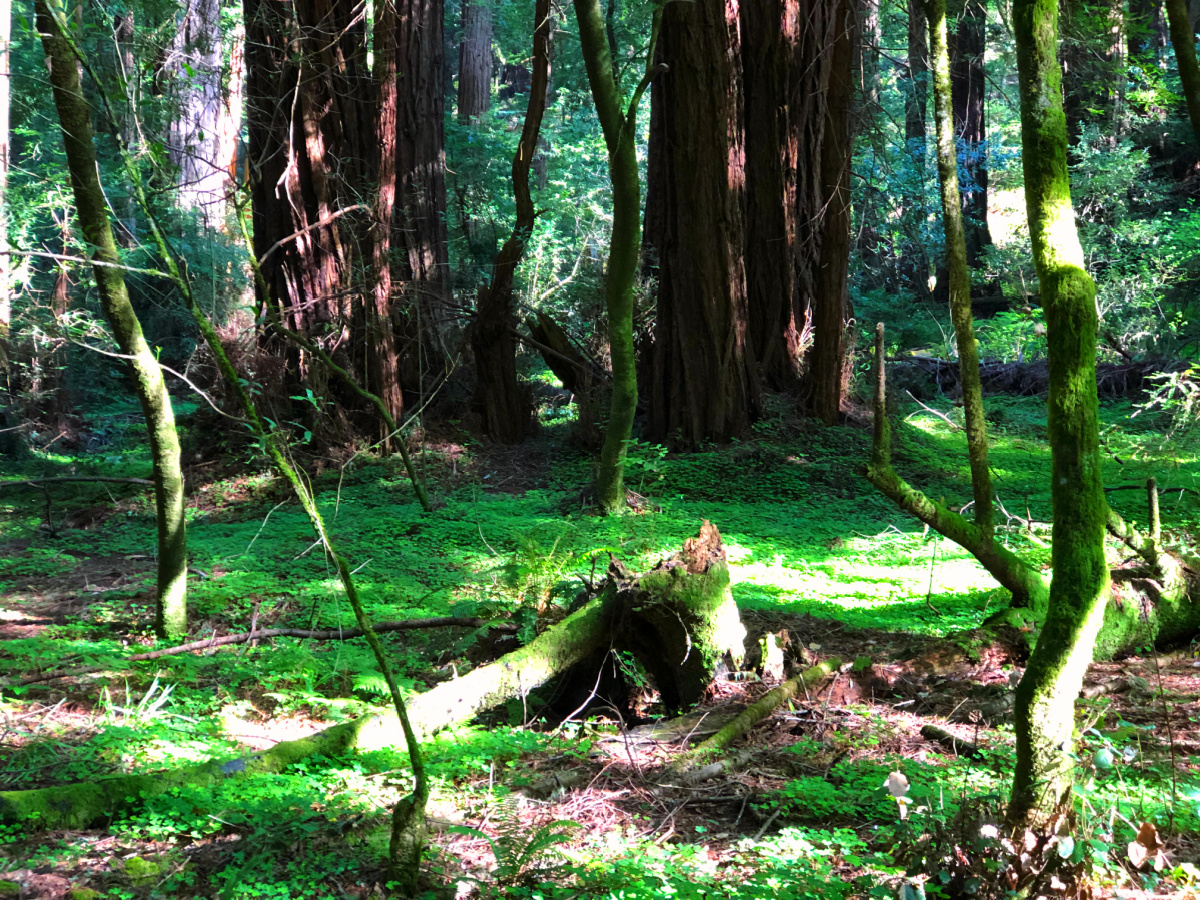
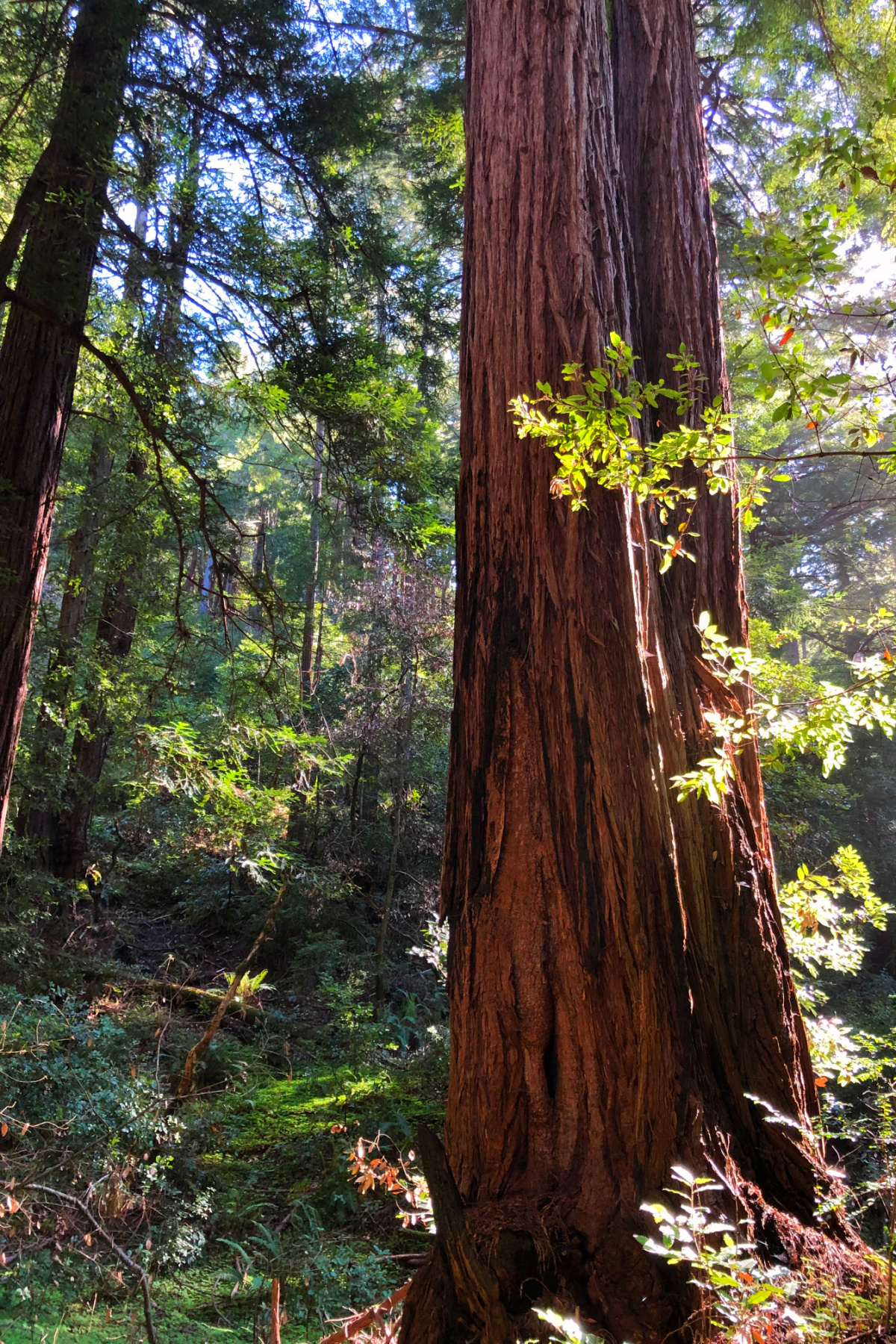
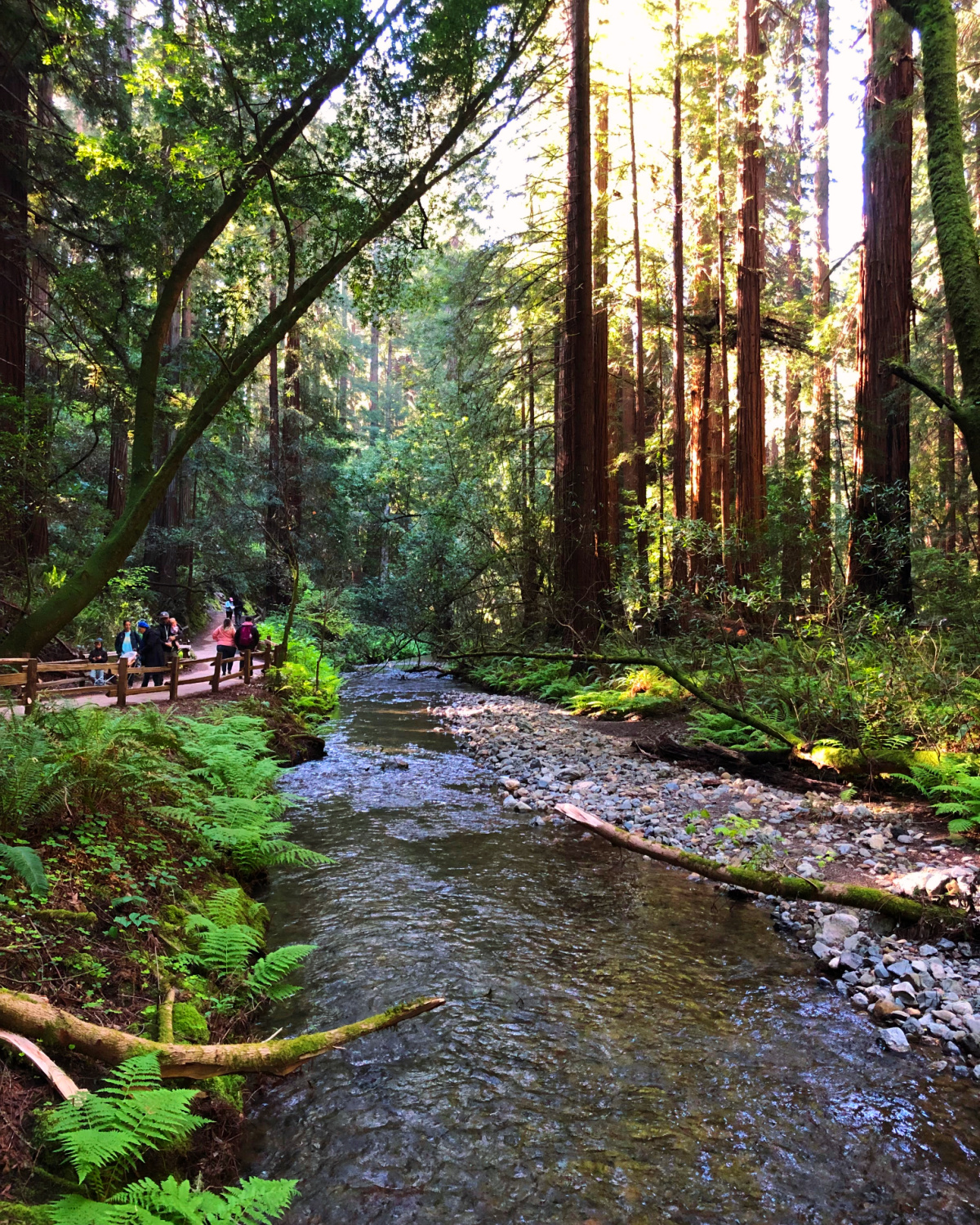
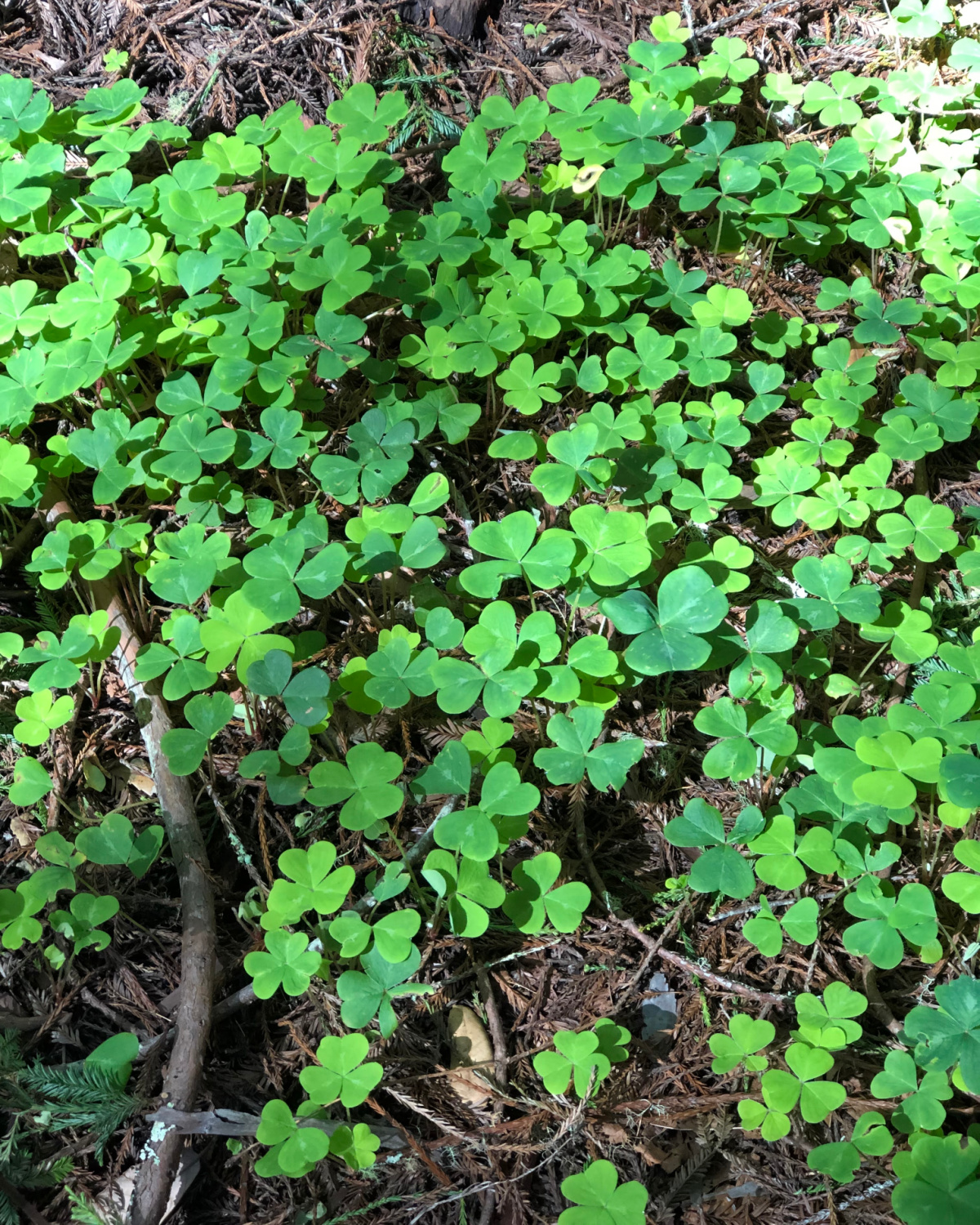
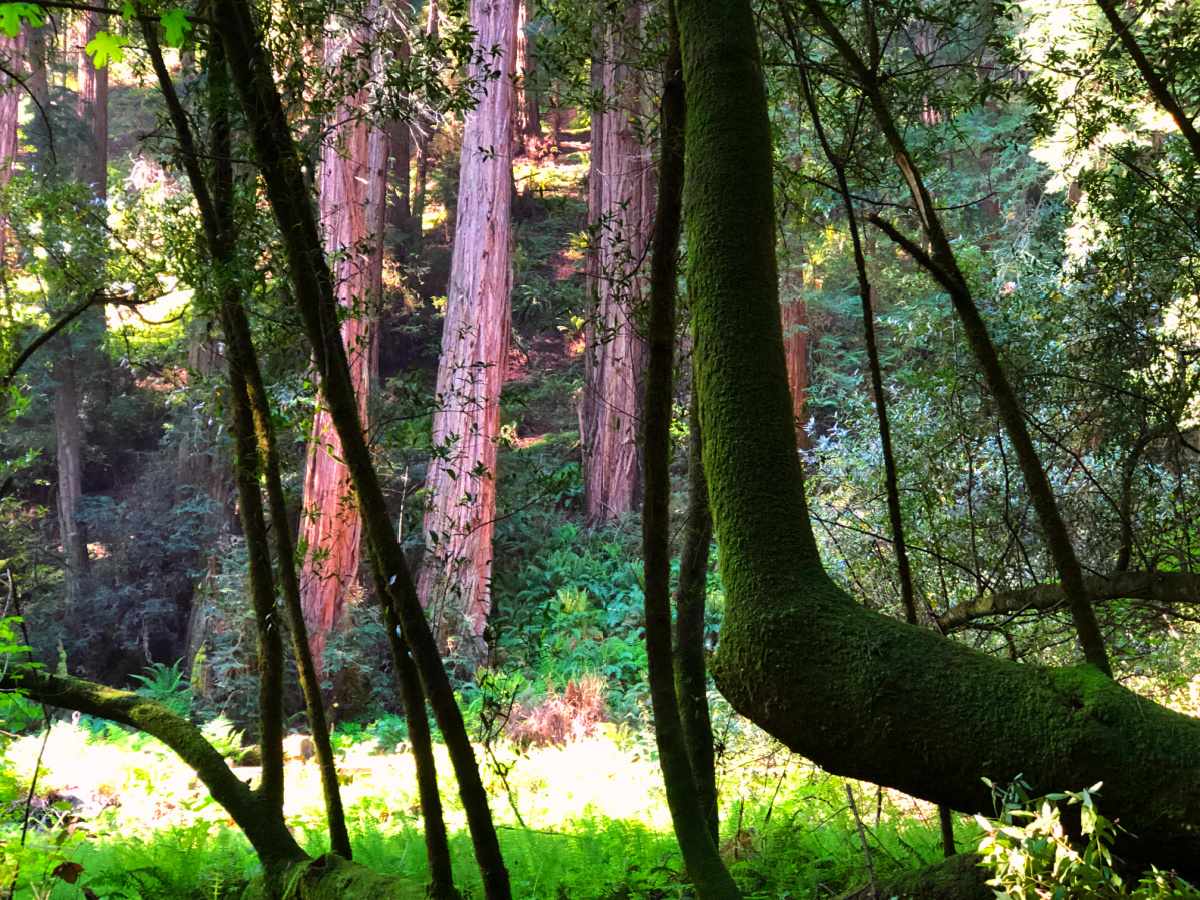
Ferns spread across the forest floor. Redwood sorrel forms carpets of bright green leaves beneath the trees. Moss grows across trunks and fallen logs. Redwood Creek winds alongside the main trail. Shafts of sunlight occasionally break through the canopy and illuminate the red bark in a way that almost makes the trees glow.
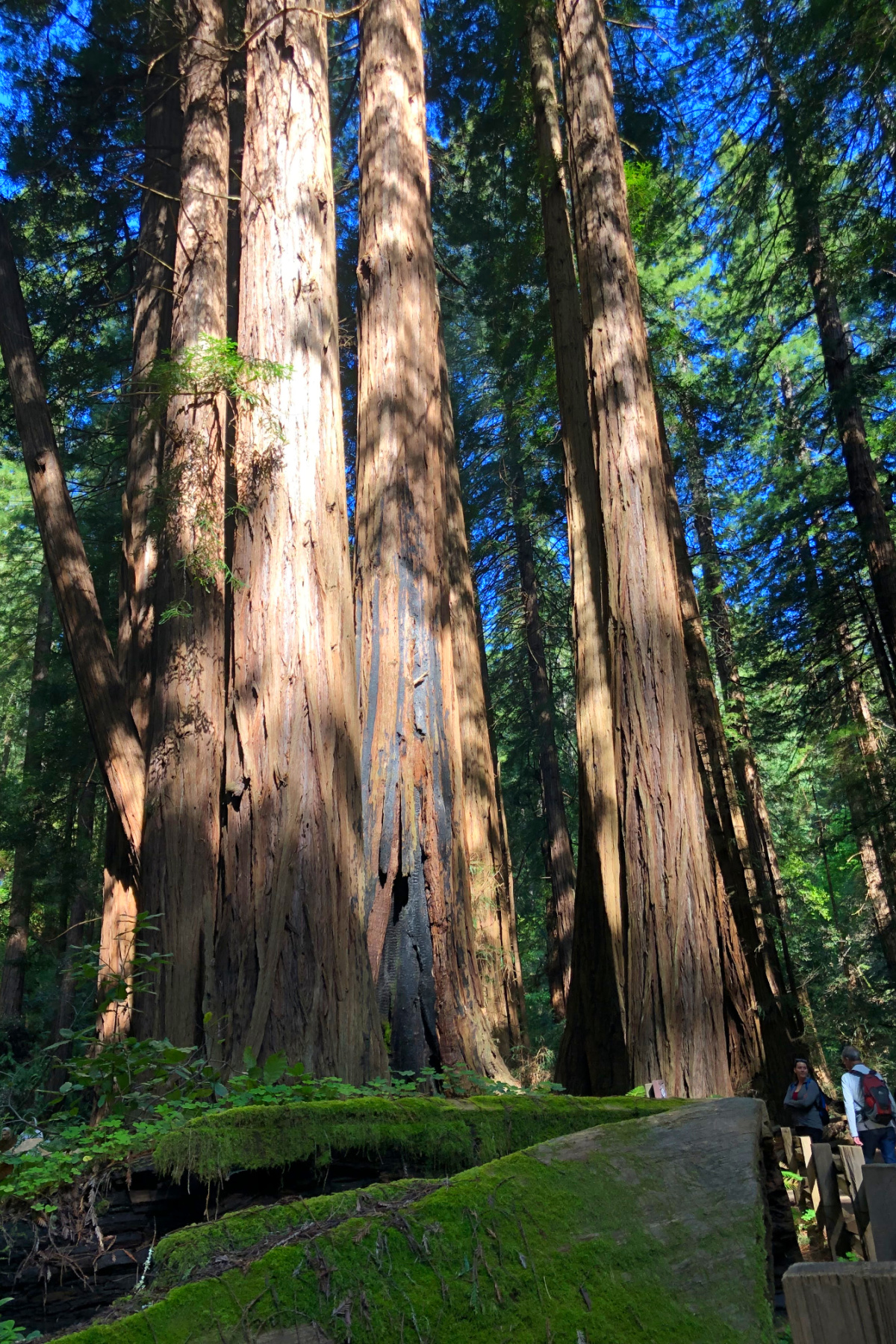
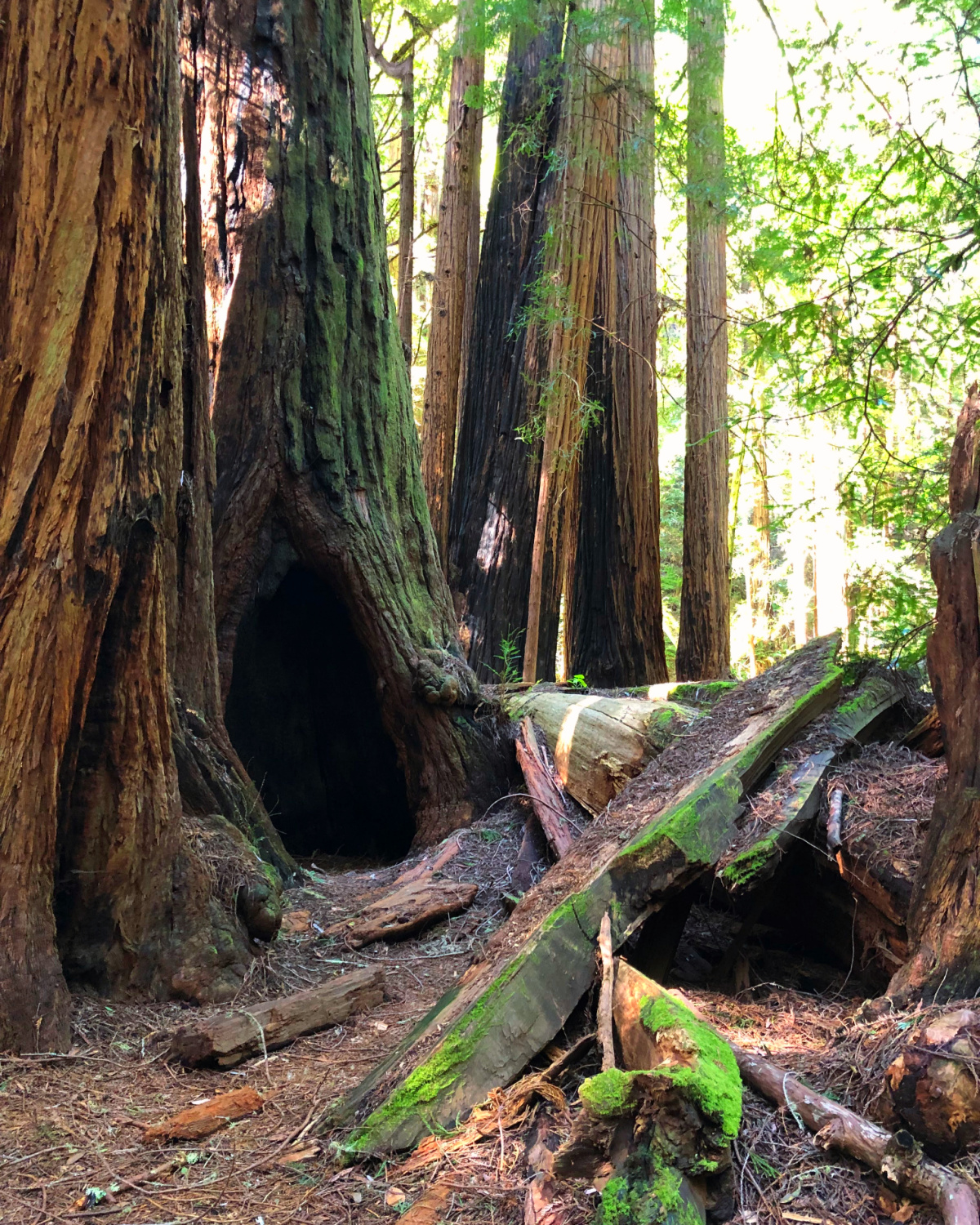
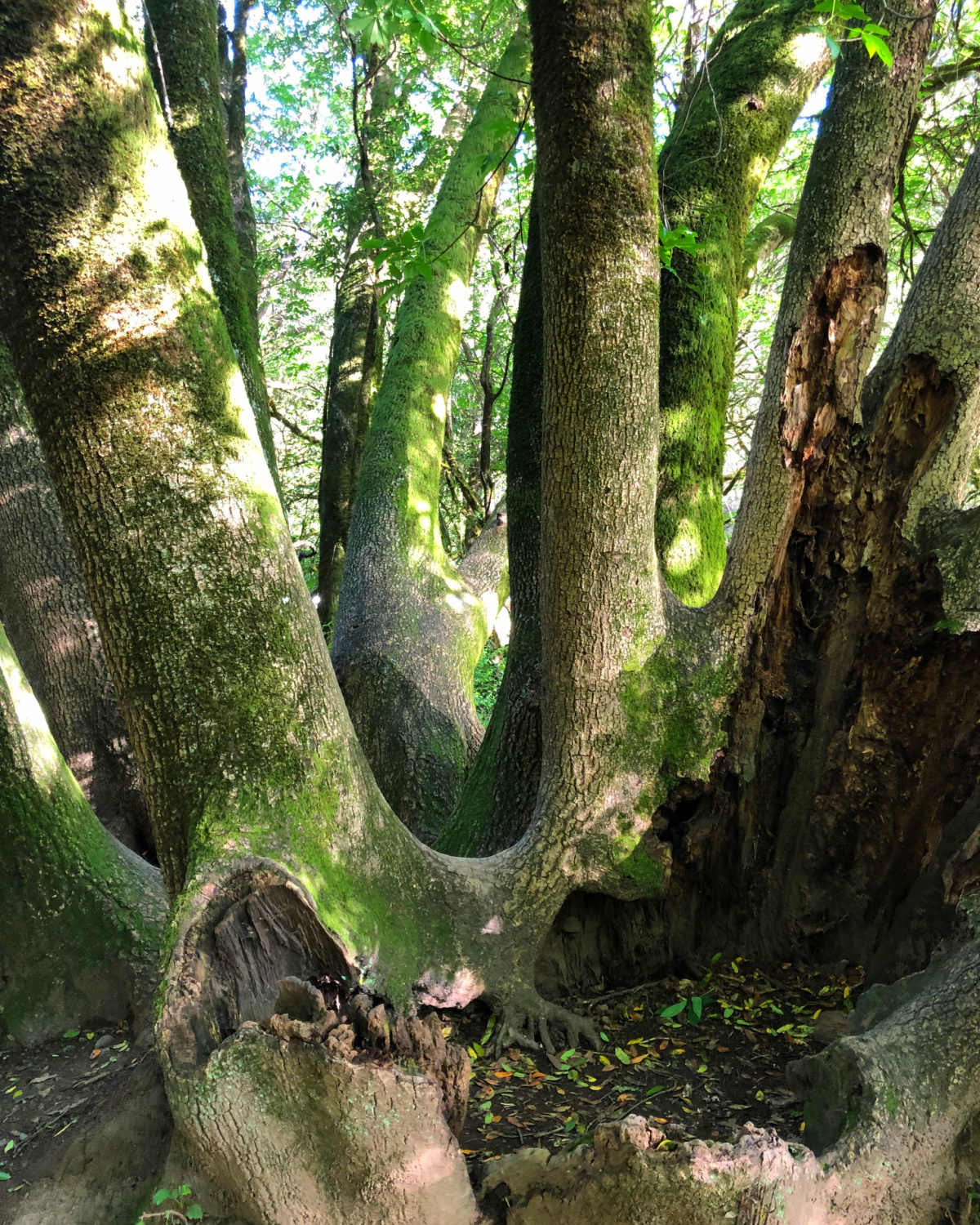
There are hollow trunks, enormous root systems, fallen trees slowly returning to the forest, and places where several redwoods seem to rise together in giant clusters.
It feels ancient.
And a little otherworldly.
You start noticing details you would ordinarily walk right past because everything around you is operating on such a different scale.
Of course, we hugged a few trees.
If you are going to visit the big tree park, you have to be a tree hugger at least once.
How Much Time Do You Need at Muir Woods?
For most first-time visitors, I think two to three hours is plenty.
The National Park Service recommends planning on spending a few hours exploring the monument, and that matches our experience very well.
We did not spend the entire day at Muir Woods, and I would not recommend doing that unless you specifically want to venture onto the longer trails connecting into Mount Tamalpais State Park.
For most families, the sweet spot is simple:
Arrive in the morning.
Walk the main redwood trail.
Take an absurd number of pictures.
Stop and actually look at the trees instead of racing through.
Grab something to eat.
Then continue with the rest of your day.
That is enough time to experience what makes Muir Woods special without reaching the point where younger kids are simply done looking at trees.
Start With the Muir Woods Main Trail
For most first-time visitors, the Main Trail is the obvious place to start.
Also called the Redwood Creek Trail, this is the primary route through the heart of Muir Woods. It begins near the visitor center and follows Redwood Creek through the old-growth forest. The trail consists primarily of firm surfaces including wooden boardwalk, pavement, and packed soil.
The full Main Trail route is about 2 miles with only around 30 feet of elevation gain, so this is not a difficult hike.
That is one of the things I remember most clearly from our visit.
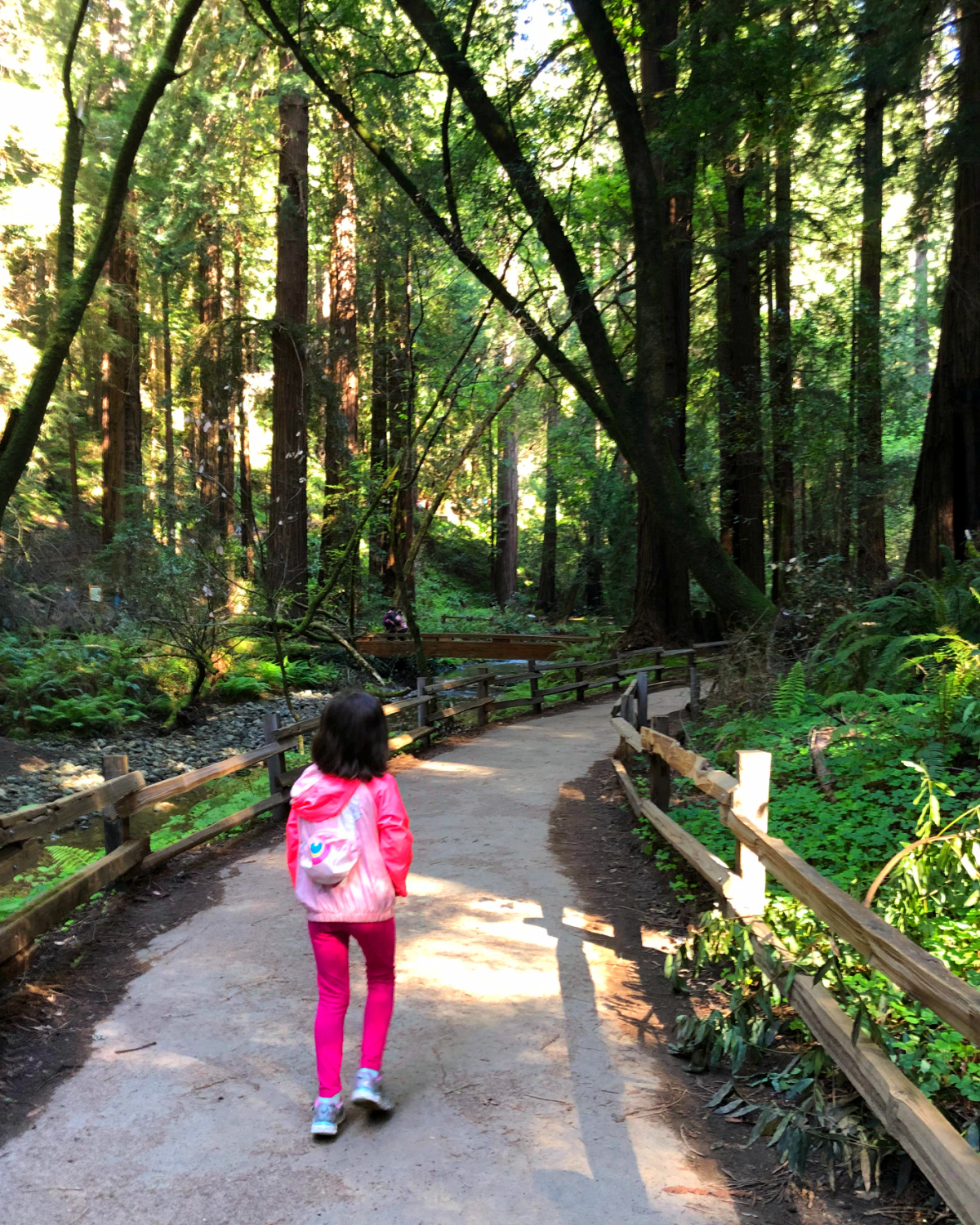
The main paths felt wide and approachable. Our six-year-old could simply walk along with us without the entire outing becoming a production.
And you do not even have to walk the entire route.
There are several bridges crossing Redwood Creek that allow you to create shorter loops.
Bridge 2 Loop
The shortest option is about half a mile and takes roughly 30 minutes.
You walk past Bridge 1 to Bridge 2, cross Redwood Creek, and return along the opposite side.
This would be a great option if you are traveling with very young children, grandparents, or anyone who mainly wants the experience of standing beneath the redwoods without walking very far.
Bridge 3 and Cathedral Grove Loop
Continue farther and you can create approximately a 1-mile loop by crossing at Bridge 3.
This route includes Cathedral Grove and takes roughly an hour at a leisurely pace.
For a lot of first-time visitors, I think this is probably the ideal Muir Woods walk.
You see plenty of enormous redwoods, spend enough time immersed in the forest to feel like you actually experienced it, and still have plenty of energy for the rest of your Bay Area day.
Bridge 4 and Hillside Trail
The longer Main Trail option continues to Bridge 4.
From there, visitors can return using the Hillside Trail, an unpaved route that climbs above Redwood Creek before descending again. Unlike the primary Main Trail, the Hillside Trail includes stairs and is not wheelchair accessible.
Looking back through our 2019 photographs, I am fairly certain we walked a substantial portion of the Main Trail and ventured at least a little way onto one of the hillside sections. I have photos of those steps climbing through the redwoods.
But I did not label every single trail, grove, and tree when we visited.
Honestly, most of the time I was just looking up and thinking, “That tree is enormous.”
And that is perfectly fine.
You do not need to identify every individual redwood to appreciate Muir Woods.
What Will You See Along the Main Trail?
You will encounter several named areas along the main corridor, including Founders Grove, Cathedral Grove, Bohemian Grove, and the Pinchot Tree, as well as interpretive displays explaining the history and ecology of the forest.
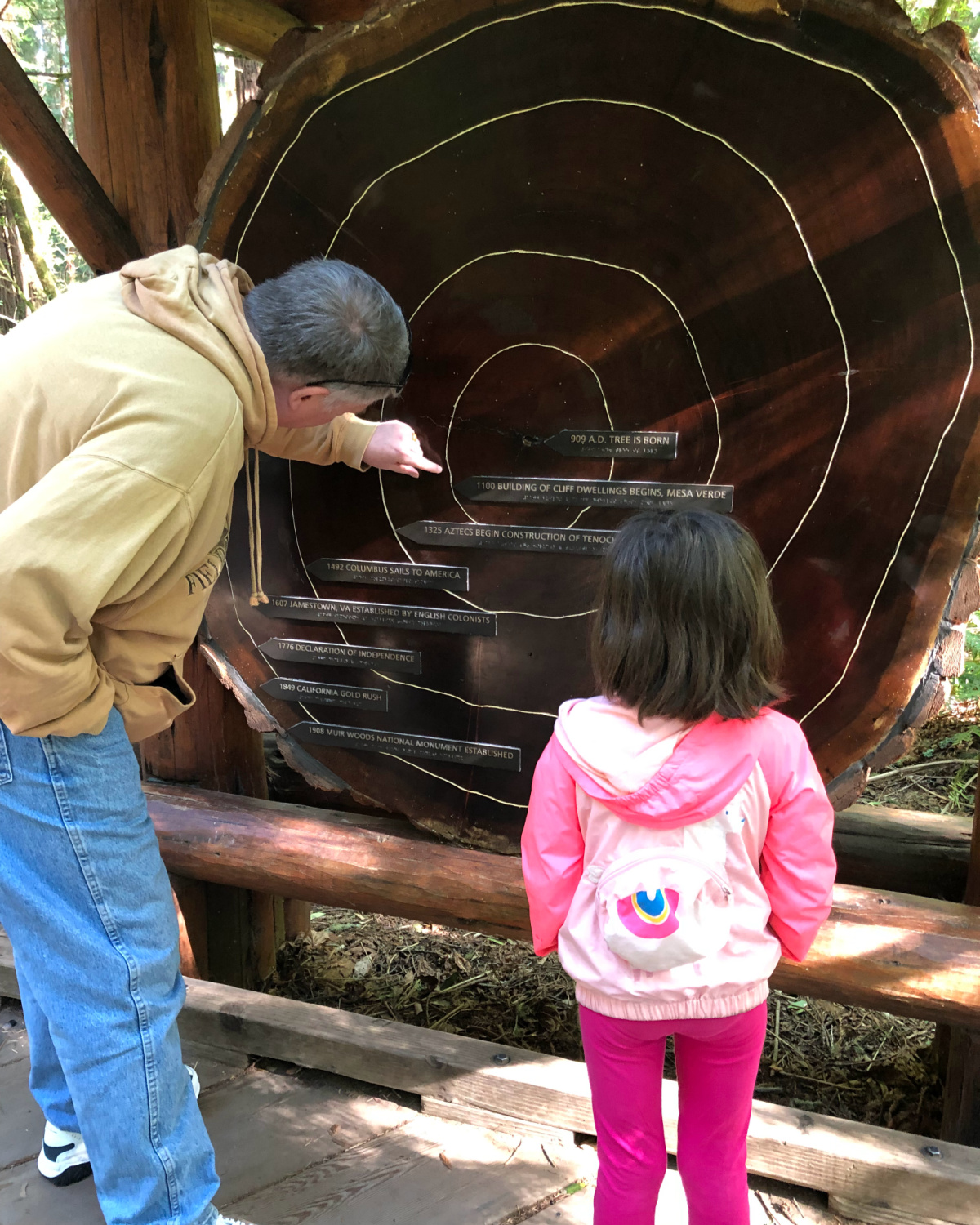
One of the displays our daughter particularly enjoyed was a massive cross-section of a redwood tree marked with historical dates.
The tree began growing around 909 A.D.
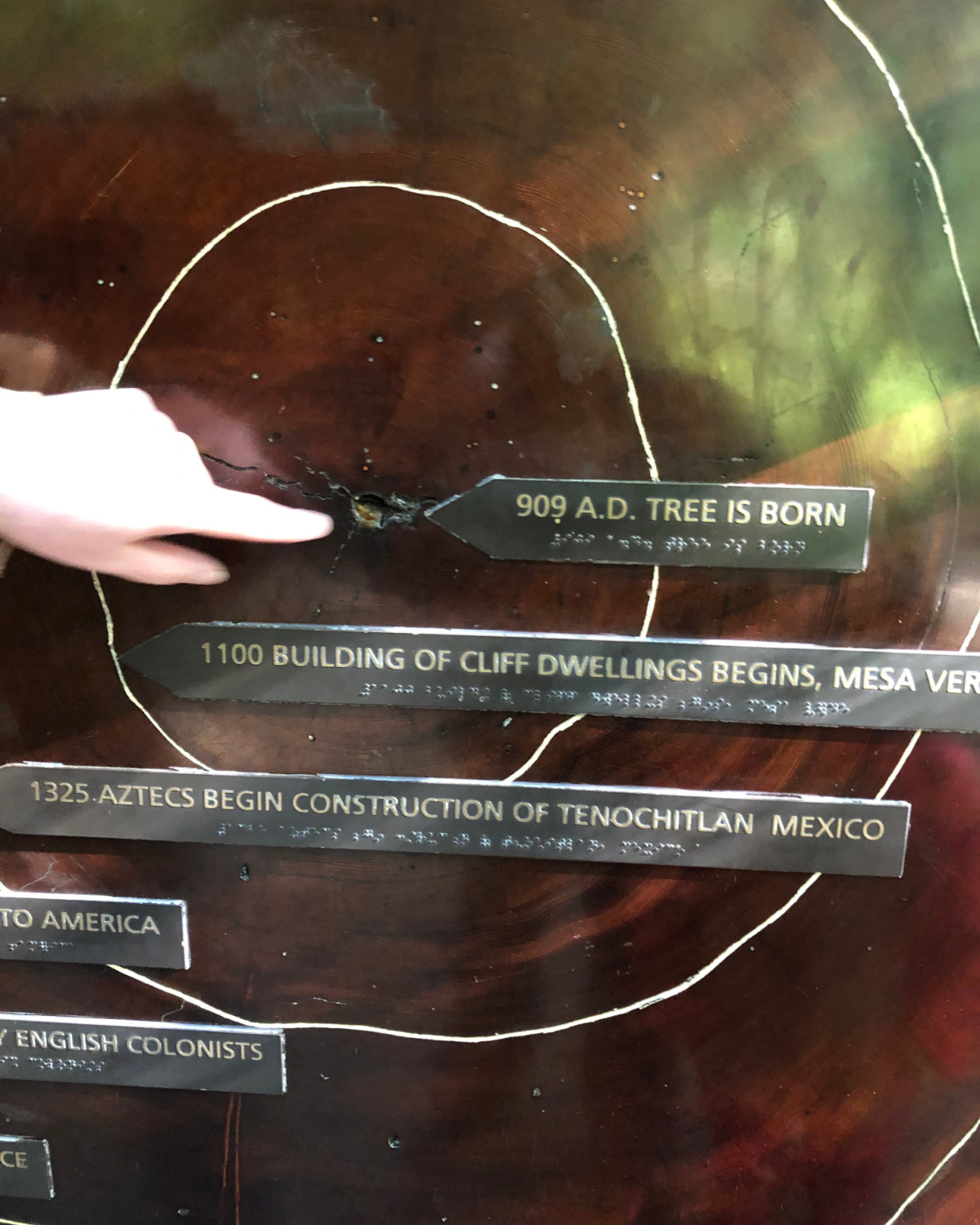
Other markers showed events including the construction of cliff dwellings at Mesa Verde, the founding of Tenochtitlan, Columbus sailing to the Americas, the California Gold Rush, and eventually the establishment of Muir Woods National Monument.
Standing beside a tree that was already hundreds of years old before many familiar historical events occurred gives you an entirely different understanding of the word old.
And kids understand that.
You can tell a six-year-old that a tree is a thousand years old, but showing them an enormous tree ring and pointing out everything that happened while that tree was growing makes the age much more tangible.
Do You Need to Know Which Redwood Is Which?
No.
And I am living proof.
I took dozens of photographs during our visit, and I did not carefully label each image with the specific grove or individual tree.
Some photographs are clearly recognizable landmarks or interpretive displays. Others are simply beautiful redwoods.
That is how most visitors experience Muir Woods anyway.
You notice the enormous trunks.
You notice sunlight streaming through the canopy.
You notice moss and ferns and redwood sorrel beneath your feet.
You notice your child standing beside a tree and suddenly looking impossibly small.
You notice the forest.
That is enough.
Muir Woods Is Especially Good for Casual National Park Travelers
This is probably the most important thing I want people to understand about Muir Woods.
You do not have to be a serious hiker to have an extraordinary experience here.
The primary trail is roughly 2 miles long, mostly level, and follows Redwood Creek through the old-growth grove. You can shorten the route whenever you want by crossing one of the bridges.
That makes Muir Woods an excellent choice for:
families with younger children,
multigenerational groups,
visitors with limited time,
people who enjoy nature but do not want strenuous hikes,
and San Francisco travelers who simply want to experience California’s giant redwoods.
You can make the day more adventurous if you want.
But you do not have to.
And sometimes the best national park experiences are exactly like that.
You show up.
You walk beneath something extraordinary.
And for a couple of hours, you remember just how enormous the natural world really is.
Planning Your Visit to Muir Woods National Monument
Muir Woods is easy to explore once you arrive.
Getting there is the part that requires a little planning.
This is not a place where I would recommend waking up in San Francisco one morning, deciding that giant redwoods sound fun, and simply driving north to see what happens. Parking reservations are required, the road into the monument is winding, and cell service around Muir Woods is extremely limited.
Fortunately, none of the logistics are particularly complicated if you know about them ahead of time.
Make Your Muir Woods Parking Reservation Before You Go
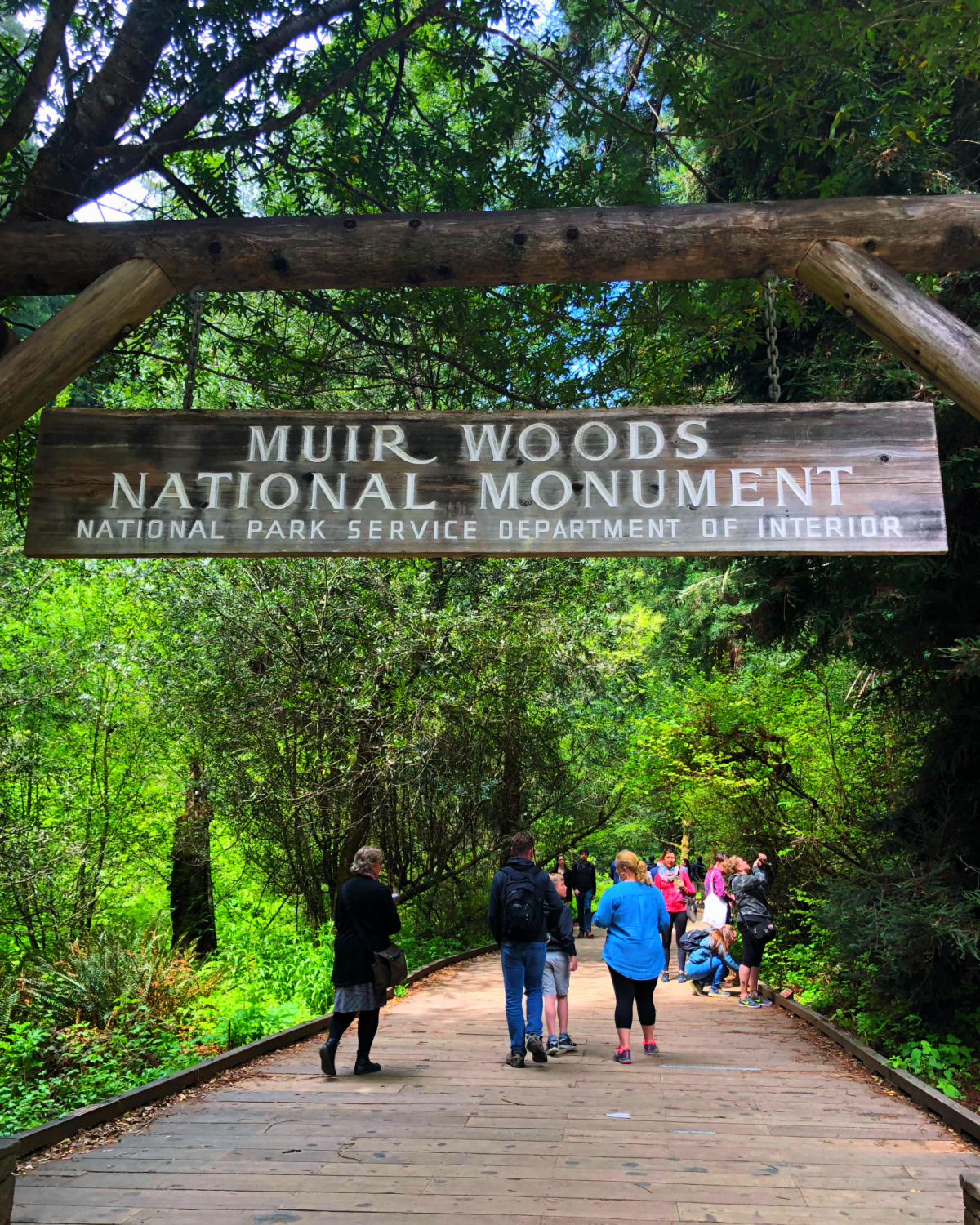
If you are driving to Muir Woods, you need a parking reservation.
This was already true when we visited in 2019. I remember having a timed parking reservation for our visit, and the reservation system remains an important part of planning a trip today.
Parking reservations are separate from your entrance fee and should be booked through the official Muir Woods reservation system before your visit. Reservations can sell out, particularly on weekends and holidays.
One important thing to understand is that your parking reservation gives you an arrival window. It does not mean you have to leave the monument after 30 minutes or an hour.
Once you arrive and park, you can stay and enjoy Muir Woods.
Which brings me to one of my golden rules for national park travel.
Go to Muir Woods Early in the Day
The early bird gets the worm.
I follow this rule at national parks whenever I reasonably can, and Muir Woods is exactly the kind of place where it pays off.
If this is your day to visit Muir Woods and you are not driving in from four hours away, book a morning arrival.
People who arrive early do not have to leave when the next parking window begins. They can spend several hours in the forest. That means parking turnover is not necessarily immediate as the day progresses.
An earlier reservation gives you a better chance of:
getting a more convenient parking spot,
walking the trails before the busiest part of the day,
enjoying a quieter forest,
and having the rest of your afternoon available for other Bay Area activities.
Summer is particularly busy. The National Park Service notes that hundreds of thousands of people visit during June, July, and August, and traffic on the narrow roads approaching Muir Woods can slow the drive considerably.
You do not have to arrive before sunrise.
Muir Woods does not even open that early.
Just choose one of the earlier reservation windows if you can.
How Much Does Muir Woods Cost?
As of 2026, the standard entrance fee for Muir Woods is $15 per person age 16 and older. Children 15 and younger enter free.
America the Beautiful passes, including eligible Senior, Military and Access passes, can cover the monument entrance fee.
However, your national parks pass does not replace the separate parking or shuttle reservation.
So if you are driving, think of the visit as having two separate pieces:
your entrance fee or park pass,
and your parking reservation.
Fees can change, so I would always check the National Park Service and official Muir Woods reservation website shortly before your trip.
Download Your Reservation Before Leaving San Francisco
Do this.
Seriously.
Muir Woods has little to no reliable cell service around the monument.
The National Park Service specifically recommends downloading your parking reservation before arriving. Limited public Wi-Fi may be available around the Visitor Center, but you should not plan on being able to pull up your reservation from the cloud once you are already there.
I would screenshot:
your parking confirmation,
your entrance ticket if you purchased one in advance,
and anything else you might need for the visit.
This is also worth remembering if your family splits up.
Do not assume you can simply text each other from different parts of the forest.
What Is the Drive to Muir Woods Like?
Muir Woods is only about 11 miles north of the Golden Gate Bridge, but this is one of those situations where mileage does not tell the entire story.
The roads approaching the monument become narrow and winding, so the trip can take longer than you might expect. The National Park Service specifically warns visitors to anticipate steep terrain and sharp turns on the drive.
If you are coming from San Francisco, allow extra time and do not schedule your arrival so tightly that one traffic slowdown makes you panic about missing your reservation window.
This is Northern California.
Eleven miles does not necessarily mean eleven easy highway miles.
Can You Take a Shuttle to Muir Woods?
Yes.
Muir Woods also operates a shuttle from the Larkspur Ferry Terminal on Fridays through Sundays and federal holidays.
Current round-trip shuttle tickets are $4 for adults, while children 15 and younger ride free. Visitors using the shuttle do not also need a Muir Woods parking reservation.
The shuttle can be useful if you do not want to navigate the winding drive or if parking reservations for your preferred time are unavailable.
Personally, for a family already traveling around Northern California with a rental car, I would probably still drive if I could secure a morning parking reservation. It gives you more flexibility before and after your visit.
But it is nice to have another option.
What Time Does Muir Woods Open?
Muir Woods is open 365 days a year, barring temporary closures for weather, air quality, emergencies or other unsafe conditions.
The monument opens at 8 a.m., while closing times change seasonally depending on daylight. In 2026, seasonal closing times range from 5 p.m. in winter to 8 p.m. during summer.
This is another reason I would choose an early reservation.
Muir Woods is beautiful at any time of day, but I would much rather begin my visit when everyone is still excited than arrive later after already spending half a day sightseeing around San Francisco.
What Is the Weather Like at Muir Woods?
Bring layers.
Even if San Francisco or another part of the Bay Area feels warm, the redwood forest can be surprisingly cool.
Temperatures typically range from roughly 40 to 70 degrees Fahrenheit, and the forest receives plenty of shade beneath the redwood canopy. Late October through early May can be cool and rainy. Summers are generally drier, although fog is common in the morning.
We visited in April, and the photos from that day tell the story pretty well: lush green forest, jackets, and filtered light beneath the canopy.
I would bring:
a light jacket or fleece,
comfortable walking shoes,
a water bottle,
and a rain layer if rain is anywhere in the forecast.
You do not need hardcore hiking gear for the Main Trail.
This is one of the rare places where you can experience something genuinely extraordinary while dressed like a normal tourist.
Is Muir Woods Accessible?
Muir Woods is unusually accessible for an old-growth redwood forest.
The National Park Service describes nearly 2 miles of firm-surfaced, relatively flat trails, with frequent benches throughout the main area. Accessible parking, restrooms, portions of the Main Trail, the café and gift shop are available. Wheelchairs can also be borrowed at the Visitor Center on a first-come, first-served basis.
That does not mean every trail is fully accessible.
Beyond some of the boardwalk sections, tree roots have caused cracks and uneven areas in portions of the asphalt trail. Trails that climb away from the valley floor, including the Hillside Trail, may include stairs and steeper terrain.
But compared with many natural destinations, Muir Woods gives visitors an impressive amount of scenery without requiring steep climbs.
That is one of the things I appreciated most about it.
Can You Bring a Stroller to Muir Woods?
For the main forest experience, yes.
The broad Main Trail and boardwalk sections make Muir Woods much more stroller-friendly than many national park trails.
There may be uneven pavement caused by tree roots farther along the route, and the hillside trails are not appropriate for strollers, so I would stick with the Main Trail if you are bringing one.
We visited when our daughter was six, so we were well past stroller territory. But I remember thinking how easy the primary walking route felt compared with many places we have visited since.
Are Dogs Allowed at Muir Woods?
No.
Pets are not permitted on the trails at Muir Woods.
Service animals meeting ADA requirements are permitted.
If you are traveling with a dog, you will need to make other arrangements before your visit.
Where Can You Eat at Muir Woods?
Yes, you can actually get food here.
And I have unexpectedly strong feelings about this because I still remember my grilled cheese sandwich.
The Muir Woods Trading Company Café is located near the entrance area. The café generally opens at 9 a.m., with hot food service beginning at 11 a.m.

We ate there during our visit, and I had a grilled cheese sandwich that was genuinely good.
Seven years later, I still remember the grilled cheese.
That probably tells you everything you need to know about the grilled cheese.
The menu can change, so I would not plan your visit around one specific item still being available. But having an actual café makes Muir Woods particularly convenient for families.
One important restriction: you cannot wander through the redwood forest eating lunch.
Food is allowed in the entrance plaza and on the café patio rather than along the trails.
That helps protect wildlife and keeps food waste out of the forest.
Should You Pack a Picnic?
You can certainly bring food, but this is not a traditional national park picnic situation where you throw a blanket beneath a tree along the trail.
Because eating is restricted to designated areas near the entrance, I would either:
eat before you begin walking,
have lunch at the café afterward,
or save your bigger meal for somewhere else in Marin County.
For a two- or three-hour visit, you really do not need to carry half your pantry into the woods.
Water is another matter.
Bring that.
Visiting Muir Woods With Kids
I have an entire separate guide devoted to visiting Muir Woods with kids, because the family experience deserves more detail.
But the short version is that Muir Woods is an excellent choice for younger children.
Our daughter was six when we visited, and this was her first time seeing truly enormous redwoods.
There was enough happening around her to keep the walk interesting.
Huge hollow trees.
Bridges.
A creek.
Tree rings.
Roots.
Moss.
Ferns.
Places to look straight up and try to figure out where the tree ends.
And because the main walking route was relatively short and flat, we were not spending the day negotiating with a tired six-year-old about how many miles remained.
That matters.
There are national park experiences where the spectacular payoff requires considerable physical effort.
Muir Woods is not one of them.
You walk a few minutes from the entrance and you are already surrounded by redwoods.
The Visitor Center also offers free Junior Ranger booklets for children.
How to Photograph Giant Redwoods
One challenge nobody warns you about before visiting a redwood forest is this:
Giant trees are surprisingly difficult to photograph.
You point your camera upward and get half a trunk.
Or you fit the top of the tree into the frame but lose any sense of scale.
Or the bright sky completely overwhelms the dark forest.
I certainly did not master redwood photography during one visit, but I learned a few tricks that help.
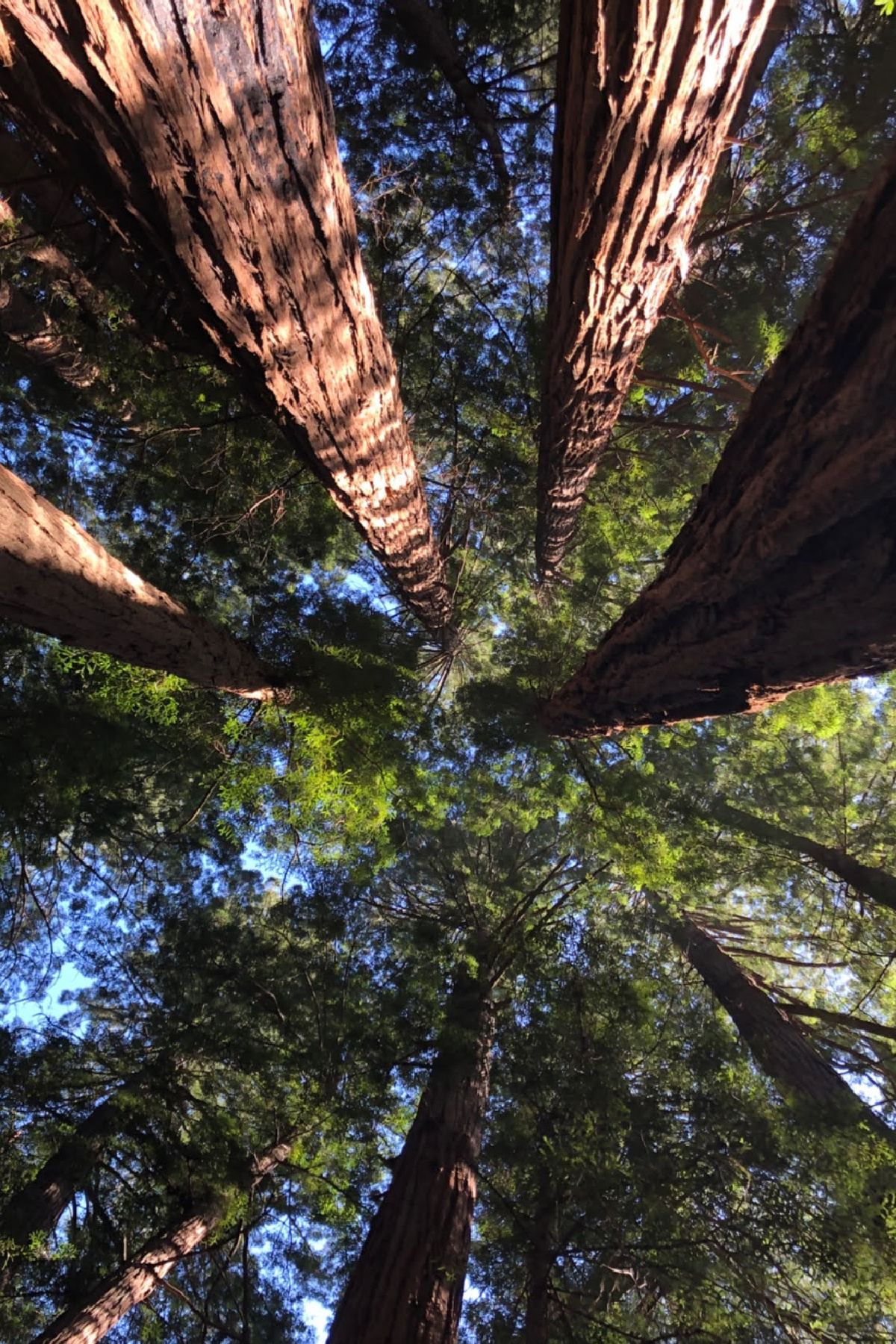
Get Your Camera Low
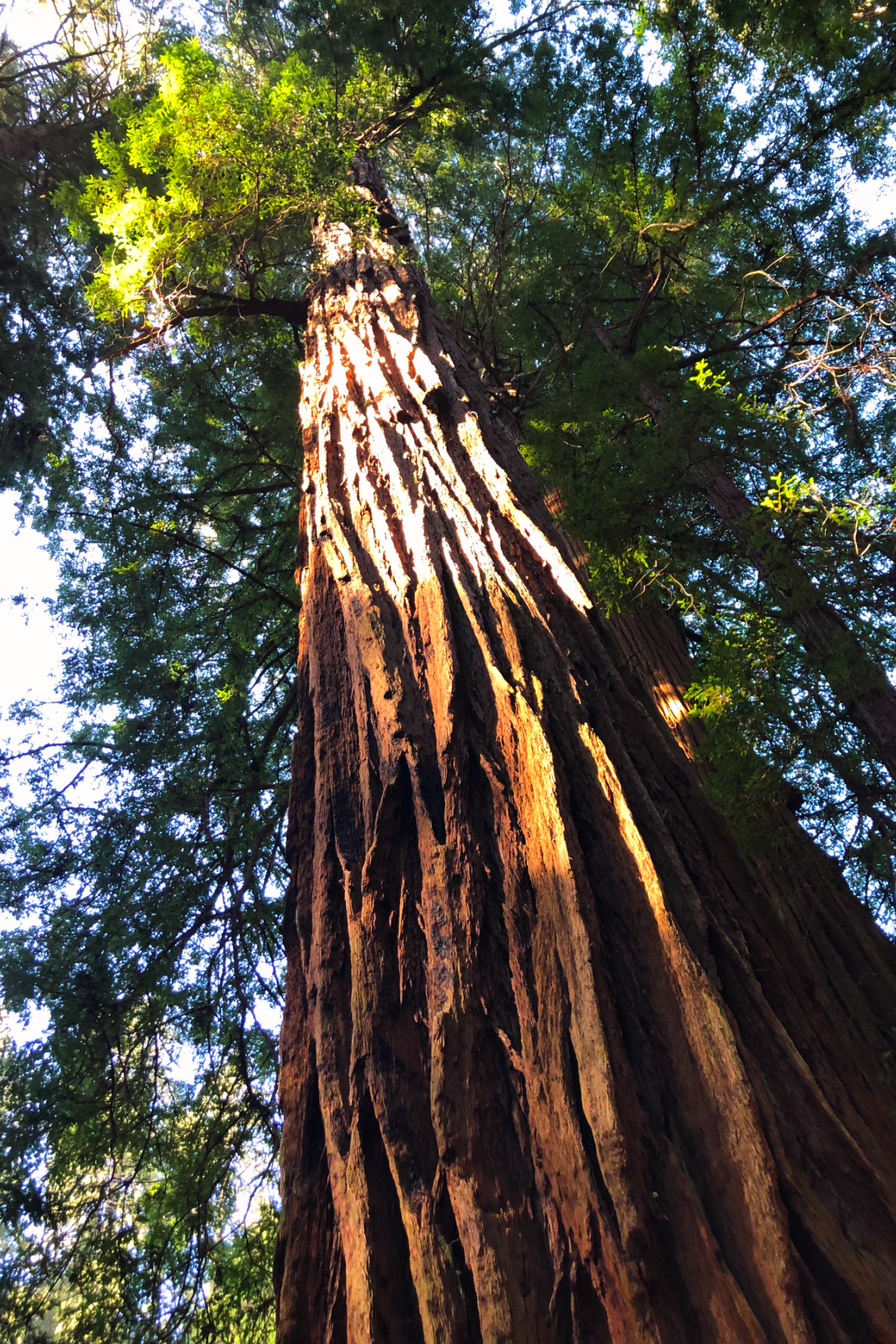
This is one of my favorite techniques for photographing very tall trees.
Instead of holding your phone or camera at eye level, bring it much closer to the ground and angle it upward.
That exaggerated perspective lets you capture more of the trunk and makes the tree feel even taller.
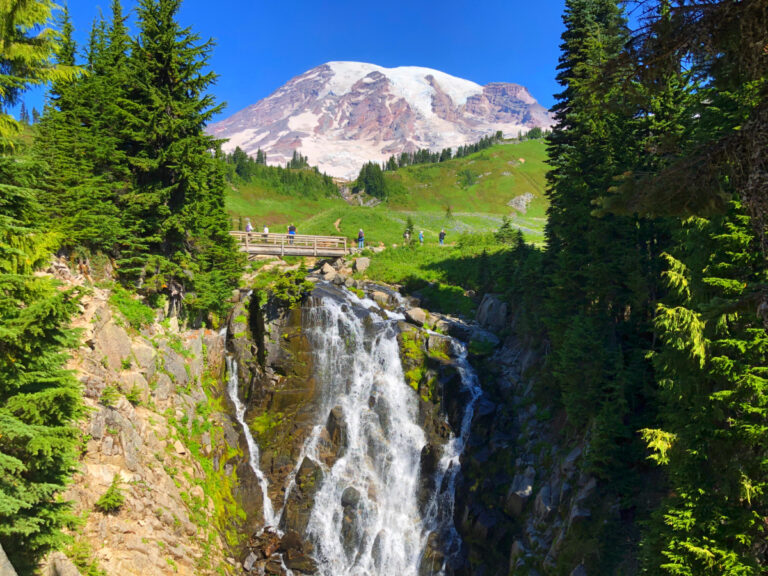
I recently showed a friend this same trick while photographing tall trees at Mount Rainier National Park.
It works.
Photograph Several Trees Together
You do not always need the entire height of a single tree.
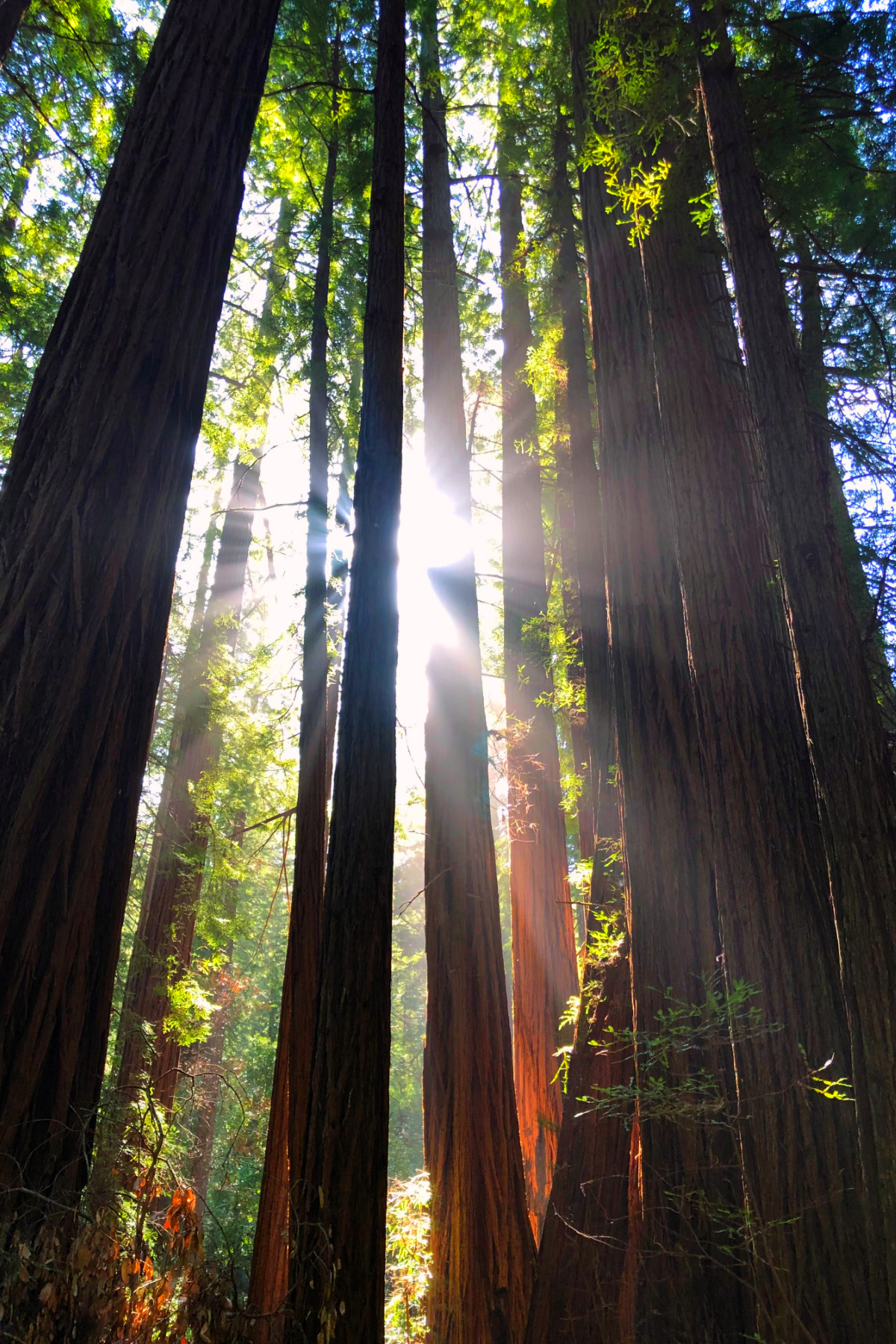
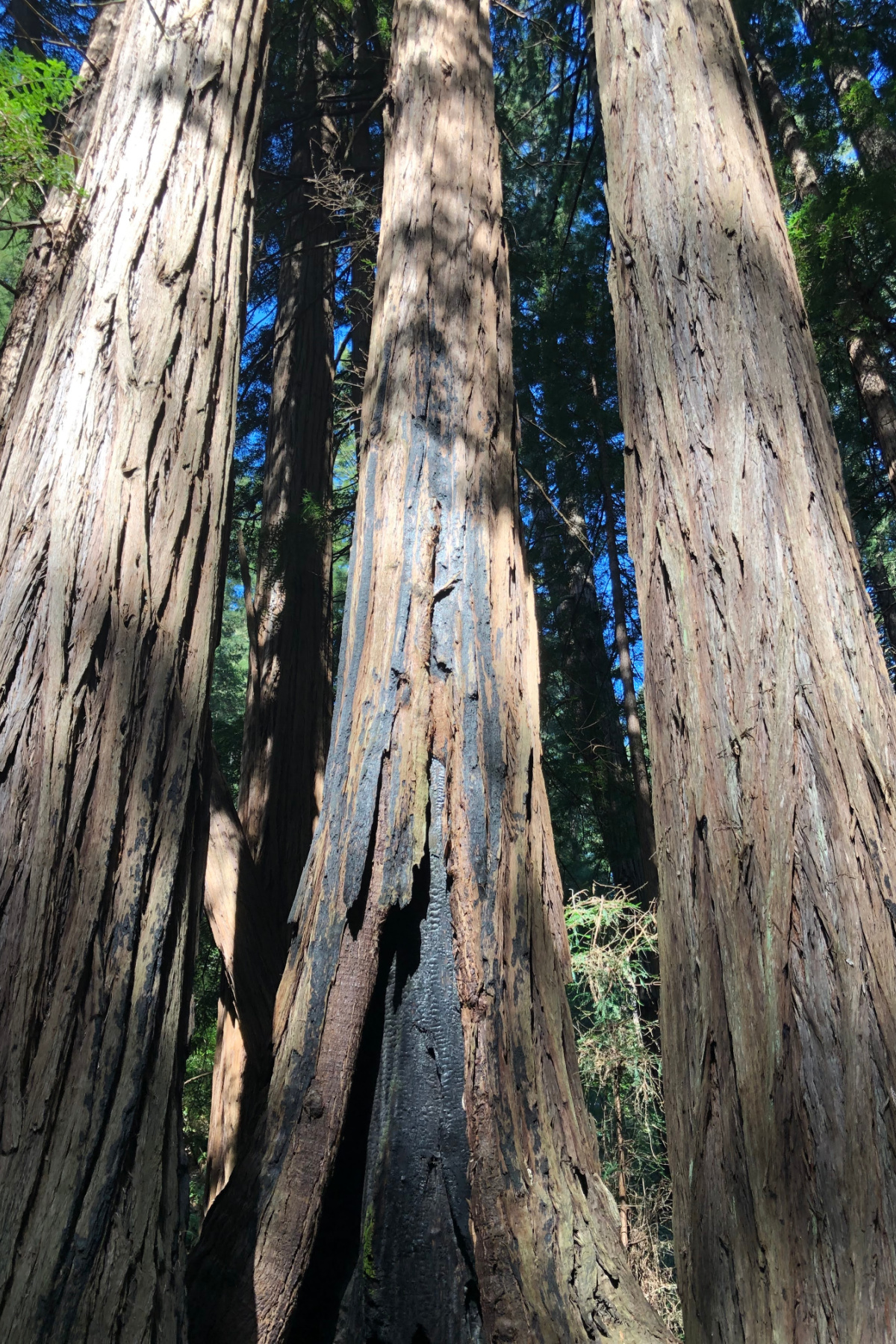
Sometimes the best photograph is simply pointing straight toward the canopy and capturing several trunks disappearing overhead.
Those photographs communicate what it feels like to stand inside a redwood forest much better than trying to squeeze one enormous tree into a vertical frame.
Use People for Scale
This may be the single best redwood photography tip I can give you.
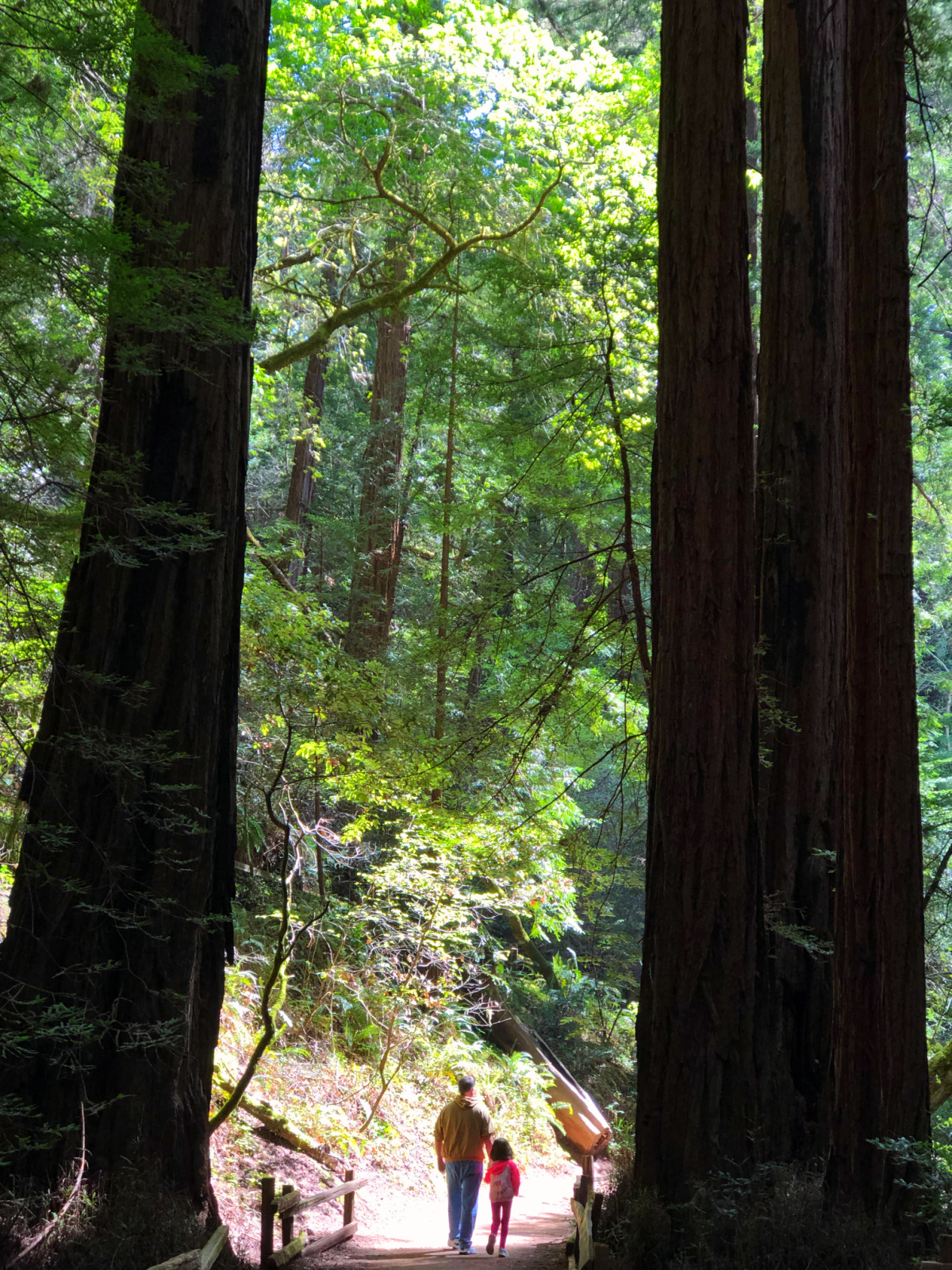
Put a person in the photograph.
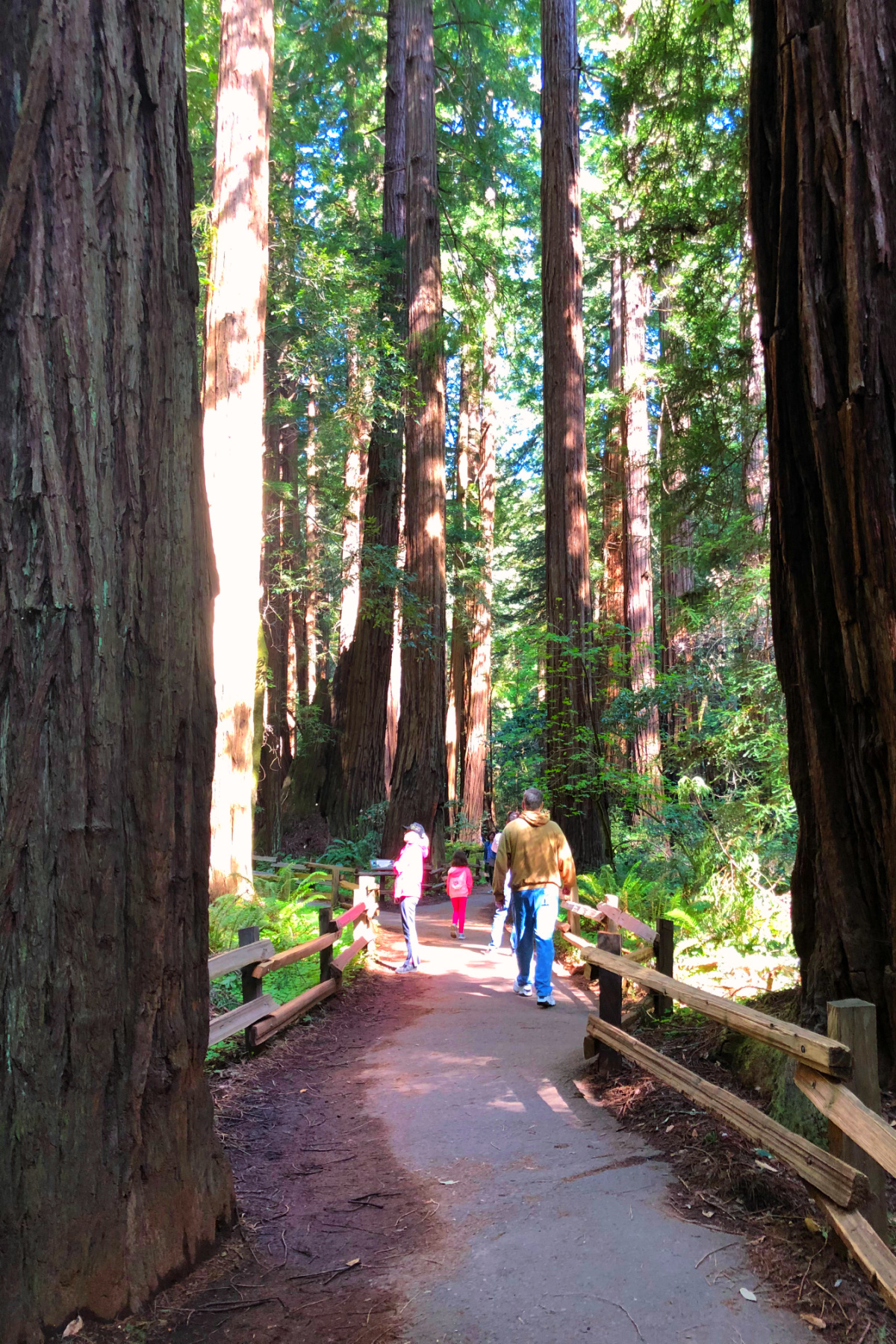
I have a favorite photo from our visit showing my husband and daughter walking between two enormous redwoods.
They look tiny.
Without them, the picture would still be beautiful.
With them, you understand the scale.
These trees are enormous in a way that a photograph often cannot communicate unless you give the eye something familiar to compare them with.
Look for Sunlight Through the Trees
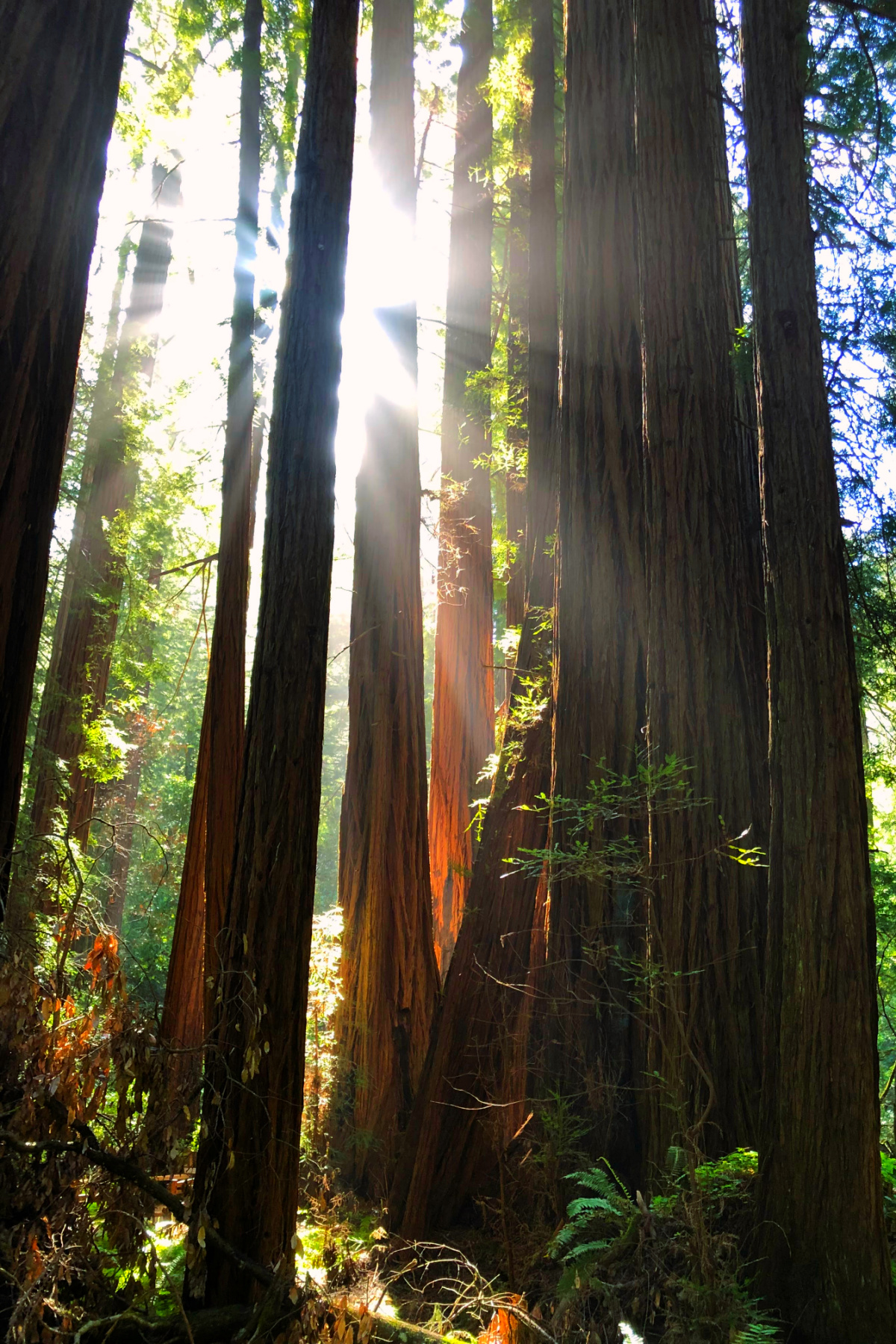
The redwood forest is dark.
That is precisely why little bursts of sunlight are so beautiful.
Watch for places where the sun breaks through the canopy and illuminates one tree trunk or creates visible rays through the forest.
Chef’s kiss.
Those were some of my favorite photographs from our visit.
Do Not Forget to Look Down
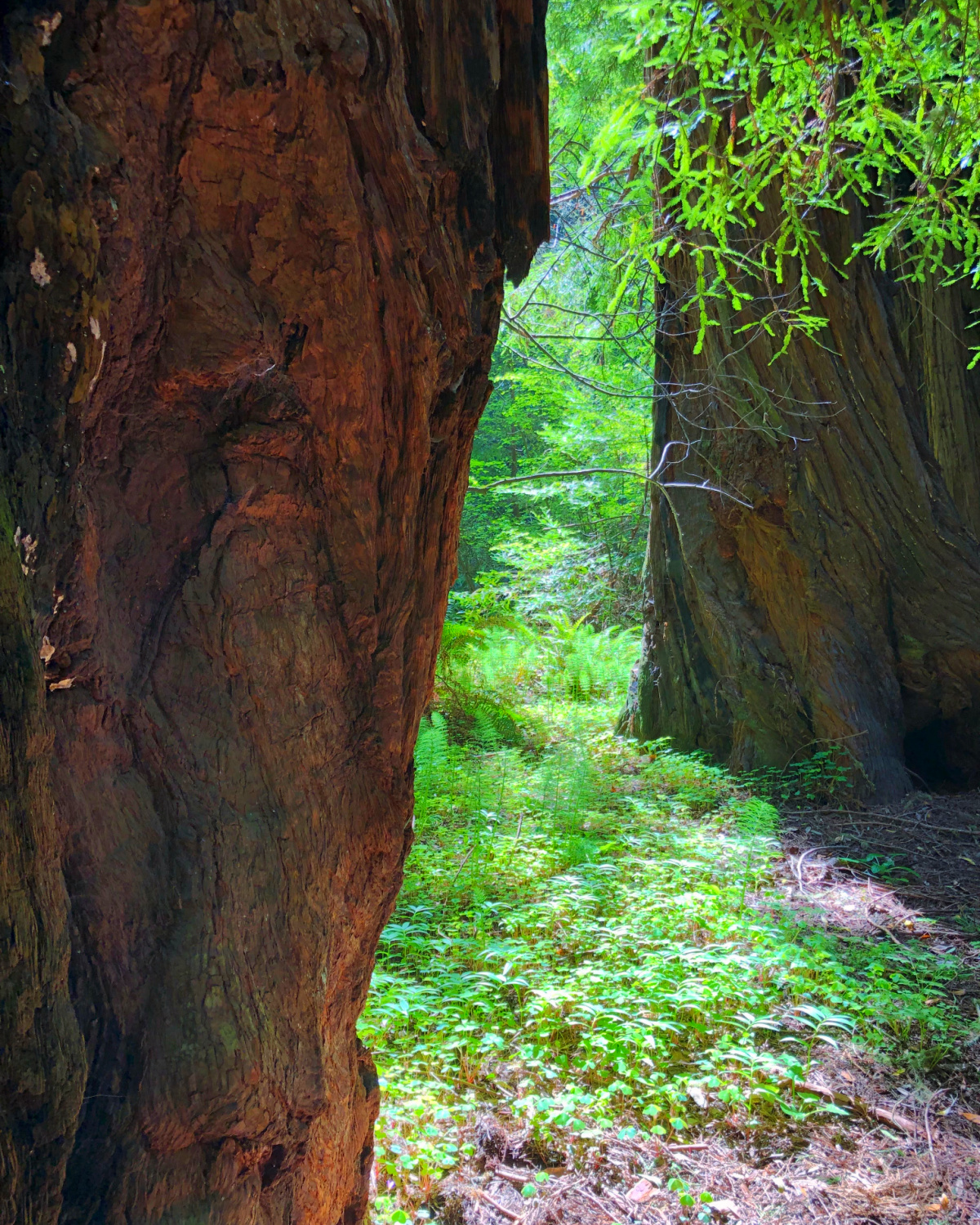
It is very easy to spend your entire time at Muir Woods staring toward the canopy.
Do that.
But then look down.
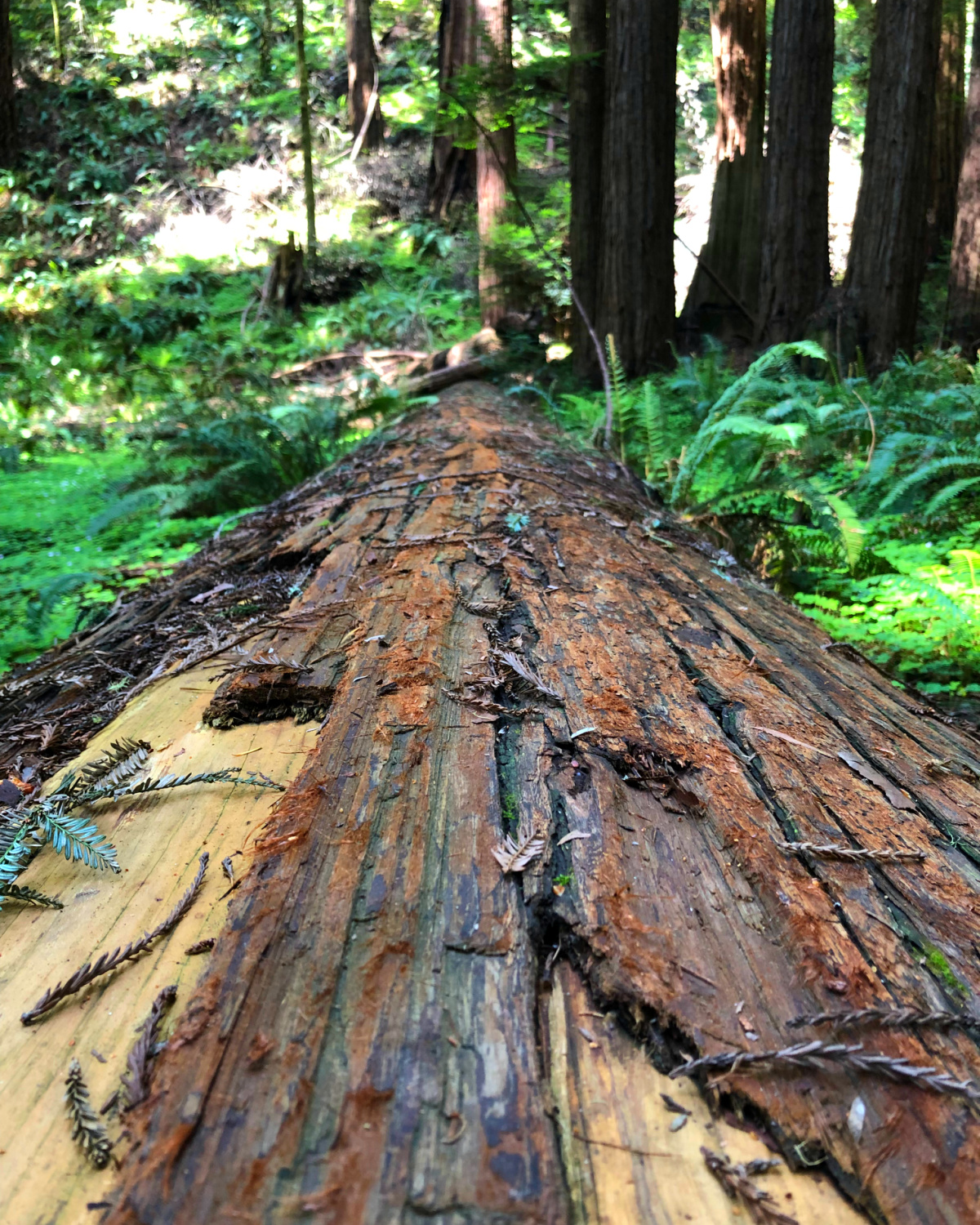
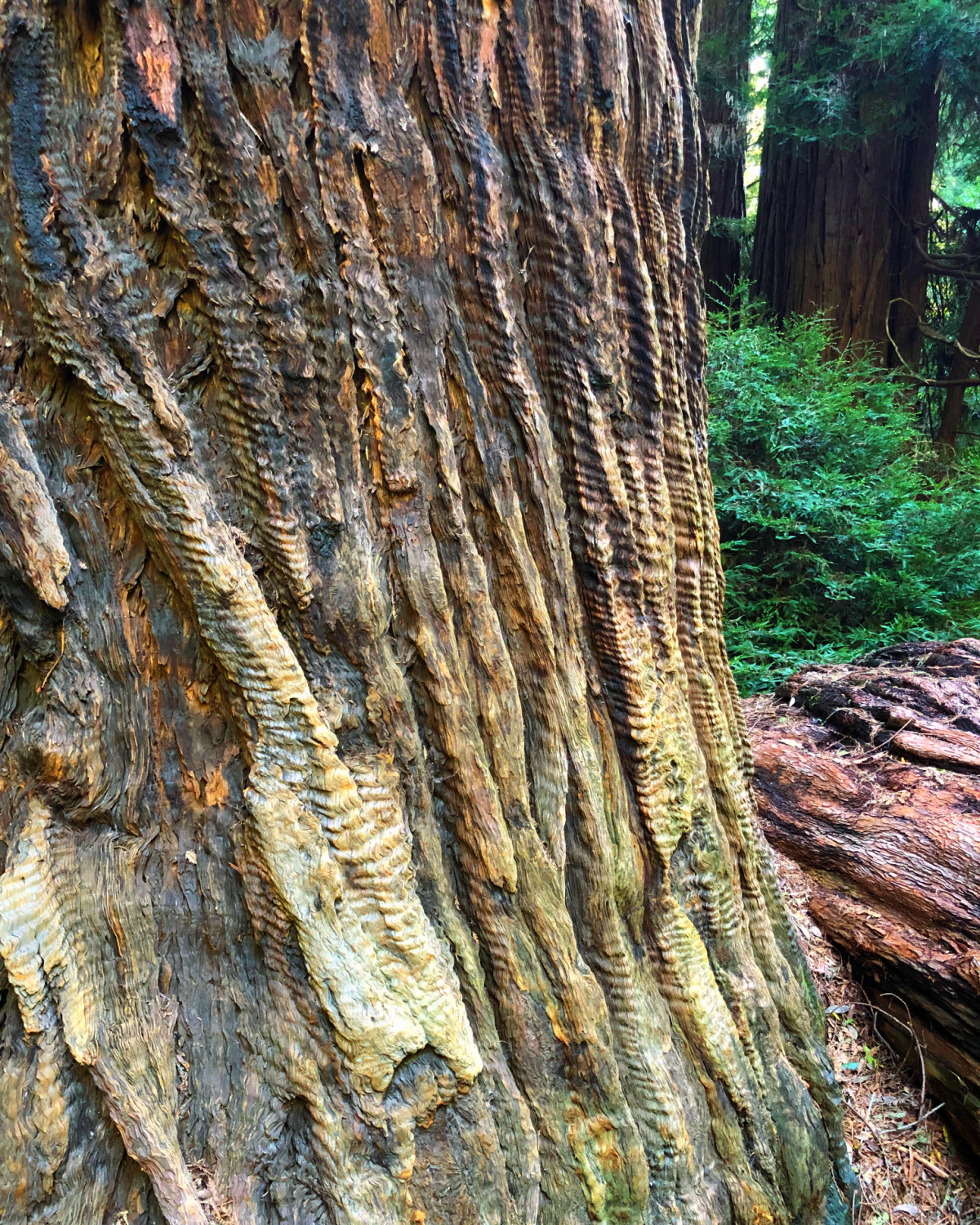
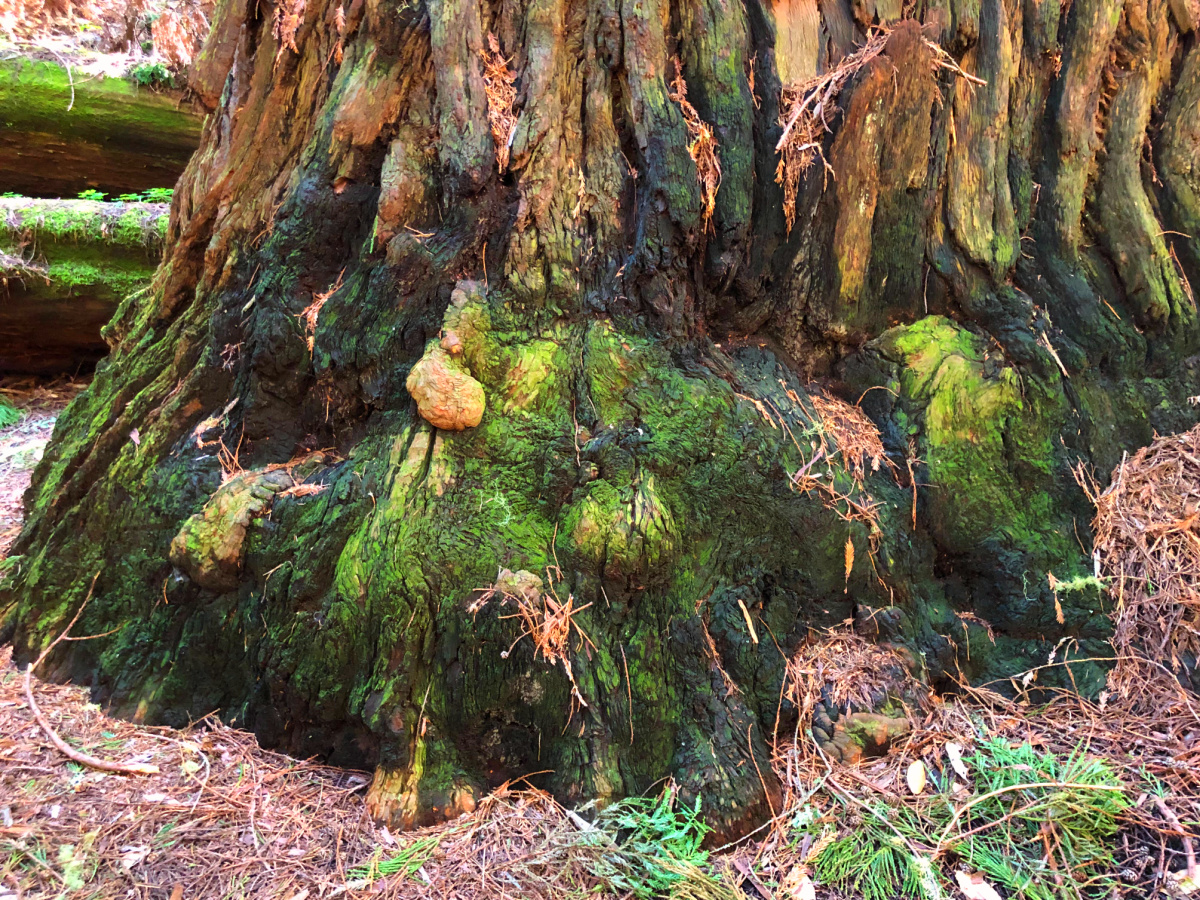
Photograph the thick bark.
The enormous bases of the trees.
Root systems.
Fallen logs.
Moss.
Ferns.
Redwood sorrel carpeting the forest floor.
Redwood Creek.
The smaller details are part of what makes this forest feel so lush.
Photograph the Hollow Trees
Where visitors are permitted to approach a hollow tree safely, take advantage of the perspective.
We stood inside one of the enormous hollowed-out trees during our visit.
I have the pictures.
I am not sharing those particular ones because they show my daughter’s face, but I promise you: the hollow trees are real.
And standing inside one is a pretty effective reminder of just how large these trees become.
Do Not Damage the Forest for a Photograph
There is one important caveat to all of this.
Stay on designated trails and obey barriers.
The National Park Service specifically asks visitors not to leave trails for photographs and not to pick or remove plants, sticks, flowers or other natural objects.
There are plenty of incredible photographs available from the established trails.
You do not need to trample the forest floor for Instagram.
My Best Muir Woods Planning Advice
If I were planning our visit again today, I would do essentially the same thing.
I would reserve an early parking time.
I would download everything before leaving San Francisco.
I would give us roughly two to three hours.
I would walk the Main Trail at whatever pace felt good.
I would let the kid stop and investigate things.
I would take far too many photographs.
And yes, I would check whether the café still had grilled cheese.
Muir Woods does not require an elaborate touring strategy.
It just requires enough planning to get through the gate.
After that, your job is pretty simple:
Walk into the forest.
Look up.
And enjoy the trees.
What Is the Best Time to Visit Muir Woods?
There really is not a bad season to visit Muir Woods.
The coast redwood forest stays relatively cool throughout the year, with typical temperatures ranging from about 40 to 70 degrees. Rain is more common from late October through early May, while summers tend to be drier and can start with heavy morning fog. Fall often brings some of the warmest weather of the year.
We visited in April, and I loved it.
The forest was intensely green, the ground was covered in lush vegetation, and everything felt fresh. Looking back at our photos, you can see how much moisture-loving plant life surrounded the redwoods.
For me, spring is a fantastic time to visit Muir Woods.
Spring at Muir Woods
Spring brings cooler temperatures, plenty of greenery, and the possibility of rain.
That rain is not necessarily a reason to cancel your plans.
In fact, the National Park Service specifically suggests considering a rainy day because fewer people tend to visit, and the redwoods can be particularly beautiful when they are wet.
I would just bring a rain jacket and shoes you do not mind getting damp.
Summer at Muir Woods
Summer brings longer operating hours and generally dry conditions, but it is also the busiest season.
Hundreds of thousands of people visit during June, July, and August. The National Park Service recommends mornings and weekdays if you are hoping for a quieter experience.
This is where my early-bird rule becomes especially important.
If you are visiting during summer vacation, reserve one of those morning parking slots.
Fall at Muir Woods
September and October can be surprisingly appealing.
The forest is often warmer during this period than it is during the foggier summer months, although you should still bring layers.
You also begin moving beyond the peak summer travel season.
Winter at Muir Woods
Winter is cooler and wetter, but the monument remains open year-round unless weather or another safety concern forces a temporary closure.
If you are willing to deal with rain, winter could give you a much quieter redwood experience.
And honestly, a misty redwood forest sounds pretty fantastic to me.
What Should You Wear to Muir Woods?
Layers.
Even if the weather forecast for San Francisco looks pleasant, remember that you are walking beneath a dense forest canopy near the coast.
I would wear comfortable walking shoes and bring a light jacket or fleece. During the wetter part of the year, add a rain jacket.
For the Main Trail, you do not need hiking boots unless that is simply what you prefer to wear.
This is not Yosemite backcountry.
You are walking on mostly easy, developed trails.
What Should You Bring to Muir Woods?
Keep it simple.
For a typical two- or three-hour visit, I would bring comfortable shoes, layers, water, your phone or camera, and a rain jacket if necessary.
Most importantly, make sure you have your parking or shuttle reservation saved somewhere you can access without cell service.
There is limited connectivity around Muir Woods, and this is not where you want to discover that your confirmation email is buried somewhere online.
Muir Woods vs. Redwood National Park: What Is the Difference?
This is the distinction I wish I had completely understood before our trip.
Muir Woods National Monument is not part of Redwood National Park.
Muir Woods is just north of San Francisco in Marin County.
Redwood National and State Parks are much farther north along the California coast and protect a much larger collection of redwood forests, prairies, rivers, and coastline.
So if you are specifically planning a trip to Redwood National Park, Muir Woods does not substitute for that experience.
But if you are visiting San Francisco and wondering whether you can see magnificent old-growth coast redwoods without driving several hours farther north, Muir Woods is exactly why the answer is yes.
And for a family vacation centered around San Francisco, Yosemite, or the broader Bay Area, that convenience is enormously valuable.
Muir Woods vs. Big Basin Redwoods State Park
I also have some personal history with Big Basin Redwoods State Park.
My husband and I visited Big Basin years ago, before we had our daughter, and I loved it.
In 2020, the CZU Lightning Complex Fire devastated much of Big Basin. The park has been undergoing a long recovery and redevelopment process, with some trails and visitor access gradually returning. In 2026, California State Parks continued expanding access, including seasonal shuttle service to reopened areas such as the Sequoia Trail and Sempervirens Falls.
It still makes me sad to think about what happened there.
But even remembering Big Basin as it was before the fire, I think Muir Woods is the better choice for many first-time visitors, particularly families.
Big Basin felt more like a larger state park where you could spend serious time hiking.
Muir Woods gives you the drama of old-growth redwoods almost immediately.
You park.
You enter.
And within minutes, you are beneath enormous trees.
For a child seeing redwoods for the first time, that is pretty hard to beat.
What Else Can You Do Near Muir Woods?
Because Muir Woods does not require an entire day, it is easy to combine with other Bay Area sightseeing.
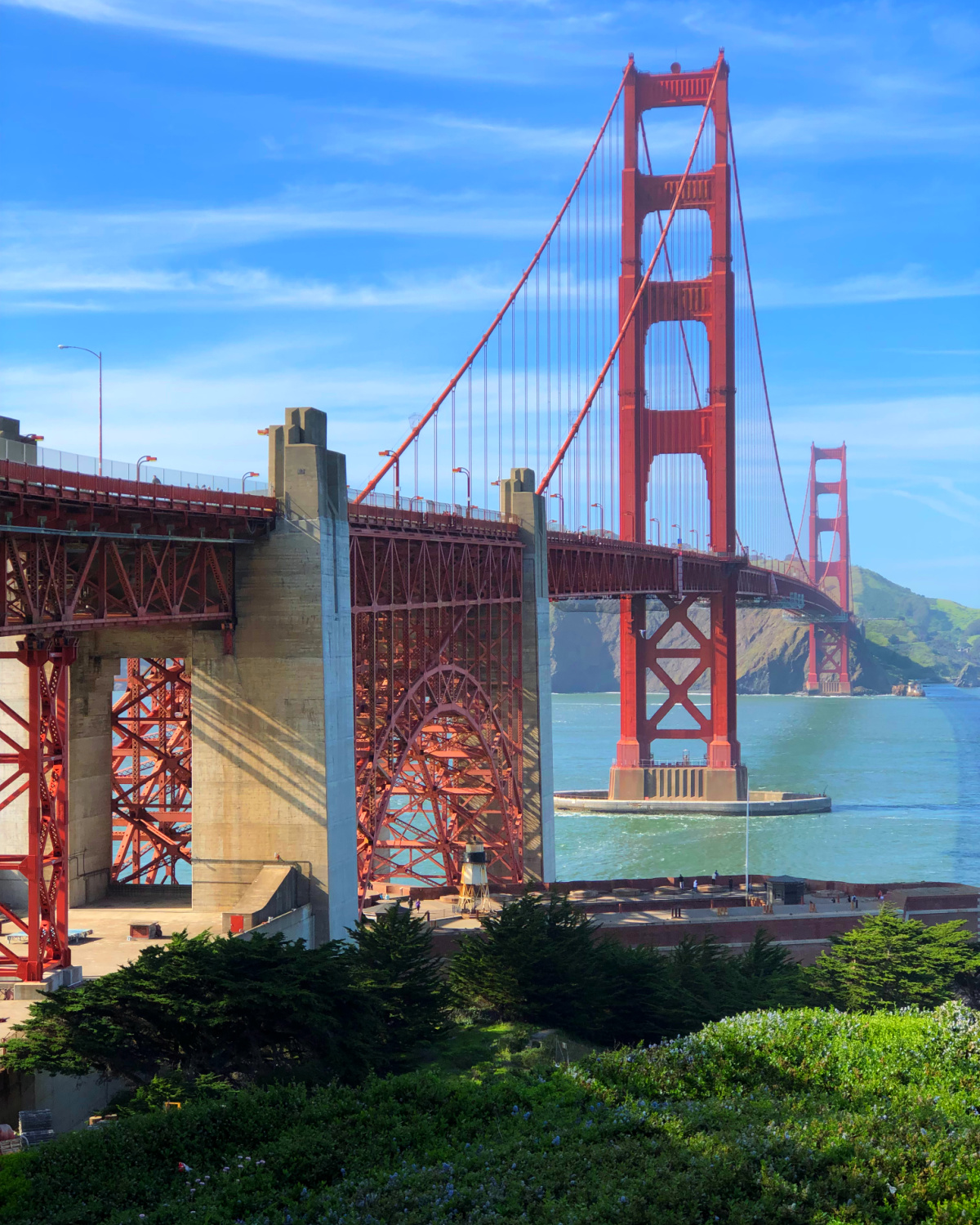
Golden Gate Bridge
This is the most obvious pairing.
Muir Woods is only about 11 miles north of the Golden Gate Bridge, so if you are staying in San Francisco, you will naturally pass through this part of the Bay Area on your way to the monument.
You could easily combine a morning at Muir Woods with Golden Gate Bridge viewpoints later in the day.
Sausalito
Sausalito is another natural addition to a Muir Woods day.
The waterfront town sits between San Francisco and the redwood forest and makes an easy place to stop for lunch, shopping, or a walk along the bay.
If you spend two or three hours at Muir Woods in the morning, you still have plenty of time for Sausalito afterward.
Marin Headlands
If you want dramatic views of the Golden Gate Bridge and San Francisco skyline, the Marin Headlands pair beautifully with Muir Woods.
This would be an especially good option for people who want a nature-heavy day without adding another major hike.
Mount Tamalpais
Muir Woods sits at the base of Mount Tamalpais, and longer trails from the monument connect with the surrounding state park trail system.
If you actually want a more strenuous hiking day, this is where you can turn your easy Muir Woods visit into something much bigger.
That was not what we were doing with our six-year-old.
And honestly, I was perfectly happy with our couple of hours among the trees.
Frequently Asked Questions About Muir Woods
Is Muir Woods worth visiting?
Absolutely.
If you are staying in San Francisco or traveling through the Bay Area, Muir Woods gives you one of the easiest opportunities to experience an old-growth coast redwood forest.
You do not need to be a serious hiker, and you do not need to devote an entire day to it.
How long should you spend at Muir Woods?
For most first-time visitors, I recommend about two to three hours.
That gives you enough time to explore the Main Trail, stop for photographs, read some of the interpretive exhibits, and enjoy the forest without rushing.
Do you need reservations for Muir Woods?
Yes.
If you are driving, you need a parking reservation before arriving. Shuttle riders also need reservations.
Do not count on simply showing up and finding a parking space.
What time of day is best for Muir Woods?
Morning.
The National Park Service recommends mornings and weekdays for a quieter visit, particularly during the busy summer season.
And this is one of my general rules for national park travel anyway.
The early bird gets the worm.
Can you see the redwoods without hiking very far?
Yes.
That is one of Muir Woods’ biggest strengths.
You begin seeing impressive redwoods almost immediately, and the primary Main Trail is relatively flat and easy.
You do not need to complete a difficult hike to have the full “wow, those trees are enormous” experience.
Is Muir Woods good for kids?
Very.
Our daughter was six when we visited, and it was a great age for the experience.
The trails were easy enough that the day did not become about endurance, but there was constantly something interesting to see: huge trees, hollow trunks, bridges, a creek, moss, ferns, tree rings, and enormous roots.
Is Muir Woods stroller-friendly?
Much of the Main Trail is stroller-friendly because it uses boardwalks and other firm surfaces.
Some areas can become uneven because of tree roots, and trails climbing away from the main forest floor may include steps, so families with strollers should stay primarily along the Main Trail.
Can you visit Muir Woods when it rains?
Yes.
And you might actually have a wonderful experience.
The National Park Service notes that rainy days often bring fewer visitors, and the redwoods provide some natural cover.
Just dress appropriately.
Does Muir Woods have food?
Yes.
The Muir Woods Trading Company Café near the entrance sells food and drinks.
And unless the menu has changed dramatically since 2019, I remain firmly in favor of the grilled cheese.
Is Muir Woods the same as Redwood National Park?
No.
Muir Woods National Monument is near San Francisco.
Redwood National and State Parks are much farther north.
Both protect coast redwoods, but they are completely different destinations.
Can Muir Woods be a half-day trip from San Francisco?
Definitely.
In fact, that is probably how I would recommend experiencing it.
Reserve an early arrival, spend two or three hours exploring the forest, and then use the rest of your day for another Bay Area destination.
More California and National Park Travel Ideas
If Muir Woods is part of a larger California trip, it pairs especially well with several other Sunshine Whispers destinations.
Yosemite National Park: We traveled from the Bay Area to Yosemite on this same family vacation, and the combination was fantastic. Muir Woods gave our daughter her first experience with enormous redwoods before we introduced her to Yosemite’s waterfalls, granite cliffs, and giant sequoias.
San Francisco and the Bay Area: Muir Woods fits naturally into a trip that also includes the Golden Gate Bridge, Pier 39, California Academy of Sciences, Exploratorium, and other Bay Area attractions.
Monterey and the Central Coast: If you are continuing south, Monterey Bay Aquarium, Pacific Grove, Carmel, and the spectacular California coastline make another easy extension.
And if you enjoy national parks but prefer experiencing them without planning your entire vacation around hardcore hiking, I have plenty of other guides built around that exact style of travel.
Final Thoughts: Is Muir Woods Worth It?
Muir Woods was not the biggest destination on our 2019 California vacation.
Yosemite came later.
San Francisco had plenty of its own attractions.
We were traveling around Northern California with a six-year-old on our first major family vacation that did not revolve around Disney.
But seven years later, I still remember this place.
I remember the enormous trees.
I remember looking straight up into a canopy that seemed impossibly far away.
I remember our daughter standing beside trunks that completely dwarfed her.
I remember the ferns and moss and redwood sorrel covering the forest floor.
I remember standing inside a hollow tree.
I remember shafts of sunlight cutting through the redwoods.
And apparently, I remember a grilled cheese sandwich.
Muir Woods is not a place where you need an ambitious itinerary.
You do not have to identify every grove.
You do not have to know the name of every tree.
You do not have to hike ten miles.
You just need to give yourself a couple of hours.
Walk slowly.
Look up.
Look down.
Take pictures of the enormous trees, but also photograph the little things growing beneath them.
Put someone you love next to one of those trunks so you can remember just how ridiculously small all of us looked.
And if you are visiting San Francisco with kids, grandparents, casual hikers, or anyone who simply wants to experience one of California’s great natural landscapes without undertaking an expedition, put Muir Woods on your itinerary.
Those trees are worth it.
More California Nature and National Park Guides
If you’re planning a larger Northern California trip, these two guides pair especially well with Muir Woods:
3-Day Yosemite National Park Itinerary
Muir Woods and Yosemite make an excellent combination if you want two very different California nature experiences on the same trip. Muir Woods gives you an easy introduction to towering coast redwoods, while Yosemite adds granite cliffs, waterfalls, scenic drives, and some of the most iconic national park scenery in the country.
Read next: 3-Day Yosemite National Park Itinerary
Mariposa Grove of Giant Sequoias
If giant trees are one of the highlights of your California trip, add Mariposa Grove to your Yosemite plans. Muir Woods is home to coast redwoods, while Mariposa Grove protects giant sequoias, so visiting both gives you a chance to see two completely different kinds of California’s most extraordinary trees.
Read next: Mariposa Grove of Giant Sequoias