Irvine Nature Center in Owings Mills, MD: What It’s Really Like to Visit (Maple Sugaring, Trails, Playground & More)

Affiliate Disclosure: This post may contain affiliate links. If you make a purchase or booking through these links, I may earn a commission at no additional cost to you.

Planning a visit to Irvine Nature Center in Owings Mills, MD? This detailed family guide covers maple sugaring weekends, the nature playground, hiking trails, live animal exhibits, programs, hours, and admission information.
Estimated reading time: 11 minutes
The first time we went to Irvine Nature Center, I almost didn’t go.
It was one of those late winter weekends where everything looks gray. The trees were bare. The air had that damp chill that sneaks through your coat. I remember thinking, “Are we really driving out for this?”
We were going for Maple Magic, the Maple Sugaring Weekends.
By the time we left, my daughter was carrying a wooden sap yoke across the field like she’d just been handed an important job, and I was already checking their website to see what other programs they offered.
That’s usually how Irvine goes. You show up casually. You leave planning your next visit.
Related: Check out our picks for the best nature centers in Maryland

Irvine Nature Center – Practical Info
Address:
11201 Garrison Forest Road
Owings Mills, MD 21117
Hours:
Monday–Saturday: 9:00 am – 4:00 pm
Sunday: 12:00 pm – 4:00 pm
Admission: Free for general visits.
Special events and programs require tickets.
Parking is simple. You pull in, walk a short path, and you’re at the main building.
Always check the website before heading out, especially in winter or during special event seasons.

Related: The Oregon Ridge Nature Center is another fantastic nature center we love!
Maple Magic– Maple Sugaring Weekends (More Interesting Than You’d Think)
The maple sugaring program is what introduced us to Irvine.
The guide drilled into the maple tree. You could hear the wood give slightly. Sap began to drip. Clear. Almost watery.

Kids gathered around and asked questions that were surprisingly practical.
“How long does it take?”
“Why only certain trees?”
“What happens if it’s too warm?”
They explained that it takes a huge amount of sap to make a small amount of syrup. That part stuck with my daughter. She still brings it up when we pour syrup at home.

The wooden yoke with the hanging metal buckets made it real. It wasn’t just a diagram. It was heavy, awkward, and clearly designed for work.
It’s usually held in late February into early March. If that’s your main reason for visiting, buy tickets early.

The Outdoor Space (Where You’ll Lose Track of Time)
After maple sugaring, we wandered into the outdoor play area.
It doesn’t announce itself as a “playground.” There isn’t a big sign or bright equipment calling attention to it.
It’s just there. Wood. Logs. Dirt. Metal pans. Water.
Kids immediately spread out.

The Logs
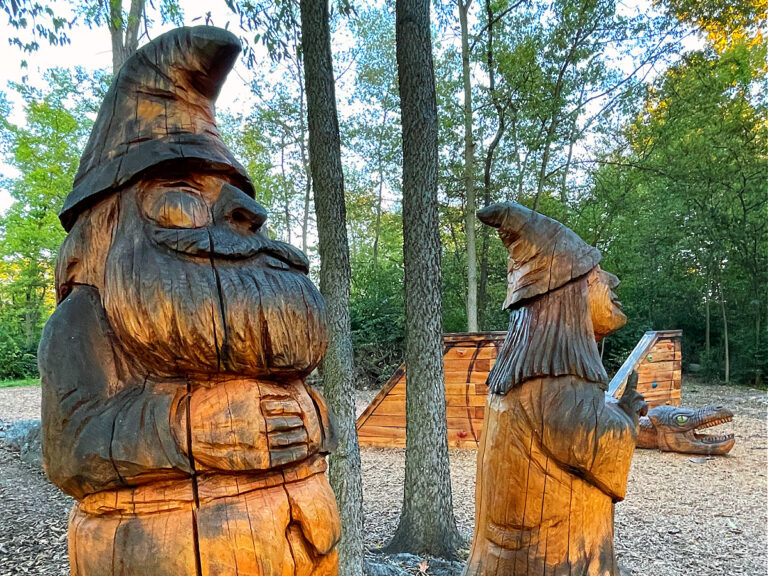
There are enormous logs scattered throughout the space. Some are smooth and cut cleanly. Others are rough, bark peeling at the edges.
Kids climb them instinctively.
There’s something about real wood that changes how they move. They’re more careful. More deliberate.
I’ve watched kids sit on those logs and talk like they’re in their own clubhouse.

Related: These are our picks for the best playgrounds in Baltimore County
The Mud Kitchen (Plan for Laundry)
The mud kitchen setup looks simple at first glance.
Wooden counters. Metal trays. Muffin tins. Old kettles. Two sink basins built into the counter.
But give it five minutes.
Suddenly there are layered mud “cakes” with leaf garnish. Someone is stirring with intense focus. Another kid is rinsing pans like it’s a real job.
It’s not chaotic the way traditional playgrounds can be. It’s quieter. Focused.

If you’ve ever had a child who could spend an hour mixing water and dirt in your backyard, this is their happy place.
Bring clothes you don’t mind scrubbing later.

Related: A fantastic state park nearby is the Patapsco Valley State Park!
The Sound Structure
Off to one side there’s a wooden frame with hanging metal pans and lids.
Kids bang them together experimentally at first. Then they start trying patterns.

It’s noisy, but because it’s outdoors, it doesn’t feel overwhelming.
Parents usually smile and let it happen.

Related: We love exploring outside at Double Rock Park!
Trails (When You Want to Stretch It Into a Half Day)
Irvine sits on more than 200 acres, and you can feel that once you step away from the building.
The trails wind through meadow and woods. They aren’t extreme. You don’t need special gear.
But they’re not paved suburban walking paths either.
In spring, you’ll see early wildflowers along the edges. In fall, the leaves gather in thick piles that kids inevitably kick through.
There are moments on the trails where you genuinely forget you’re in Baltimore County.
We’ve done short loops when attention spans were limited. We’ve also walked longer when the weather cooperated and nobody was rushing us.

Related: 30 Easy Hikes in Maryland that are perfect for kids!
Inside the Building
The building itself is modern — lots of glass and natural light. It doesn’t feel like an older nature center with dusty taxidermy in dark corners.
It feels cared for.

Live Animals
There are native Maryland animals inside: reptiles, amphibians, birds of prey.
The enclosures are close enough that kids can really observe details. Patterns on scales. Slow blinking eyes. Subtle movement.
You don’t rush through those exhibits.

The Night Exhibit
There’s a dimly lit room designed to mimic nighttime conditions.
It takes a moment for your eyes to adjust.
The fox exhibit inside that room tends to hold people longer than they expect. There’s something about seeing an animal in low light that makes it feel more real.
Voices naturally lower in there.

Pollinators and Insects
There are displays about bees and pollination that manage to be informative without feeling like a science textbook.
Some interactive elements let kids view things from an altered perspective, which usually leads to giggles and repeated attempts.

If you visit in summer, you may see butterflies outside afterward, which ties the whole thing together without anyone needing to point it out.

Programs Beyond Drop-In Visits
Irvine isn’t just a place to wander through.
They offer:
- Nature-based preschool
- Seasonal camps
- Homeschool classes
- Scout programs
- Family workshops

Summer camps are especially popular.
If you live nearby, this can easily shift from “occasional outing” to “part of our routine.”
You can browse current offerings here:
https://www.explorenature.org/classes-camps-programs/

Something I Appreciate (As a Parent)
There’s space.
Not just physical space — though there’s plenty of that.
But space to let kids figure things out.
No one is hovering. No one is directing every movement. There’s room for quiet observation. Room for messy play. Room for wandering conversations on the trails.
It doesn’t feel rushed.
And that’s harder to find than you’d think.

When to Visit
Winter is ideal for maple sugaring.
Spring brings new growth and fewer bugs.
Summer works surprisingly well because of the tree cover over the playground.

Fall is probably the prettiest season on the trails.
Weekday mornings feel calmer. Weekends have more energy but still enough space that it doesn’t feel crowded.

A Few Small Tips
Wear layers.
Expect mud.
Bring water.
Plan for at least two hours, even if you think you’ll only stay for one.

Is Irvine Nature Center Worth It?
Yes.
Not because it’s flashy.
Not because it has one big headline attraction.
But because everything works together.
The maple sugaring feels grounded.
The playground invites imagination.
The trails give you breathing room.
The exhibits feel intentional.
You don’t leave overstimulated.
You leave feeling like you actually did something.
And that’s usually enough to make us go back.