Fort Foote Park: Civil War Cannons & Potomac Views Near Washington DC


Explore Fort Foote Park in Maryland, a Civil War fort near Washington DC featuring 15-inch Rodman cannons, scenic Potomac River views, and the remains of historic wartime defenses of Washington.
If you’re the kind of person who sees a brown National Park Service sign and immediately pulls over… Fort Foote Park might be your thing.
Fort Foote Park is a small Civil War site in Fort Washington, Maryland, managed by the U.S. National Park Service as part of the National Capital Parks–East system. It was built to defend the nation’s capital during the Civil War, and today you can still see two massive 15-inch Rodman cannons sitting on Rozier’s Bluff above the Potomac River.
It’s not a big destination. There’s no visitor center. No gift shop. No reenactors marching around.
But if you’re already near Fort Washington or doing a Southern Maryland day trip, this is a solid little history stop — especially if you have a kid who thinks giant cannons are cool.
And honestly? Most kids do.

Related: Check out these 100+ FREE Things to do in Maryland with kids
Quick Planning Info (Because I Always Want This First)
Name: Fort Foote Park
Address: 8915 Fort Foote Road, Fort Washington, MD 20744
Managed by: U.S. National Park Service (official government organization)
Hours: Sunrise to sunset
Admission: Free
Parking: Small parking lot at the entrance

Why Fort Foote Exists (The Short Version)
During the Civil War, Washington, DC was surrounded by a massive ring of fortifications. These civil war forts were built to prevent Confederate forces — or even foreign intervention — from threatening the capital.
Fort Foote was built in 1863 as part of the Civil War defenses of Washington.
What made it different?
It was the only fort designed specifically to guard the Potomac River approach to the city.
Instead of focusing only on the landward side like many other earthwork fort sites, Fort Foote was positioned on Rozier’s Bluff (you’ll sometimes see it spelled Rozier’s Bluff) to command the river.
If enemy ships tried to move toward Washington? These guns were waiting.

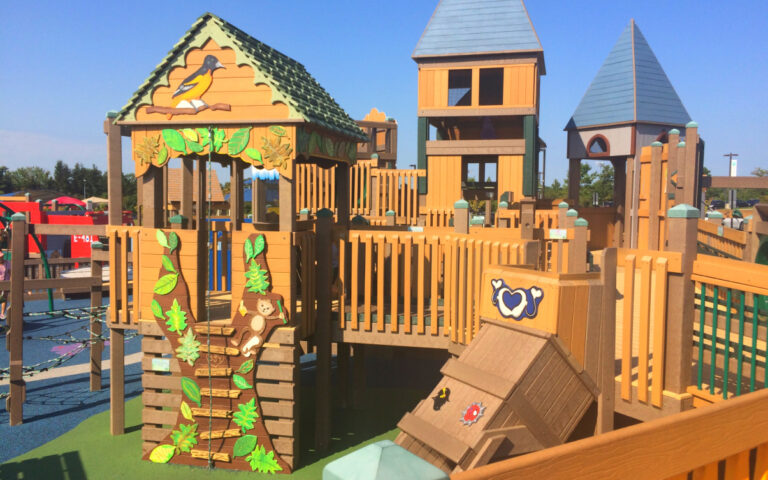
Related: Great playgrounds in Prince George’s County… a great side quest for this day trip!
The 15-Inch Rodman Cannons (This Is Why You’re Here)
Let’s talk about the real reason people visit.
Battery Rodgers (sometimes written Battery Rogers), named in honor of Rear Admiral Andrew H. Foote, mounted two 15-inch Rodman guns.
These were the guns of the heaviest caliber used in the defense of Washington.
They are enormous.

Each 15-inch Rodman cannon could fire a 440-pound projectile. When you stand next to them, you suddenly understand what that actually means. The barrels alone are massive. It’s hard to picture them in use without imagining the shockwave.
Fort Foote also mounted 200-pounder Parrott rifles, adding to the defensive strength.
The wild part? The fort never fired in battle.
But it was a strong position. And sometimes, the threat of artillery is the defense.

What You’ll Actually See Today
Let’s level-set expectations.
Fort Foote Park is not a restored fort. You won’t see reconstructed walls or buildings.
What remains are:
- The two 15-inch Rodman cannons
- Earthworks from the earthen fort design
- Concrete magazines
- The outline of the parade ground
- Interpretive signs explaining the military site
- Wooded walking trails
- A peaceful overlook toward the Potomac River
The interior of the fort is open and easy to explore. You can walk along the landward side and get a sense of how the earthwork fort was shaped.
There’s something kind of cool about the remains of the fort. It’s quiet. Wooded. A little forgotten.
It doesn’t feel curated. It feels preserved.

A Little More History (Without the Textbook Tone)
Fort Foote was named in honor of Rear Admiral Andrew H. Foote, a Union naval officer.
It became part of the broader civil war forts network protecting the capital. After the war, like many military sites, it lost importance quickly.
Over time, the structures deteriorated. Some of the property saw limited use during the Second World War. At one point, the site even functioned as a military prison.
Today, Fort Foote Park is preserved by the U.S. National Park Service as part of the National Capital Parks–East system.
It’s a small piece of the larger United States military story — and one of the quieter stops compared to Fort Stevens or other more heavily interpreted sites.

My Honest Take
Would I drive an hour just to see Fort Foote Park?
Probably not.
Would I stop if I were:
- Visiting Fort Washington?
- Exploring Piscataway Park?
- Driving through Southern Maryland?
- Planning a Civil War day trip near DC?

Absolutely.
It’s free. It’s peaceful. It takes maybe 30–60 minutes. And those cannons are genuinely impressive.
Also — and this matters if you have kids — there’s room to move. They can walk around. Climb small hills. Burn some energy.
There’s something nice about pairing history with space to run.

Related: 30+ Easy Hikes for Families in Maryland
Day Trip Ideas from Washington DC or Maryland
Because Fort Foote Park is small, it works best as part of something bigger.
Here are a few easy combos:
Civil War Focus
- Fort Foote Park
- Fort Washington
- Fort Stevens
That gives you a fuller picture of the Civil War defenses of Washington.

Potomac River + History
- Piscataway Park
- Fort Foote
- National Harbor for dinner
Virginia + Maryland Combo
- Mount Vernon (across the river)
- Old Town Alexandria
- Fort Foote Park
It’s also a good “host park” add-on when you’re exploring this stretch of the Potomac.
Things to Know Before You Go
- No visitor center.
- No restrooms.
- Trails are uneven in spots.
- Bring water.
- Check the official government website for updates.
- Download the NPS app if you want deeper context.
Because it’s a preserved earthwork fort, not a rebuilt one, you’ll need to use your imagination a bit. But honestly? That’s part of the charm.
Is Fort Foote Worth It?
If you’re expecting a full museum experience, you’ll be disappointed.
If you appreciate military history, civil war forts, or the quieter corners of the National Park Service system — it’s worth your time.
It’s not flashy.
But standing next to 15-inch Rodman cannons that once guarded the nation’s capital from the Potomac River approach? That’s pretty cool.
And sometimes, that’s enough.