Best Waterfalls in Yosemite National Park (Without Hardcore Hiking!)

Discover the best waterfalls in Yosemite, from Yosemite Falls to Bridalveil Fall, with easy viewpoints, hiking tips, and the best time to visit.
Estimated reading time: 35 minutes
Yosemite National Park has some of the most spectacular waterfalls in the United States. And while there are plenty of opportunities to hike to the top of a waterfall, or even hike alongside one, you don’t actually have to do any of that to appreciate just how magnificent Yosemite’s waterfalls are.
In fact, some of my favorite waterfall views in Yosemite were from the side of the road. Or a meadow. Or even the dining room of our hotel!
I’ve visited Yosemite National Park three times, and each visit was a little different. In the spring of 1998, I hiked to Vernal and Nevada Falls, when the waterfalls were absolutely roaring from the spring snowmelt. In October 2002, I repeated that hike, but the experience was considerably less impressive. There was barely any water coming over Vernal Fall, which was particularly disappointing considering how much effort it took to get there.
And then in April 2019, we visited Yosemite with our daughter. This time, we concentrated more on exploring Yosemite Valley, taking shorter walks, and enjoying the scenery without committing to any particularly strenuous hikes.
And you know what? I don’t think we missed out on anything.
We saw Yosemite Falls from practically every angle in the valley. We got absolutely drenched by the mist at Bridalveil Fall. And as if the beauty couldn’t get better, we even saw a double rainbow at the base of Lower Yosemite Fall and an enormous rainbow at Bridalveil Fall from Tunnel View.
So, if you’re planning a Yosemite vacation and want to see some incredible waterfalls without spending your entire day hiking uphill, this guide is for you. I’ll cover the best waterfalls in Yosemite National Park, where to find them, which ones are easy to access, and which ones might require a little more effort than you’re willing to put into your vacation.
When Is the Best Time to See Waterfalls in Yosemite?
One thing I learned from visiting Yosemite in both spring and fall is that the waterfalls can look completely different depending on the time of year.
Most of Yosemite’s waterfalls are fed by snowmelt from the Sierra Nevada mountains. As the weather warms up in the spring, all that melting snow makes its way down the mountains and eventually tumbles over the enormous granite cliffs surrounding Yosemite Valley.
Generally speaking, May and June are the best months to see Yosemite’s waterfalls at their peak. However, April can also be fantastic, particularly after a winter with plenty of snow.
We visited in April 2019, and the waterfalls were spectacular. Yosemite Falls was flowing beautifully, Bridalveil Fall was so powerful that getting close meant getting soaked, and even the smaller waterfalls along the roads were impressive.
Of course, there is a tradeoff to visiting Yosemite in the spring. Some of the higher-elevation roads, including Tioga Road and Glacier Point Road, are often still closed because of snow. That means you won’t necessarily be able to visit every part of Yosemite National Park.
But if your main priority is exploring Yosemite Valley and seeing waterfalls, I think that’s a pretty reasonable tradeoff.
Fall is a completely different experience.
When I visited Yosemite in October 2002, some of the waterfalls were barely flowing. I remember hiking up to Vernal Fall and being genuinely disappointed by how little water was coming over the rocks. Especially because I had remembered it being so impressive just a few years earlier.
That’s not to say you shouldn’t visit Yosemite in the fall. The park is beautiful any time of year, and there are plenty of reasons to visit outside the peak summer season.
But if I had to choose between an April trip and an October trip, and waterfalls were high on my priority list, I would choose April every single time.
1. Yosemite Falls
Let’s start with Yosemite Falls.
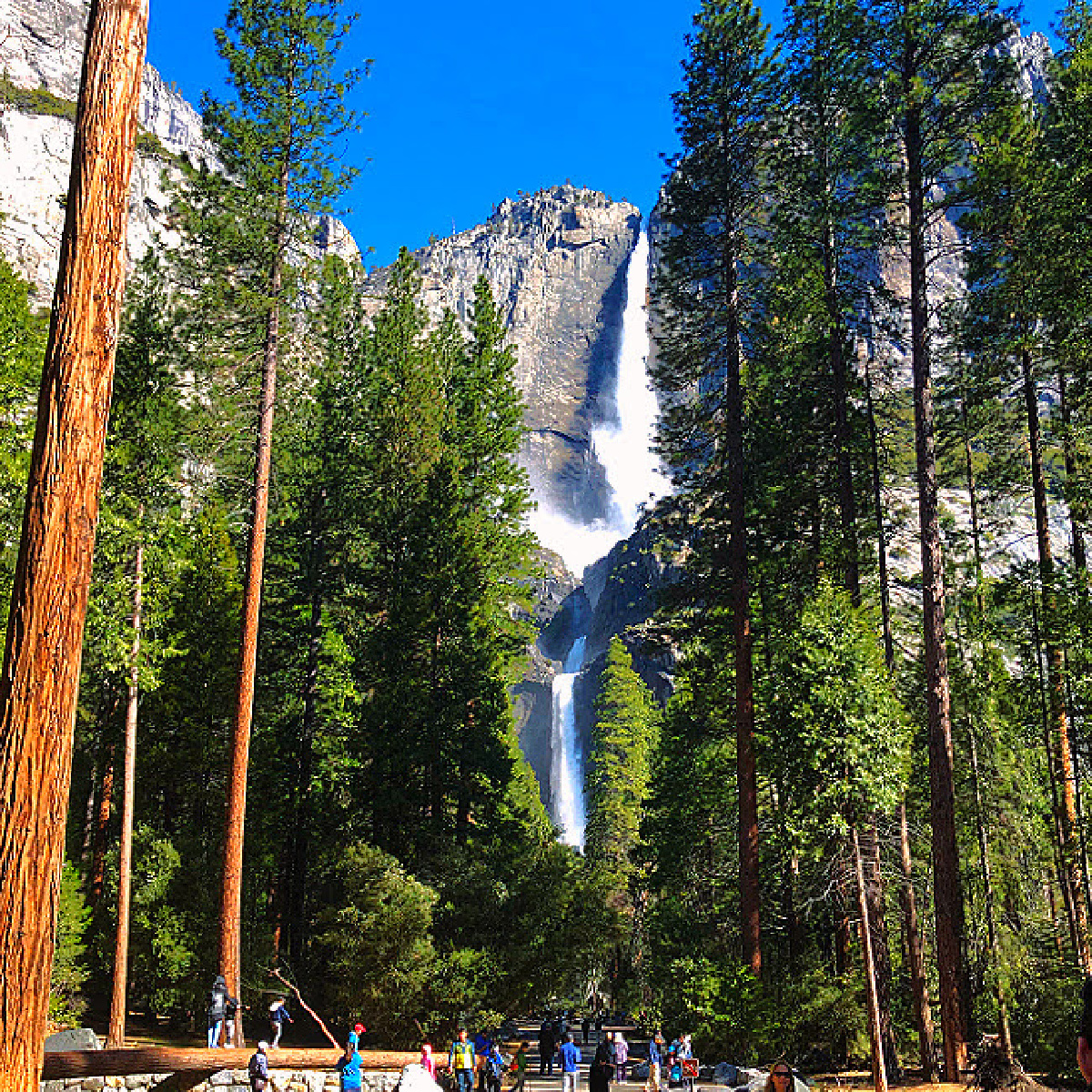
At 2,425 feet tall, Yosemite Falls is one of the tallest waterfalls in North America. It’s also one of the most distinctive features of Yosemite Valley, which is saying something considering you’re surrounded by enormous granite cliffs in practically every direction.
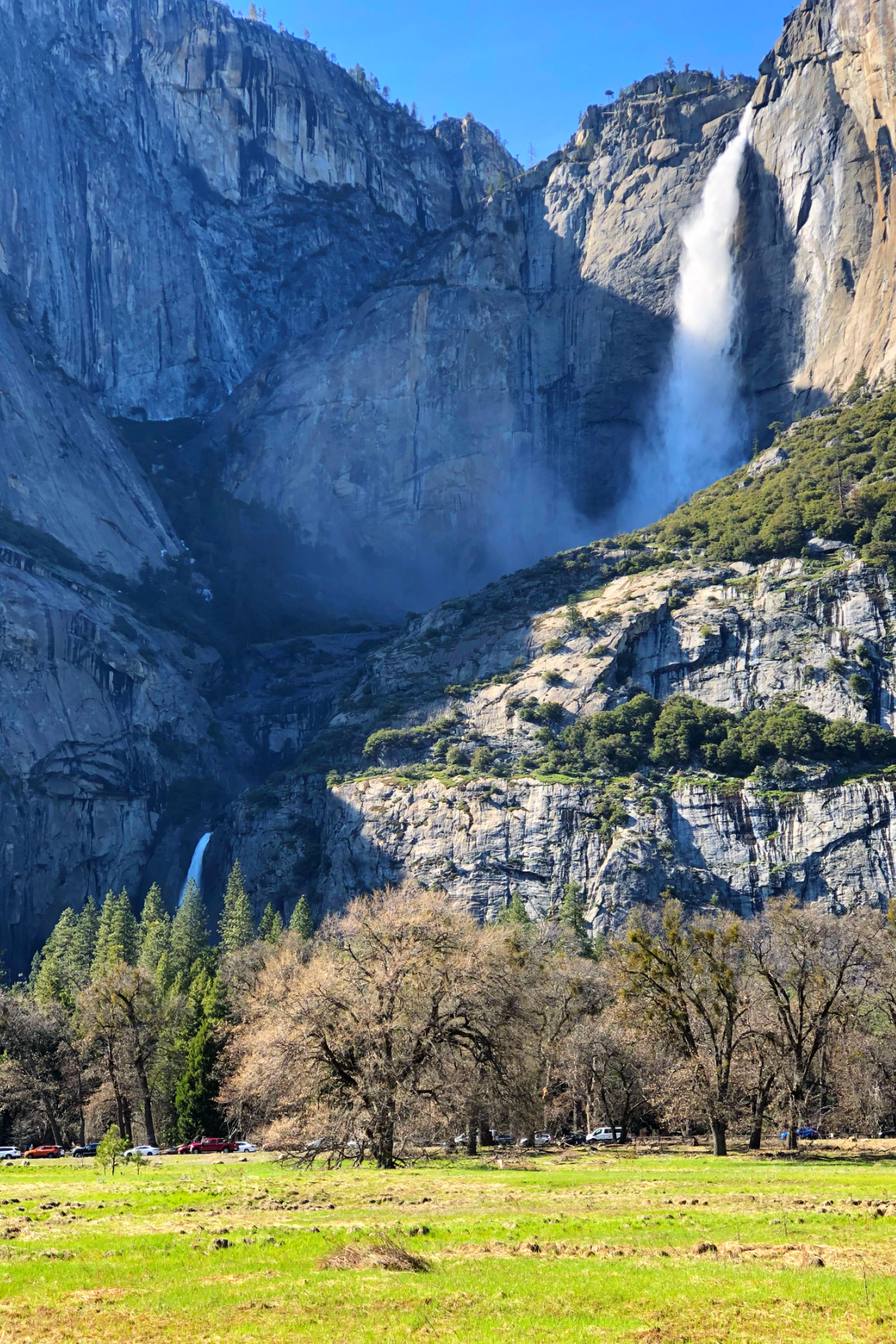
And I think one of the best things about Yosemite Falls is how ridiculously easy it is to see.
You can walk through a meadow and see it.
And you can look up while wandering around Yosemite Valley Lodge.
You can even sit in a restaurant and enjoy the view through enormous picture windows.
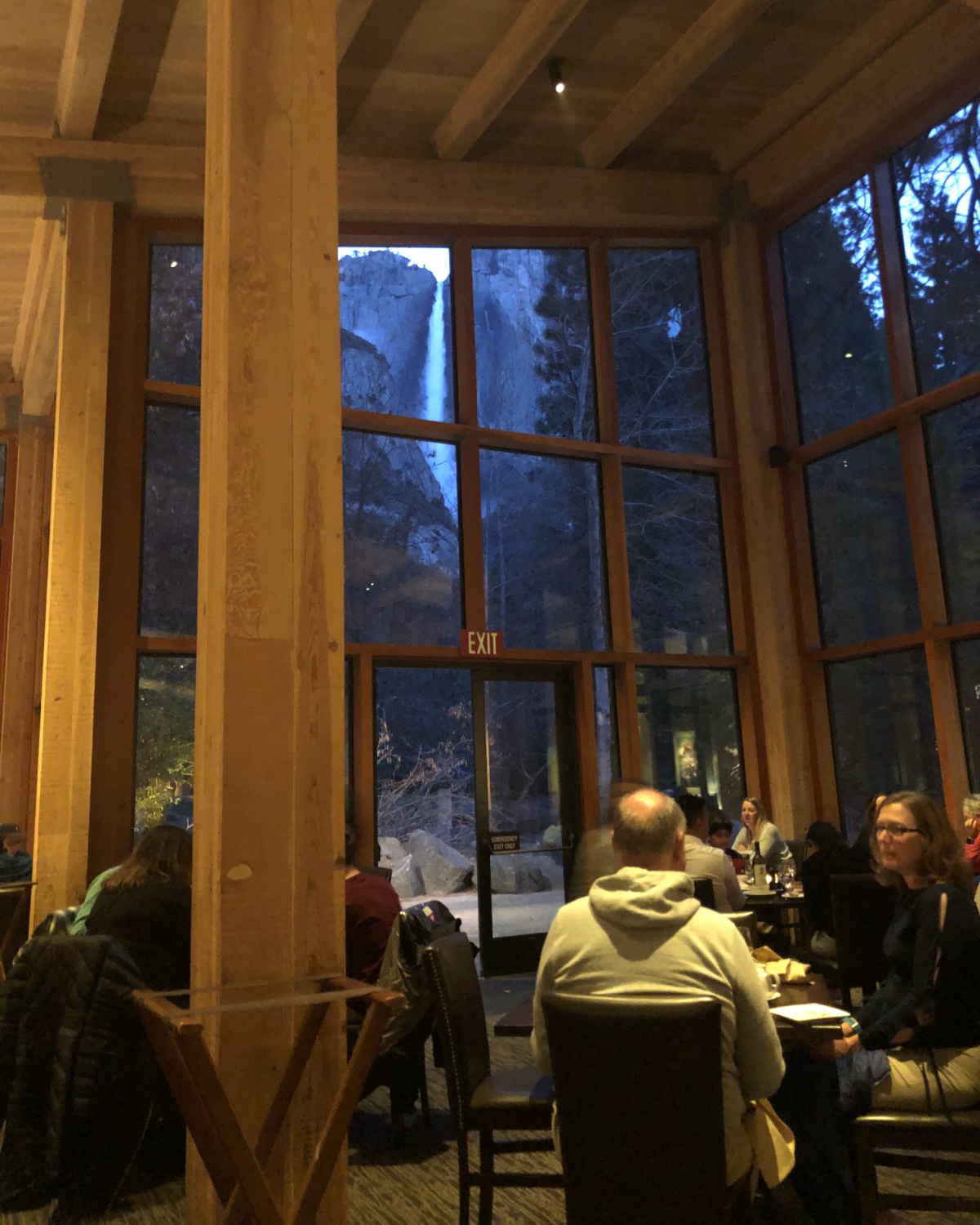
There are actually three sections to Yosemite Falls: Upper Yosemite Fall, the middle cascades, and Lower Yosemite Fall. Most visitors will spend their time admiring the upper falls from a distance and walking to the base of the lower falls.
Which, in my opinion, is a perfectly wonderful way to experience Yosemite Falls.
Upper Yosemite Fall
I’ve never hiked to the top of Upper Yosemite Fall.
Not once.
And I’ve been to Yosemite three times.
It’s not that I don’t think the hike would be amazing. I’m sure it is. But the trail to the top is strenuous, gains thousands of feet in elevation, and takes most of the day.
Meanwhile, I can stand in a meadow on the valley floor and look up at a 1,430-foot waterfall.
That works for me.
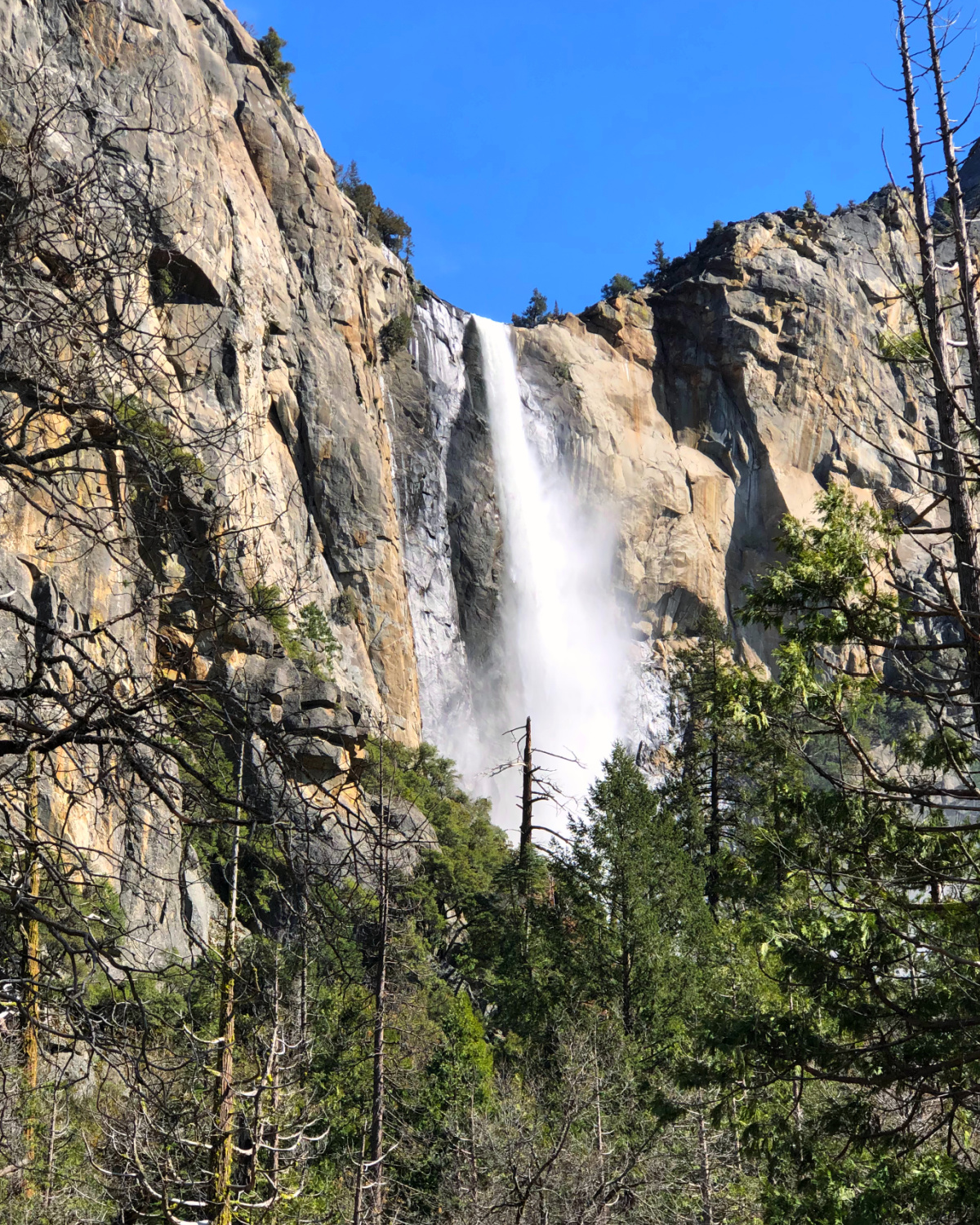
One of my favorite places to see Upper Yosemite Fall is around Yosemite Valley Lodge. We stayed there during our April 2019 trip, and the location was fantastic.
You’re practically underneath Yosemite Falls.
And there’s another little perk to staying there.
The Mountain Room Restaurant has enormous picture windows looking out toward Yosemite Falls. Depending on where you’re seated, you can enjoy a meal with the waterfall framed in the windows.
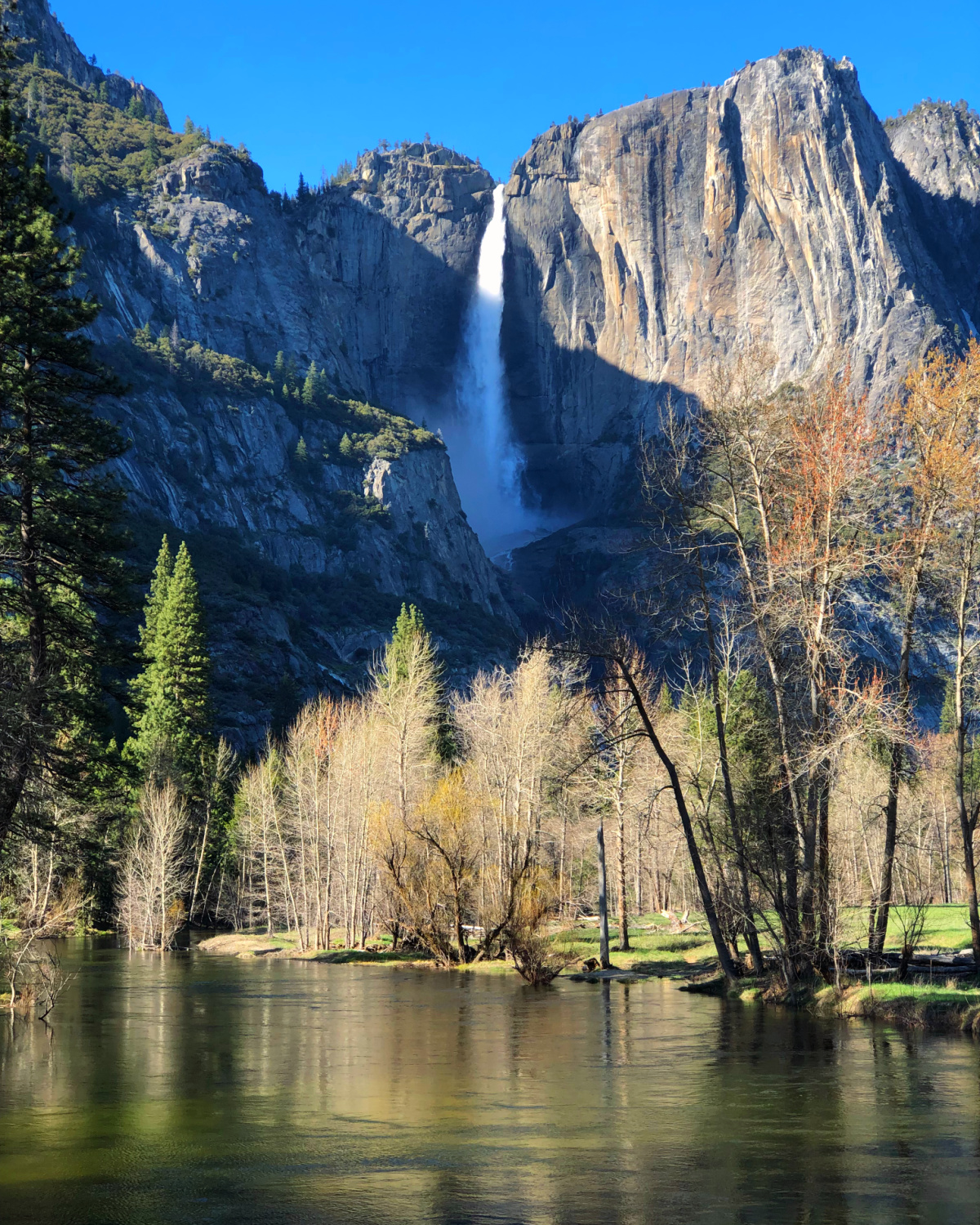
I mean, how many restaurants can offer that?
If you’re planning to eat at the Mountain Room, check the current dining hours and make a reservation if one is available. Even if you’re not staying at the lodge, it’s worth considering for dinner simply because of the setting.
I also love the views of Yosemite Falls from the meadows around Sentinel Bridge and Yosemite Valley Lodge.
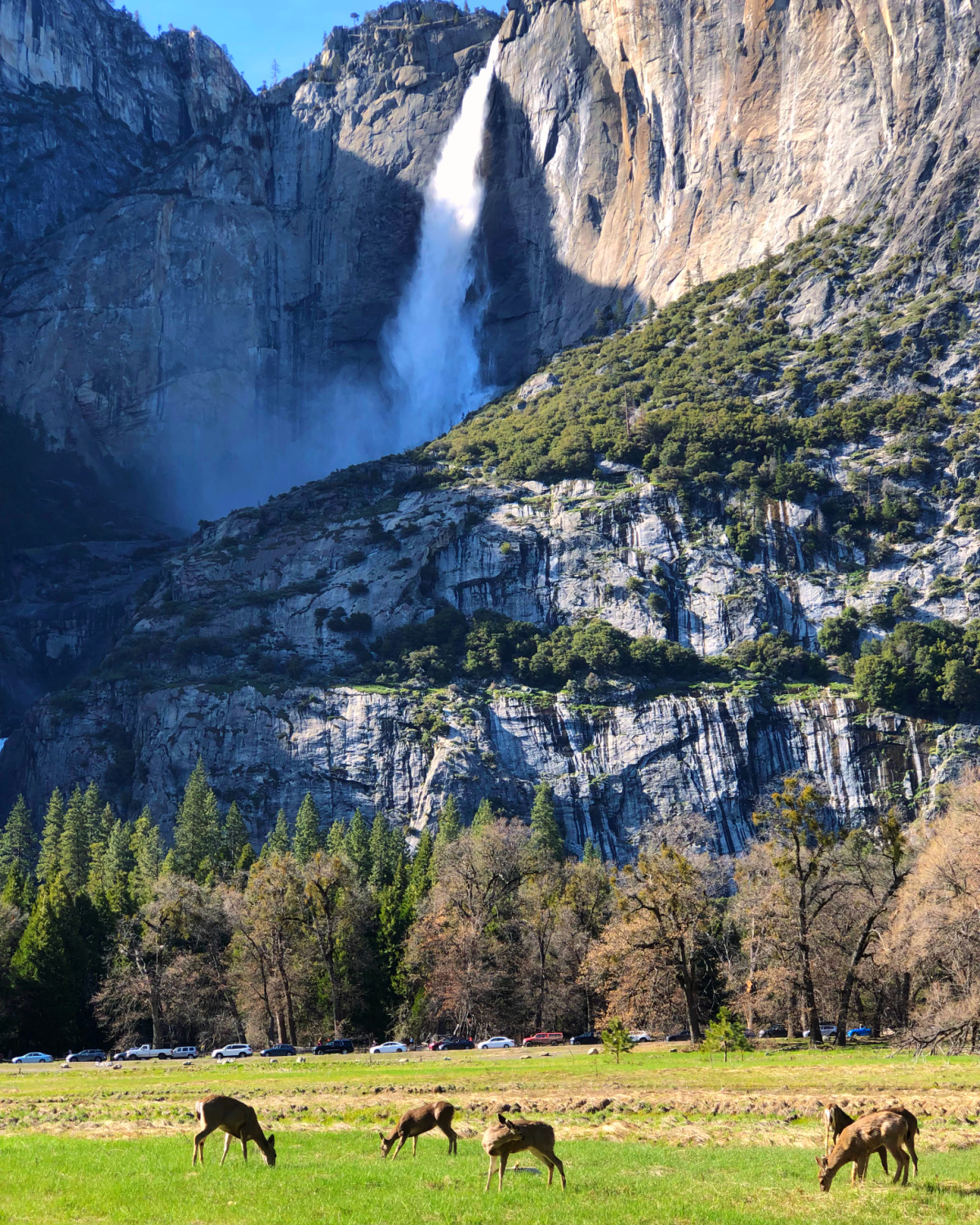
During our April trip, we saw deer grazing in one of the meadows with Yosemite Falls in the background.
Deer.
Giant granite cliffs.
A massive waterfall.
And we were just walking around Yosemite Valley.
This is why I love national parks.
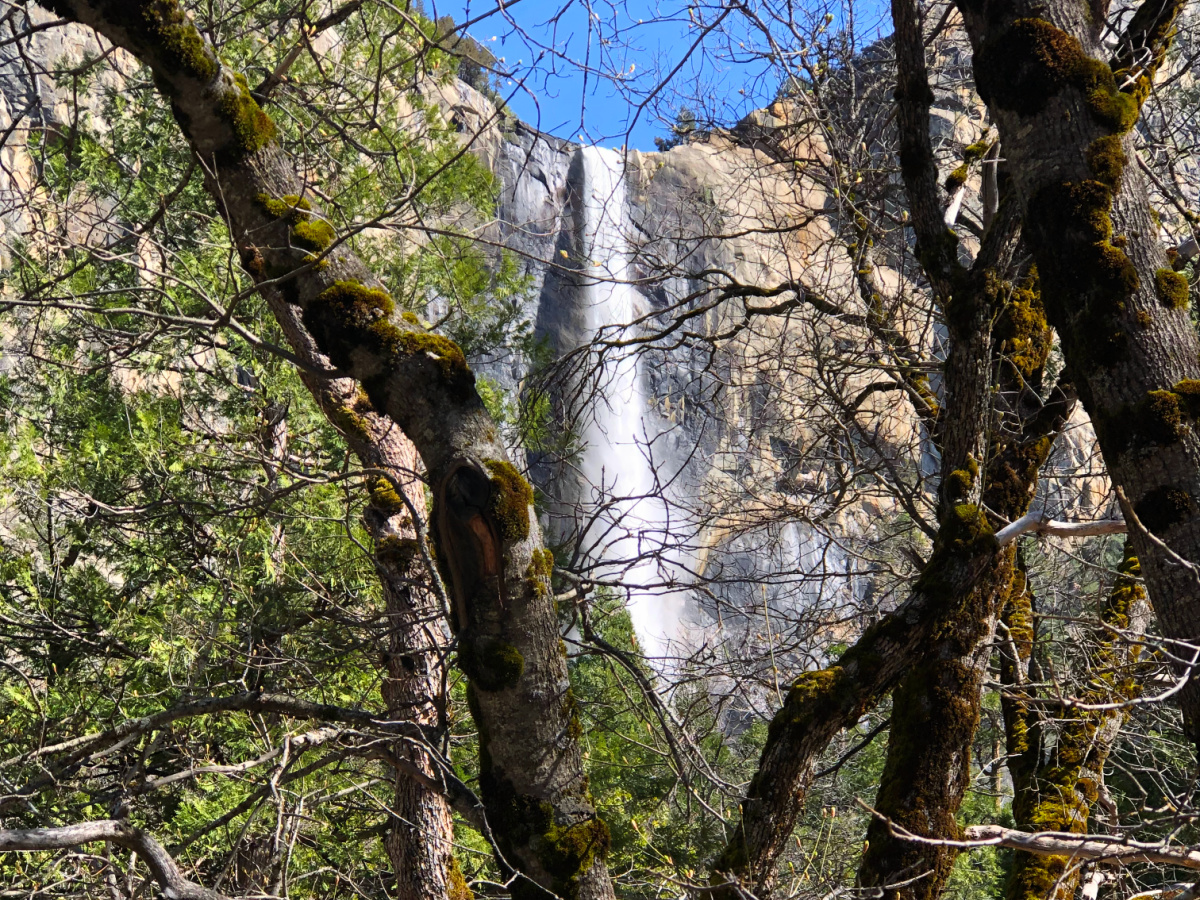
Lower Yosemite Fall
Now, if you’re only going to do one waterfall walk in Yosemite National Park, Lower Yosemite Fall is an excellent choice.
It’s easy.
It’s beautiful.
And you can get surprisingly close to the waterfall without having to climb halfway up a mountain.
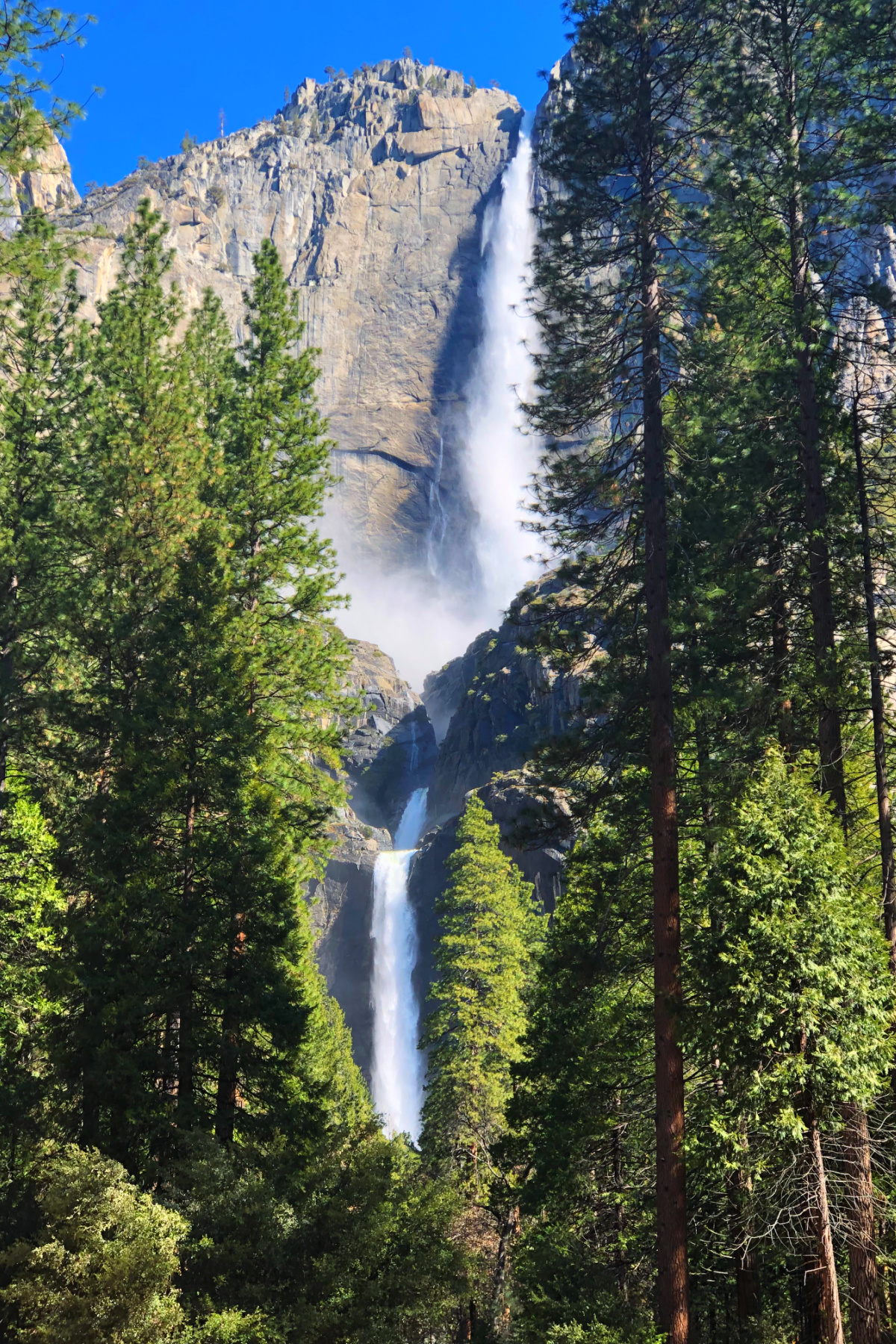
The Lower Yosemite Fall Trail is approximately one mile if you complete the entire loop. Much of the trail is a wide, paved path through the forest, and the eastern approach to the viewing bridge is wheelchair accessible.
But I think calling this simply a waterfall trail doesn’t quite do it justice.
Because the forest is part of the attraction.
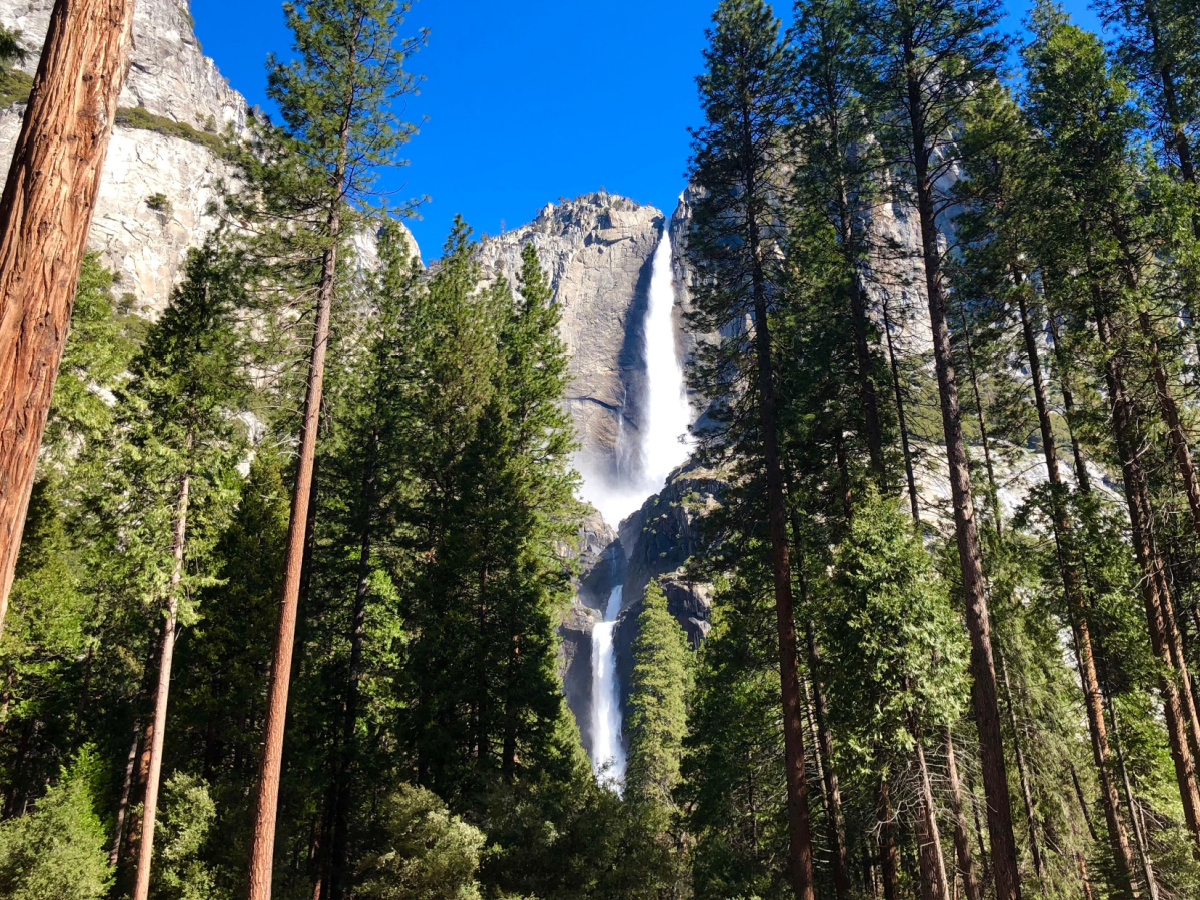
There are enormous ponderosa pines along the trail. And when I say enormous, I mean the kind of trees that make you stop walking and stare up into the branches.
There are also huge granite boulders scattered throughout the woods.
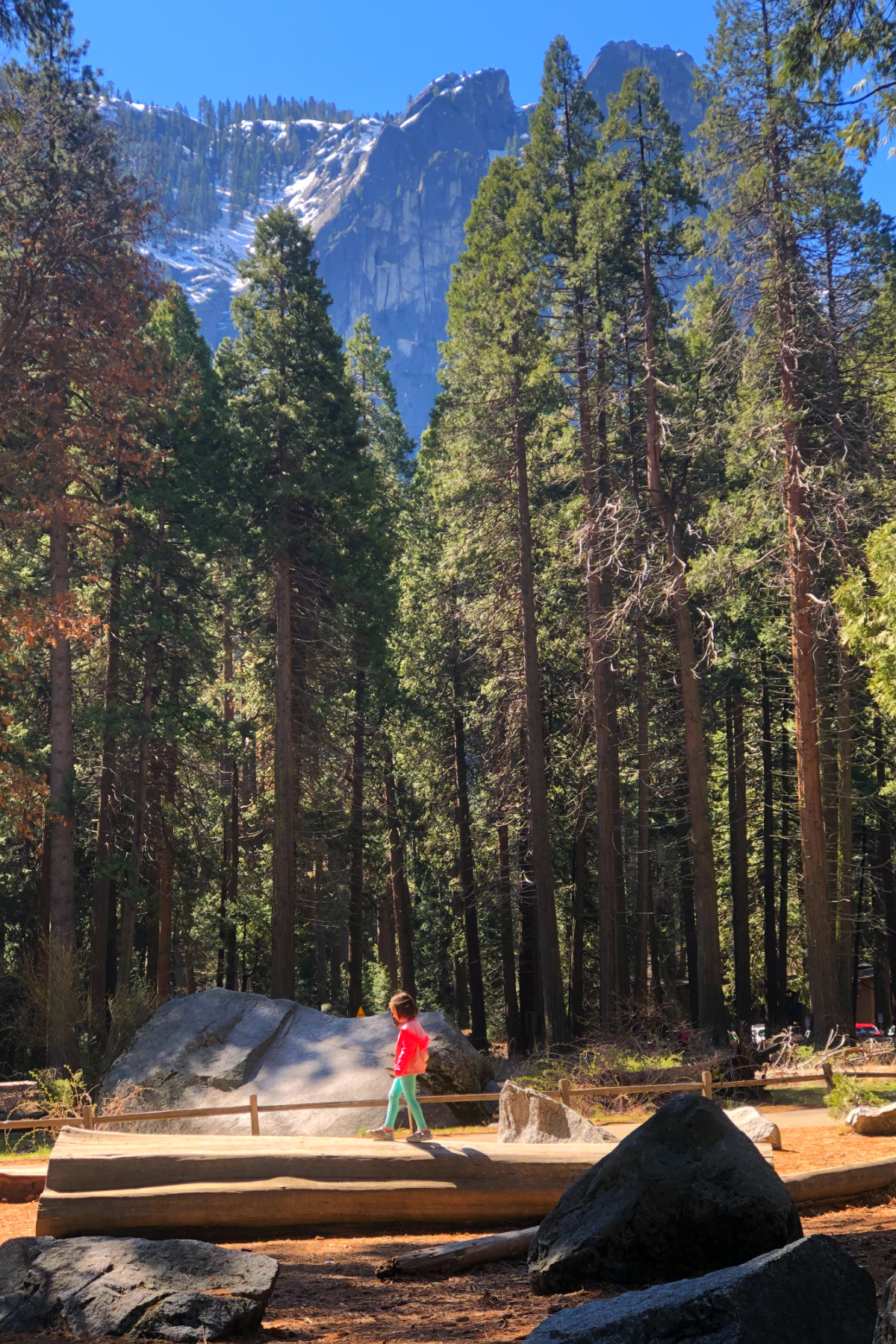
When we visited with our daughter in April 2019, she enjoyed exploring around some of the rocks along the trail. You don’t have to do any scrambling to reach the waterfall, but there are plenty of interesting things for kids to look at along the way.
Just be careful around the creek. The water can move incredibly fast during spring runoff, and wet granite is slippery. Stick to the established trail and keep children away from the rushing water.
Eventually, the path brings you to a footbridge near the base of Lower Yosemite Fall.
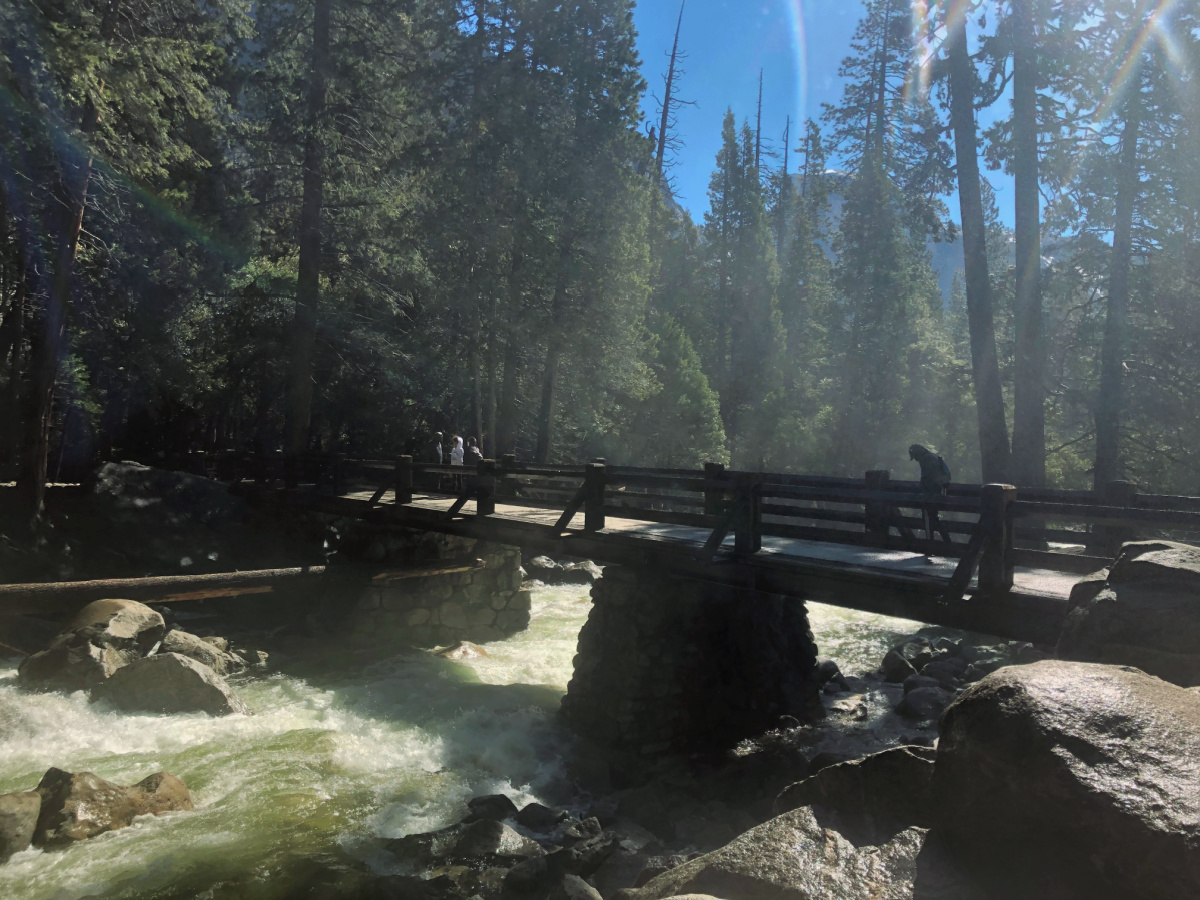
And this is where things get really good.
Lower Yosemite Fall drops 320 feet. Which is technically the shortest section of Yosemite Falls.
But standing near the base of a 320-foot waterfall while thousands of gallons of water are crashing over the rocks is not exactly an underwhelming experience.
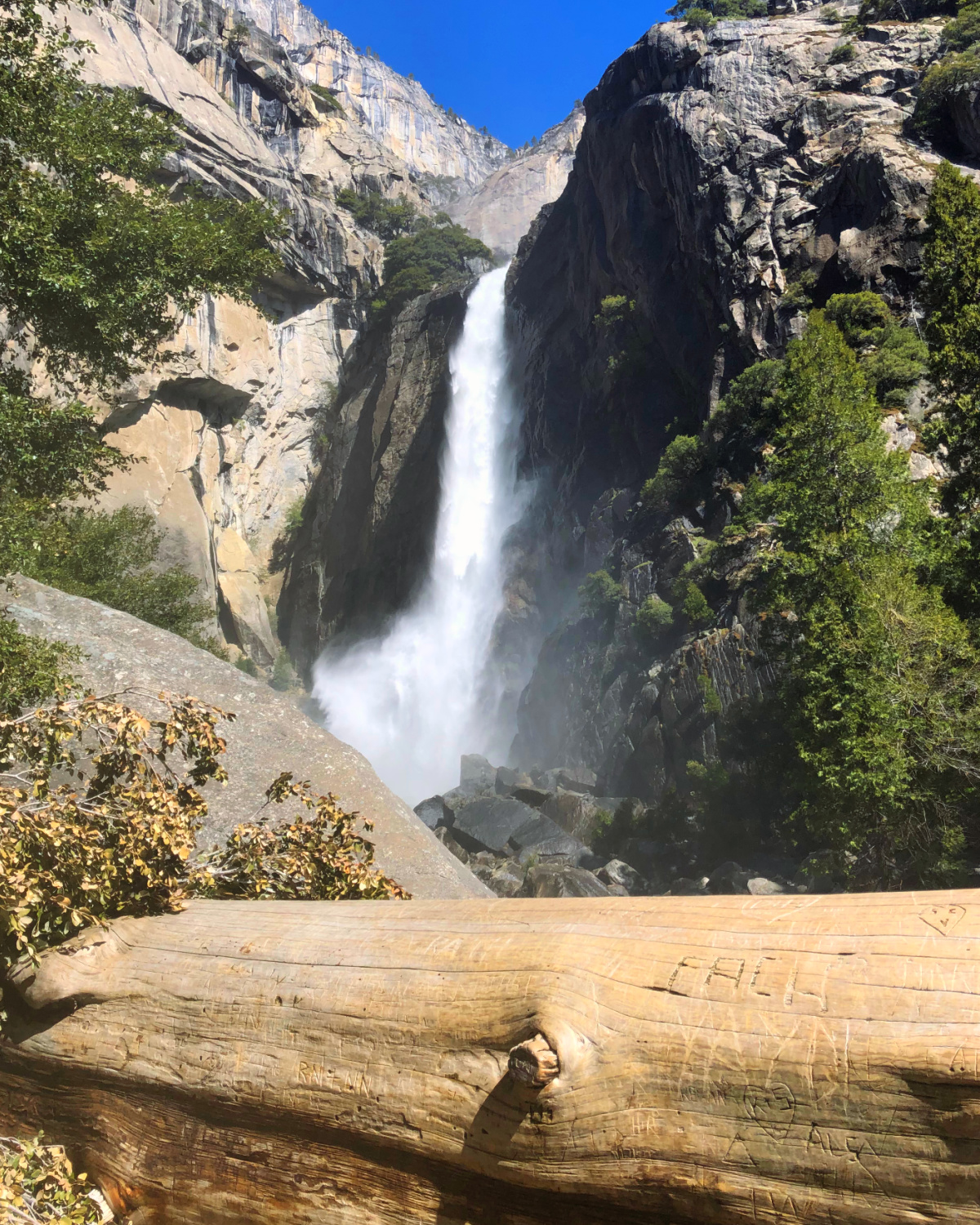
Especially in April.
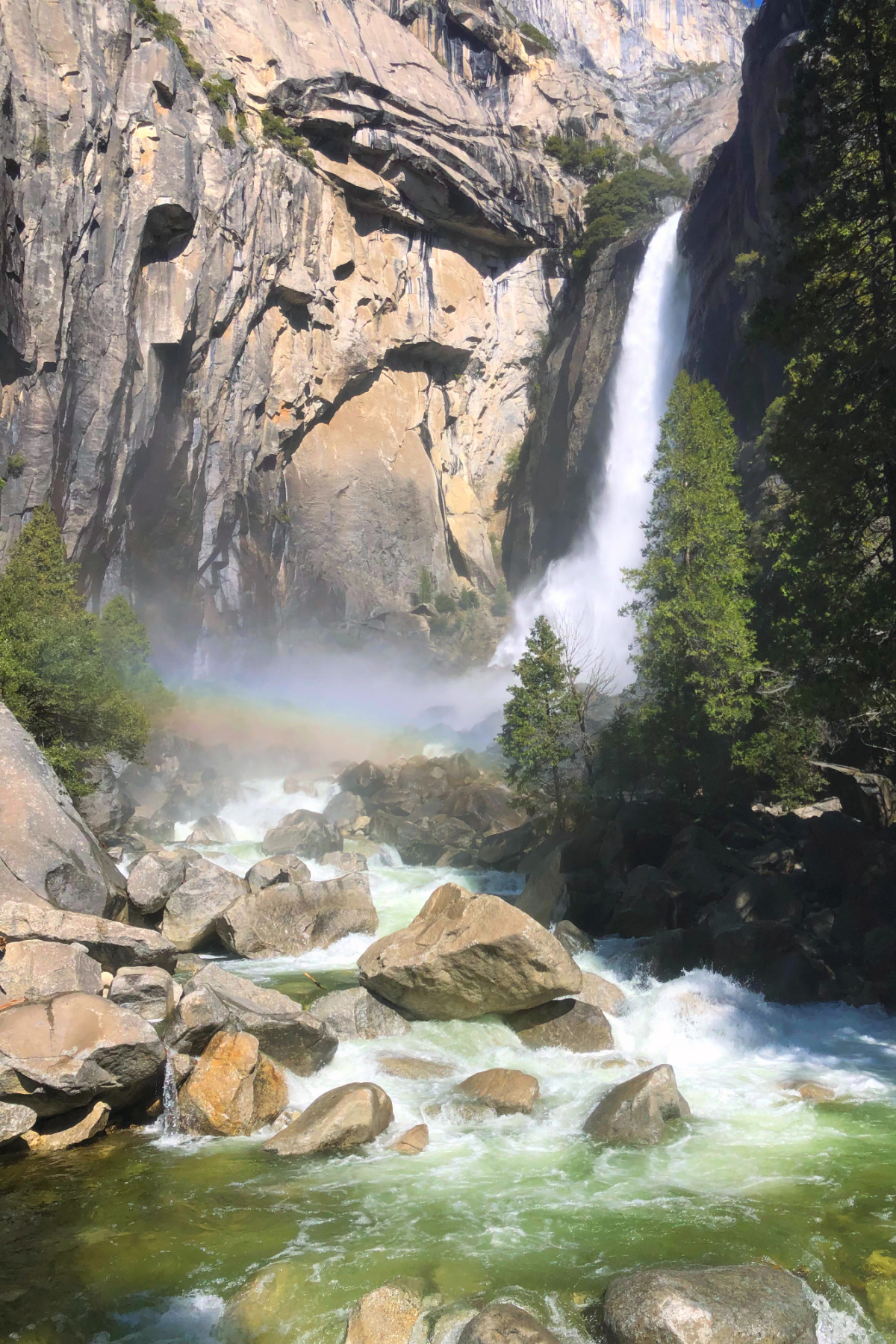
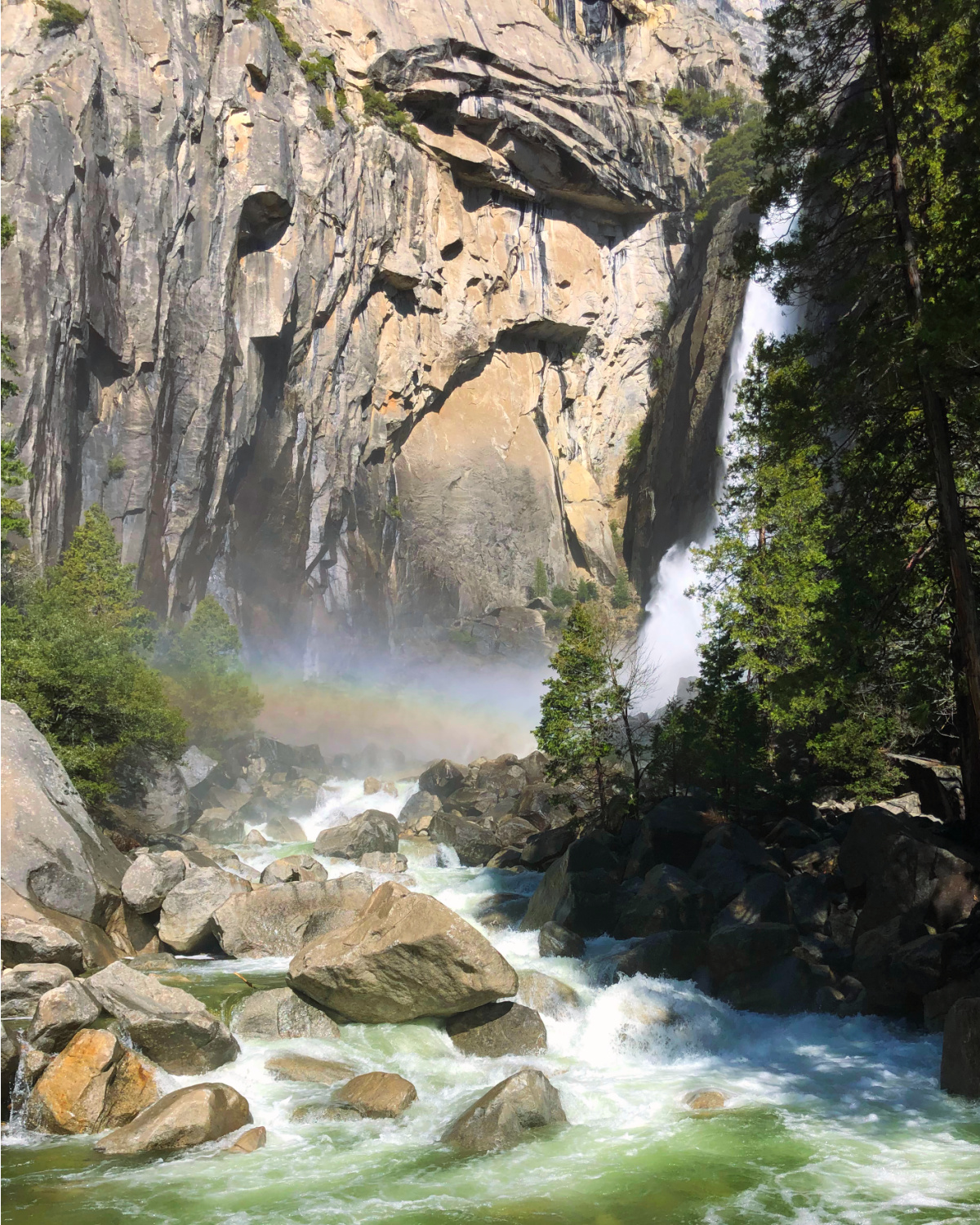
During our visit, the water was roaring, and there was so much mist that we actually saw a double rainbow at the base of the falls.
A double rainbow!
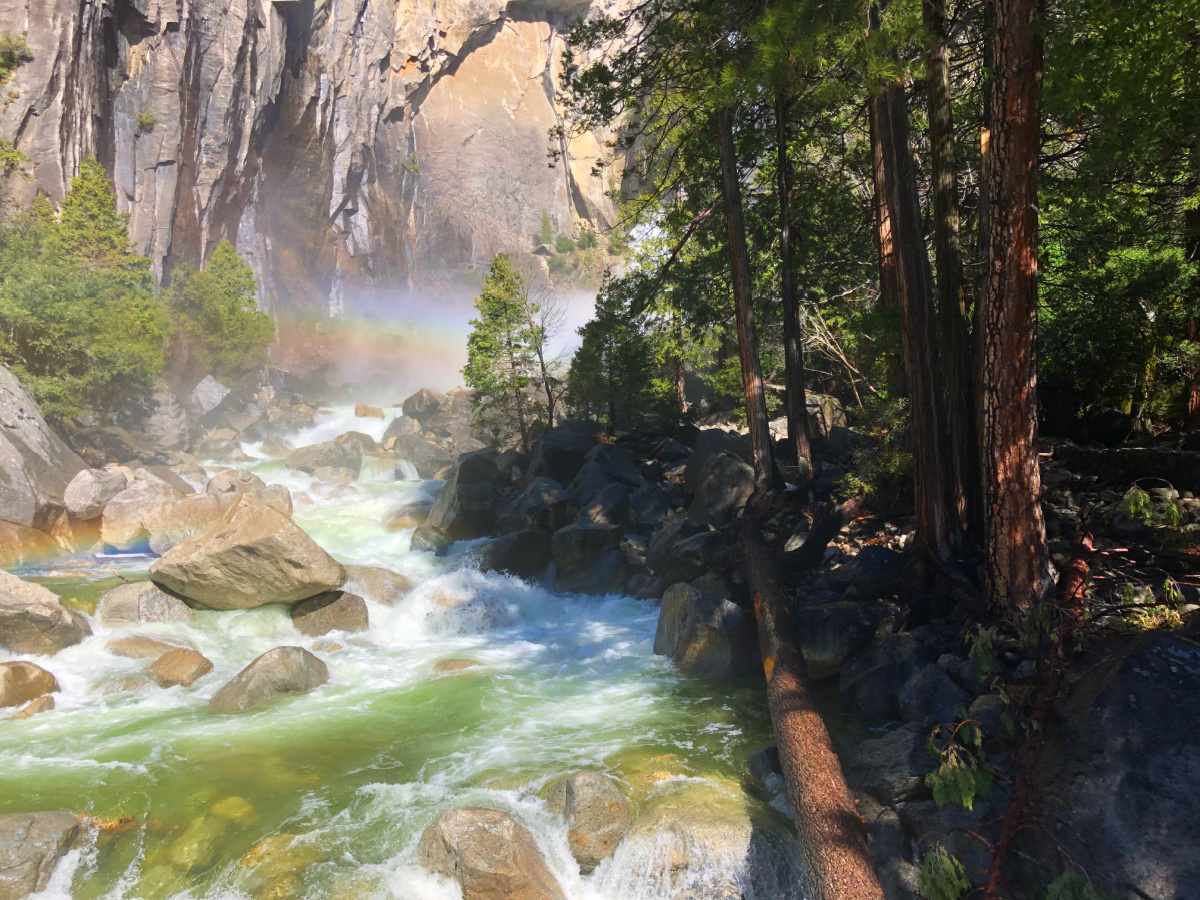
I have photographs of it, and I still think it’s one of the prettiest things we saw during our entire Yosemite vacation.
The rainbows were appearing in the mist while the water crashed down behind them. And because the sun was shining, the whole area was beautifully illuminated.
I could have stayed there taking pictures for a very long time.
Actually, I probably did. 😂
Getting to Lower Yosemite Fall
Here’s where staying at Yosemite Valley Lodge was particularly convenient.
We didn’t have to worry about finding parking or moving our car. We just walked over to the trail.
If you’re staying somewhere else or visiting Yosemite Valley for the day, I would recommend using the free park shuttle.
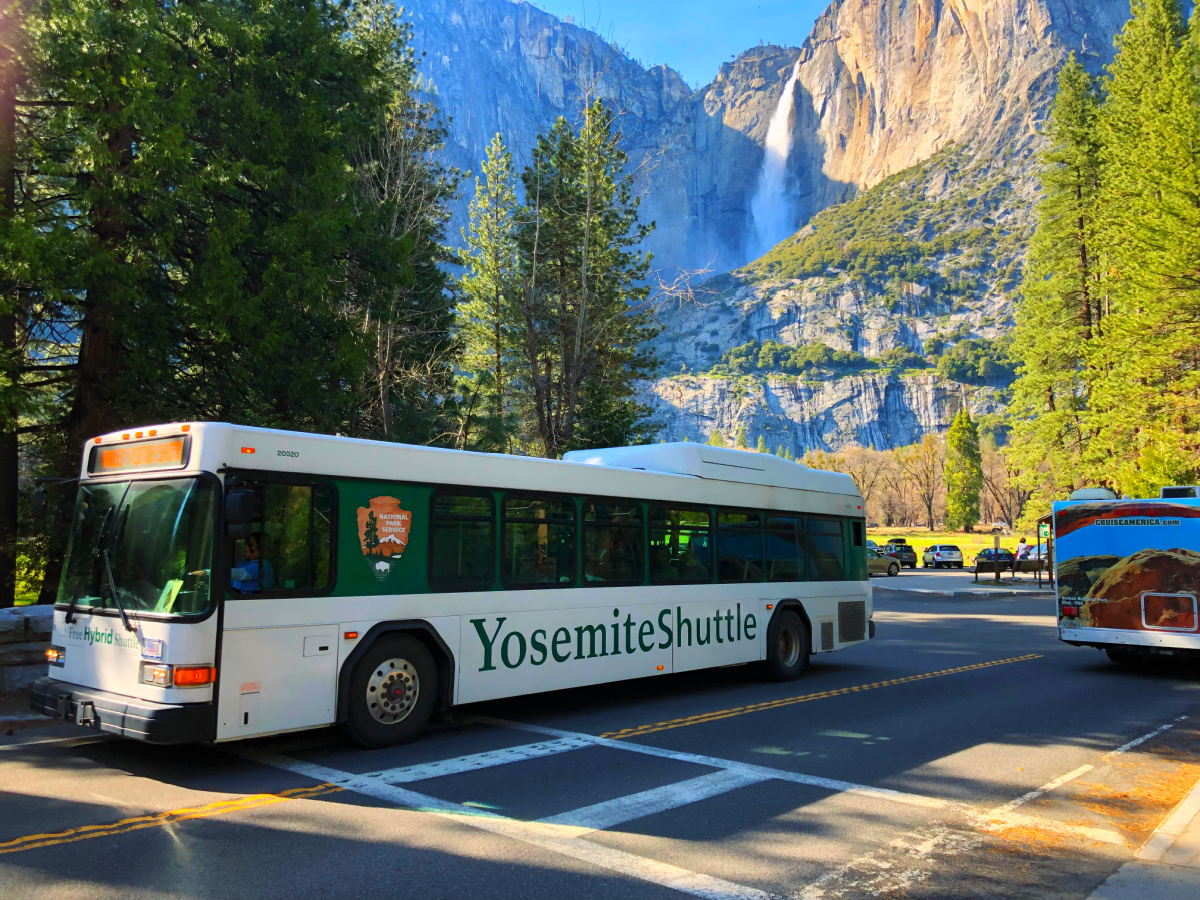
The Valleywide Shuttle serves Yosemite Valley Lodge/Yosemite Falls at Stop #7, which puts you within easy walking distance of the trail.
Parking in Yosemite Valley can be frustrating, especially during busy periods. And honestly, once you’ve found a parking spot, I wouldn’t be particularly eager to give it up just to drive a short distance to another attraction.
Use the shuttle.
Or walk.
Yosemite Valley is a lovely place to explore on foot anyway.
Allow approximately 30–45 minutes for the Lower Yosemite Fall Trail, although you could easily spend longer if you’re taking photographs or exploring with kids.
And one last thing.
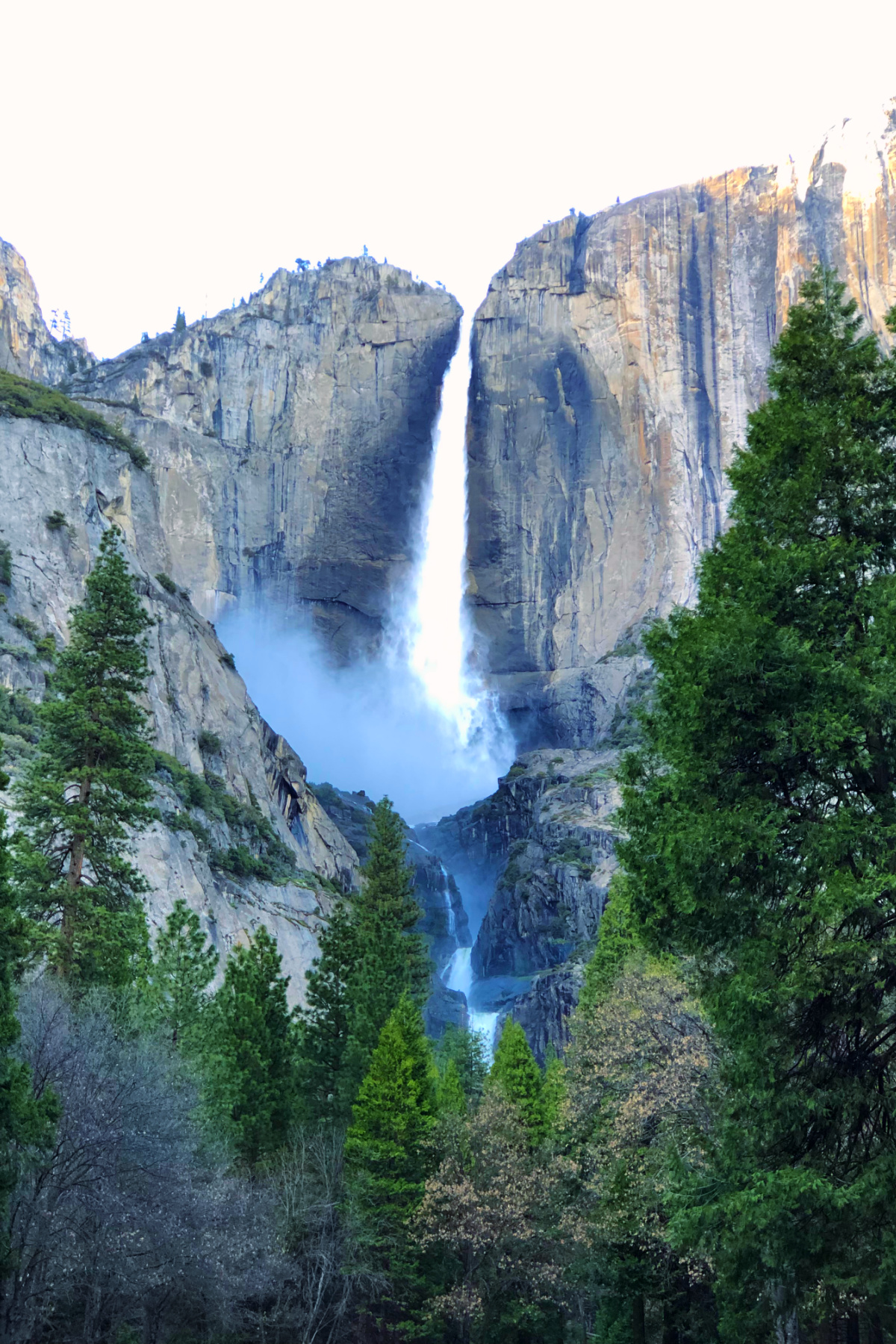
If you’re staying in Yosemite Valley for more than one day, consider visiting Yosemite Falls at different times. The sunlight changes throughout the day, and the cliffs and waterfall can look dramatically different depending on the lighting.
We got some of our favorite photographs simply by being in the right place when the sun was shining through the waterfall mist.
Sometimes the best part of a national park vacation isn’t something you planned.
It’s something you happened to see while you were there.
2. Bridalveil Fall
Bridalveil Fall is another one of those Yosemite waterfalls that you really don’t have to work very hard to see. Which is great, because I think everyone should see it at least once.
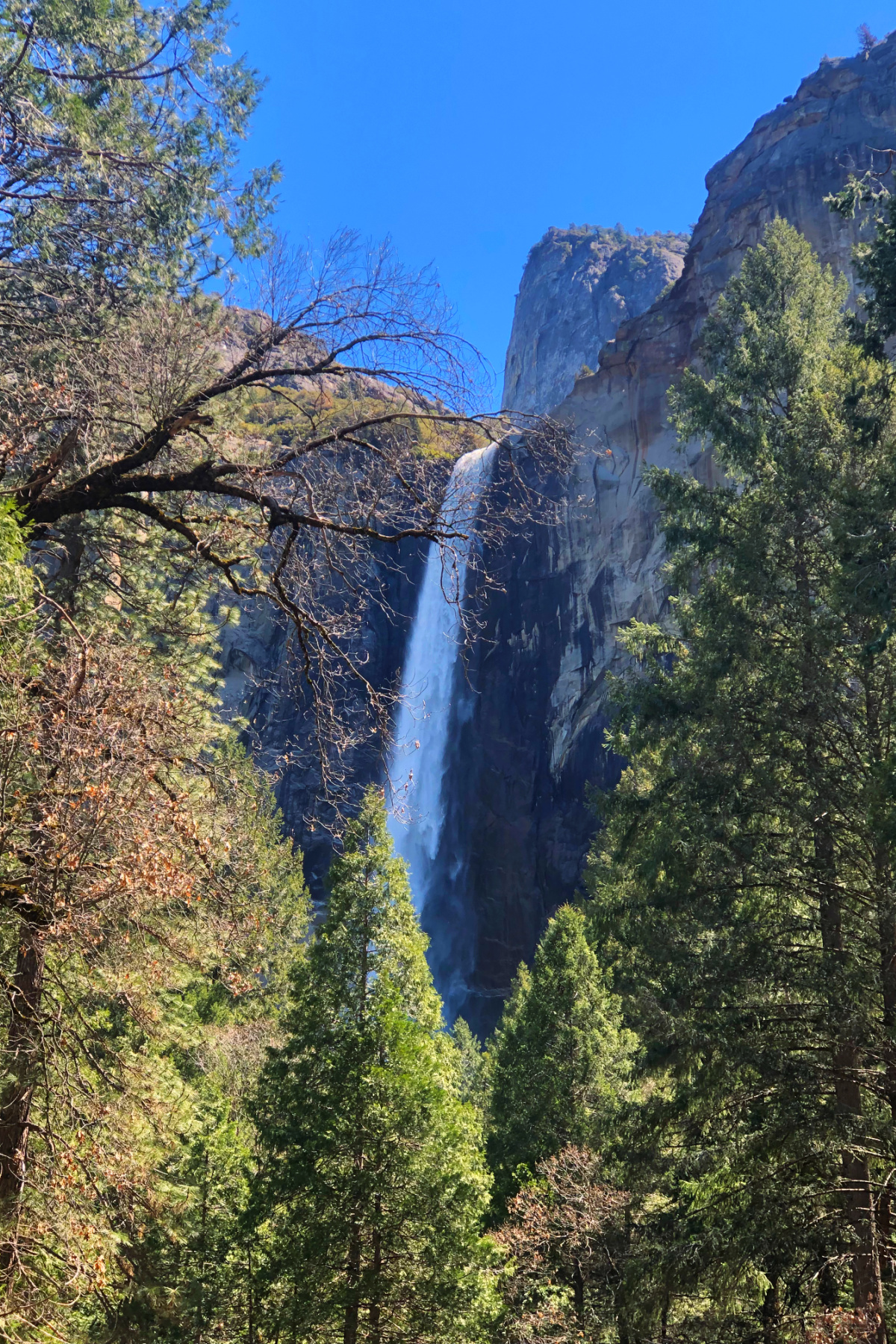
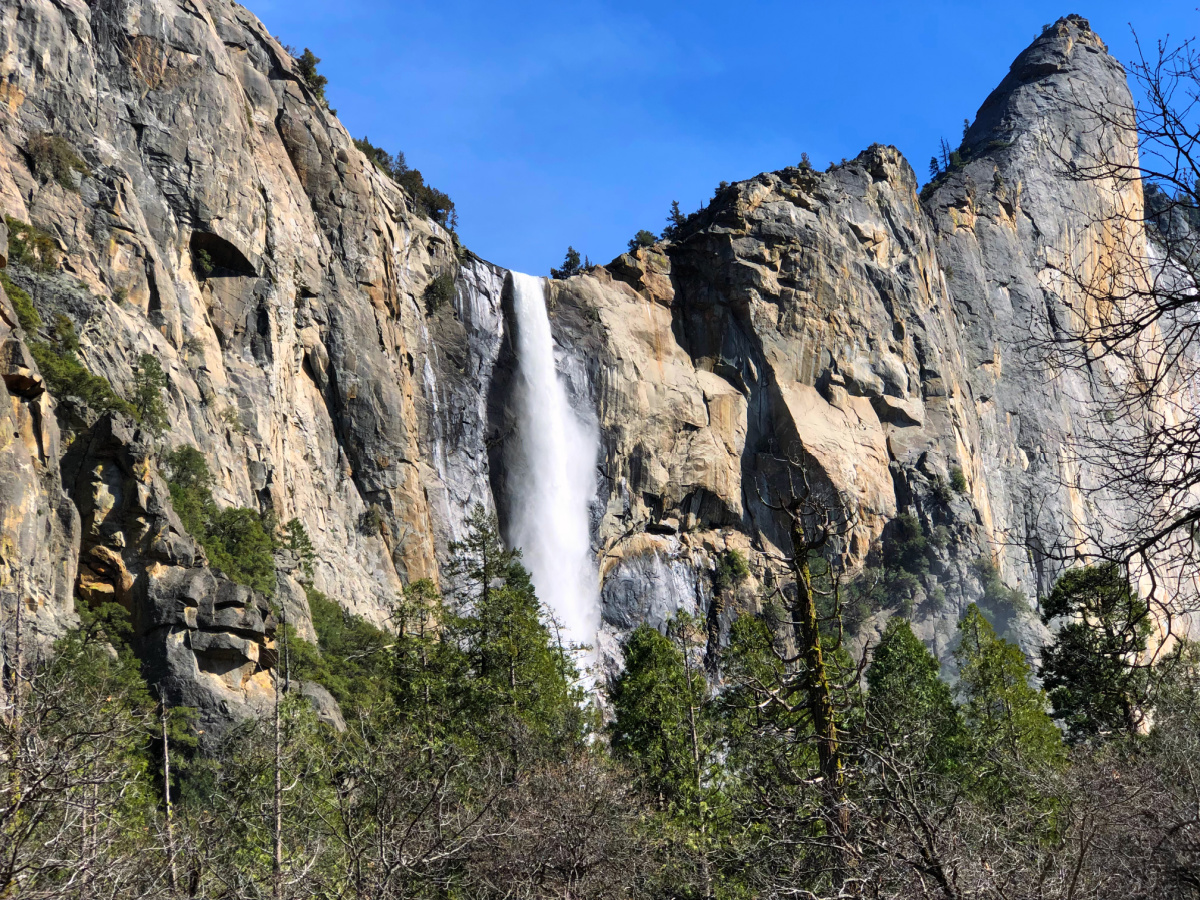
The waterfall plunges 620 feet down the granite cliffs near the entrance to Yosemite Valley. And if you’re visiting in the spring, there’s a very good chance you’ll hear it before you get anywhere close to the base.
We visited Bridalveil Fall in April 2019, and the amount of water coming over that cliff was ridiculous.
Seriously. RIDICULOUS.
But here’s the thing. Even though I absolutely recommend walking to Bridalveil Fall, I actually think it’s prettier from a distance.
And I have the photographs to prove it!
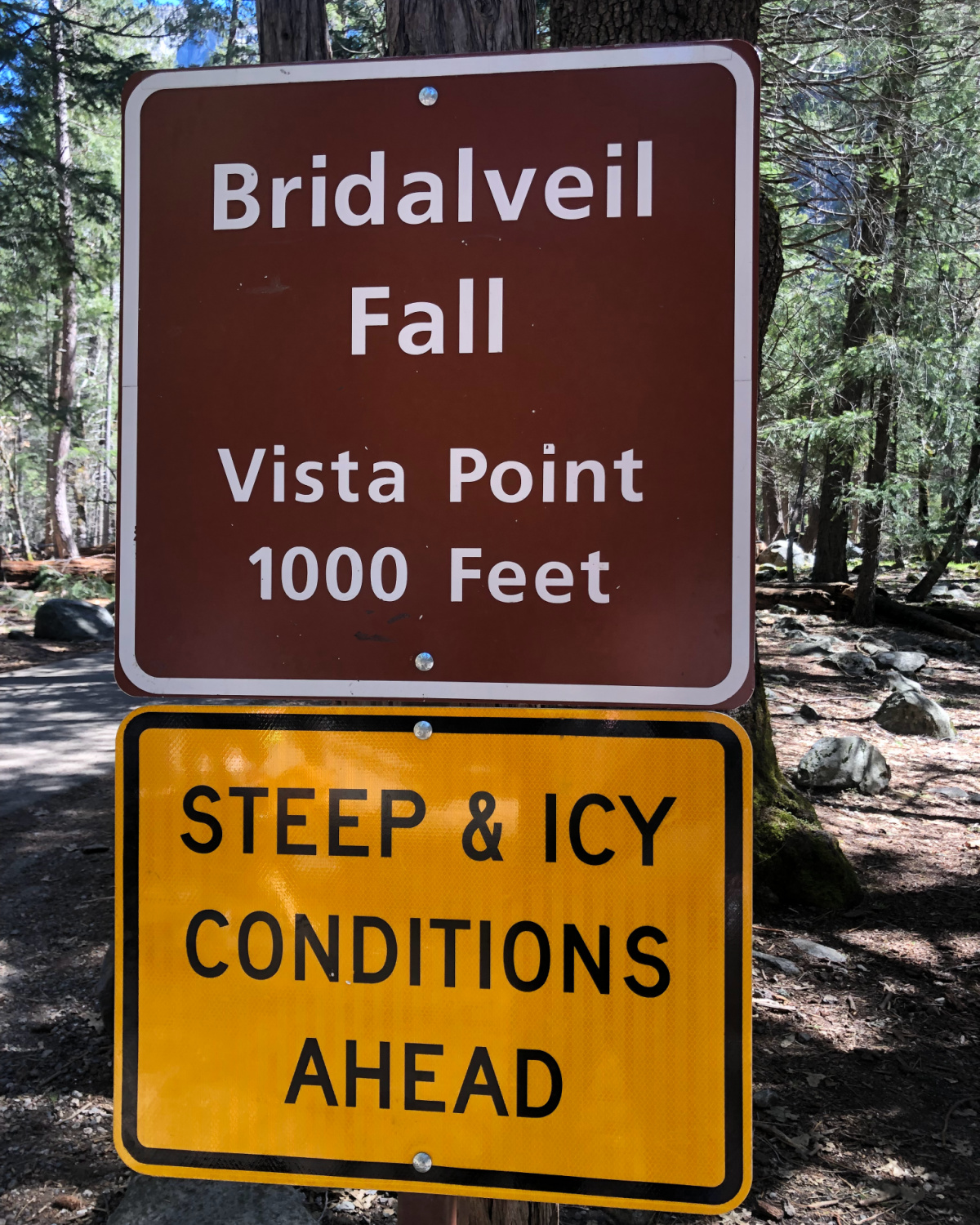
The Bridalveil Fall Trail
The walk to Bridalveil Fall is approximately half a mile round trip, so this is a pretty easy waterfall to include in your Yosemite itinerary.
We did the walk with our daughter, and I remember being struck by how much water was rushing through the creek below the waterfall.
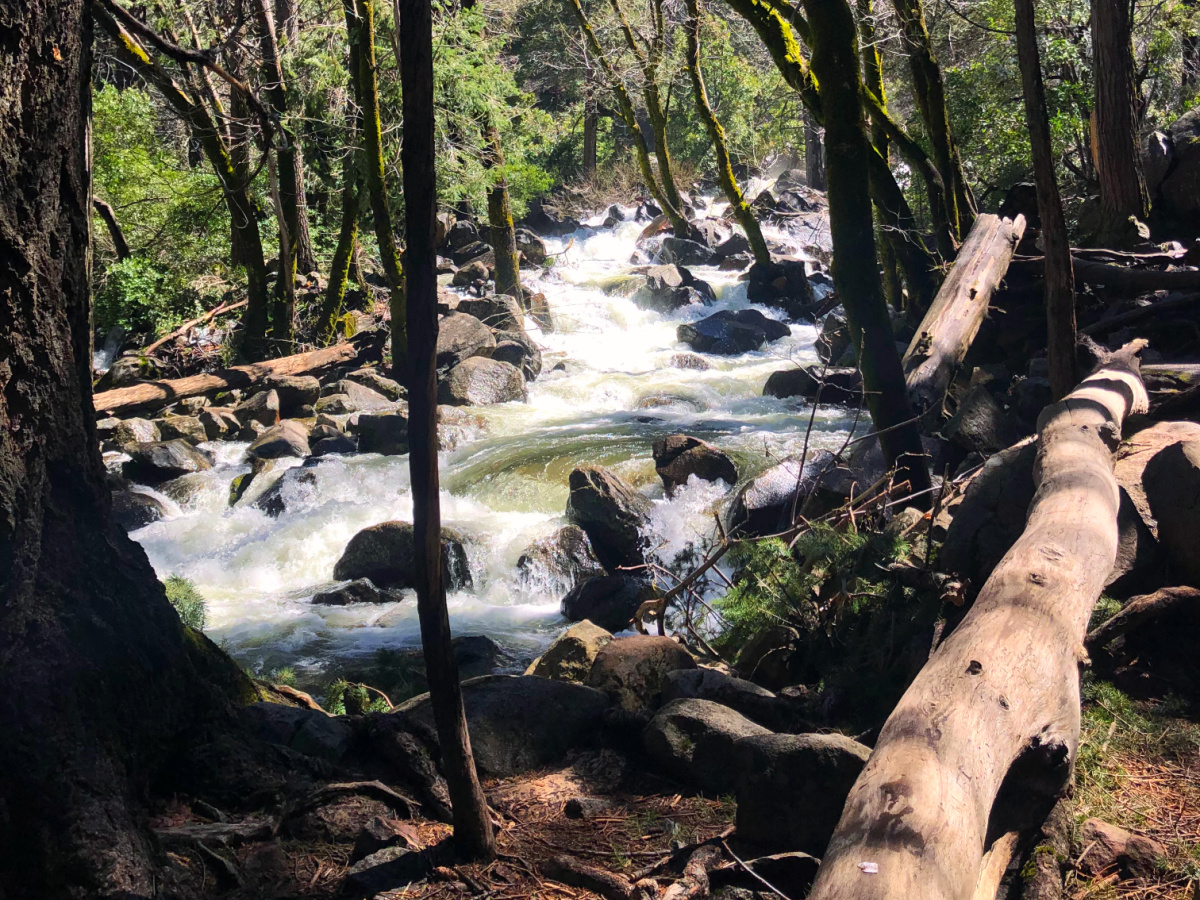
There were enormous boulders everywhere, and the water was crashing through them. The whole area was beautiful, even before we got close enough to see the waterfall itself.
And then we got closer.
… and wetter.
Lol.
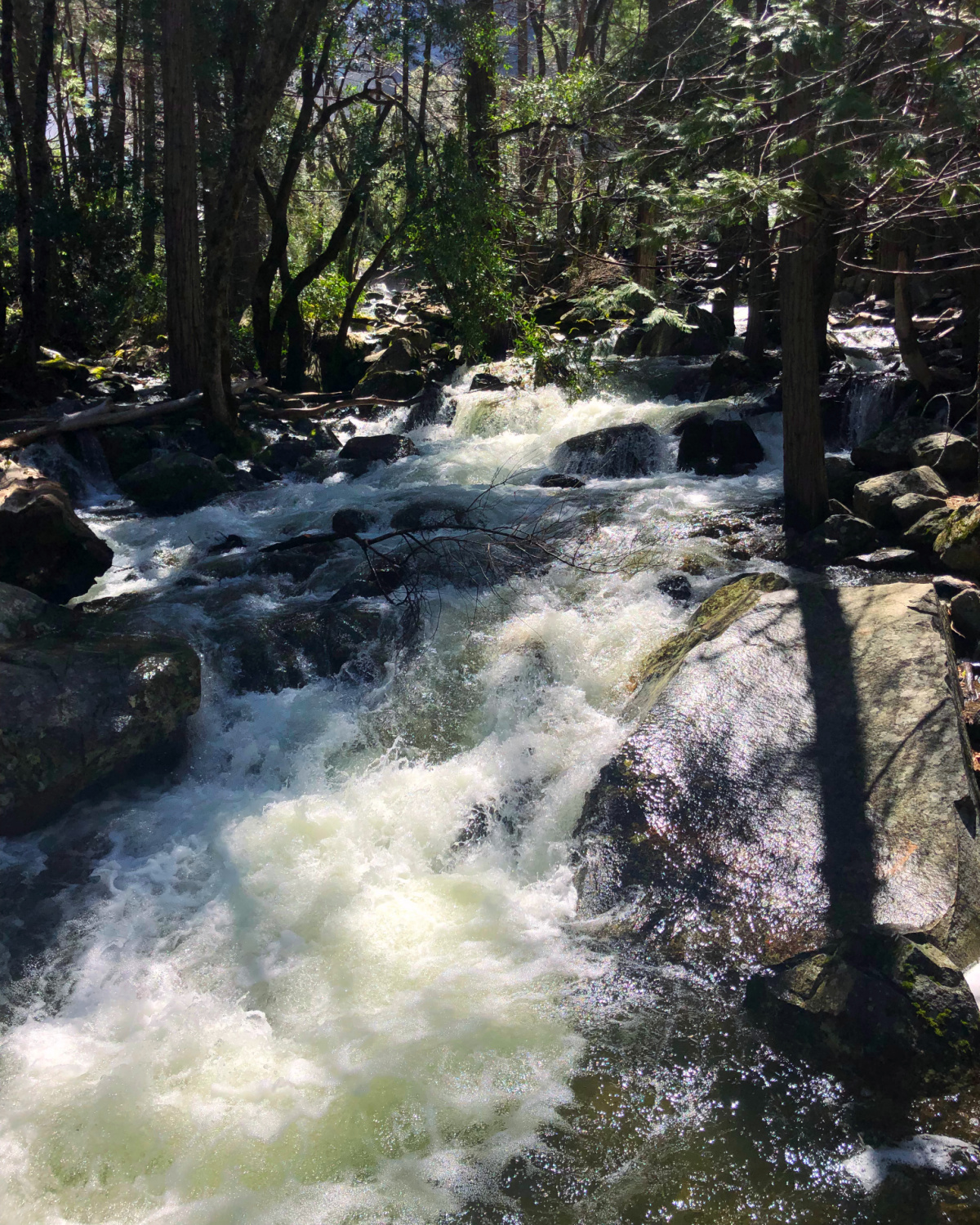
I was trying to take photographs of Bridalveil Fall, but the spray was so intense that it was almost impossible to keep the camera dry. I would get everything lined up, and then another gust of mist would blow through.
So much for that photograph.
I did get some lovely pictures of the creek, though!
If you’re visiting in April, May, or June, bring a rain jacket. You might not need it, but if the waterfall is really flowing, you could get pretty soaked.
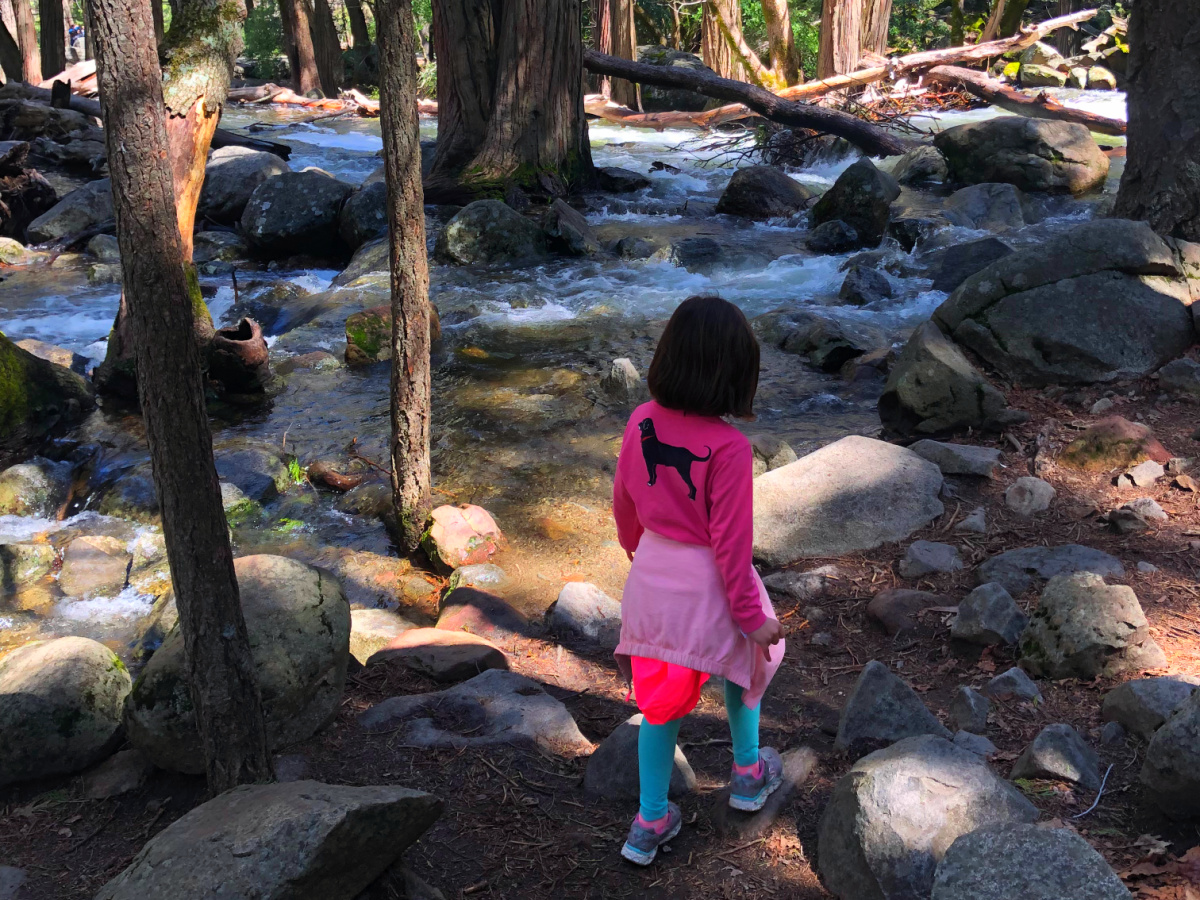
The trail and viewing areas were also renovated after our 2019 visit, with improvements completed in 2024. So if you visited Bridalveil Fall several years ago, the area may look a little different now.
But the main attraction is still the same. A 620-foot waterfall crashing down the side of Yosemite Valley.
And that’s pretty hard to beat.
Bridalveil Fall From Tunnel View
Now, THIS is my favorite way to see Bridalveil Fall.
If you’ve spent any time looking at photographs of Yosemite National Park, you’ve almost certainly seen Tunnel View.
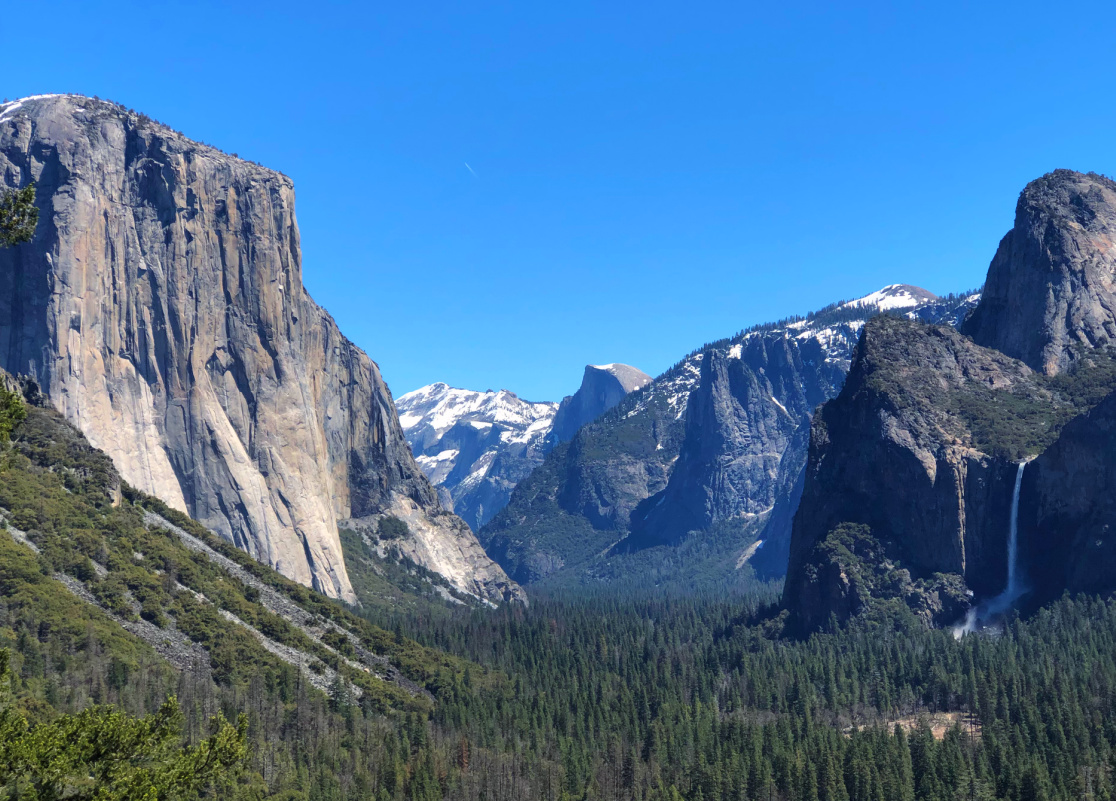
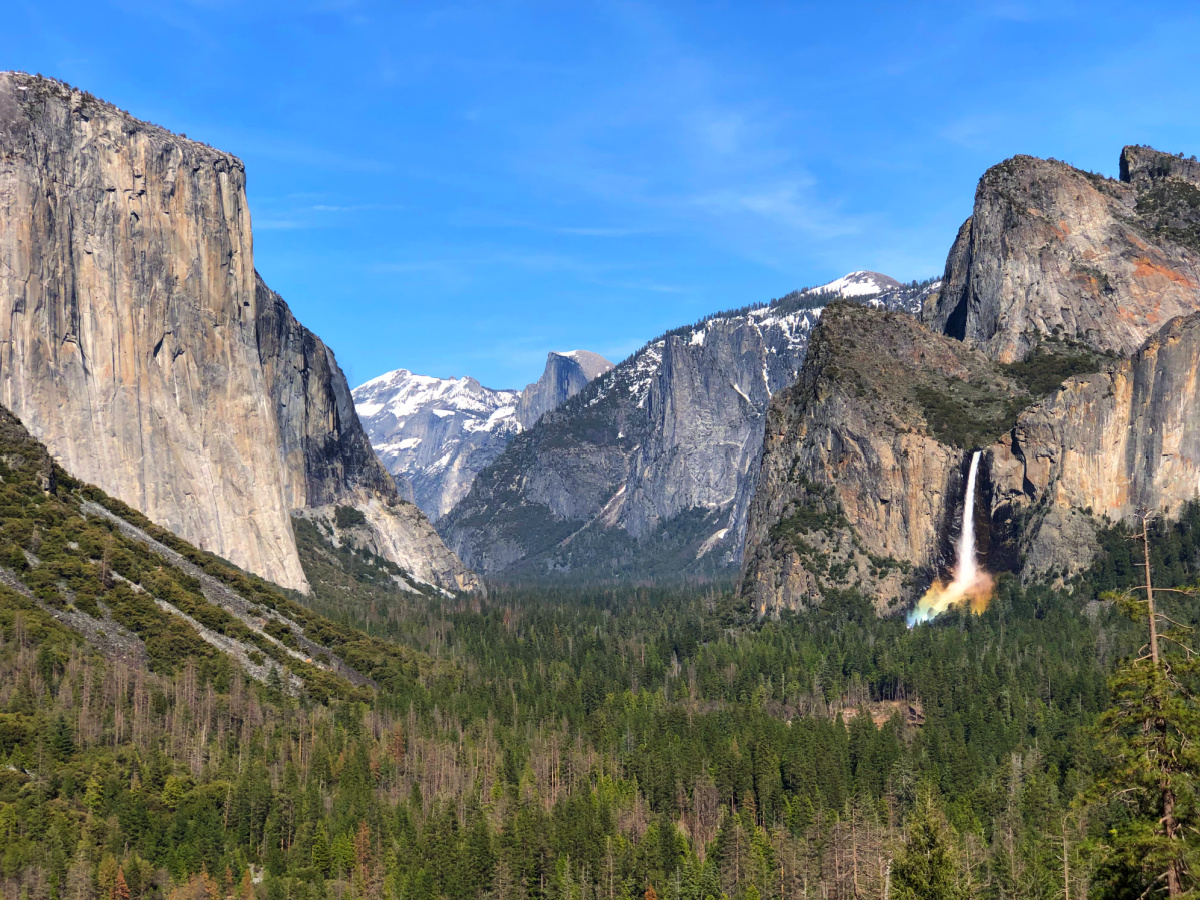
It’s the famous overlook where you can see El Capitan on the left, Half Dome in the distance, and Bridalveil Fall cascading down the cliffs on the right.
And during our April 2019 visit, we happened to be at Tunnel View at just the right time.
It was around 4 PM, and the afternoon sunlight was hitting the mist at the base of Bridalveil Fall.
And there was a rainbow.
Not just a little hint of a rainbow.
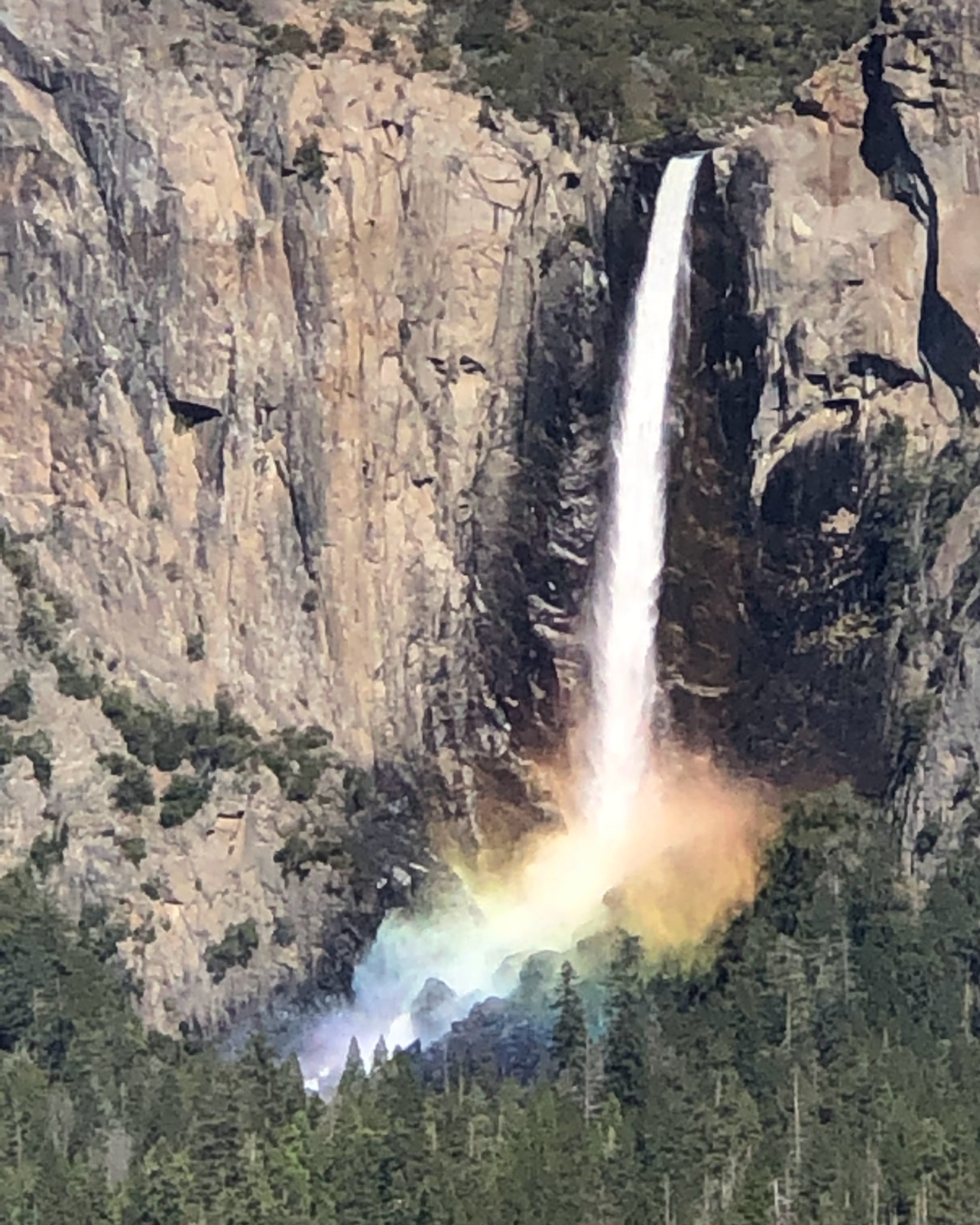
An enormous, brilliantly colored rainbow stretching across the mist.
I remember looking at it and thinking it was almost comically beautiful. Like a unicorn had stuck its tail into a pot of rainbow paint and swirled it around the waterfall.
Seriously. The colors were THAT bright.
And the best part?
We weren’t standing underneath Bridalveil Fall getting soaked.
We were standing at Tunnel View, enjoying the entire Yosemite Valley panorama, with the waterfall and rainbow tucked into the scenery.
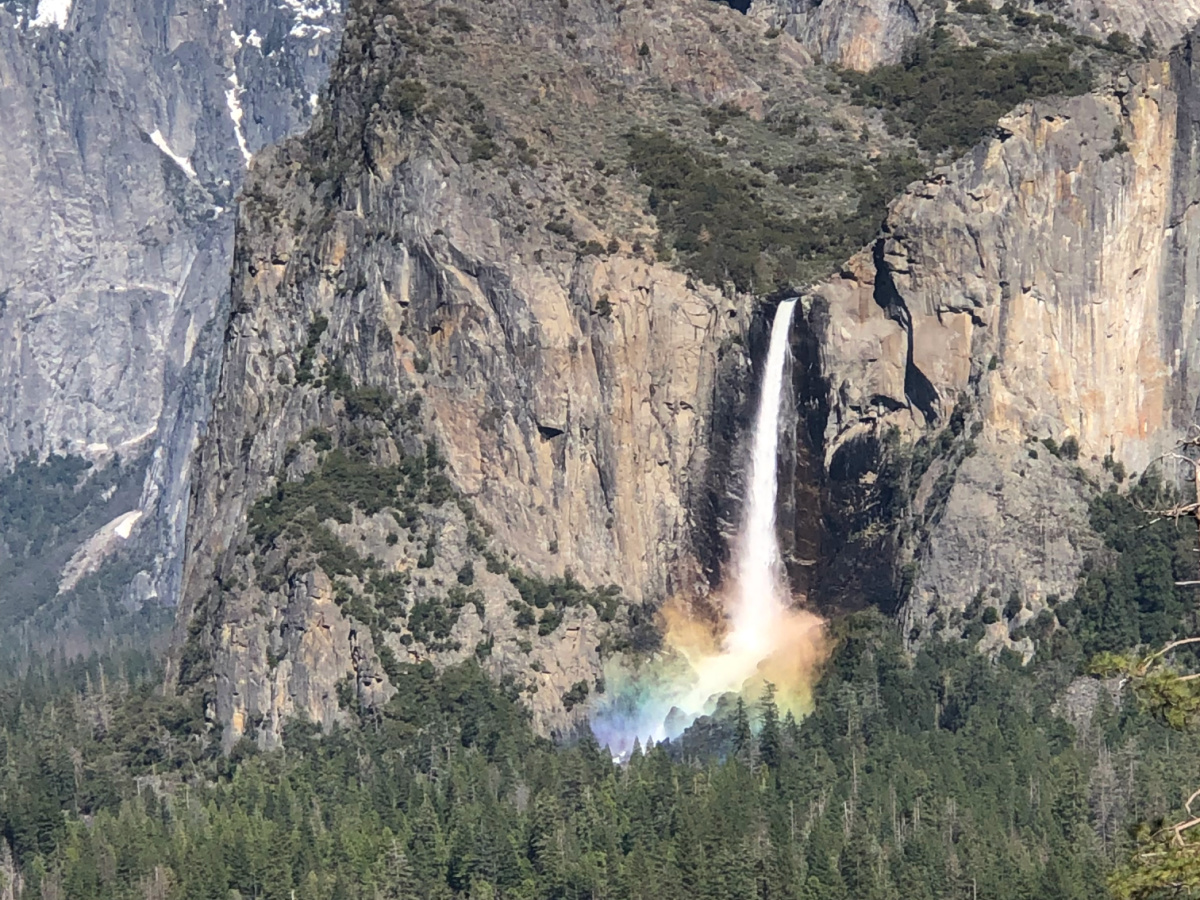
When you’re standing near the base, you can appreciate the sheer power of the water. But from Tunnel View, you can see the entire waterfall against those massive granite cliffs.
It’s a completely different perspective.
If you’re visiting Yosemite on a sunny spring afternoon, make a point of stopping at Tunnel View to see if the sunlight is creating rainbows in the waterfall mist.
You might get lucky!
Bridalveil Fall From Valley View
Another great place to see Bridalveil Fall is Valley View, located along Northside Drive near the western end of Yosemite Valley.
This is one of my favorite photography stops in Yosemite.
You have the Merced River in the foreground, enormous granite cliffs rising above the valley, and Bridalveil Fall in the distance.
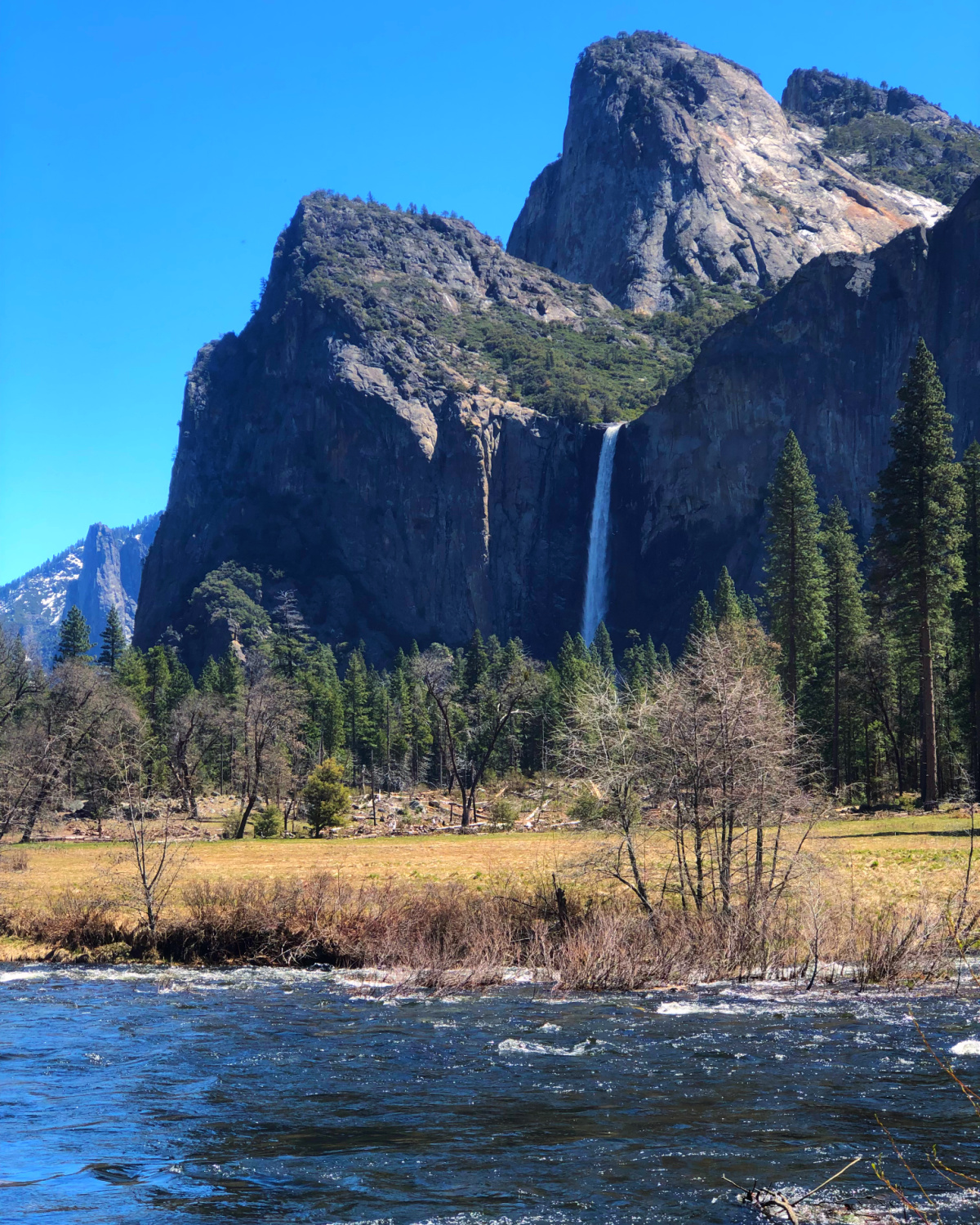
During our April visit, the river was moving quickly, and the reflections of the cliffs and trees made for some gorgeous photographs.
I actually prefer this type of waterfall photograph in some ways. Instead of filling the entire frame with the waterfall, you get the river, the trees, the cliffs, and the waterfall all in one picture.
And Yosemite certainly doesn’t have a shortage of gorgeous scenery to photograph!
If you’re driving through Yosemite Valley, I would make a point of stopping at Valley View. It’s an easy roadside stop, and you don’t have to hike anywhere to enjoy it.
Does Bridalveil Fall Flow All Year?
Yes! Unlike Yosemite Falls, which can dry up completely in late summer or fall, Bridalveil Fall generally flows throughout the year.
But that doesn’t mean it always looks the same.
In the spring, the waterfall can be incredibly powerful. That’s when you’ll see enormous amounts of spray, the rushing creek, and possibly even rainbows in the mist.
By late summer and fall, there’s usually considerably less water.
I remember being disappointed by the waterfalls during my October 2002 visit, particularly Vernal Fall. But I don’t specifically remember what Bridalveil Fall looked like during that trip, so I can’t compare those two visits directly.
What I can tell you is that Bridalveil Fall in April 2019 was absolutely magnificent.
And if I were planning another spring trip to Yosemite, I’d make time to see it from both the trail and Tunnel View.
3. The Cascades
Okay, this is one of those waterfalls that we probably wouldn’t have stopped to see if we hadn’t happened to drive right past it.
We were driving into Yosemite from the San Francisco Bay Area during our April 2019 trip when we came across a beautiful series of waterfalls cascading over enormous granite boulders.
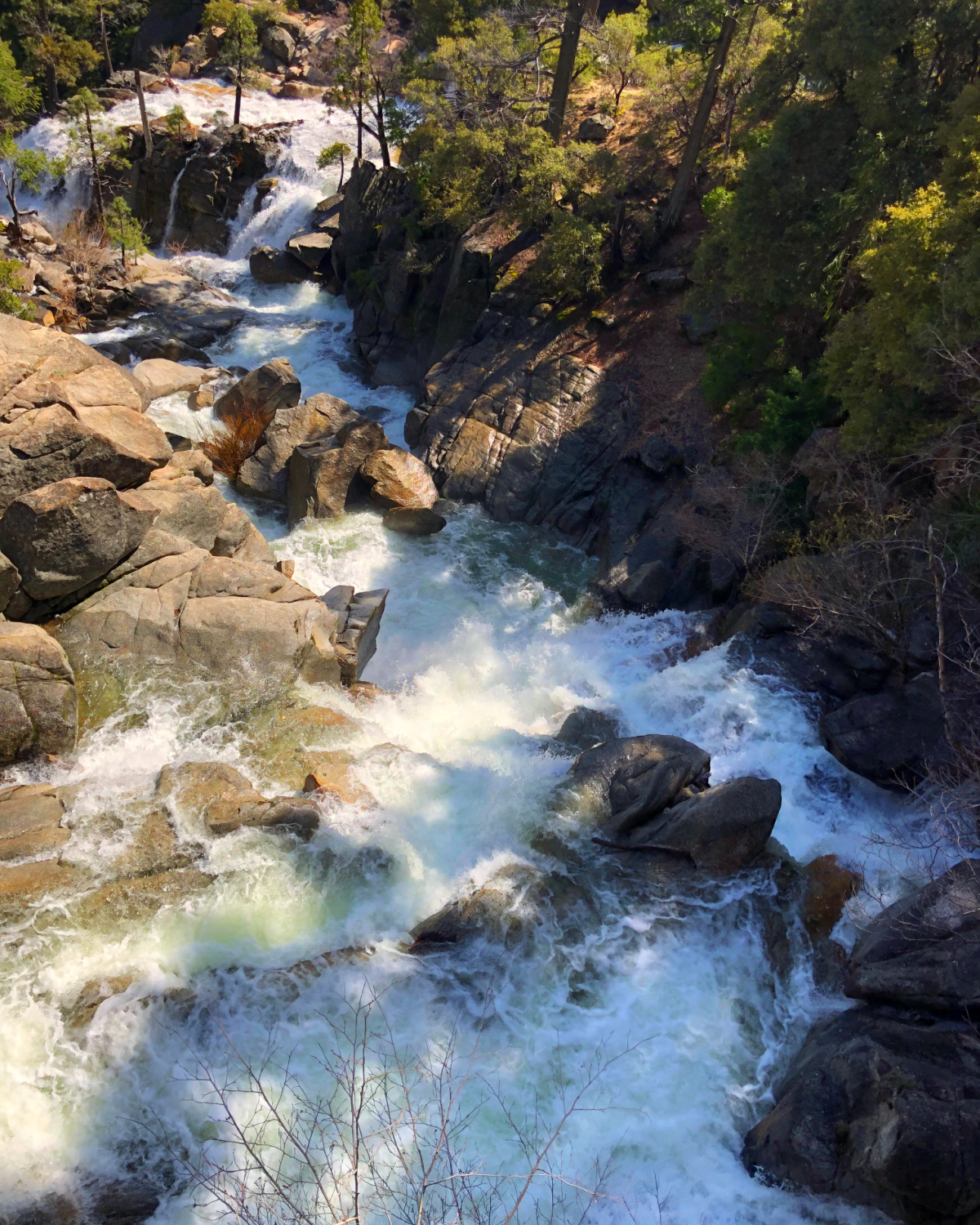
And of course, we had to stop.
There was literally a pull-off right beside the road. No hiking, no searching for a trailhead. We just parked, got out of the car, and started taking pictures.
It wasn’t until later that I realized this waterfall actually has a name.
The Cascades.
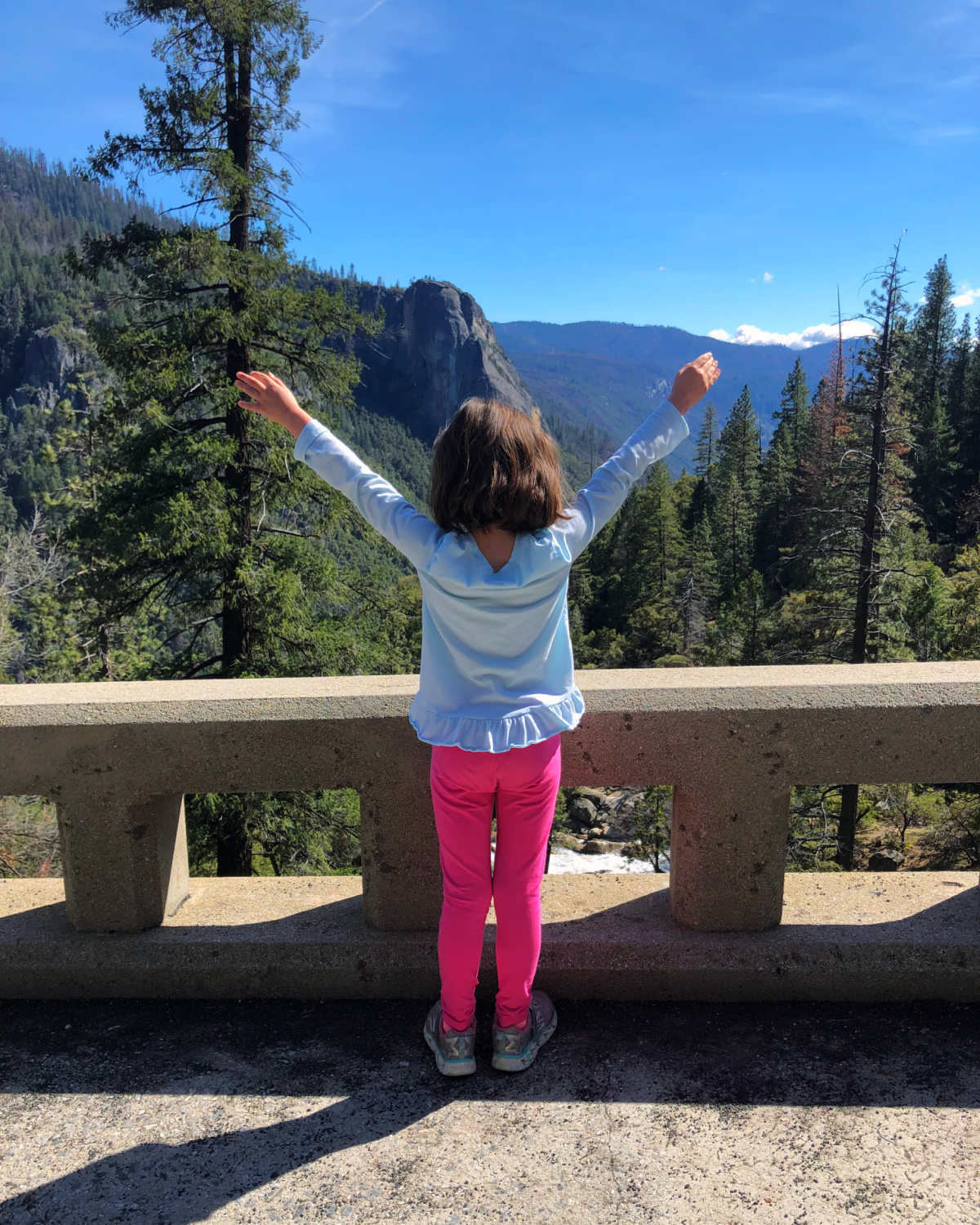
Where Is The Cascades in Yosemite?
The Cascades is located along Big Oak Flat Road near the western entrance to Yosemite Valley, where Cascade Creek and Tamarack Creek come together.
It’s a completely different type of waterfall from Yosemite Falls or Bridalveil Fall.
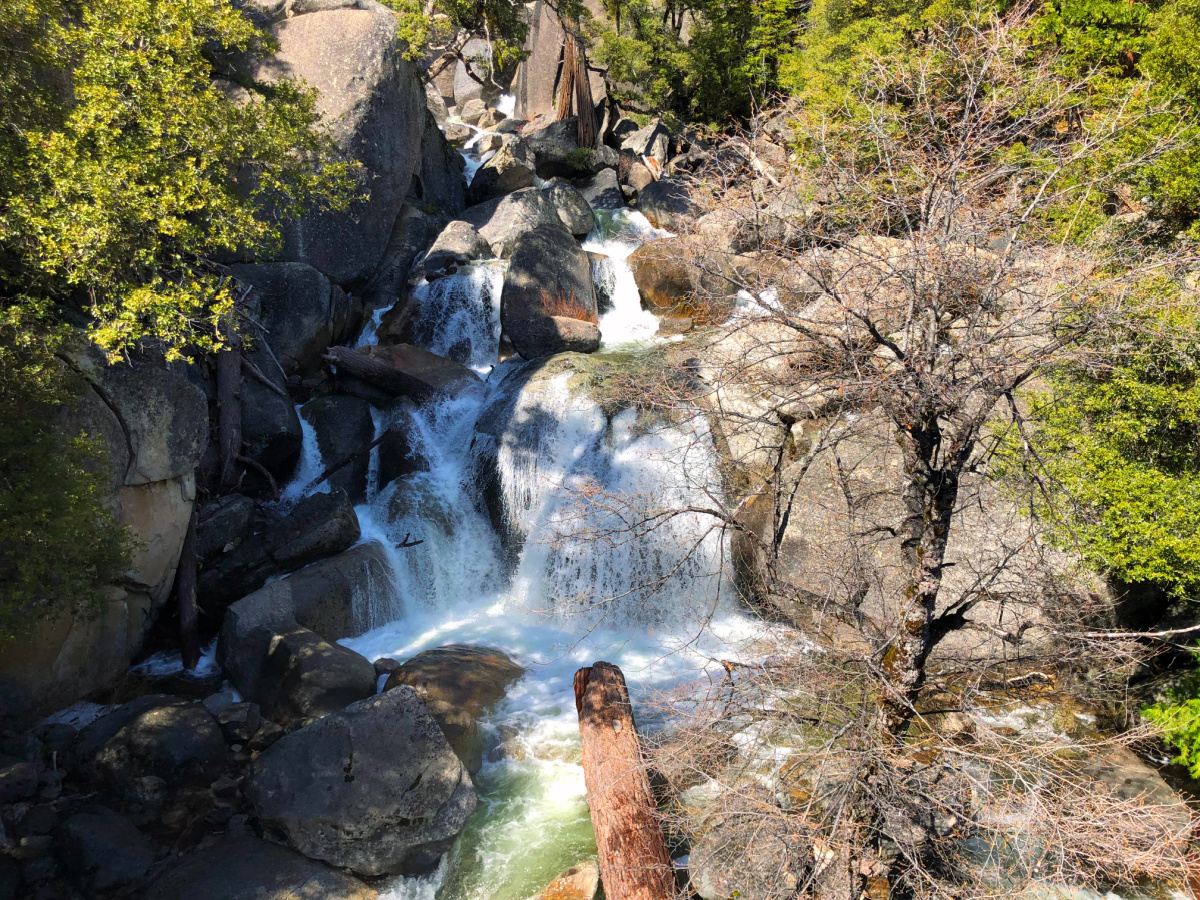
Instead of one enormous drop over a granite cliff, the water tumbles down a series of rocky steps and boulders.
And during our April visit, there was a LOT of water.
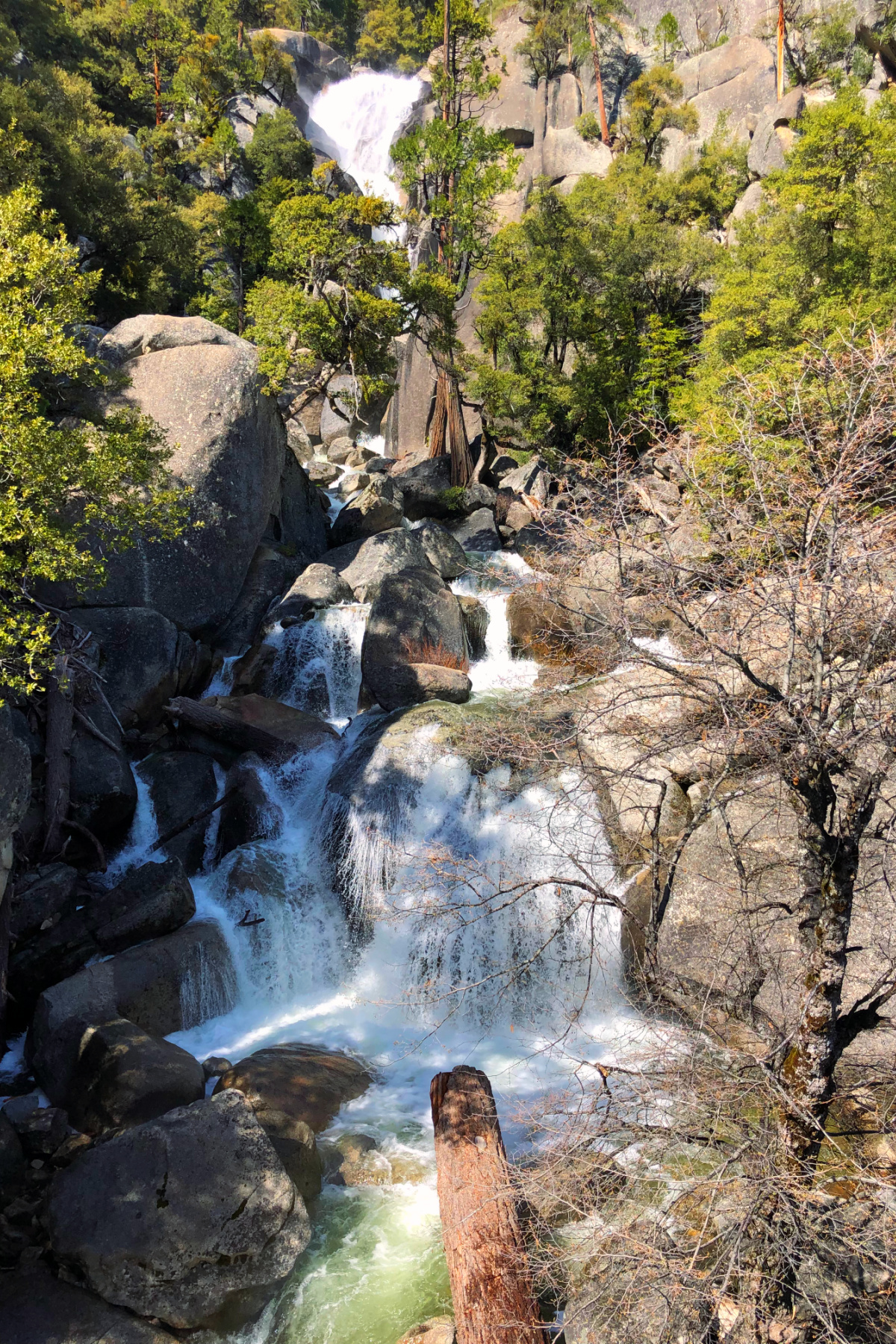
The creek was absolutely roaring, with whitewater rushing around enormous granite rocks. Some of the boulders were practically surrounded by water, and there were smaller cascades spilling over the rocks in every direction.
I loved it.
And I especially loved that we didn’t have to work for the view.
We had already been driving for hours, so being able to pull over and enjoy something this beautiful without having to tackle another trail was pretty fantastic.
Is The Cascades Worth Stopping For?
Absolutely, especially if you’re visiting Yosemite in the spring.
Now, I wouldn’t necessarily recommend driving all the way across Yosemite Valley just to see The Cascades. There are so many things to see in the park that this waterfall makes the most sense as a stop along your route.
But if you’re driving into Yosemite Valley along Big Oak Flat Road, keep an eye out for the designated pull-off.
It takes very little time to stop, and you can get some beautiful photographs without going more than a few steps from your car.
Like many of Yosemite’s waterfalls, The Cascades is especially impressive during spring runoff. Later in the summer, the water flow can be much lower.
For us, this was one of those unexpected little discoveries that made our Yosemite vacation even better.
We weren’t following a hiking guide. And we didn’t have a reservation or a timed itinerary.
We just saw a beautiful waterfall on the side of the road and decided to stop.
And sometimes that’s all you need.
4. Vernal Fall
Vernal Fall has a special place in my heart. And not just because it’s one of the prettiest waterfalls in Yosemite National Park.
I’ve seen this waterfall during two completely different seasons, and I can tell you that the experience was VERY different.
The first time was in the spring of 1998. Vernal Fall was absolutely roaring. Water was pouring over the 317-foot cliff, and the whole scene was just spectacular.
Fast forward to October 2002.
My husband (then boyfriend) and I were visiting Yosemite, and unbeknownst to me, he had an engagement ring with him. He was planning to propose during our trip!
But the waterfalls? Well, let’s just say that October was not exactly the best time to see them. Lol.
Vernal Fall was barely a trickle compared to what I remembered from 1998.
Same waterfall. Same beautiful Yosemite scenery. Completely different experience.
And that’s one of the reasons I always tell people that if seeing Yosemite’s waterfalls is a priority, you really need to think about WHEN you’re visiting.
Note: Sorry to say I don’t have photos because… this was a time before camera phones and my point and click camera photos are… lacking. lol.
Hiking to Vernal Fall
Unlike Yosemite Falls and Bridalveil Fall, Vernal Fall requires a little more effort to see up close.
The waterfall is located along the Mist Trail, one of Yosemite’s most popular hiking trails. And while the scenery is gorgeous, this isn’t exactly a leisurely stroll around Yosemite Valley.
The hike to the Vernal Fall footbridge is approximately 1.6 miles round trip, with about 400 feet of elevation gain.
That might not sound like much, but you’re walking uphill for a good portion of it. And depending on your fitness level, you may find yourself stopping to catch your breath.
The footbridge is a good turnaround point if you want to see the waterfall without committing to the entire hike.
But if you’re feeling adventurous, you can continue up the Mist Trail toward the top of Vernal Fall.
The full hike to the top is approximately 2.4 miles round trip, with about 1,000 feet of elevation gain. And here’s where things get considerably more challenging.
There are hundreds of granite steps, and during peak spring runoff, the spray from Vernal Fall can make everything wet and slippery.
There’s a reason they call it the Mist Trail!
If you’re hiking in the spring, expect to get wet. Possibly VERY wet.
And please be careful around the waterfall. Stay on the designated trail, pay attention to the conditions, and don’t venture into the river above the falls. The current is incredibly dangerous, even when the water looks relatively calm.
Is Vernal Fall Worth the Hike?
I think Vernal Fall is absolutely worth seeing, especially in the spring.
But I also think it’s important to be realistic about the hike.
If you’re traveling with younger children, grandparents, or anyone who isn’t comfortable with steep trails, I wouldn’t automatically recommend hiking all the way to the top.
The footbridge is a reasonable goal for many visitors, although even that section involves a steady climb.
And if you’re visiting in the fall, remember my October 2002 experience. You might put in all that effort and discover that the waterfall is considerably smaller than the photographs you’ve seen online.
That doesn’t mean the hike isn’t beautiful. Yosemite’s granite cliffs, forests, and river scenery are worth appreciating in their own right.
But if you’re expecting the roaring waterfall I saw in 1998, spring is your best bet.
5. Nevada Fall
Nevada Fall is another waterfall along the Merced River, located upstream from Vernal Fall.
And at 594 feet tall, it’s nearly twice the height of Vernal Fall.
But here’s the catch.
Seeing Nevada Fall up close requires a significantly longer hike than most of the other waterfalls in this guide.
How to See Nevada Fall
The hike to the top of Nevada Fall is approximately 5.4 miles round trip via the Mist Trail, with roughly 2,000 feet of elevation gain.
And remember, this isn’t a flat five-mile walk. You’re climbing uphill into the mountains, with steep sections and plenty of granite steps along the way.
For experienced hikers, this is one of Yosemite’s classic adventures.
But for families who prefer easy or moderate hikes, or visitors who only have a day or two in Yosemite, I would think carefully before adding it to the itinerary.
You can also reach Nevada Fall using portions of the John Muir Trail, which offers a different route and some spectacular views. However, that doesn’t magically turn it into an easy hike. You’re still dealing with substantial elevation gain.
Trail conditions and seasonal closures can also affect which routes are available, so check with the National Park Service before heading out.
Do You Need to Hike to Nevada Fall?
Nope!
And this is where I think it’s helpful to remember that Yosemite isn’t a competition to see how many miles you can hike.
You can have an absolutely fantastic Yosemite vacation without hiking to the top of Nevada Fall.
In fact, if you only have a couple of days in Yosemite Valley, I would prioritize Yosemite Falls, Bridalveil Fall, Tunnel View, and some of the easier valley walks before committing most of a day to this hike.
Now, if you LOVE hiking and want a challenge, that’s a different story. Nevada Fall is a wonderful destination for a longer day on the trails.
But if your goal is simply to see gorgeous waterfalls without wearing yourself out, Yosemite has plenty of other options.
And that’s one of my favorite things about this national park. You don’t have to be a hardcore hiker to appreciate how beautiful it is.
6. Ribbon Fall
Did you know that one of the tallest waterfalls in Yosemite National Park is practically hiding beside El Capitan?
Ribbon Fall drops an impressive 1,612 feet down the granite cliffs just west of El Capitan. And yet, I would be willing to bet that plenty of people drive through Yosemite Valley without even realizing it’s there.
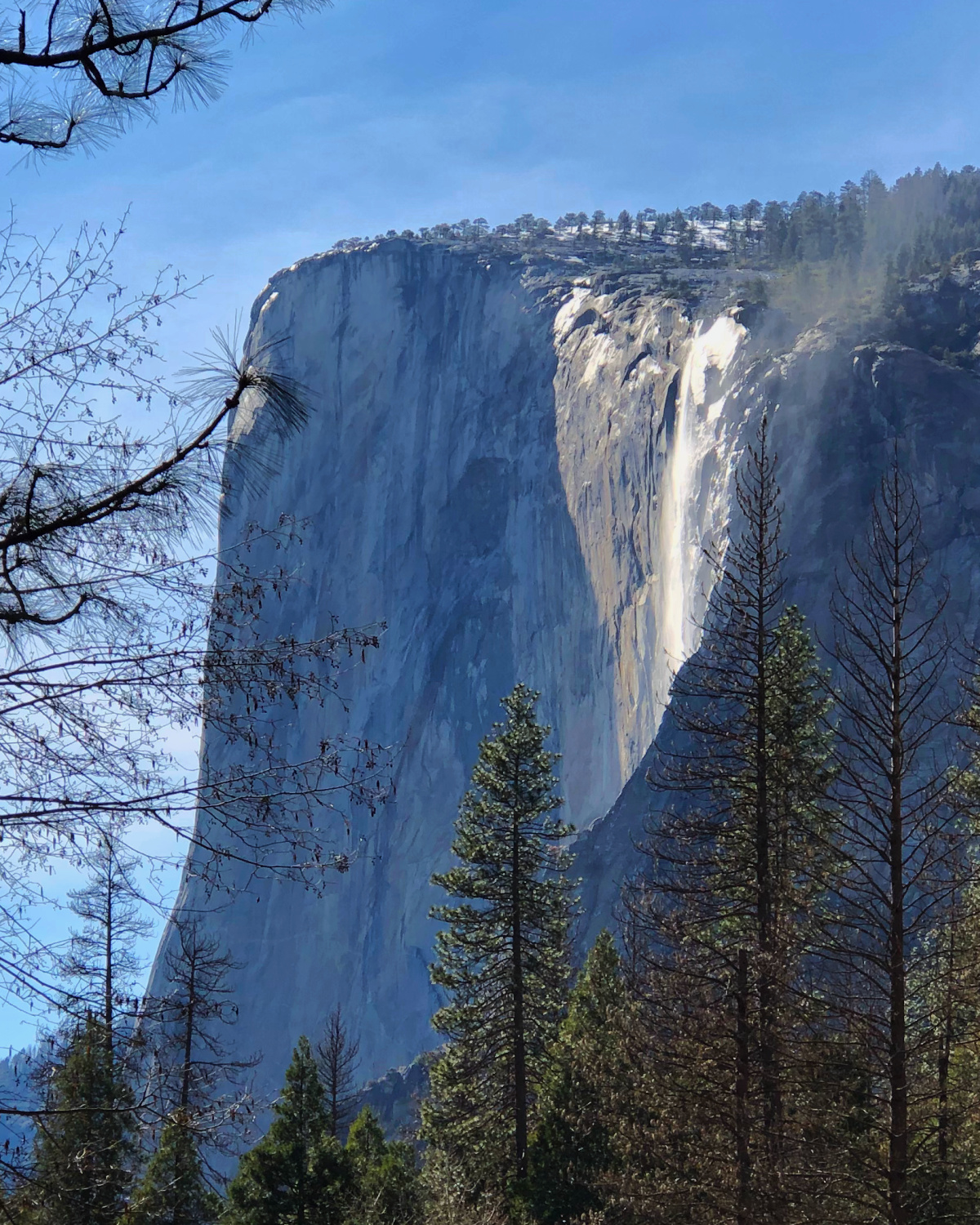
Which is kind of funny when you consider how tall it is!
The problem isn’t the height. It’s the amount of water.
Ribbon Fall is a seasonal waterfall, and when the spring snowmelt is really going, it can be gorgeous. But visit Yosemite later in the summer, and there might not be much of a waterfall to see.
Where Can You See Ribbon Fall?
Here’s the good news. You don’t have to tackle a difficult hike to see Ribbon Fall.
If you’re already exploring the El Capitan area, look toward the cliffs immediately west of that enormous granite monolith. When Ribbon Fall is flowing, you’ll see a long, narrow stream of water dropping down the cliff.
And once you spot it, the name makes perfect sense.
I think Ribbon Fall is a great example of why visiting Yosemite in the spring is such a treat. You have the famous waterfalls that everyone comes to see, but you also have these seasonal waterfalls appearing along the cliffs.
Some of them are enormous, even if they don’t get nearly as much attention.
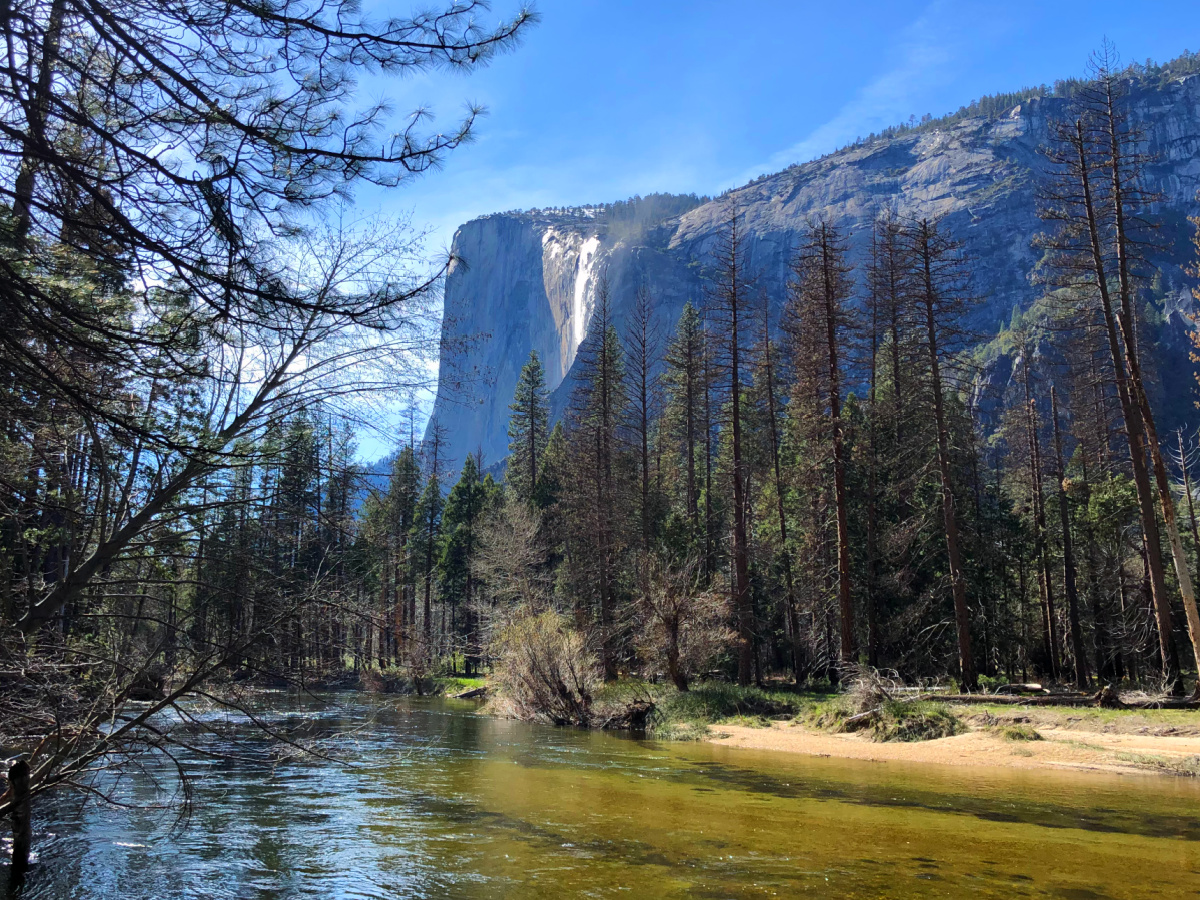
Would I rearrange an entire Yosemite itinerary to see Ribbon Fall? Probably not. But if you’re already stopping to photograph El Capitan, why wouldn’t you look for a 1,612-foot waterfall while you’re there?
Just remember that timing matters. April, May, and sometimes early June are generally your best opportunities, depending on the snowpack that year.
7. Sentinel Falls
Sentinel Falls is another one of those Yosemite waterfalls that can be easy to miss if you don’t know where to look.
It’s located on the south side of Yosemite Valley, near Sentinel Rock, and drops approximately 2,000 feet down the cliffs in a series of cascades.
And unlike Bridalveil Fall, which makes one dramatic plunge, Sentinel Falls takes several different tumbles down the granite.
I actually think that’s a pretty interesting distinction, because not every waterfall in Yosemite looks like the classic postcard image of water pouring over a single cliff.
How to See Sentinel Falls
You can look for Sentinel Falls from the valley floor, particularly around Sentinel Beach and the nearby viewpoints.
No strenuous hike required!
But there’s one pretty significant catch.
Sentinel Falls is highly seasonal. It typically flows during the spring snowmelt, and by summer, it may have disappeared altogether.
So if you’re visiting Yosemite in October, like David and I did in 2002, this probably isn’t a waterfall you’re going to see.
And that’s okay.
I wouldn’t put Sentinel Falls in the same must-see category as Yosemite Falls or Bridalveil Fall. But if you’re visiting in April or May, and you’re already enjoying the scenery around Sentinel Rock, it’s worth looking up to see whether the waterfall is flowing.
You might be surprised at how much water is coming down those cliffs.
8. Horsetail Fall
Okay, this one is a little different.
Most people visit Yosemite to see waterfalls with enormous amounts of water rushing over granite cliffs.
But Horsetail Fall?
People travel to Yosemite in February hoping to see a waterfall that looks like it’s ON FIRE.
Seriously!
You’ve probably seen the photographs. There’s this narrow waterfall spilling over the eastern side of El Capitan, and instead of looking white or silver, the water is glowing bright orange.
It almost looks like somebody poured molten lava over the edge of the cliff.
Except it’s not lava. It’s sunlight.
And the whole thing is called the Yosemite Firefall.
What Causes the Yosemite Firefall?
Horsetail Fall is a seasonal waterfall that flows down the eastern side of El Capitan.
For a short period in February, the angle of the setting sun can illuminate the falling water so that it glows orange or red.
But here’s where things get tricky.
You need enough water flowing over the cliff. You need clear skies at sunset. And you need to be standing in a location where the sunlight hits the waterfall at just the right angle.
If any one of those things doesn’t cooperate, you might not see the famous Firefall effect.
And I can only imagine how frustrating that would be if you’d traveled all the way to Yosemite specifically to photograph it!
Is the Yosemite Firefall Worth Seeing?
I haven’t personally seen the Firefall, so I’m not going to pretend I can tell you exactly what the experience is like.
But I do think it’s one of the most fascinating natural phenomena in Yosemite National Park.
And if you’re a photographer, I can certainly understand why you’d want to see it.
Just know that February in Yosemite is a completely different vacation from visiting in April or May.
There can be snow and ice, some roads and trails may be closed, and you need to pay attention to the National Park Service’s current guidance for Firefall viewing.
The event has become so popular that Yosemite sometimes implements special parking restrictions and other crowd-management measures.
Personally, I wouldn’t plan my very first Yosemite vacation around Horsetail Fall. There’s just too much else to see, and the Firefall is too dependent on weather and water conditions.
But if you’ve already visited Yosemite Valley and you’re looking for a reason to come back in winter?
Trying to catch the Firefall would be a pretty memorable reason to return.
And if you manage to photograph that brilliant orange waterfall against El Capitan, I think you’ll have one heck of a Yosemite souvenir.
Best Time to See Waterfalls in Yosemite National Park
If you’ve been paying attention to my Yosemite stories, you’ve probably figured out that I have some pretty strong opinions about when you should visit Yosemite to see waterfalls.
And my vote is definitely spring!
I’ve visited Yosemite in late spring 1998, October 2002, and April 2019. And the difference between seeing the waterfalls in the spring and seeing them in October was almost comical.
In the spring, you have all that snow melting in the Sierra Nevada mountains, sending enormous amounts of water over the granite cliffs. Yosemite Falls is roaring, Bridalveil Fall is spraying mist everywhere, and even some of the smaller seasonal waterfalls are putting on a pretty impressive show.
October? Well, let’s just say the waterfalls were not the highlight of that particular vacation. Lol.
Here’s what you can generally expect throughout the year:
- March and April: The waterfalls start getting stronger as the snow melts. April was fantastic during our 2019 visit, although the exact timing depends on the weather and snowpack.
- May and June: These are often the peak waterfall months. If seeing enormous amounts of water is your main priority, this is probably your best window.
- July and August: Some waterfalls are still flowing, but the volume generally decreases as summer progresses. Seasonal waterfalls may dry up completely.
- September and October: Don’t expect the same roaring waterfalls you see in spring photographs. Some waterfalls may be reduced to a trickle, while others disappear altogether.
- November through February: Winter brings its own beautiful scenery, but waterfall conditions vary. February is also when photographers flock to Yosemite hoping to see the famous Horsetail Fall Firefall.
One thing I would caution you about: don’t assume that every spring is going to look exactly the same. A winter with heavy snowfall can produce a very different waterfall season from a winter with relatively little snow.
Tips for Seeing Yosemite’s Waterfalls
After three visits to Yosemite, I have a few recommendations that can make your waterfall sightseeing a whole lot easier.
Don’t underestimate the waterfall spray. Seriously. When Bridalveil Fall is roaring in the spring, you can get surprisingly wet just walking toward the viewing area. Bring a rain jacket, and protect your phone or camera.
You don’t have to hike to see some of the best waterfalls. Yosemite Falls, Bridalveil Fall, Ribbon Fall, and several others can be enjoyed from relatively easy viewpoints. And don’t forget Tunnel View! Some of my favorite waterfall photographs were taken from scenic overlooks rather than hiking trails.
Take your time in Yosemite Valley. I know it’s tempting to race from one famous attraction to another, especially if you only have a day or two. But some of the prettiest views are the ones you notice while driving or walking between the major stops. That’s exactly how we discovered The Cascades!
Pay attention to the time of day. If you’re interested in photography, the lighting can make a huge difference. We saw that ridiculous rainbow at Bridalveil Fall from Tunnel View around 4 PM in April. I can’t promise you’ll see the same thing, but it’s certainly worth keeping an eye out for rainbows when the sunlight hits the waterfall mist.
Check trail conditions before hiking. The Mist Trail and other waterfall hikes can have wet granite steps, steep climbs, and seasonal closures. Don’t assume a trail is open just because you found a beautiful photograph of it online.
And one final safety reminder: stay out of the water near waterfalls, especially during spring runoff. The Merced River can look beautiful and inviting, but the current is incredibly powerful.
Which Yosemite Waterfalls Should You See First?
If you’re visiting Yosemite for the first time, especially with kids or family members who aren’t interested in strenuous hiking, I wouldn’t try to see every waterfall on this list.
There is SO much to enjoy in Yosemite Valley, and I think you’ll have a better vacation if you pick a few favorites rather than spending your entire trip rushing from one waterfall to another.
My top three recommendations would be:
- Yosemite Falls: You really can’t visit Yosemite without seeing its most famous waterfall! The Lower Yosemite Fall Trail is relatively easy, and the views of Upper Yosemite Fall from around the valley are fantastic.
- Bridalveil Fall: Walk to the waterfall if conditions allow, but definitely see it from Tunnel View too. I actually prefer the distant views, especially when the afternoon sunlight creates rainbows in the mist.
- The Cascades: If you’re entering Yosemite along Big Oak Flat Road in the spring, this is such an easy bonus stop. Literally pull over, get out of the car, and enjoy the waterfall.
If you enjoy hiking and have more time, Vernal Fall is absolutely worth considering. Just remember that the Mist Trail is considerably more challenging than the easy waterfall walks around Yosemite Valley.
And if you’re lucky enough to visit during peak spring runoff, keep an eye out for the seasonal waterfalls along the cliffs. You might see Ribbon Fall or Sentinel Falls without even having to leave the valley floor.
Final Thoughts on Yosemite’s Waterfalls
I have some pretty incredible memories associated with Yosemite National Park.
I remember the roaring waterfalls during my first visit in 1998. And of course i could never forget my now-husband proposing to me at Sentinel Bridge in October 2002. And I remember returning in April 2019 with our daughter, watching the waterfalls practically explode over the granite cliffs.
Three visits. Three very different experiences.
And I would happily go back again.
If there’s one thing I’d encourage you to do, it’s to visit Yosemite in the spring at least once. You don’t have to be a hardcore hiker, and you certainly don’t need to see every waterfall in the park.
Just give yourself enough time to enjoy the ones you do see.
And if you happen to spot a rainbow that looks like a unicorn has been playing with a bucket of paint?
Well, consider yourself very lucky indeed. 🦄
More National Park Waterfalls Worth Exploring
If you love waterfalls as much as I do, Yosemite is just the beginning! Some of my favorite national park memories involve waterfalls, and the good news is that you don’t always have to tackle a difficult hike to see them.
Here are a few more waterfall adventures to add to your national park bucket list!
– Best Waterfalls in Mount Rainier National Park – Mount Rainier has some absolutely gorgeous waterfalls, including several you can see with very little hiking. And if you’re visiting during the summer, the combination of waterfalls, mountain scenery, and wildflowers is pretty hard to beat.
– Best Waterfalls in Olympic National Park – Olympic National Park has a completely different feel from Yosemite. Think moss-covered forests, lush greenery, and waterfalls tucked into some of the prettiest scenery in Washington.
– Easy Waterfalls in Yellowstone You Can See Without a Long Hike – Yellowstone isn’t just geysers and hot springs! There are some fantastic waterfalls throughout the park, and quite a few are surprisingly easy to see.
– Johnston Canyon Hike in Banff National Park – If you’re planning a Canadian Rockies vacation, Johnston Canyon is a fantastic waterfall hike. The elevated walkways and canyon scenery make this a completely different experience from Yosemite’s waterfalls.
And if you’re planning a spring trip to Yosemite, don’t miss my guide to Visiting Yosemite in April. April is one of my favorite times to visit, especially if seeing the waterfalls at their fullest is high on your vacation wish list.